
Pseudoregalia is an indie 3d platformer metroidvania, a rare combination. And it has the best movement I’ve ever seen outside of a Mario game. It starts off a little slow, but quickly ramps up as you get the slide and wallkick powerups. The game is very short, I was able to beat it in only 5 hours.
Movement & Powerups
There are a number of optional collectibles throughout the game, augmenting your health, regeneration, or giving small buffs, but obviously the movement powerups are the only thing that really matters. Each of the movement powerups allows you to access new areas, but also just enhances the way you move through the game in general. Slide initially lets you slide under small gaps, but eventually gets upgraded into a slide jump that lets you jump across massive gaps, and even bunnyhop to maintain momentum.

Another powerup gives you 3 wall kicks, which push you away from walls if you kick into them directly, requiring you to use them carefully to scale walls. Eventually you get a ground pound, which lets you jump extra high by jumping as you hit the ground, like Mario in Odyssey, and if you jump at the start of the groundpound, you’ll do a backflip, which helps counter the momentum of a wall kick, raising you neatly onto a platform after kicking off of it. This is like the missing link in the movement that really helps it all fit together. Finally, there is a wall run, which is obtained last. It snaps onto walls reliably and generally feels pretty good to use.
One thing I like about the game is the subtle contextual actions that aren’t explicit upgrades, but still exist. For example, you can crouch and then jump to backflip, then jump again to jump higher than normal. You can also run then turn around suddenly and jump to do a flip that is higher than normal. The backflip from groundpound mentioned above is another fun trick that helps tie things together. The game clearly takes some cues from the contextual actions and movements of Mario 64, and really cares about dynamic systems of interaction, rather than paired animations, or snap-to-point or snapping to surfaces. Only the ledge grab, and the wall run animations snap to surfaces, and the wallrun still has its own physics along the surface rather than simply playing a canned animation like Assassin’s Creed. Additionally, all of your platforming moves cancel into one another and are designed to naturally flow together, allowing for combinations of moves in sequence to gain height or skip across multiple walls.

There are other upgrades, but they really only function like lock and key compared to filling out your moveset, such as a charged power attack that can break green walls, or a wind blade projectile off the charged attack, which can trigger far-off switches. The ability to bounce off enemies and objects that you attack is fairly helpful and does create a number of interesting platform challenges, but this is deployed so sparingly that it feels more like another lock-and-key than necessarily an integrated part of your moveset. Especially since it doesn’t really help to bounce off an enemy during a normal fight. Even some of the movement powerups have a lock-and-key aspect to them that eventually becomes irrelevant later in the game, like slide slipping through gaps, and groundpound getting through cracked floors.
Levels & Enemies
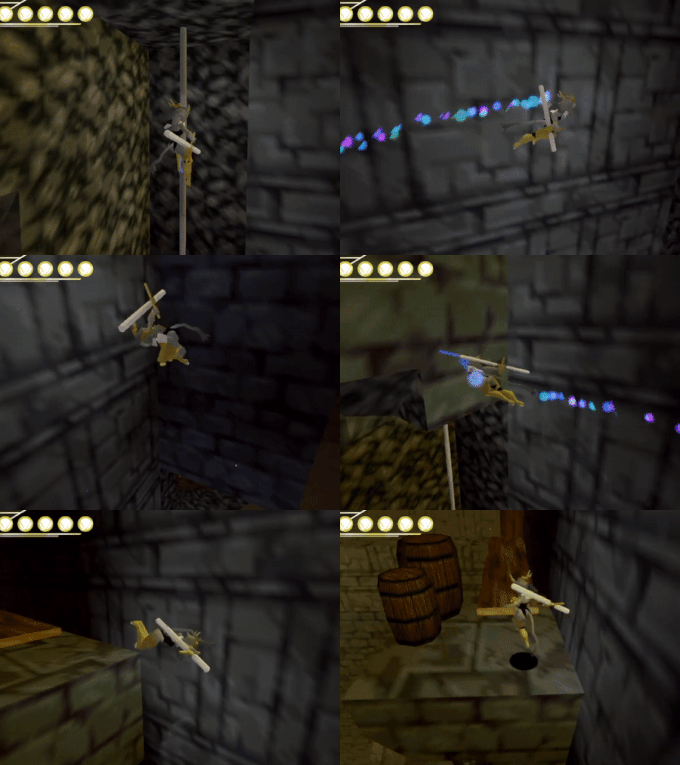
The level design frequently requires you to jump across gaps and use multiple abilities in sequence, alternating between one another, to reach the far side, or to scale up to a higher platform. It pulls no punches and I had a legitimately tough time in many sections. Pseudoregalia really demands mastery from its players of the platforming mechanics, and it rewards you for being able to find solutions with less movement tools than you’re supposed to have.
The healing system borrows a little from Dark souls and Hollow Knight, but with an interesting twist. As you hit enemies, you build up a meter that can be used to heal yourself, however, your attacks get bigger and stronger when the meter is more full. Much like Souls games, the healing animation plays out in real time and takes a little time to complete, adding some risk to it. Altogether, this means that you can choose to either heal, or keep your stronger attacks. This is a little reminiscent of classic Zelda games, where you only get the powered up beam saber at full health, except by tying your weapon strength to healing, they’re not incentivising you to play the game at full health or critically low health, but rather to dynamically choose what works for you in the moment, based on your risk tolerance. Despite this, combat is still fairly insubstantial. Your attacks are fast and you can move freely during them. Enemies have simple patterns and there is only one real boss battle in the whole game, the final one.
Objective & Artstyle

The game has a low poly look, reminiscent of the Playstation and N64. While the game runs at 60fps, the character is animated at a much lower framerate for stylistic purposes. I think the poses are spectacular and stand out well. The animations help the character feel really fluid as she flips and kicks and dives. However, the low poly look means that many places can be rather indistinct. While the architecture is fairly good at creating unique and memorable rooms, it can be difficult to tell whether some dead ends are places I collected something already, or if there’s a secret I missed. While I know Lordran and Mirror’s Edge like the back of my hand, I had a lot of difficulty piecing together how the world of Pseudoregalia was fit together, and mostly ended up wandering around until I ended up where I wanted to be.
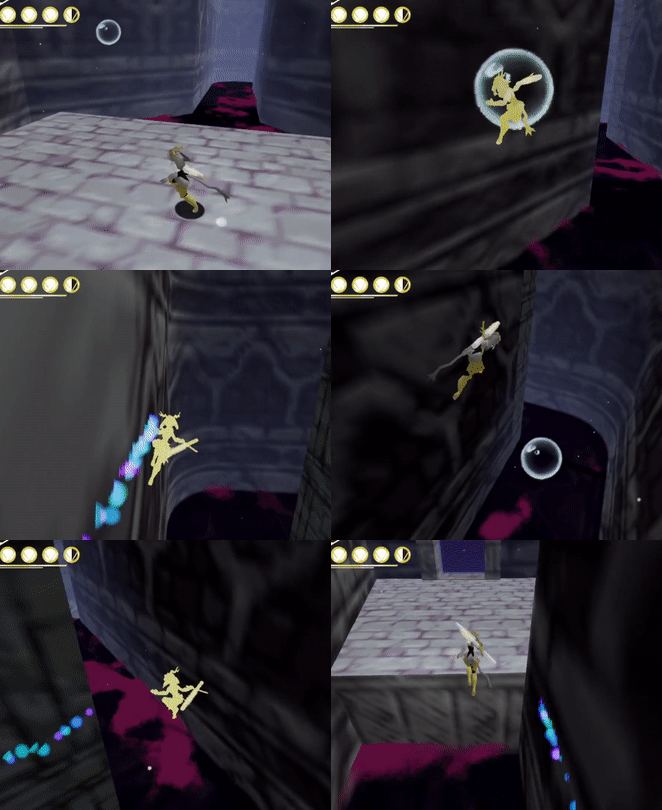
The objective of the game is to collect 5 big keys scattered across the world. The final boss door is helpful and tells you which zones each key is located in, but I had a difficult time tracking down the big keys in the Underbelly, Sansa Keep, and Twilight Theater. Twilight Theater in particular frustrated me, due to there being 3 paths surrounding a theater stage that all looped back into a balcony that faced out towards the audience. This made me think the paths existed just as 3 ways to get into the audience, which I could already do with some careful jumps. I didn’t understand why these paths kept leading me somewhere I’d already been without giving me anything else, and left the area entirely on completing the 3rd one, not realizing the big key had been unlocked.

While the limited artstyle is charming, and I can understand having a limited budget, it definitely would have been nice to have slightly better signposting of objectives. It also suffers from the issue of presenting 2 paths where one is the main path, and the other is an optional collectible, but it’s unclear which is which, so I’d frequently have to replay areas to find the optional objectives after missing them the first time (or vice versa for main objectives, for example, the Underbelly big key was in a fairly nondescript sidepath). Related to that, many areas of the game are VERY dark and I couldn’t see at all, and not just the one that is intentionally dark until you find a powerup (which doesn’t make it much brighter unfortunately, and I still didn’t really enjoy fumbling around in the dark to get said powerup).
Conclusion
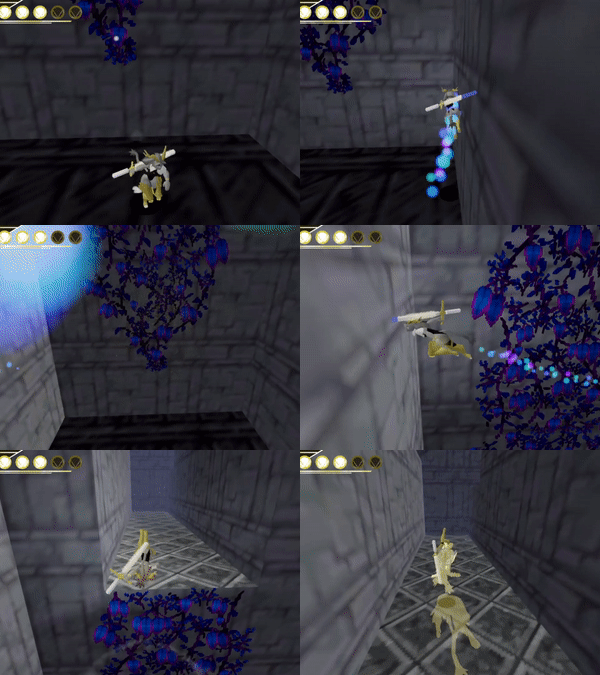
The game has some very difficult and fun platforming challenges, although some areas it felt like I cheesed, rather than finding the intended solution. Or rather, it felt like they had no intended solution, and there was only a janky way of getting up or across. While I feel like there were some very challenging and fun sections, I think that the game lacks some dynamism. Many of the obstacles are static, simply requiring a sequence of jumps, kicks, and wallruns. Enemies don’t have very complex movement patterns and aren’t especially threatening. Obviously movement is the focus, but more definitely could have been done to create dynamism all around, especially given you can bounce off enemies by attacking them.
Overall, I really enjoyed the game, and I hope it sees a sequel. Despite the issues mentioned above, it still manages to string together a number of interesting and difficult platforming challenges and create interlinked levels that have a number of possible ways you can platform through them. I give Pseudoregalia an 8/10 for creating a genuinely deep game that is willing to actually test the player’s mastery, but falling short of dynamic enemies and level design.
 Celia Wagar's CritPoints