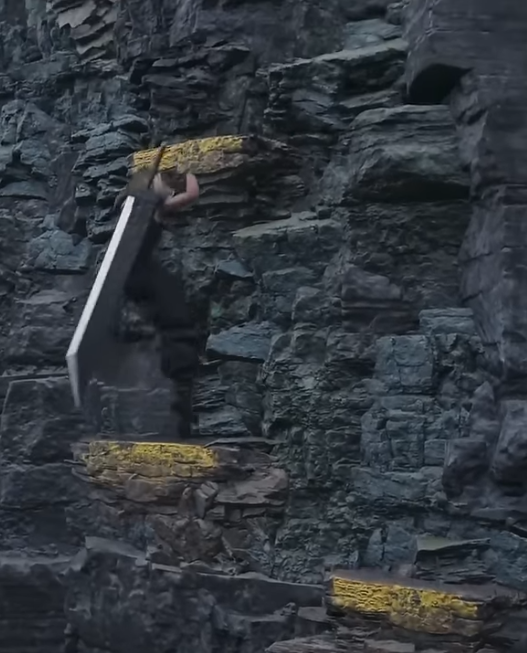
Recently footage of Final Fantasy VII: Rebirth was released, and it contained a shot of The Yellow Paint that we keep seeing to denote objects in the environment that can be climbed or otherwise interacted with. Kayin wrote an article on this, and it inspired me to write my own take.
What’s wrong with Yellow Paint?
So, why do people kneejerk hate the yellow paint? People hate the yellow paint because it “breaks their immersion”, since there’s no diegetic reason why every single ladder, cliff face, or vaultable cover would be splattered in the same yellow or white paint and because it makes them feel like they’re being treated like a child, needing to have the interactable part of the environment highlighted so they can progress.
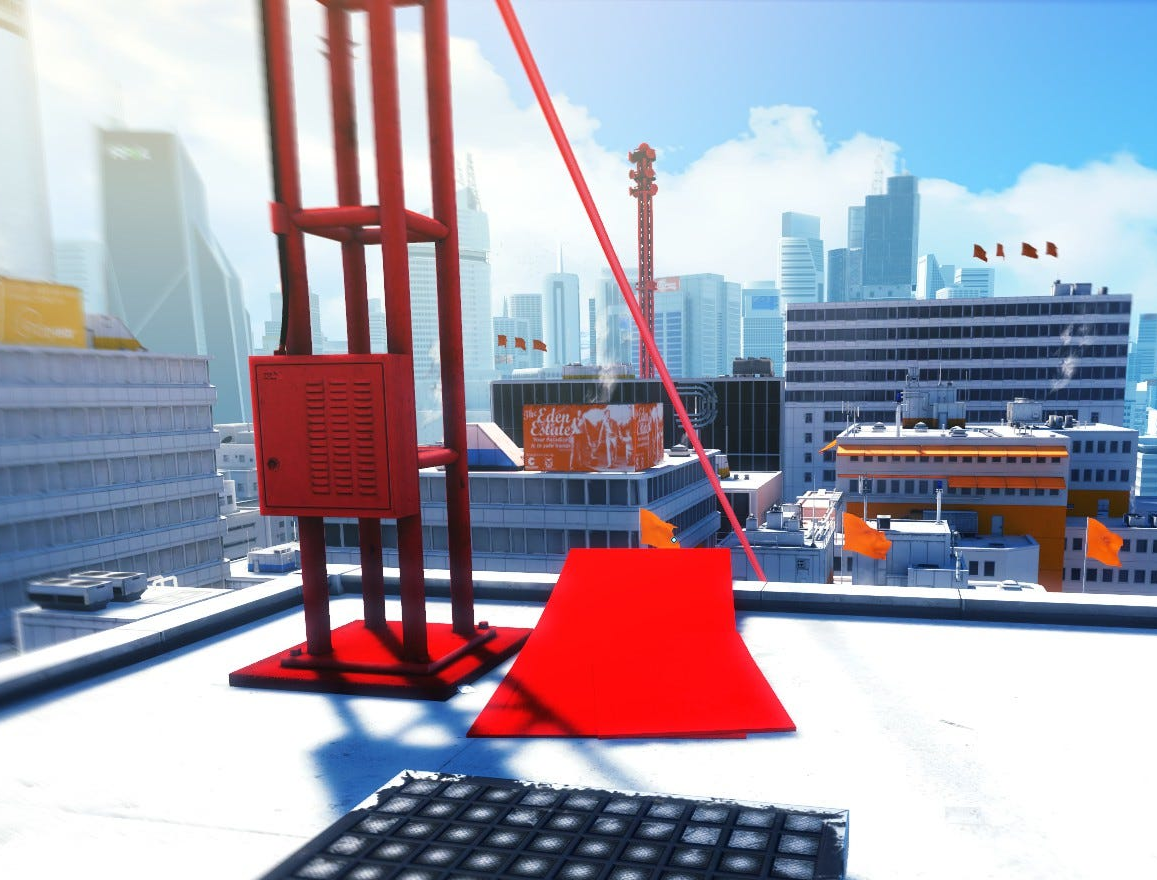
Lets break that down. Why do you care? Mirror’s Edge had red object highlighting, called “runner’s vision”, for ladders, climbable pipes, balance beams, and springboards and pretty much everyone thought that was genius. People thought it was genius because it was diegetic and made sense for the story, and you can’t do that for every game, because not every game is about being a parkour runner. Why else did it work? Because the highlighted red interaction objects weren’t the only way to go, and frequently they weren’t the fastest. Mirror’s Edge actually had level design that featured multiple interconnected routes, not just a single context interaction point that you need to interact with to move the story forward. So if a game is going to design itself that way, why do you actually care if it’s saving you the work of trying to pick out which object in the environment is the way forward instead of strictly decorative?
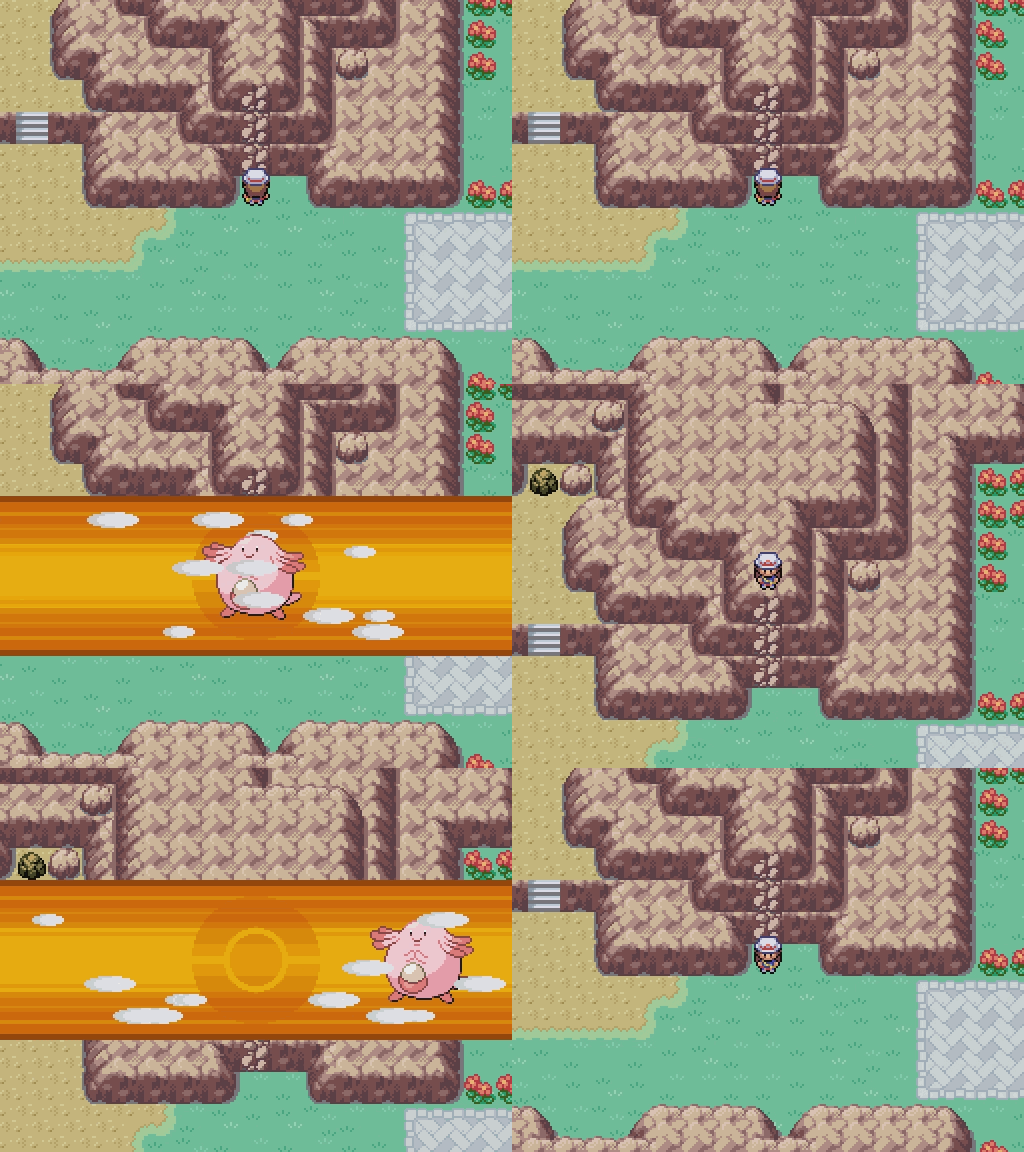
Now, why do games do this? Older games didn’t do this. If they wanted you to climb a rock face, they’d stick vines or hand holds on it, and those would be the only cases where those art assets or anything that looked like them showed up in the entire game, and that would be that. You want to cut down a tree in Pokemon? It’s completely obvious which tree you’re going to cut.
Modern games have more detailed graphics, with more superfluous details that can’t be interacted with. If a game wants to look realistic, it needs to have details. Details mean things get lost in the noise. So now your playtesters get lost, and instead of scrapping a ton of art assets, or changing the art direction completely so things are more clear, you might as well highlight the way forward, because your game isn’t Eye Spy.
So, if you’re an art director for a game, and there needs to be interactive objects contrasted with non-interactive ones, probably your best choice is to have interactive objects be completely distinguished visually from non-interactive ones, and to keep the level of detail surrounding these objects low, so that they stand out from the environment. If you have anything similar to them in the environment, then make those elements have a different color palette, and be clearly non-functional. Yellow paint is a cheap and easy way of accomplishing this, but it probably represents an earlier failure in the art design of the game.
What does Yellow Paint really mean?
But lets get back on topic. If a game has a point of interaction, why does it actually matter whether or not it’s highlighted in an obvious or hand-holdy way? If you’re here to play with the game’s systems, don’t you care more about those systems themselves, rather than whether or not it’s “condescending” by indicating points of interaction with clear visual cues?
I think the underlying issue isn’t the yellow paint itself, but rather the design trend that has accompanied this visual cue: Designing purely for functional utility. What kind of games have this yellow paint highlighting? Games with visually dense environments that don’t have a focus on traditional platforming. This means that if you were to look at a graybox rendering of the game’s levels, they’d resemble rooms connected by doors more than complex works of architecture. In other words, games that use yellow paint also tend to not have detailed climbing mechanics, like say Assassin’s Creed, or Infamous, or Getting Over It with Bennett Foddy.
If climbing is as simple as knowing where the interact point is and pressing the interaction button (and maybe holding forward for a bit), then that’s not a very engaging game system. What’s disappointing about Yellow Paint is that it’s filler. It’s something the developers put into the game so that you’d do something other than simply walking from A to B. It’s variety for the sake of variety, made by a developer who cares more about content than design.
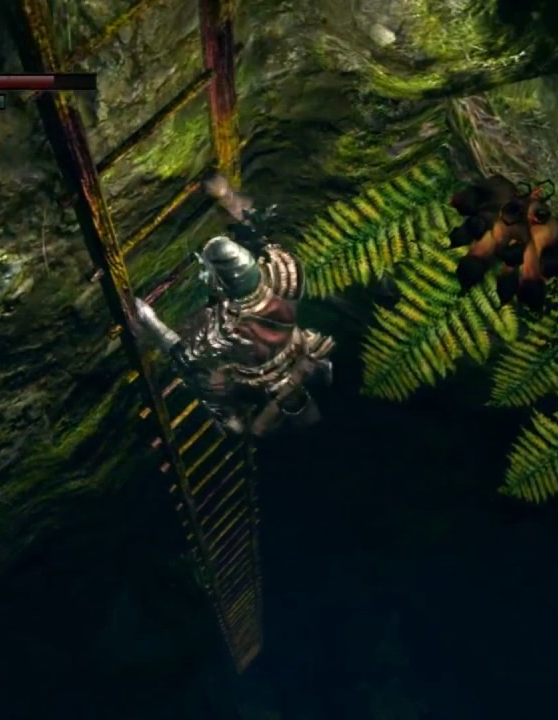
If you consider another visually dense modern game, Bloodborne, or Elden Ring, you’ll notice that it doesn’t bother doing this type of highlighting, and there aren’t a lot of animations or player actions that are unrelated to combat. You can push open doors, pull switches, and climb ladders, but these aren’t variety for the sake of variety. There’s no animation for scaling a cliff, because if they wanted you to scale a cliff, they’d place a ladder. Similarly, there’s no animation for shimmying through a narrow crevice, or vaulting up a ledge, or so on and so forth, because these games don’t see the need to introduce variety through a bunch of pointless animations intended to provide visual interest.
The Soulsborne games are games solely focused on creating interesting fights by combining environments and enemies in ways that force you to think about both, and so they don’t bother making a bunch of filler besides the things that are important. When Dark Souls wanted to connect Dark Root Basin to Sif’s boss area, they just put a really tall ladder. This lacks “polish” compared to a game willing to make a bunch of bespoke animations that are used only once and never again, but it also signals a design focus. Helpfully, ladder climbing also isn’t always the simplest in souls games. You can punch enemies above you and kick ones below you to try to force them off the ladder. This isn’t amazingly complex, but it is something.
Means-To-An-End Design
The trend we see in a lot of modern AAA titles is this focus on polish and functional utility, which frequently translates into having a large amount of bespoke content, but lacking any interactivity beyond pressing the interact button and watching the animation, which typically is invincible and freezes time, so there can’t be any complex interaction of game state while it’s going on. The concept is, “I want the player to be able to do all these things”, and then implementing those things only insofar as the bare minimum to make them functional, rather than having any sort of game design vision about systems of interaction.
Spider-man 2 (2004) has a web-slinging system where Spider-man attaches his webs to objects in the environment and swings like an actual pendulum. This is the type of dynamic system design that I like to see in video games! By contrast, many games that came after this one simply had Spider-man’s webs attach to thin air, so you could web-sling in the middle of Central Park
You could also contrast Mirror’s Edge to Assassin’s Creed. Mirror’s Edge looked at parkour like a platformer, creating a variety of contextual animations for specific environmental interactions in a game about jumping between platforms. Assassin’s Creed instead looked at everything as a series of node interactions, instead of creating more flexible tools like the wall run, or the side boost, or the steady acceleration as you run. Though, arguably even Mirror’s Edge lost the plot, as its sequel standardized the various animations, and tuned wallrunning and climbing to always produce the same results.
If we want to avoid the underlying problem behind the yellow paint, we need to consider how we can create more dynamic, challenging, and deep gameplay systems. Our game systems need to have skill tests and interesting choices, not simply be a means to an end in some broader fantasy. Yellow paint isn’t the cause of our problems, it’s a symptom of them. I’d advise you worry less about being condescended to, and more about whether the game has substance behind it.

