
The Big Catch: Tacklebox is a demo for an upcoming 3d platformer game, The Big Catch. Despite being only a demo, Tacklebox is closer to a prologue chapter, featuring a different protagonist and entirely distinct areas from the upcoming game! This free “demo” has so much content, that it’s practically an entire game in its own right.
In The Big Catch: Tacklebox, you are tasked with catching fish, who run around on tiny legs around ancient ruins scattered across a desert plateau. You can also collect coins/tokens, which unlock the final dungeon if you collect all 696 of them. Naturally, this is a bit like 3d platformer collectathons of the past, but part of what helps distinguish Tacklebox is that rather than scattering coins and fish around everywhere, they’re in deliberately chosen locations that are difficult to get to. While cleaning up some of the better hidden coins at the end of the game can be a bit of a pain, for the most part, the game focuses on only putting coins in locations that are a challenge to get to, so that they’re closer to optional challenges scattered across the game, rather than simply collectables for the sake of being collectible.
Mechanics

The main character, Tackle, has many common 3d platformer capabilities. He can jump, wallrun, wall climb, wall jump, ground pound, ground pound jump, swim, attack while running, crouch, slide kick, slide kick jump, spin, spin jump, grab ledges, grapple to hooks, climb on vines, swing on hang bars, jump off elastic ropes, grind rails, and more. And nearly all of these interactions will cancel to and from one another in a sensible way at any point in the animation. Animations have very low commitment, and you almost never get stuck in an animation that you don’t want.
The big difference between Tacklebox and most other 3d platformers is that unlike the rest, once you jump, you have no mechanical way to stall your fall, or change direction in mid-air besides simple air control. In other words, you’re going to go flying in the direction you chose to jump, so you better choose correctly! Tacklebox may not have strong commitment to any animations, but it has an intense commitment to your momentum, and to gravity.
Tacklebox is the kind of game that I’m surprised wasn’t made already. I realize that this is cliche for talking about retro styled games, but Tacklebox does a lot of things that set itself apart from the crowd relative to other 3d platformers, yet in a way that could have been done at almost any time in the past 15 years and simply wasn’t. It still deserves a lot of credit for distilling this style of gameplay from all the platformers that have been made up to now, and it’s easy to see many of the influences, between Mario, Sonic, Wind Waker, Ape Escape, Crash Bandicoot, and more. We’ve seen many 3d platformers that allow you to double jump, air stall, and dive in different directions than where you started, or use wall jumps to scale sheer surfaces, but we haven’t seen many that force you to simply jump correctly.
Overall, I’m just surprised that no 3d platformer before now really decided to hone in on simply jumping in the way that Tacklebox has. It’s so simple that it feels like it should have been made already, but allowing the animations to cancel and carry momentum the way they do shows a level of refinement that clearly has learned from the past.
You have a jump arc, and doing advanced moves will only get you a little further, not a lot further. Walls will let you augment this jump arc, but not by much. In order to get the most out of your jumps, you really need to jump in the right direction, at the right angles, at the right times. Tacklebox cares about how you control the character, rather than which verbs you use. It plays with the raw analog values of your speed, direction, and momentum, instead of with technical animation canceling.

Typically, many games will simplify their physics when using interactable level design features to produce consistent results. Tacklebox does not do this. Yet, even when you are going crazy, and taking advantage of speed boosts and flying off in any direction, Tacklebox is very careful to constrain your momentum and force you to control it, and apply it in exactly the right direction. You are free to cancel your moves and redirect your momentum as you wish, but you are being tested very deliberately. Even when you are allowed to accelerate past your maximum run speed, there are maximums to how fast you can go, and there is friction, but you are not automatically guided to the solutions by either of these things. It’s up to you to make the most out of whatever speed you get ahold of.
Because of Tacklebox’s decision to limit fancy mechanics and really focus on its core jumping, it doesn’t have the most technical movement most of the time. You can go a little faster by crouching, pressing attack to kick slide, then jump to do a leaping kick forward. This is the long-jump of this game, but it doesn’t go nearly as far as Mario’s long-jump. It’s easy to get into a rhythm of doing this to move around any flat terrain more quickly, but it’s almost never necessary or more useful than a normal jump.
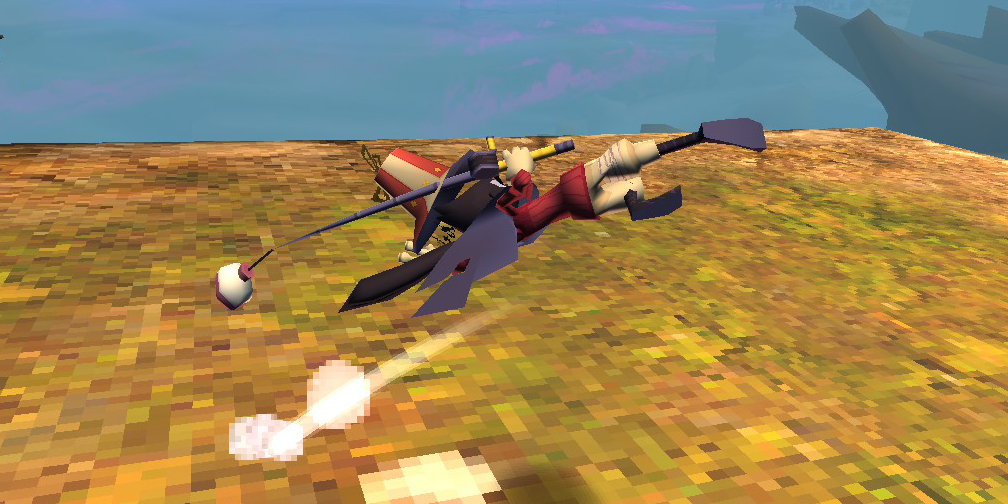
Tacklebox also took Mario’s spin jump, from Sunshine and Odyssey, making it function more like Odyssey. The spin jump will go a little higher than a regular jump, and fall a bit more slowly. However, this still doesn’t give it an incredible amount more height or distance than a regular jump. It is necessary to use the spin jump to collect a few coins, and you can slow yourself at any time when falling by spinning. The furthest standard jump you can perform is by doing a spin jump, ground pounding, then jumping as you hit the ground for an increased height spin jump.
Level Design
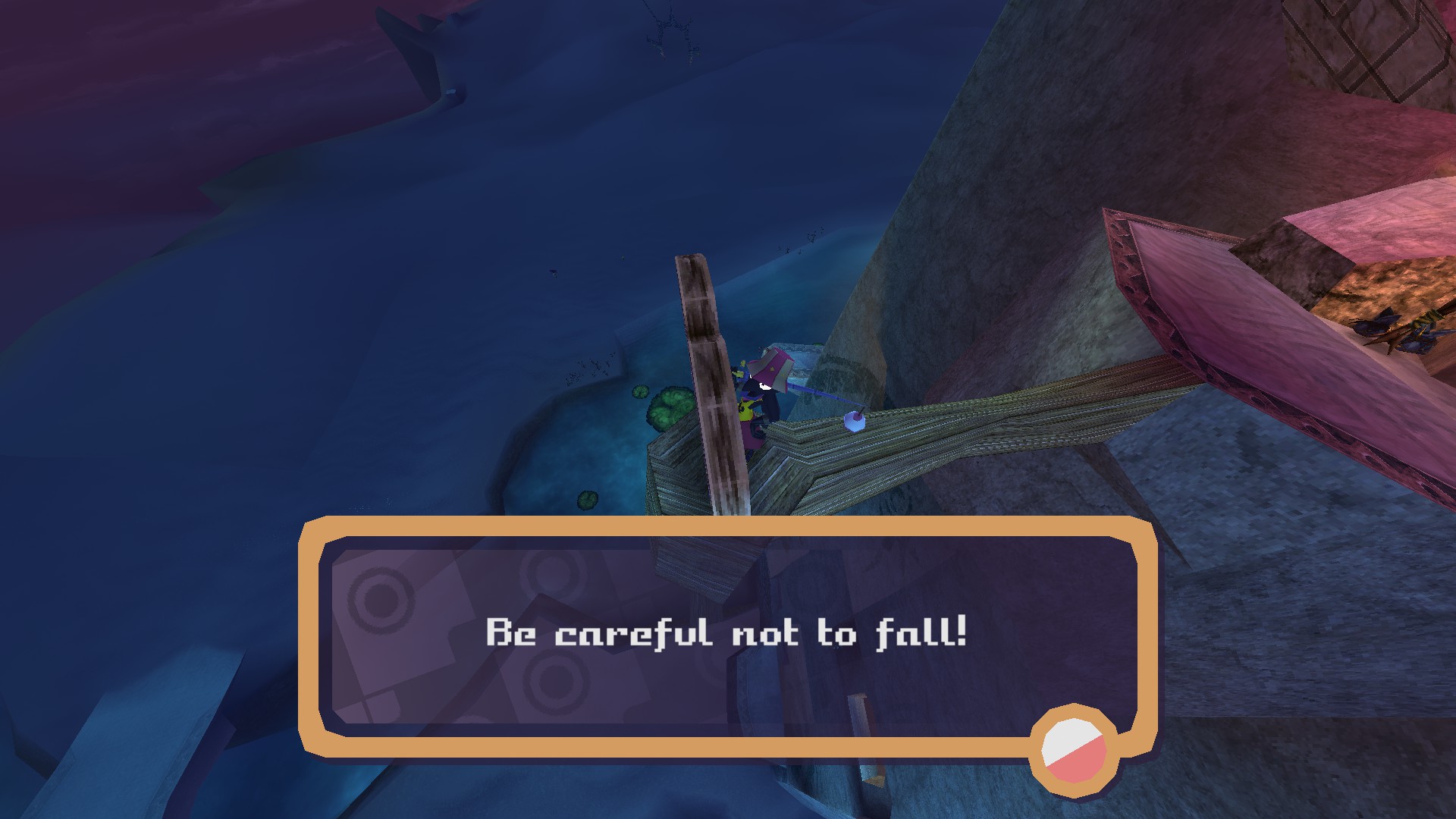
Tacklebox makes extensive use of nature’s favorite checkpoint: Gravity. Most areas are constructed as either a tower that you ascend, or high paths surrounded by low paths. This means most mistakes will require you to climb back up to where you were.
There is a health system, and after losing 3 pips, you’ll return to a warp lantern (which will helpfully refill your health whenever you stand near it). If you ever fall into a bottomless pit, you’ll be teleported right back to where you fell. Tacklebox wants to give you a little tolerance for messing up, but not an incredible amount. There are healing items placed at rest points in levels.
Another form of checkpointing in Tacklebox levels is doors you can pry open, or fishing lines you can smack to lower, giving you a quick ride back up from an earlier party of the level. This feels like it takes a small amount of inspiration from Dark Souls, but I think the stronger parallel for Tacklebox is Getting Over It with Bennett Foddy.
Levels are designed so that each jump can be approached with a lot of wiggle room, yet the jumps are still very difficult. Many jumps are almost like puzzles to figure out the right input to get past, but when revisiting them after getting more experience with the game, I can breeze through. Having confidence and a good sense of your jump arc makes a huge difference.
Despite having a lot of wiggle room for individual jumps, there isn’t an incredible amount of wiggle room to how you approach levels. Most levels have a fairly set path of progression. These paths integrate a variety of different platforming skills and styles of jumps, as well as giving you a fair amount of flexibility in how you can approach each obstacle, but there is usually only the one path forward. Tacklebox doesn’t have the more multi-threaded style of level design that is present in Mario 64, or some of the better levels in A Hat in Time, or the Mario Sunshine secrets, but it does manage to be significantly less prescriptive in its level design than say Psychonauts 2, as well as presenting skill challenges for each of its mechanics, rather than simply asking you to use your tools in a lock-and-key style.
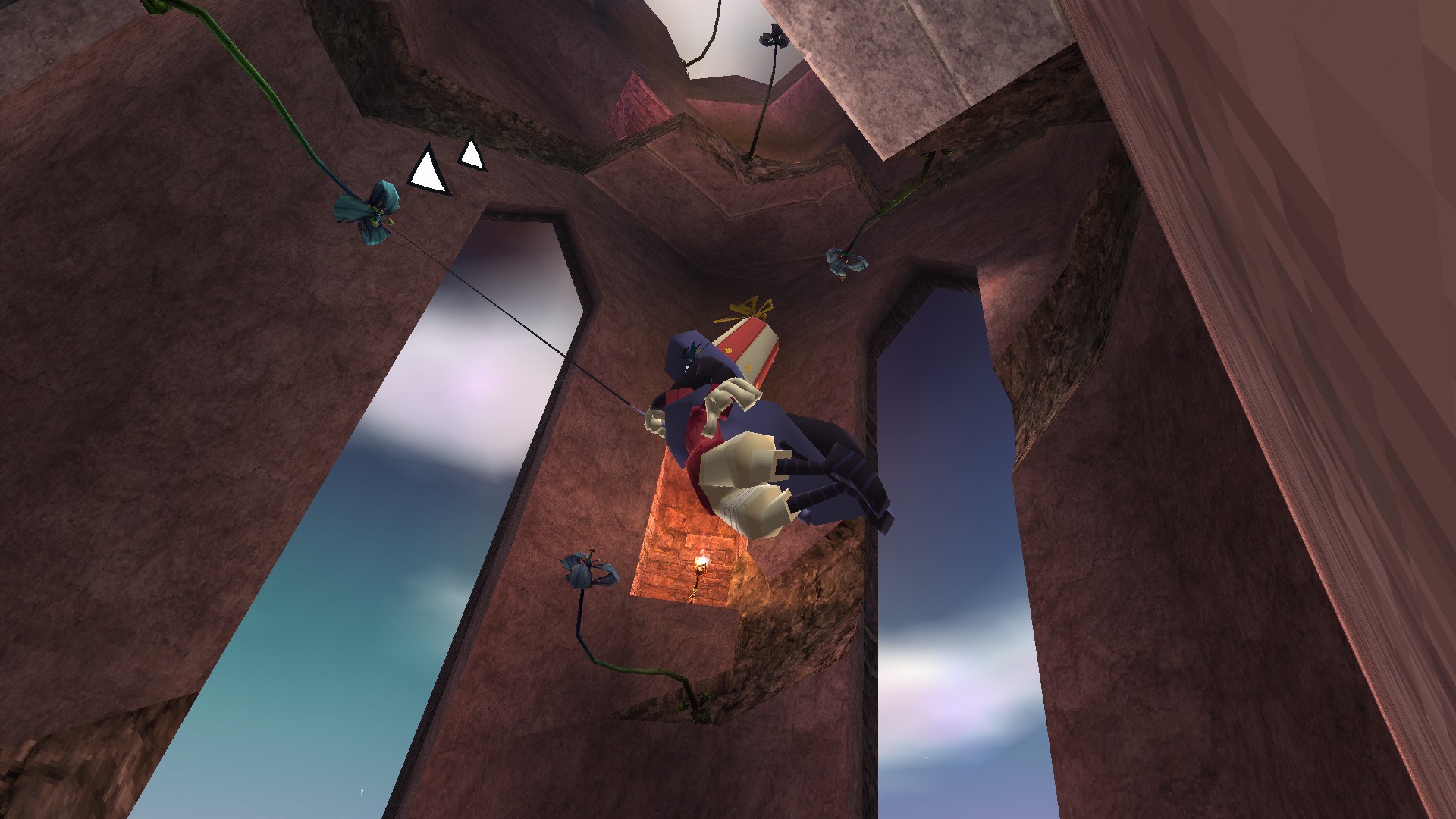
Some of the more interesting level design features are “fling orbs” and “grapple flowers”. With fling orbs, you can latch onto them with your fishing line, then pull back and release to fling yourself forwards. A small amount of course-correction is applied to make sure you are headed in the direction of your target, but it’s still very possible to simply miss. This is one of the fastest ways to accelerate in the game, and you can carry this momentum by bunnyhopping, and scale tons of things you normally couldn’t with fling momentum.
The grapple flowers let you hook onto them from anywhere in their activation radius, and much like the fling orb, you will reel yourself in and be propelled straight towards the flower and out the other side. Unlike the fling orb, there is no course-correction here, and you can fling yourself in any direction with these, the strength of the fling being proportional to how far away from the flower you were before grappling it.
Tacklebox doesn’t have particularly complex obstacles, mostly relying on interesting architecture and well placed level design features rather than a bunch of complex interactions and moving parts. Most parts of levels do not move. There is perhaps only one moving platform in the entire game. This is fine, and Tacklebox does as much with this as it can, short of more multi-threaded level design.

The world is presented as a big desert plateau, with ruins interspersed through the desert, allowing you to freely scale any of them at any time. Whenever you’re on sand, you can blow your whistle to summon Sand Skimmers, which you can hook your fishing line onto and surf behind. You can press the attack button to make the sand skimmer go faster, and with good timing you can get a gold boost to go even faster. This is a simple busy-work skill test, mostly to keep you occupied between areas, but it’s better than nothing. At a few points in the game, you’ll need to boost with the sand skimmer to make a big jump. A few skips are even possible with clever use of the sand skimmers.
Enemies
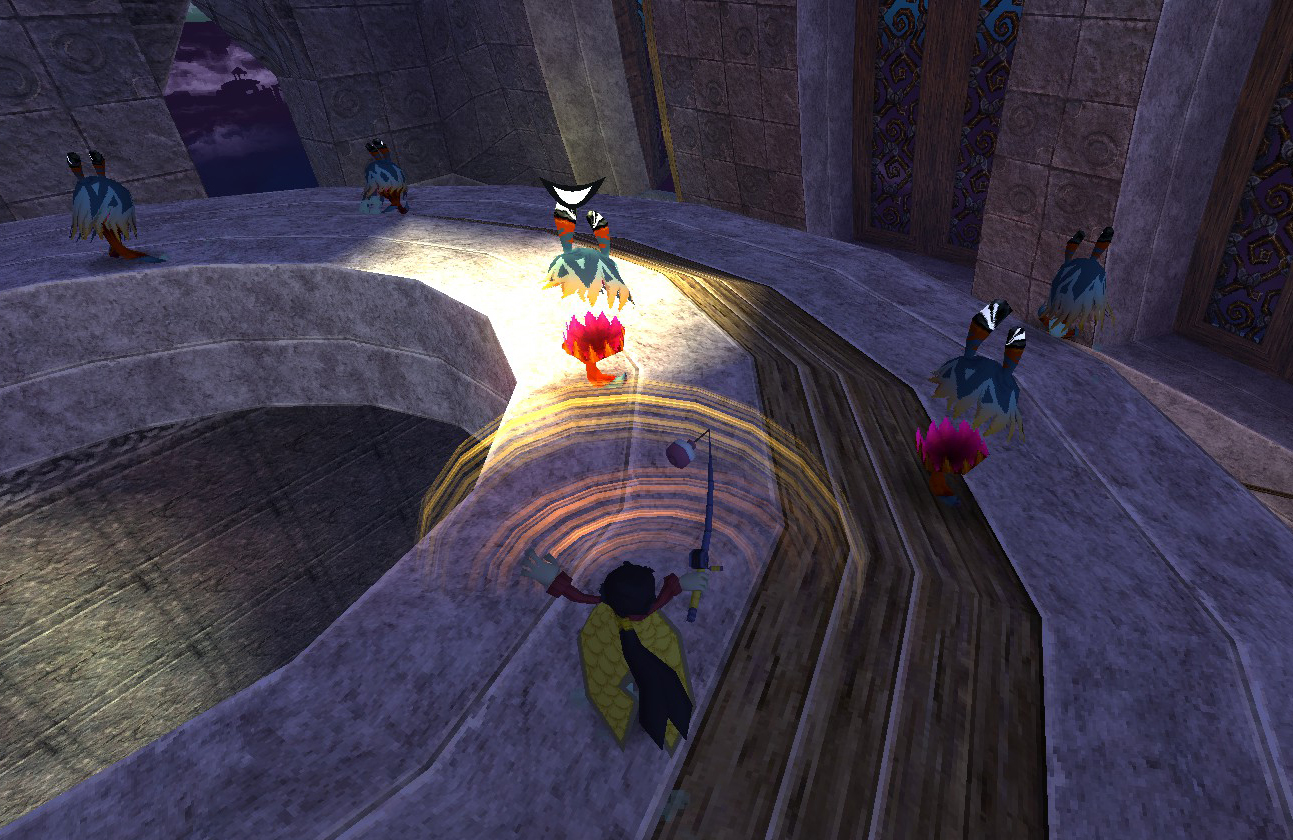
There are only 2 enemy types, besides fish. Smaller enemies that will move directly at you, and tall birds that will shoot big bombs at you, offset to catch you where you’re running. Beating these enemies will net you coins, but these coins have physics applied when they spawn, making it so they can fall all the way to the bottom of a level, forcing you to give up progress to chase after them, which can be annoying. Some level design features will hurt you, such as pointy trees and sea urchins, but these are rare.
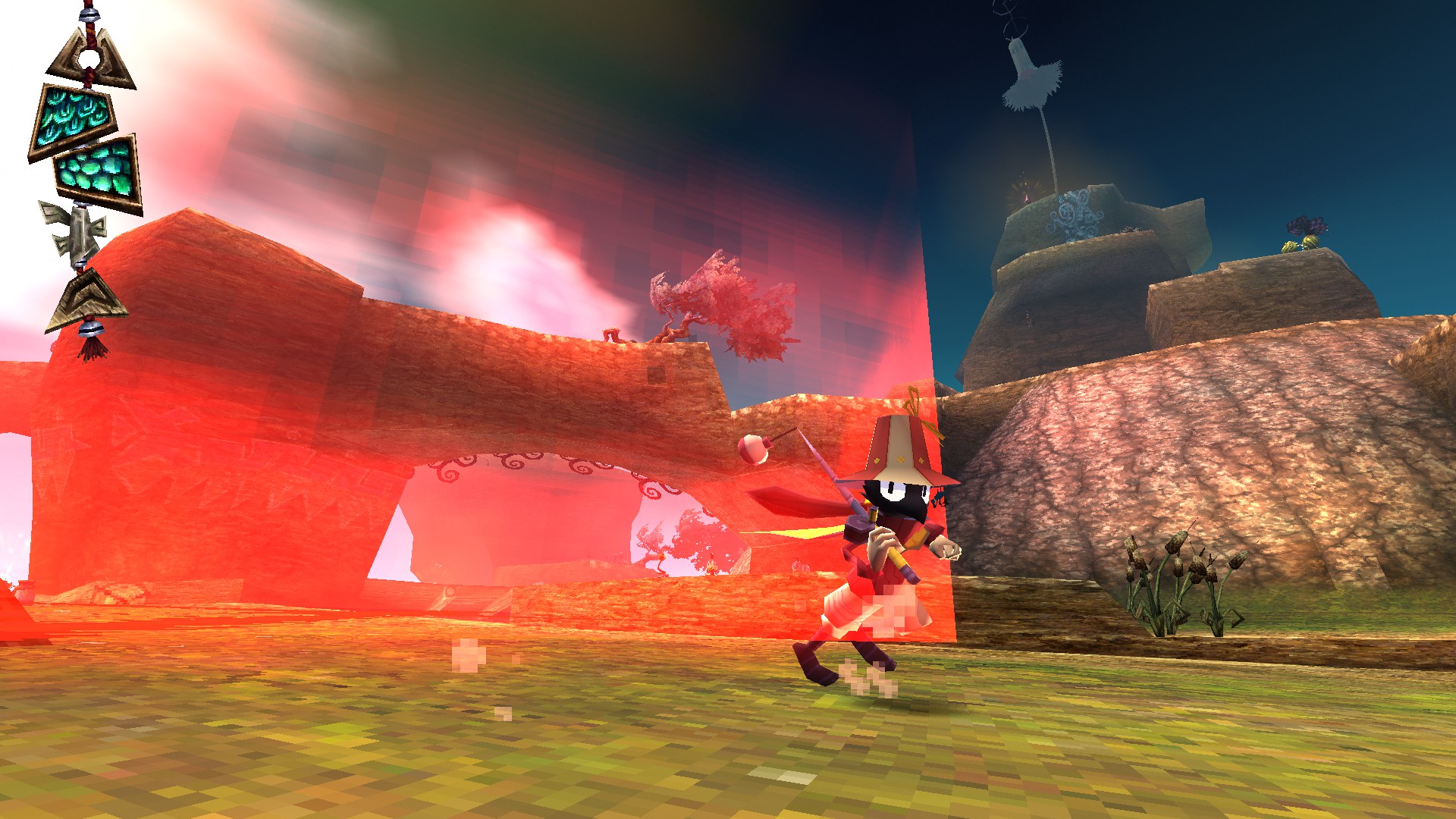
So, this is a game about catching fish, right? The fish in Tacklebox are like the Stars in Mario, rare objectives at points of interest. Each ruin has 2-3 fish to catch, for 26 in all! When you encounter a fish, it will run away from you, following a few predetermined paths, attempting to juke you when you’re about to catch it. You need to hit it first to stun it, then cast your line and yank it up into your hat. A single hit is all you need! Most fish will get tired and slow down if you chase them a long time, but at least one fish will never slow down, so you need to beat it for real. Some fish will shoot small projectiles at you, giving you an opportunity to smack them. The fish are pretty fun to chase, and frequently have fun little arenas to chase them around in. Some fish will even dash across the entire ruin you’re currently on, testing you on your competency with the core platforming mechanics in a more fluid way than just making it to the next ledge.
Conclusion

I completed the entire game in roughly 7.3 hours, collecting every fish and coin. The final platforming challenge this unlocks was very fun to play through, though maybe not the best that the game has to offer. Hunting down the last few coins was tricky, but thankfully the game provides a compass, which will pulse when it is close to coins or fish, helping you to figure out where you’ve missed collectibles, and how close you are to them. Fish also have a distinctive footstep sound, alerting you when they’re nearby.
Overall, I like Tacklebox’s focus and many of the platforming challenges it presents, but its decision to limit how technical its movement mechanics are, combined with fairly straightforward levels, forces me to only give this game a 9/10. I’m very excited to see what they do with the full game, and I seriously hope that this game can have a big influence on the genre!

 Celia Wagar's CritPoints
While I love the movement in the game and the general concept behind it, the level design felt underwhelming to me. The most fun I had with it was on the slope temple thing and fucking around the lake in the bottom of the lake tower. Both of these areas allow you to approach them riding a worm and use the momentum out of it to do cool stuff. In the slope area, I managed to find a couple of skips both by using the worm momentum and from groundpounds on slopes. In the lake, while it leads to nothing, bunnyhopping on water after jumping out of a worm is really fun. Especially with the little bit of lillypad movement tech (where you land close to their edges and they rotate a bit, netting you more speed).
The vertical areas didn’t feel like they used the movement system’s strengths to me. They lead to this slow Prince of Persia-style of platforming that I’m not a huge fan of. While the whole “gravity as checkpoint” thing is elegant, climbing vertical structures isn’t as engaging as going fast on slopes and shit. Lots of vine climbing, balancing on ropes, jumping off poles and wallruns (which is a mechanic that is implemented nicely, but very quickly you learn that going almost parallel to the wall before jumping clears pretty much all the wallrun challenges in the game). It’s ok platforming, but the ceilling for this stuff is much lower than the slope jumping, bunnyhopping, momentum-from-lillypad-spinning action we can glimpse on the few “wide areas” of the game. It’s also a kind of gameplay that would work well on a game without such robust physics. It feels like a waste. I looked up speedruns for the game and people already implemented cool movement using momentum, once they reach the dense parts of the game, the speedruns slow down and start looking like gameplay from a just competent player instead of something pushing the boundaries of the game’s physics and movement system.
The vertical nature of its levels also leads to the same kind of overworld of Wind Waker, where you can approach points of interest from many angles, but there’s a clear and often single way to enter each area. Again, the only counter-example to this I can think of is in the slope stage with the worm skip. Which is one of the most wide rather than tall structures in the game.
I’m just not sold on the vertical level design thing.
LikeLike
That echoes a lot of what I said. It’s not the most technical platformer, and while it’s exciting to see the parts where you can get a good fling and do some wild stuff, a lot of the game is not that.
I do want to see the level design improve by having more layers and routes through levels, which I noted in the review. Linearity isn’t a sin, I’d just like to see more route diversity. I can definitely see the parallels with Wind Waker, I didn’t want to belabor it in my review.
I think it’s respectable to make a focused platforming experience that isn’t trying to be extremely fast and technical and focuses on the flexibility of each jump.
LikeLike