Good glitches and Piqued Interest

I know you hate Borderlands 2 but you also said you were planning on writing that good games make good glitches article… What do you think of this Speedrun of BL2: (https://www.youtube.com/watch?v=t2YYwM1coOU)?

I saw it before, I was impressed. Mostly by the exploit that lets that one guy move absurdly fast by stacking a buff over and over again due to poor netcode.

I wouldn’t call Borderlands 2 a good game, but the point is to describe a tendency in games that give rise to interesting glitches like these. I think there’s a connection, a common thread. There’s a reason new things keep getting figured out for smash bros melee, and it’s not just the dedication of the fans.

A lot of bad games are glitchy too, but not in interesting ways usually. Glitches tend to arise when the programmers or animators or other people putting together the interactive components tend to “over-model” something. Like when they put more detail into something than is strictly speaking necessary. When variables carry over from other places, or certain things have dependencies on other variables.

Like bunnyhopping in Quake, they could have done something simple and just capped the max speed you can go, easy. Instead they decided to do something really silly, limit the amount of acceleration you can obtain on a given frame versus a vector projection of the current velocity vector onto the prior one.

Another example is how a lot of out of bounds areas have collision. Honestly it would take less time and effort to just use a ton of invisible walls, kill volumes, etc. Nobody is ever supposed to get over to those areas or outside the bounds of the game, so it shouldn’t matter if they can walk correctly on OoB areas, yet frequently they’re perfectly accessible.

When something carries variables over, reacts differently in response to different variables, it exponentiates the number of states that a game has. This means more depth, and in the cases of useful glitches, more depth that is actually relevant to the player. This is good game design in a nutshell.

This video is full of stuff I’d normally expect to see in a glitch exhibition. It was made by the game’s programmer, showing off that this ability, Center Stage, is capable of doing a massive number of things. When I first saw it, I thought it was kind of cool that they were playing with the standard fighting game convention of the camera controlling the walls, but never expected such application. I saw a few combos that used it and those seemed kind of cool but gimmicky, however because Mike Z allowed you to set any move as an assist, naturally this is included and clearly can be used for a lot more than basic combos.

This is the type of game design I’d like to see from major companies. Ori and the Blind Forest has it (at least partially intentionally), Axiom Verge doesn’t.

How can a game pique your interest personally?

By giving me the impression that it has some type of potential. What originally piqued my interest for Ori and the Blind Forest was seeing this video:

I was like, “Wow, what the fuck is going on? What’s he doing?” Because I didn’t know how bash worked. I went around, saw some other videos, couldn’t tell much of how the game worked, but I had this hunch that it would be good. Probably not the best reasoning, but my intuition paid off.

Demon’s Souls I got into because I heard yahtzee and other internet people whine about how hard it was, and I was like, “I want in on that.”

God Hand had a good reputation and I didn’t know much about the game other than that it was a cult hit. I was lucky to find it, my brother actually spotted it at a gamestop.

Again, maybe those aren’t the best case examples.

Though for upcoming games, only The Phantom Pain really gives me the impression that there’s something special to it. Kojima has all these systems working together in it, all these things to mess around with enemies using.
I was drawn to Skyward Sword initially actually, because they had implemented a stamina meter, you could run up walls, the item switch menus were in realtime, you could swing your sword in 8 directions and spin attack costing a chunk of stamina. It seemed to me like they were trying to give 3d zelda a depth it didn’t have before. I was really disappointed to say the least when all of these things only really had one purpose, could only be used in specifically designated ways, had no interaction between the different elements.

Why shouldn’t Hitboxes match perfectly?

Do you think there is any advantage to having hitboxes and animations/models not being 1:1 (or close to that)?

Yes. I’ve looked a lot into hitboxes/hurtboxes and experimented with them. More than anything I’d say it’s a matter of the KISS principle. When you make the hitboxes and hurtboxes 1:1 with the model, you end up with values that fluctuate wildly between frames, such as when characters flail their limbs as they are wont to do. This is especially likely to happen when you have a lot of concave and convex surfaces making complex geometries, weird shit is super-prone to happening and you don’t know what the fuck the result will be frequently. Why do you think clipping out of bounds is so common in so many games? It’s usually a result of the hitboxes or the environmental collisions getting distorted so something goes inside something else. When you keep things simpler, the odds of unintended or flat-out weird interactions that nobody can understand go down, especially for collisions where objects affect the position of other objects, like in environmental collisions.

The scale of the hitbox needs to be appropriate to the interaction too, relative to the size of each entity interacting. For example, in Wonderful 101, does each Wonderful one really need a 1:1 accurate model for collision? This also varies depending on the pace of the game, because the fidelity of our perception changes based on the speed of the game, smaller areas that barely make contact are hard to notice, so you can afford to be more forgiving and general in making hitboxes for faster games.

14299041356_06cdf1cc32_o.jpg

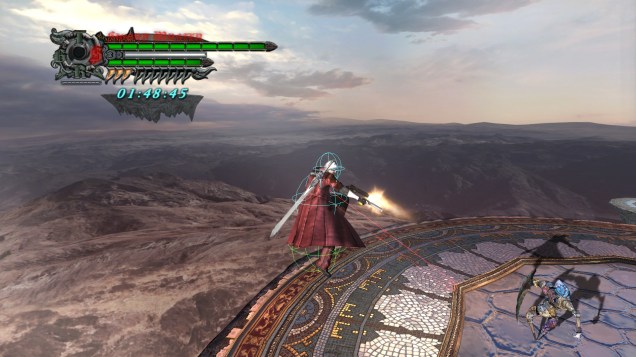
This is why Devil May Cry uses 3 spheres to represent Dante and Nero and no hitboxes on the limbs. Marvel 3 has similarly simplified hitboxes. I’ve seen hitboxes cleanly miss in smash that people swore should hit, and vice versa.

CCEuSRjW0AAu1OA

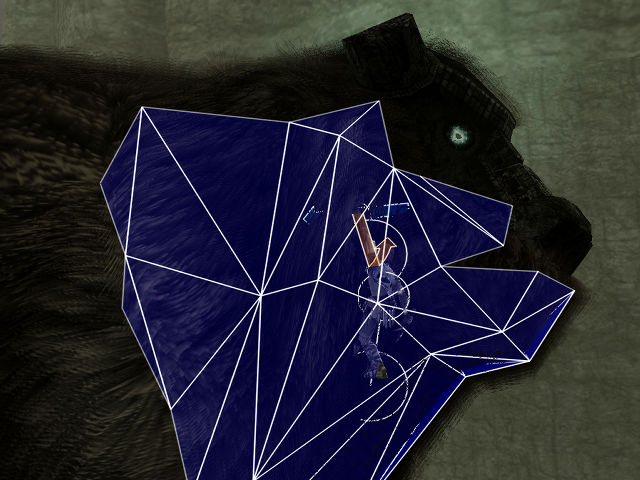
In the opposite extreme, Shadow of the Colossus has extremely detailed hitboxes for its Colossi and extremely simple ones for Wander. The Colossi need complex geometry in proportion to their scale. Wander doesn’t fight enemies around his size, the colossi have much larger implements to hit with, so it only needs to track his central body mass. The Colossi need to be climbed up accurately, the Wander is like a small implement probing a large surface, like the hook dentists use on your teeth. If Wander sticks a limb out and that ends up in your entire body getting crushed then you’ll be shouting about how bullshit that is. You need to be a bit forgiving to make up for difficulties in perception. Also players generally like it better when their hitbox is smaller than represented and an enemy’s is bigger, like in Shmups which took this principle to the extreme. Same for things that the player collects or interacts with, they like it better when their area to interact or collect things that help them is bigger.

3dwa67

In Smash bros there’s this term, Roy-Zoned, for when you’re so close to the opponent that your attacks miss them because they’re on the far side. It’s called that because Roy has a sweet spot close to him, so Roy players try to sweet spot so hard they frequently miss entirely. When someone punches, how much of their arm should actually be the hit area? Just the fist? The entire length of the arm? Some way into the body? Remember, Roy is a character with a sword, he doesn’t exactly have small hitboxes, yet I’ve had silly things like two marths Fsmashing at point blank range and we miss each other. Or try to grab each other and miss. And if you’ve ever seen Marth’s grab box you’d know how silly that is.

It gets sillier when you have the legs given individual hitboxes and someone does like a kick or something where the hitbox fits inbetween the legs, and it’s like, “Seriously? there’s no way that should miss.” I’ve seen this sort of thing happen a LOT in all sorts of games.
CDEUMEsUkAEgE1d[1]
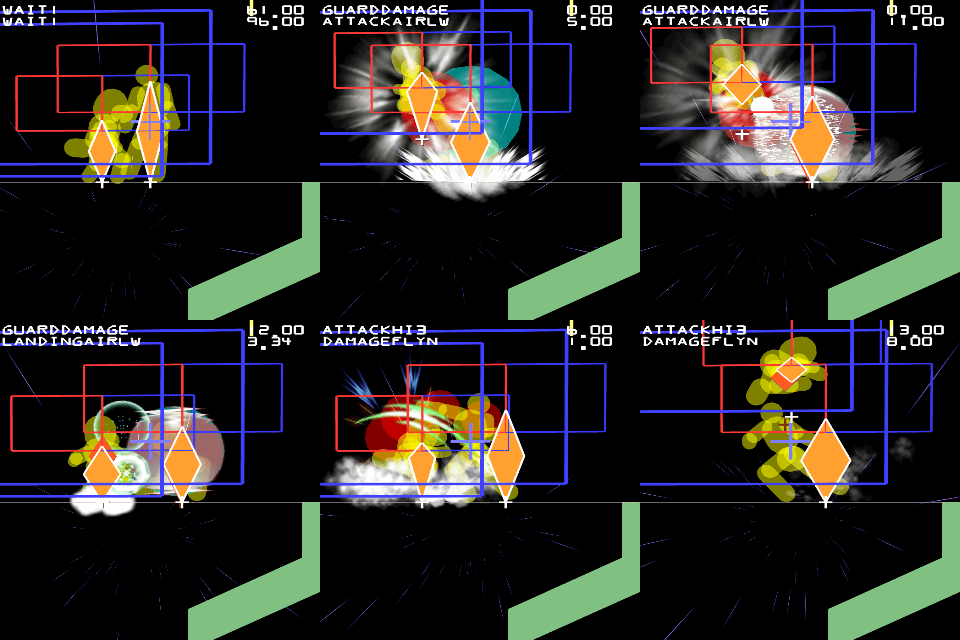
You have to think about the hits being the very edges of each hitbox’s range, and would a hit in those regions be acceptable or look weird relative to the animation? Especially true for grab animations, because when you grab the character gets dislocated, teleporting to the held position. The obvious example is Mewtwo’s grab in PM 3.02, because part of the box was inside him, people barely brushing his back would be grabbed and teleported in front of him where he held them. I took a picture of that and have an animated example.
Iu2M93m[1]
nhSug8g[1]
The intention is clear, they wanted crouching characters to go under the hitbox in front so they could get around the grab, but people closer into mewtwo to not get roy-zoned, but it had this unfortunate consequence.

Because environmental collisions in particular are so finnicky, most games don’t use anything close to the character’s model for that. Smash uses a small diamond shape, Dark Souls uses a big pill shape. Mirror’s edge has a cylinder. If you use something more complicated and don’t have a complex animation engine based on inverse kinematics, you’re going to run into trouble there. Even with one you’re going to run into trouble, because GTA and other games like it do.

j3v

Why is Dante such a lame fight in DMC4?

Why is Dante such a lame fight in DMC4? His attacks are so fast and he’s easily cheesed by pistol > buster.

It’s not that he’s faster than you necessarily, it’s that protagonists of 3d beat em up games have fast attacks, while enemies usually have slow attacks. This makes fighting Dante unsatisfying in much the same way as fighting bots in fighting games is unsatisfying. Furthermore, the movesets of dante and nero aren’t given clear counters or other weaknesses like fighting game movesets are. In fighting games, most moves are less than 15 frames of startup, which make them difficult to react to, so players need to predict what their opponents will do in order to fairly combat them. In most action games like DMC, most enemies have attacks or sequences that start up like 30-60 frames in advance of when they actually hit you, so you have a fair time to dodge or stuff their attacks.

When you have a bot choosing options and all those options are as fast as all of your options, you can’t predict what they’re going to do and you can’t react when they do it. Fighting games have a leg up there in that everything is designed with a counter, it makes you vulnerable in some way. In action games, you only really have dodging and attacking. The hitboxes of dante and nero make them insusceptible to whiff punishing, because they can only be hit at their centers.

The solution is really to establish some clear tendencies for the AI and give players a number of ways to counter those behaviors, some of which are more effective and some of which are less effective, some of which are harder/easy, higher chance of success/lower chance of success, and to have them vary based on circumstance so that you can’t repeat the same thing over and over again without risk. Then you have to make all these factors obvious to the player so they can see into the machine a little and fairly predict what will happen based on their input.

The reason pistol > buster works is because they went overboard in making dante’s behaviors rigid and not really respond to circumstance. They should have had a number of different behaviors to respond to shooting from far away, like readying the pandora charge shot quickly (even though it would break canon), or using a stinger after a taunt so you had time to react. For the clashing pistols, he probably should have tensed up more over time and as you got closer, in like his posture or something via animation blending, something obvious the player can see, before breaking into a counter attack, so that in the case they’re both shooting at each other’s bullets the player needs to be careful about how quickly they move in to punish that action (and it opens up the possibility of baiting out the followup and punishing that). Just to give some basic examples of possible ways the fight could be varied up and cheese could be removed while keeping it fair.

What do you think of off-screen attacks?

In Dark Souls I love them, in Metal Gear Rising I hate them. In Dark Souls I feel like it’s my fault, in MGR I feel they’re nigh unavoidable.

Good idea is to have auditory cues for offscreen enemies, or some other type of attack indicator. I prefer audio, we can do 3d sound fairly well these days, and audio I think can be a bit more clear about the pacing of the attack, and I feel like it’s the “right” level of feedback clarity directionally.

The big thing is, players need a fair chance to perceive that they might be threatened from offscreen. In Dark Souls, this usually only happens if you rush past enemies and let them surround you. Enemies are not easily missed in Dark Souls. When I am engaging multiple enemies, I know there are multiple enemies and I keep a mental map of where all the enemies are. I really enjoy fighting multiple enemies at once because the game makes it possible. In MGR, the camera is practically biased to force you into walls, so enemies are always coming from offscreen until you are down to 1 enemy and can finally camera lock them without ignoring the rest. Many enemies have ranged attacks that need to be blocked up, or they’ll dash into you as they attack. Dark Souls has no soft-lock, and the jumping attack and kick commands can be done in any direction. MGR has a soft lock, so if you do the stinger move or the wide slicing trip move, you won’t hit inbetween the two/four enemies where you aimed it, you’ll hit one or the other/three of them but not the fourth.

Cheating a bit and altering enemy aggro/attack speed when offscreen is perfectly permissible in my book. Just don’t do something silly like Amnesia where the monster practically can’t hurt you if you look in the right direction and relax those restrictions if the player engages in combat with one of them, because then they’re asking to get smacked.

God Hand gives the player a Radar, given the camera is like a tank and mostly fixed, this is probably necessary for that game, it seems like UI clutter or overkill for many others. God Hand AI cheats like I mentioned, except on LvDIE.

The idea is, either make sure the players know about all the enemies around them before they turn their back, or give them a warning they can see or hear before an unknown offscreen enemy attacks in a way that gives them a chance to react correctly. Or both.

Grind and How to Eliminate It

Grinding is something that nearly every game player is familiar with at one point or another. Grinding is best known from JRPGs and MMOs, and is almost universally reviled.

First, I’m gonna define what grinding is so we can all be clear on terms. Grinding is the repetition of a relatively simple series of actions that do not directly advance the game.

In an article on Critical Gaming, KirbyKid explores what grinding is by attempting to come up with examples of grinding, and ultimately concluded that as long as players are having fun and voluntarily choosing to play there isn’t really any such thing as grinding, and I kind of have to disagree, because I think his examples weren’t really on point.

The first example he gives is repeating Mario levels, and then he argues about how this isn’t grinding, and largely his point is correct. Having mario levels repeat themselves, beating each level twice, isn’t really grinding. But imagine that there were a block in mario that generated a coin every time you pounded it and never stopped (or at least had a very large number of coins). Now imagine stopping and getting a ton of extra lives from that block. You’re no longer progressing in the game or engaging in the game, you are staying in the same place and pressing A for a long time. Grinding is a cessation of progress. A modern example of this, in New Super Mario Bros. no less, is returning to the first level and abusing the giant mushroom to get a ton of 1ups. The result is players repeating the same section ad infinitum until they have enough 1ups. The old infinite life trick on a turtle shell is only vaguely more tolerable because you don’t have to actually stick around for it. A lot of people did similar in Oblivion by making spells that did nothing and binding their keyboard to cast them forever while they did something else and their skill levels rose.

The issue with Kirby Kid’s example is that even with repeated levels, you are still making progress as you play those levels, unlike repeating 1-1 over and over to get extra lives.

A big reason I quit Disgaea is because of institutionalized grinding. I reached a certain stage and realized that to get any further, I’d have to go back and repeat prior stages until my characters’ levels were high enough to continue. Then my items all had levels too, and I had to grind to beat each of their levels. The entire game is built around forcing the player to sink as much time as possible into it. Then the sequels gave you the option to restart from scratch with better base stats. It’s one thing to provide a lot of content, but to require close to mindless repetition in order to access it all is positively painful.

Dark Souls was a huge step up from its predecessor Demon’s Souls because it eliminated a lot of the grind based elements. One of the things demon’s souls players still have nightmares about is grinding for pure bladestone. Dark Souls by contrast seriously eased up on absurd random drops, and gave the player some of the rarest random drop items guaranteed. The big grind issue in dark souls is only really present for people who play online and even then those who lose at online. In dark souls to play online you need humanity, which is an item that is dropped by sewer rats (and gained by defeating an enemy in online play or assisting someone with a boss). This means that to play online consistently, you need to go back to the depths every so often and kill rats and hope they drop humanity. This can be mitigated somewhat. Drop rates on humanity in the last patch were multiplied by 20, and you can use humanity, enter human form, and wear various items to increase your drop rate further. Also an option is to skip beating the boss of the depths, the gaping dragon, allowing black phantoms to invade you while you are farming. All in all this is a step up from the prior method of online play which required you to beat a boss every time you wanted network functions enabled, but it’s stull pretty tedious.

One of the Castlevania series’ advantages after going the Metroidvania route is that they never forced the player to grind in order to beat the game. The level progression enables the player to keep up their health and damage output as they progress through the game and never really fall behind the enemies, meaning that they will never need to grind. The big trouble is though that these games included random item drops, which boiled down to exiting and re-entering rooms to kill the same monster over and over again for hours on end to get rare items, including weapons. Order of Ecclesia eventually solved this problem by having new weapons (in that game represented by glyphs) obtainable by absorbing them when enemies cast spells or at specific hidden locations. It still had randomly dropping items, but these were less required than ever.

The classic deal in every JRPG or MMO conceived is that the entire game has become less about overcoming challenges and more about making your numbers go up. This is why people raid, this is why people battle monsters outside of town for hours on end. The reason for this being popular or people subjecting themselves to this arduous process at all is detailed in my skinner box and sunk cost fallacy essay.

The reason this is bad should be obvious, it’s dull and unengaging. It doesn’t require anything beyond minimal interaction or thought from players. Even in a game with a combat system that has depth, grinding boils down to a tedious repetitive process.

Shin Megami Tensei Nocturne and Digital Devil Saga are great examples of this. They have perhaps the best and most strategic combat systems of any JRPG, but they also practically mandate grinding to succeed, which makes them a lot more annoying to play, which is why on some of the DS titles, I ended up using experience multipliers on new game+ so that I could focus on playing the game instead of wasting time on grinding I had already done.

The next question to ask is, what can be done about grinding? There are a few possible solutions. These include, tying experience gains to plot events, having a finite number of enemies, having anti-grinding algorithms for experience gain, having ability gain be attached to player performance instead of random drops, decreasing level caps, and creating combat systems that enable a low level player to defeat a high level enemy with enough skill.

Tying experience to plot events is something that was done by the original Deus Ex and Vampire The Masquerade: Bloodlines. You gain experience when you finish quests, side quests, or complete objectives. What this means is the player is only capable of gaining experience in proportion to how far along they are in the plot and they cannot farm enemies for experience, and now have no real motivation to do so.

Finite enemies is very similar to tying experience to plot events. This can provide a more direct reward for combat and can similarly prevent infinite grinding. However without regulation it can lead to grinding just the same. On the Rain Slick Precipice of Darkness is a great example of finite enemies done right. Every enemy encounter is given care and instead of grinding, it turns into a game where the player actively looks forward to finding new battles. Players are forced into enough battles to ensure their stats are never particularly low, and it’s impossible to grind your way up and destroy the difficulty.

Anti-grind algorithms would be something along the lines of scaling exp drops in proportion to how strong a character should be at a given point in the story. A diagetic rationale for this would be that a character does not gain much by facing the same enemies over and over again, nor enemies below their skill level. By regulating experience more directly like this, it can limit the effectiveness of grinding and generally keep characters on track with where they should be. Underleveled? Defeat monsters way stronger than you for scaled up experience so you’ll be on track in no time. Overleveled? You’ll earn less and less to prevent you from getting too much of an edge. The big trouble with this method is that it takes a lot of effort to balance on the part of the designers, but difficulty is always hard to balance.

Random drops are a big feature in a lot of RPGs with respawning enemies, and frequently players are required to kill the same enemy for long periods of time to farm a resource or obtain a rare weapon. In general I think systems like this are best left out, attach rare weapons to bosses, or secret locations or puzzles. Don’t waste player’s time, give them real nonrepetitive goals. Dark Souls did this by having every unique item and a lot of rare non-unique weapons be tied to a specific location instead of forcing the player to grind for them. There is no item in the game that requires players to grind in order to get it, and that is a good thing.

Level caps should probably be decreased across the board. High level caps are not inherently good nor bad, but it’s better to have fewer levels and make them count than long gradual progression, which almost seems to demand lazy filler level design and grinding to fill out (see Disgaea).

EDIT: Add Ys solution example with enemy quota.

The final thing that can be done is creating battle systems that enable players to win even when locked to level 1. Examples of games that do this are Dark Souls, Castlevania, and The World Ends With You (notable for people frequently doing level 1 runs). The primary thing that creates a game like this is the ability to avoid damage via rock paper scissors type systems. It’s possible to beat all these games without taking damage. An alternative to this is keeping lethality levels consistent throughout the game (such as in legend of zelda which almost never has an attack that knocks off more than 2 hearts). This can help deal with grinding by largely making it unnecessary. If you do not need to grind to win, then it frequently creates a more natural level progression. Dark Souls in particular is notable for penalizing high level players (200 and above roughly) by preventing them from easily invading and being invaded by other players due to how the matchmaking system works (in demon’s souls matchmaking would fail completely).

Not all of these systems are suitable for every game, but between them they can help empower games to be more capable and interesting while also being less repetitive. Grind based games have always had the particular flaw that the player is not really asked to improve nearly so much as their character improves for them and the game actively conspires to force the player to sit through the same content rather than allowing them to keep moving onto new content. It means making battle systems that are themselves engaging rather than the (dying) trend of trying to sell an RPG on story alone.

RNG, How it Can Hurt, How it Can Help

The mighty random number god is the almighty entity that damns, that saves. In games there have always been the use of random numbers. Even since the days of the egyptians, people rolled blocks to generate random numbers. People have flipped coins, and more recently grabbed numbers off the system clock and a dozen other places and mixed that into something with no predictable pattern.

The first question we’ve gotta ask is, “why?” Why do people use random elements in the first place? I believe this reason is unpredictability. If things are certain, then why bother testing them? People enjoy uncertainty. If you played monopoly or candyland and just picked numbers to move, it would be dull. If you just said put the coin down on the table and said heads, it would be dull. Rock paper scissors and derivative games are interesting because both players are not aware of what the other player has chosen. What makes games interesting is on a fundamental level, uncertainty.

I hate RNGs. My reason for this is that RNGs remove control from a player on the most fundamental level that it is possible to remove control. I believe that games should be fair. Fair means to me that the player is given means to control their situation equally to every other player. There may be systems that act outside the player, but those can be learned and taken advantage of, but an RNG is something that throws that to the wind. Random or pseudorandom numbers by definition cannot be taken advantage of. They are unlearnable, prognostication is not a skill that a player can be expected to develop (and if it was, then it kind of indicates that the number wasn’t random in the first place). The general idea here is, you cannot get better at predicting random numbers.

People can be rock paper scissors champions, but you can never become a coin toss champion. Predicting what people will do is a skill that can absolutely be developed. People aren’t random, but people are complex and constantly evolving. People can be predicted, but people are uncertain. You can never be totally sure what the other person is going to do. They always ostensibly have the option of choosing something different. This is what keeps competition interesting. Competition is in part how well you can perform and how well you can read minds. RNG kills this. The only thing you can do to control the RNG is attempting to cut it out.

In the original counter strike, the bullet spray patterns were static, meaning they moved the same way each time. What this meant was that someone could memorize the pattern and move their gun to counteract the wide and shaky spray pattern. This is what counter strike players actually did. Then counter strike source came along and implemented tighter but randomized spray patterns. This, along with complaints over the physics are the reason counter strike source is disdained by the CS community. The RNG stole their control.

In a way, what we need is both predictability, and uncertainty. We need to know deterministically what the outcome of both player’s actions are, but we can’t know for certain what will be decided. We must be given means to evaluate future outcomes, but not know them for certain. RNG prevents evaluation. You cannot evaluate, cannot guess at the random. You can only do things and pray they work.

A friend of mine coined a term, “intelligent uncertainty”, and I think it entirely accurately describes the phenomena. We are uncertain of what will happen until it does, but we can learn to predict it better and better.

RNG can sometimes play nicely with other components, but only when it’s carefully regulated. Poker for example takes a lot of the luck out of the draw and places it back into player’s hands. It does this by making the game a lot more about bluffs and betting strategies than just winning hands.

Project M had a great fix for Luigi’s misfire which used to activate randomly. Now it can be stored and released when you need it, but you have to keep using Luigi Missile to get it. It will show up randomly within every six times the move is used, and when it does, it becomes optional whether to use it then or store it for a use later. Using it of course means you have to retry 1-6 times to get it back again.

Items have been an issue of contention in smash bros ever since they were introduced, but frankly, I think the easy fix for them is just to make them spawn in regular places at regular times and announce what item it will be before it spawns, like having a ghost item appear there before it can be picked up and used. With regulation, items could go from breaking games to just being another element players use. Items like the quad damage, haste, regeneration, flight, invisibility, battle suit, personal teleporter, medkit, and mega health are perfectly acceptable in Quake 3, and items could have a place in Smash with more regulation.

Randomness is way more acceptable with peach and game and watch. Peach’s turnips have a random chance of producing stitch-face, a really powerful turnip. Game and Watch’s hammer has a random chance of a number of different effects occurring. The big deal here is peach can only pull a bunch of similar objects with similar functions from the ground, and to do so, she needs to use a highly telegraphed and interruptable move. Game and watch’s attack generally doesn’t matter if he doesn’t hit his opponent. He still needs to play well to hit which was the point in the first place. It’s not an advantage or disadvantage being given out at random here, they’re both functions of the character. They are decisions the players actively undertake, knowing what their chances are.

Another example is the 50% miss chance against units on higher terrain in Starcraft, though I am not fond of this particular example (editor’s note: fuck this example, halve the fucking damage, or deterministically make every other shot miss please). What it can create is a gamble where one can pass units through certain locations at a high risk.

Relationships and Dimensionality

The basis of depth in a game isn’t how complex it is, it is the means by which those complexities interact. The interplay between elements.

This is highly related to our concepts of dimensions. Spatial dimensions overlap and envelope each over and creates depth between them. Even our language mirrors this thought process, such as saying a character is two dimensional, flat or a narrative is deep. Depth as a narrative term comes from the literal meaning of the word depth.

Depth in games should be about adding new layers to games, new means by which the player must interpret them to succeed.

The most basic demonstration possible is to imagine a 1d game, a game where you are on a line. In a game such as this, if you encounter an obstacle. You have no real way to go around it, only through it. Collisions occur when your position is the same as another object.

Now imagine that there are two of these lines, one vertical and one horizontal, and they both operate independently on this principle. This is an added complexity, but it is not really depth. Now imagine that collisions only occur when your position is the same as objects on both axises. Beyond that, that whenever you shift on one axis, the other changes. In accordance with the shift, the prior object is no longer in your way. This is now effectively a 2d game, it has another dimension added to it. It is now possible to go around objects instead of going through them. This could be represented as a flat picture now instead of just 2 lines. But then, how do you get around objects which do not have an opening somewhere for you to go through?

Imagine there being a third line, and objects on that line can only be collided with if you are in the same position as them. Then, you can tie that into the prior two lines, and bind them all together, creating three dimensional space.

Beyond this, imagine that there were another dimension, and that analogous to the prior ones, as you moved through this dimension, objects in the other dimensions seem to shift around you. One such dimension already exists, and it’s time. The difference between time and other dimensions is that it cannot be seen, as our methods of seeing are themselves subject to time, and that collisions cannot occur with time, time passes whether we want it to or not.

Imagine another such dimension, it’s a bit hard to think about, because we don’t actually have another spatial dimension. Imagine that as you travel through this dimension, space and objects around you warp and change. One obvious metaphor for this could be color or temperature. Imagine that you could only see objects if they were the same temperature or color as you, and that you could only collide with them if you were the same color or temperature as them.

Perhaps this idea could itself be used as the basis of a game?

Competitive Games: RPS and Efficiency Races

In general, as I look at competitive games, I see two big styles emerge, that which I call efficiency races, and rock, paper, scissors. I believe that good competitive games are a blend of both, but that RPS should generally take priority over efficiency races.

A classic quote from Sid Meier, creator of civilization, “A [good] game is a series of interesting choices.” An interesting choice is a choice that has advantages and drawbacks so as to make it not explicitly better than any other choice the player has, except in the context of a specific situation. Ideally players must carefully evaluate their situation and make the right choice to come out on top.

By contrast efficiency races are not about making interesting choices nearly so much as perfect performance. Racing games are inherently efficiency races most of the time. There is a definitive path to victory and may woe befall all those who do not copy it as perfectly as possible. The issue with efficiency race style games is they end up with brain dead gameplay. In a shooter styled as an efficiency race, the game becomes, who can fire first and hit most consistently, without any other sort of mitigating factors.

Without RPS interactions, a multiplayer game cannot have strategy, comebacks are only possible by the lead player screwing up, or an external comeback mechanic forcing that player out of the lead, like the blue shells or lightning in Mario Kart.

Having a mix of RPS and efficiency race styles of play is generally speaking ideal, because it enables a depth of interaction, while giving players a basis to make their predictions on. When they know how much payoff their opponent gets from particular options, they can see what their opponent is biased to pick. Things based purely on efficiency (like tricky to perform execution based techniques) are often looked down upon by outsiders but they help create a sense of progression in the game and enables a whole range of interesting choices to be made that couldn’t otherwise that are balanced on the basis of how tricky they are to perform.

Quake 3 is an example of a great mix of efficiency and RPS. Quake 3 is a game about map control. In any other game this would be camping the best powerups, but in Quake 3’s speed prevents effective camping from ever being too viable. Essentially map control consists of grabbing power ups, like the red armor, yellow armor, and megahealth, so that you get an advantage over the opponent in battle. Beyond this, Quake champions watch the clock to determine when these power ups Respawn so they can be there when it happens to keep their advantage up. Quake is a massive battle of information. Metagame tactics include delaying when you pick up a power up to change the timing of that power up so it is harder for the enemy to pick it up and monitoring the timings of the power ups so you can predict where the enemy will want to go in the future.

Another example is in fighting games, where you have efficiency in the maximum combo punish you can pull off when you hit your opponent, and RPS in trying to hit them at all.

Glitches augment games

Games like any other form of art are a work of design and interpretation, and sometimes interactions occur that the artist does not intend and sometimes they aren’t entirely mistakes. In Animation we call these happy accidents and they often occur when a sequence isn’t animated pose to pose. When designing layouts, or dealing with moving scenes in film, there is a huge potential to create bizarre, flat, or varied compositions within shots. In programming games or even board game design, there is a similar potential. Sometimes rules interact in ways that cannot be predicted or the precise algorithms function weirdly in some corner cases.

In general, most glitches are destructive, falling through the world, causing something to fail in function, freezes, etc, but sometimes these glitches can add a lot of flavor to a game or enable new strategies that increase the overall depth of the game. I would say that it is the role of a designer or programmer, like any other artist, to figure out what role these glitches play in the game and whether they add to it or not instead of rigidly abiding to their design document. Works of design are frequently a process of trial and error to discover what works and what doesn’t. Glitches can be just another possibility in the system.

In general, one of the goals of game design is to give the player a bunch of cool tools to use and give them reasons to use all of them, glitches sometimes result in new tools, or new uses for old tools that can spice up a game. Sometimes glitches can completely invalidate other aspects of the game, and you gotta make a decision, does that glitch add enough to the game to be worth it?

Beyond this is the topic of what exactly is a glitch or not? A lot of “glitches” are just uses of intended game mechanics in unconventional ways to derive an advantage, such as wavedashing or SHFFLing in Super Smash Bros Melee or snaking in Mario Kart DS and are closer to exploits than glitches outright. This invites a lot of questions over what comprises intentional or unintentional programming or how glitchlike something has to be to be classified as either a glitch or an exploit. I’ve personally looked into the means of various advanced techniques coming about for a lot of games and I hope to explain them in ways that make them easy to understand and help illuminate both how they came to be, and how they have augmented the games they came from. I obviously cannot list every amazing glitch ever, so I’m going to stick to some of the bigger, more iconic ones.

One of the most classic advanced movement tricks in video game history is strafejumping or bunnyhopping. Another contributor covered Bunny Hopping quite extensively with his video here:

Before strafe jumping there was another trick that dominated in old FPS games such as Doom, Goldeneye, System Shock 2, Perfect Dark, called Straferunning. A common programming practice among amateur programmers is to simply say that when forward is held, to move X speed forward, and that when side is held, to move X speed to the side. The result of this is that when both forward and side are held, you move both forward and sideways at the same time at that speed in both directions. Anyone with basic experience in trigonometry will realize that this means that you could move 1.4 times faster in a diagonal direction than if you were to move either cardinal direction independently. Therefore, to move fastest in these games, one simply had to turn to the side a bit and run diagonally all the time.

In developing Quake, Id Software knew about this exploit and decided to patch it by having your velocity vector be computed by your player speed variable in all 8 directions of movement using basic trigonometry. This means that no matter what they set the speed variable to, you would always move the same speed, diagonal or not. However what they didn’t realize was that in doing so, they had created an even greater source of speed, strafejumping. In the development process for Quake 2, Id decided to use integers for velocity instead of floating points. This meant rounding whatever velocity calculations were done into integers. Incidentally they set all velocity variables to be rounded up no matter what their values were (so 5.2 would be rounded to 6 and so would 5.8). What this means is that every frame in which you have a velocity that is an irrational number, your velocity will be rounded up. This creates the effect of an extremely slight speed boost. Since diagonal velocities were now computed with trigonometry, every time they were recomputed they would be an irrational number and need to be rounded again. So what players discovered was that by jumping while pressing forward and side at the same time, and moving their mouse in a whiplike pattern, they would steadily accelerate (jumping was required to prevent ground friction from reducing your velocity).

The funny thing about this glitch is that because it’s dependent on how often velocity rounding occurs, when Quake 3 was first released, players with better performance and higher framerates were capable of moving a lot faster due to it. Eventually the CPMA mod altered the game and the server software, changing the calculations and management of player velocities from clientside to serverside with a stable tickrate, preventing players with better computers from having an unfair advantage over others.

There are actually multiple styles of Bunnyhopping and they differ between Quake games and Source engine games. Both styles exist in Quake in the form of Strafe Jumping and Circle Jumping, but only Circle Jumping exists in Source engine games and it’s the dominant means of travel, referred to exclusively as Bunnyhopping. Valve in the creation of the goldsrc engine, a modification of the Quake engine, didn’t intend for bunnyhopping and fixed the rounding error that caused it. However this left a completely different exploit in place that no one could have predicted. One facet of the engine is that while you are in the air, you have a limited means of controlling your velocity. Pressing a direction will redirect you slightly, enabling you to control your jump direction after you have left the ground. In addition to this, strafe movements arbitrarily have a higher value set, making them more effective than forward or backwards movements. This can also be noticed by climbing ladders in Counter Strike, you will climb much faster with strafe movements than forward or backward ones because strafing movements simply have a higher air velocity. Turning while pressing strafe will result in this velocity addition being repeated every frame you turn. This effectively enables you to build velocity by jumping, strafing, and turning smoothly with the mouse.

Valve further attempted to limit this style of movement by making it very difficult to repeat jumps. Quake has a buffer in the air that catches your jump inputs so that you will jump again the next time you touch the ground, making it a lot easier to avoid ground contact and friction slowing you down. Source engine games have no such buffer, so you need to hit jump on the exact frame you touch the ground or you will begin walking on the ground, slowing you down. A lot of Source engine players get around this by taking advantage of Source’s support for scripts to make one that repeats the jump input in one way or another. A popular method is to bind jump to both up and down on the mousewheel, remove the binders preventing the mousewheel from being spun freely, and spinning it every time you come in for a landing, so that the jump input will be repeated every frame, ensuring that no velocity is lost to friction.

Valve eventually got wise to players circumventing their countermeasures and added a server variable called sv_airaccelerate that limits maximum accleration while in the air, to prevent players from moving fast in the air. Initially this was set to 20, but eventually Valve locked it to 0 in most of their games including Counter Strike: Source and the entire Orange Box. This effectively ended Bunnyhopping in Source games. Despite the death of Source Bunny Hopping, the techniques lived on in TF2 in the form of Air Strafing. Air Strafing took advantage of the air velocity system in much the same way Bunny Hopping did before it, by making smooth mouse motions in the air to repeat the slight burst of aerial velocity from strafing. The big difference however was that sv_airaccelerate’s systems prevented one from acceleration, so all that was possible with Air Strafing was redirection of movement. Rocket and Sticky jumpers in TF2 were capable of turning in smooth curves around corners using air strafing, which enabled movement between a lot of points that were otherwise not possible, or costly in terms of health to attempt. On 2fort, using air strafing, one could rocket jump entirely around the small room on the front upper level of each fort.

Overall, Bunny Hopping in its various incarnations adds an incredibly mesmerizing and blindingly fast style to the games where it is represented. It requires players to evaluate the terrain in much different ways than normal running because of the snaking motions it requires, and opens up a lot of pathways across far horizontal gaps in a lot of levels, like the rail gun to the overpass on Campground, but only to those who are skilled enough and have invested the time into building up velocity first. Bunny hopping also make aiming harder, as one is not only moving faster, but needs to keep up the serpentine motions of the hop as well or you’ll lose speed. Players who can bunny hop have a lot of advantages over those who can’t, but in many situations it simply isn’t a good idea, meaning that it doesn’t completely overshadow normal running or walking as a movement option, and players can express a range of skill with how well and consistently they can Bunny Hop. Normal movement, as opposed to Bunny Hopping, in games like Quake 3, has the advantage of being quieter, because every time you jump in Quake, your character grunts, which can be used by the enemy to get a hint as to your position in the level. In other cases, it simply pays off more in terms of accuracy to not be moving so wildly.

Another classic glitch that shaped fighting games forever is special canceling otherwise known of as 2in1 canceling. When Capcom designed Street Fighter 2, they added a feature where for the first 5 frames of a normal move, you could cancel its startup into a special move. This is believed to be a form of “input leniency” designed to make special attacks a bit easier to perform. Fans of the series call this Kara-canceling or “empty” canceling because it is canceling from nothing. This feature however gave birth to special canceling, which has since become a staple of all traditional 2D fighting games. One feature of Street Fighter 2 and many other games featuring melee combat since, is that when you hit an opponent the screen freezes for a few frames. This is known of as a Hit Freeze, and it exists to help make the impact seem harder animation-wise. Despite coming to exist as a fighting game concept, a lot of other games make use of it for mostly the same reason. The weird thing about the hit freeze though was, it paused the kara-cancel timer. What this meant was that if you successfully hit an opponent, the hitfreeze would make it so you could kara-cancel into a special attack even though it wasn’t the startup period of the move. One could chain attacks one into another using this technique, giving birth to the concept of combos, which have since become a nigh universal foundation of fighting games. Since SF2 invented the concept of canceling moves into each other in combos, many other fighters have used the concept creatively to make their own combo systems, such as chain combos in Marvel and Guilty Gear, and Guilty Gear’s roman cancels, Street Fighter 4’s Focus Cancels, or King of Fighter’s HD Cancels. Even series far outside of fighting games like Devil May Cry have implemented things such as jump canceling.

What 2in1 or special canceling, and later super canceling, enabled is they added a means for greater payoff for attacks in exchange for more vulnerability in case they fail. Special moves as a design point, usually have longer periods of recovery than normals, making them more vulnerable to counter attack. If one is skilled, they can use cancels to their advantage to squeeze out more damage, but against more skilled opponents they need to be careful not to hand their enemy a huge advantage. Since the invention of special canceling, it has since been programmed intentionally as a function of the hit freeze and certain moves are given or not given the special cancelable property. When Capcom added Supers in Super Street Fighter 2 Turbo, they also added the ability to cancel certain normal and special attacks into supers, further increasing the range of what was possible with combos and cancels, and adding the potential of wasting your super on a bad setup.

Gunz: The Duel, is a game with niche popularity made by a Korean company called MAIET that later got bought out by Ijji and is currently free to play. Gunz styled itself as a modern game that took a lot of inspiration from the Matrix and similar modern films where the gunmen have supernatural ability to run along walls, dodge bullets, and wield guns akimbo. Gunz also allowed players to fight with katanas, daggers and kodachis (two swords at once). Early in the game’s life span, it was noticed that a lot of animations could be canceled by slashing with a katana or kodachi and it would usually reset a number of variables, like the ability to airdash or walljump, much like jump canceling in Devil May Cry. Furthermore, the slashing animation could then be canceled with the blocking animation, so one could dash, slash, block, and dash again without the normal cooldown time. This trick became known of as the butterfly step and it completely tore out the original foundation of Gunz by the roots, replacing it with one of the fastest and wildest shooters around.

The collection of sword tricks, all originating from the butterfly cancel became codified as a style, called K-Style, because it was Koreans that invented them. In contrast to K-Style, there was E-Style, meaning European Style. E-Style in contrast to K-Style’s focus on swords was much more focused on guns, especially those that sprayed a steady stream of bullets which were unsuitable for the butterfly cancel because they required the weapon to be out for extended periods. E-style was derided by K-stylers as spray and pray, and didn’t rely on nearly as many tricks with the game engine. Alternatively there was D-Style, which relied on tricks with the dagger, but was incapable of using the butterfly cancel due to the dagger simply not having a block.

Using the butterfly cancel it was possible to scale walls by walljumping, canceling the waljump animation with the slash and block, then dashing forwards to stay close to the wall, and repeating. Suddenly, the players were no longer confined to merely the sections of the stage you could reach with walljumps or wallruns, absolutely anywhere there were walls was now a battleground. The butterfly step could also be used to glide through the air with a very slow rate of descent to cross large gaps at a high speed. Players upped the ante from there with the slash shot, essentially the butterfly step, except now with a swap out to a gun, like a shotgun or magnum, a single shot, then switching back to sword and doing the butterfly cancel. Using this weapon switch technique, they could continue scaling walls while also firing their guns at an even higher rate than the guns would normally allow fire, because the butterfly cancel also reset the refire times on the guns. This meant that shotguns became the weapon of choice. To make it even sweeter, the butterfly cancel could even be used to cancel reload times, making shotguns essentially automatic.

Beyond the fundamental tricks, K-Stylers took the butterfly cancel to further extremes with double slashing, where one would butterfly cancel twice in the same dash, slashing twice as much as normal. Once they mastered that, they moved onto the triple butterfly which used 3 slashes in the same dash. Instant Falls were a trick done with the katana’s ability to flip people into the air, where they would flip, block, jump and slash the person they had just flipped. Slashing the enemy this soon canceled the otherwise long animation where the enemy was knocked into the air and given a large window to escape from knockdown. The instant fall sent the enemy into knockdown immediately, leaving them open to get shot up. An auxillary trick was the reload shot, where by reloading a shotgun, one could then switch to a second shotgun and immediately fire.

Many more K-style tricks were invented that got progressively more complex, with the culmination of it all being the instant kill that would seriously do enough damage in one go to instantly kill the enemy. This one was done by flipping the enemy, blocking, jumping, slashing to trigger instant fall, switching to shotgun, firing, reloading, switching to a second shotgun, and firing to finish them off. Absolutely brutal, luckily rather rare in actual play.Between all of these tricks, Gunz was transformed from an average pace shooter with dodgerolls and wallrunning, to an absolutely insane shooter with people constantly slashing and firing shotguns as they crawl all over every vertical surface.

Super Smash Brothers Melee is one of the best known and widest played fighting games of all time, despite it’s extremely alternative take on the genre. This was by and large created by not only having an intuitive base level of gameplay, but having more mechanics than anyone initially realized, taking players a full decade to unravel and integrate into tournament play. Many traditional fighting games tested player’s skills with tight timing windows and muscle memory. Melee’s approach instead encouraged players to play as fast as they possibly could, with the upper limits on the game’s speed being completely unattainable by any human player. Though to be honest, Melee doesn’t fall into the same territory as the other games in this article, because every advanced feature wasn’t the result of a glitch, it was an intentional feature of the game, with few exceptions (Samus’s super wavedash being a notable one).

Domination in Melee all starts with the SHFFL. SHFFL is an acronym standing for Short Hop, Fast Fall, L cancel. In Smash 64, there was a technique called Z Canceling (the official Smash website called it “smooth landing”). If you pressed Z after performing an aerial attack shortly before landing, it would completely cancel your landing animation. This feature was brought back in Melee under the fan name L Canceling, only instead of completely canceling landing lag it now played the landing animation twice as fast so you had half the landing lag. Shorthopping and Fast falling are both standard features that despite not being listed in the manual or how to play video, nearly every player knows about. Shorthopping is performed by pressing the jump button and releasing it before the pre-jump crouching animation ends. Fast falling is done by pressing down on the control stick any time after hitting the apex of your jump. What professional players do is, they shorthop, attack, fast fall, and L cancel to get rid of most of their landing lag. Between these 3 techniques, one can attack at a highly accelerated rate and threaten land and air. Luckily for people defending against SHFFL assaults, Melee is a game where you almost never get frame advantage from air to ground on a blocking opponent. This means that SHFFLing can be defended against by simply blocking it and hitting A to shieldgrab while they’re recovering from landing lag. SHFFLing offered players a massive advantage as they got better at it, being able to chain together attacks more and more quickly as their timing got more accurate. It was SHFFLs that truly transformed Melee into a combo game.

Wavedashing is ironically a situational move that doesn’t see terribly much use (though definitely an essential part of any player’s repitoire) which receives tons of criticism despite being a really well balanced movement option and not impacting the game nearly as much as SHFFLing. In the transition between Smash 64 and Melee, Airdodges were added as an aerial defense against attacks. Players could airdodge by pressing shield in midair and holding a direction to move a small ways over in that direction, or stop in midair briefly if they held nothing. This also granted them a small period of invulnerability and put the player into a special fall where no jumps or attacks could be used. Initially this was just used as a defensive measure for avoiding aerial attacks in high risk situations, however players eventually noticed that if one airdashed diagonally against the ground, the momentum from the airdodge would carry over into ground velocity, with friction determining how far the character slid. So players would jump and immediately airdodge diagonally at the ground to produce a motion that looked like an instantaneous slide across the ground.

This varies a lot from character to character based on their friction, with most of the characters having wavedashes too small to be useful, including many of the better characters in the game. The three best characters for wavedashing are Luigi, Ice Climbers, and Mewtwo due to their low friction (although ironically none of them are ranked terribly high as characters). These three characters have such good wavedashes that they are actually faster than their normal dashes, and capable of being used as a replacement for normal dashing. Luigi replaced his dash attack completely with wavedash into down smash. The primary advantage of wavedashing is that it enables a character to slide in a short burst while still being in a neutral standing position. This can be useful for situations in which you don’t need a roll dodge’s invincibility frames or don’t want to have your attack options limited like a normal dash.

A common use is wavedashing backwards as an attacking enemy approaches, then charging up a smash attack as you slide to punish the enemy’s recovery time. Another common use is preventing enemies from recovering successfully by wavedashing backwards off the ledge they are recovering to. If performed correctly you will grab the ledge and be able to roll back onto the stage as they approach, preventing them from grabbing it because you already occupy it. Furthermore the wavedash concept can be put to more use with wavelands, which are just airdodging diagonally before you hit the ground on landing. You can even jump up through platforms and waveland as you go up through them to get a boost. Wavedashing has for whatever reason attracted a ton of controversy over glitchiness despite not being a glitch of any kind and having limited use. In the original beta testing Sakurai noticed it and left it in the game for players to discover on their own.

Melee is unique among fighting games for another feature that is never brought up in any of the tutorials called Directional Influence (DI). When you are hit by an attack, you can tilt your control stick to control the angle of your flight trajectory. Despite not being mentioned in tutorials, players definitely do this instinctively, enabling them to survive at much higher percentages. DI has no effect on how strong the knockback of an attack is, so pressing towards your point of origin is useless, with the most effective DI being perpendicular to your trajectory (In Brawl, DI is no longer computed radially, instead the most effective is always up and towards the stage except when you’re being hit straight upwards).

In Smash 64, DI actually didn’t exist, but another one called Smash DI (SDI) did, which has persisted through all 3 versions of Smash Bros. Smash DI is named because players typically do it with the C-Stick so they can focus on regular DI with the control stick. Smash DI involves mashing the control or C-stick over and over again during the hitfreeze of a move to slightly jiggle your character in the direction you want them. Some characters have more effective versions of it than others, with Luigi’s being the most powerful (try getting Luigi caught in Zapdos’s lightning stun, he can fly). By using both DI and SDI in conjunction, players can survive at higher percentages and escape combos by redirecting velocity. You have some level of control in Melee on absolutely every frame. Using both in conjunction, a perfect Melee player could survive at ludicrous percentages over 200% against even the most powerful attacks.

Additionally and more accessibly, there is Automatic Smash DI, which applies Smash DI on the first frame you are hit in the direction you are currently holding the control stick. This is frequently used by players to crouch cancel, which enables them to absorb blows and retaliate by bracing themselves against the stage, which becomes less reliable at higher percentages as there is a strong chance of being pushed hard enough to go off the edge of the stage, and inadvertently DIing straight into the pit, dooming yourself.

In terms of the real Melee glitches, there are a lot to list, like Samus’s super wavedash. Samus has a capability to slide all the way across the stage (or further with better execution) by using her morph ball bomb. If you hit back then forward exactly on the 40th and 41st frames (exactly when Samus touches the ground) she will hurtle forward. This can even be performed in midair, although it is significantly harder to time without a visual guide. High level players like Phanna can use this almost on command, giving Samus a tremendously useful movement tool in ground combat. Another Samus glitch is the extended grapple beam. By pressing Z and up down up down and the direction you want it to go, you can make the grapple beam extend an extremely far distance in any direction, even directly behind Samus. Oddly though, Samus’s grapple beam is coded to be completely incapable of grabbing people in the air, unlike every other grab in the game, making this not as useful as it should be.

Another odd one is Moonwalking. A small handful of character can do it, such as Ganondorf, Link, and Young Link, but only Captain Falcon is really good at it. No one is quite sure how moonwalking works, but it’s possible by smashing forward to dash, then immediately doing a half circle back motion like from Street Fighter. This causes Captain Falcon to first dash forward then slide backwards while still running forwards. You can jump during this for a big boost in backwards velocity. A lot of older smashers mostly used this move for mixups and mindgames, whereas newer smashers generally only do it for show.

Jump Cancel grabbing is a staple, involving pressing jump before you dash grab so that your dash is canceled into prejump frames and those prejump frames are canceled into a standing grab. Nearly all characters have a faster standing grab than dashing grab, so jump cancel grabbing is generally preferable. It’s a bit like Kara-throws from Street Fighter, only with more lenient timing. Some characters also benefit from boost grabs, which involve starting up a dash attack for added momentum, then canceling the startup into a dash grab, which gets additional range from the cancel. Boost grabs cannot be jump canceled due to the incapability of canceling a dash attack into a jump, but in some cases can greatly increase a character’s range. Sheik’s boost grab range is 3 times her normal dash grab range.

While not a Melee trick, the DACUS doesn’t deserve to go without mention. In Brawl, dash attacks can be canceled into jumps, which lead to people canceling dash attacks into up smashes. The Dash Attack Cancel Up Smash (DACUS) enables a character to use the momentum from their dash attack to slide across the stage while charging their up smash. This is most effective on Snake, who can use it to slide into his mortar launcher, which bizarrely has a hitbox in the charging animation where he pulls out the mortar. This means that he can slide nearly an entire stage length, holding out a hitbox that sends anyone foolish enough to stand in the way into the air, then he can launch a mortar at them to boot. The DACUS is typically performed by smashing forward to dash, then using down on the C-stick to activate the dash attack, sliding the control stick upwards to trigger tap jump, and hitting Z, which will combine with the tap jump input to cancel the prejump frames into an up smash. Though every character can perform this, only very few actually have a useful DACUS, and this varies with friction.

Dark Souls has its fair share of advanced tricks. It’s getting close to the bottom of the barrel now after a good 2 years of investigation, but new stuff is still turning up. A basic one is block canceling. At the end of attacks that have a successful hit, and a lot of actions in general, there are these frames that Melee players would call, “IASA frames” or “Interruptable As Soon As frames.” These frames can be canceled into any other action except walking around, so you can block or dodge a bit sooner than when the full swing animation ends. In Dark Souls terms, this means making a bunch of attacks a lot safer on block or hit than on whiff if you block as soon as those frames come up. Not exactly a glitch, but certainly worth knowing about.

One glitch worth mentioning is the spell pivot cancel. Back in Demon’s souls this was all kinds of broken, but in dark souls its efficacy was severely limited, so now it’s just good for mind games. The pivot cancel itself is a trick where the walking pivot animation will cancel the casting of nearly offensive spell. This means that you can start casting a great fireball, pivot and instead of actually casting the spell, you will instead just flash a fireball and turn around. A lot of spells are typically difficult to hit with, so having the option of canceling them instead of casting them means that you can threaten with a spell but only throw it when you think it will hit. For the opponent, t

Dark Souls: Are glitches cheating?
http://Dark Souls: Are Glitches Cheating?/watch?v=cnZDU2nvuw

Dark Souls: Pivot Cancel, toggle escape, bleed reset, block canceling, dead angle
Quickscoping sucks
dolphin diving
Skiing, Tribes
BXR, in halo along with doubleshotting rrx and quadshotting, rrxyyrx http://Double Shotting and Quad Shotting Compilation by TD5x D5/watch?v=aeFfWD1EaCU and superbouncing http://halo.wikia.com/wiki/Super_bouncing
http://halo.wikia.com/wiki/Double_fire
snaking in mario kart and F-zero
GTA and the police chasing glitch
Mario backwards longjumping
Zelda speedrun tactics
Missingno and pals
DMC Jump Canceling, distortion burst, and all the other tricks
alternate guard (KOF)
Jump install (guilty gear)
Dust Loop (guilty gear)
Urien unblockable (3s)
Cross Assault (MVC3)
Kim stomp (kof)
http://wiki.shoryuken.com/The_King_of_Fighters_98:_Ultimate_Match/Mechanics_and_Notes
Painkiller-jumping

>What kind of advanced tech is in DMC aside from jump cancelling(enemy step cancels included), royal guards, and jump invincibility usage? Most if the “cuhrayzee” comes from people using them creatively.
in DMC3: Ultimate Tempest, sword hangers, buffering, switch cancelling, shottgun knockback cancelling, mini DT flux to prevent enemies from touching the ground, or to inflict stun mid air combo where another action that does not hit must be performed, stun and knockback launching, reversed attacks, reversed attacks with direction inputs, JC tricks like E&I raves, Artemis Raves, Shotgun raves, or trick up helm breakers, attacks that get cancelled faster than they can hit, side switching, using walls to continue combos past the point of knockback, doppelganger desync, wildstomp cancelling, E&I cancelling, twosome time cancelling, literal shit-tons of boss glitches, exploits, and loops and probably dozens of other things I can’t think of right now. DMC4 has tons as well.
doing iori’s taco kick during backdash
sprintmash GTA

Interesting Choices versus Optimal Choices

“A game is a series of interesting choices.” – Sid Meier
This statement drives, this statement damns, this statement creates. Games are, no matter how you look at them, a series of decisions. Interaction, no matter how it is integrated, is offering decisions to the user. To move left, to move right, to jump, to walk, to run.
Interesting choices as Sid Meier explains are choices that the player frequently makes different decisions on in the same or similar situation(s). Interesting choices enable players to express their personal style and force them to think about their actions. Interesting choices are almost always choices that involve a tradeoff of some sort. One thing for another thing. Interesting choices are the cornerstone of RPS style gameplay and without them, tactics and strategy as a concept is impossible.
Opposing interesting choices are Optimal Choices. Optimal Choices are choices where one option is better than others. Games that feature optimal choices over interesting choices tend towards a centralized metagame where the best options dominate over worse options and gameplay involves repetition instead of exploration and thought. Simple examples of games with optimal choices are Batman Arkham Asylum, Rhythm games as a category, Racing games, and Chess, Tic Tac Toe, or Connect4 as played by AI. However from seemingly optimal choices, interesting choices can also arise.
In games such as Quake 3, Virtua Fighter, the combo systems of many fighting games, Yomi, and Mahjong, there are some decisions that are outright better than others. These relate to my concepts of integrating efficiency races into RPS style games, but ultimately each of these seemingly optimal choices make the game better overall.
In Quake 3 a vitally important part of winning matches is controlling item spawns. The Red Armor, Yellow Armor, and Megahealth, are items that each increase the defenses of the character picking them up. By grabbing these items as they spawn and smaller armor shards, one can maintain a lead over their opponents and bully them out of a lot of situations. In addition to this, there is a style of movement, strafe jumping, that is the absolute fastest way to move around the map. Naturally this means that for every map, there is a fastest way to pick up all the items in sequence as they spawn. However I can tell you right now that merely figuring this out and mastering it doesn’t dominate the metagame. The reason for this is that by making the optimal choice, by grabbing weapons and armor exactly when they pop up, you are not only required to devote attention to one area of the map, but you become predictable. The opponent can counter this on the basis of simply knowing where you will be before you’re there, and spring an ambush. For this reason, counter tactics have evolved such as delaying the timing on armor and health spawns to make movements more unpredictable and making controlling them more difficult. Beyond that, every time a character in Quake jumps, they grunt. This grunting, how loud it is, and what direction it is coming from, is a subtle hint towards where the enemy is, and moving at the fastest speed possible isn’t always the best idea, especially for ambushes and escapes.
In a similar vein, in Virtua Fighter, there are a few different types of throws, but a general rule is that the forward throw is the most powerful. In response to the different types of throws, there are different types of throw breaks. Knowing that the forward throw is the best throw, this is generally the best choice that one can make. However your opponent knows this of course and if you’re dumb enough to always go for forward throws, then they’re not gonna let you do that and will throw break you every time. The end result is that people end up using a lot of different throws because of that.
A similar example in Marvel Versus Capcom 3 is the way Team Aerial Combos pass off enemies between team mates. When pressing the S button to do a TAC, you press a direction at the same time. This direction determines if the combo victim is tossed up, wallbounced, or ground bounced. The defending player however is also capable of inputting a direction and S, and if you both choose the same one, the defending player will escape the combo, and the repelled player will take damage as punishment. The thing about the TAC is though, wall bounces and ground bounces have effects on the players’ hyper meters, and the upwards toss doesn’t. If wallbounced, the enemy will lose a bar meter and if groundbounced, you will gain a bar of meter. In this way, you can stymie the enemy out of hypers and bolster your own ability to use hypers, which can reduce their damage potential or increase yours. This in of itself is an interesting choice, but choosing either of those is an optimal choice over simply bouncing the opponent. A big reason why someone might choose to simply bounce the opponent over doing either of the meter sapping or gaining options is simply because it is unexpected and therefore has a lower risk of getting punished, enabling one to get more damage out of the combo with less risk of taking damage. However the opponent can also anticipate this and counter upwards if they anticipate it, bringing things full circle.
The combo systems of a lot of fighting games and other games are at first glance a huge matter of optimizing damage counts, this has arisen the (moronic) criticism that fighting games are all just memorization and involve no other skills or strategic thinking. Of course this ignores that frequently combos are a matter of what is possible from the starting position, the desired end position, and sometimes other factors. A combo off a crouching MK at a far distance in the center of the stage is going to have different possibilities than a launcher in the corner, obviously. Combos in a game like Devil May Cry or Bayonetta frequently have the important rule of not getting interrupted by the other enemies you’re dealing with in addition to environmental concerns. Frequently a goal with combos is also to position the enemy in such a way that they can be set up for more damage, like stuffing them in the corner or going for hard or soft knockdown. Combos are also interesting choices with regards to how difficult they are to execute, and Bread and Butter combos are usually compiled on the basis of being relatively simple to perform and not requiring special positioning. Using longer combos often means risking dropping the combo, which can lead to punishment, a famous example being the 2012 EVO SFIV competition where Human Bomb playing Sakura lost to PR Balrog playing Balrog due to dropping a lot of one frame links and eating retaliatory headbutts.
In Yomi, a card game designed by David Sirlin, there are frequently situations where you can set up something that tips the odds heavily in your favor, such as DeGray’s ability Troublesome Rhetoric, which essentially outlaws one option (Attack, Throw, Block, or Dodge) to their opponents, forcing them to play RPS without one option frequently. In other situations, one can narrow down what they expect their opponent to do and play a card that beats out multiple possibilities. I love playing Kings as Rook against beginners on the first turn because they have a tendency to start with a defensive option, and Rook’s King is faster than nearly every throw, and beats both blocks and dodges outright. However even in this situations, with a bit of anticipation, an opponent can overcome an optimal choice by simply choosing the counter to it.
In Mahjong, there is a lot of probability behind what tiles will be drawn or other opponents have based upon what you are holding, other people have discarded, or otherwise. A smart player can easily work out the probabilities behind what will produce the most effective results, like which tiles are safe to discard and which are risky, however a more clever player can figure out the intentions of their opponents and force that opponent to deal into their hand or otherwise. The anime Akagi gives a number of great examples of Mahjong strategy and probability versus mindgames in the arc featuring the fake Akagi Shigeru. Playing it safe means winning a bit more consistently, but it also prevents one from being able to game their opponents and ultimately pulling out larger victories.
Ultimately, interesting choices exist to give rise to variation and to create surprises. No one likes repetition except in a general sense. The magic of games is they change every time you play them, enabling a wide range of possible experiences. Every time I play fighting games, although many similar situations emerge, none of them are completely identical and I experience many new upsets and learn new and better methods of play. Fighting games I get sick of tend to be those where the game is so centralized on a specific concept that it dominates over all others, like reducing one set of matches in Garou with a friend to just Butt versus Butt with just jumping hard kicks and crouching light kicks and sweeps. Though I admit that I had a lot of fun there for so completely pissing off my friend by forcing the whole game to revolve around just jumping high or low and kicking.
In a lot of ways, choices are made interesting to help reinforce the central idea of the game and methodology and to prevent any one tactic from centralizing as the best tactic. If there is a section of the game that is ignored by players, then it should be made more powerful so as to entice players into using it, removed completely, or replaced with something better. If there are features in your game that players are not using, this is an indication that they are not interesting features, or rewarding features. And while it’s almost always a good idea to use everything you can, sometimes that’s perfectly alright
The Instant Kill attacks in Guilty Gear require the user to go into a special instant kill mode that drains meter, and health if they are not careful and have long activation times that are easily interrupted and cannot be combo’d into. Worse, if they fail, you are denied use of your meter for the rest of the round, and meter is very critical in Guilty Gear for Roman Cancels. This means that IKs are generally pretty silly and go unused in tournaments. However they are perfectly fine occupying that slot. Having them there, despite all the drawbacks making them inviable, still adds depth and a sense of aesthetic to the system that despite them not being exercised much, is made up for when they occasionally do actually work by someone insane enough to actually try them and succeed.
Kusoru is a famous Guilty Gear player who is known for having tremendous success for using crazy options with Sol Badguy that a player with a firmer grip on mental health would never consider. Through his crazy tactics and an ultra strong sense of fighting game fundamentals, he managed to dominate both a US Guilty Gear and Marvel Versus Capcom 3 tournament at the same event, using a number of techniques that were previously unseen. Between using frequently moves that experts shun (Such as Riot Stomp, Dragon Install, and forward high slash), and ridiculous tactics (spending an entire meter to cancel two sweeps then tick command throw) Kusoru is an embodiment of the interesting choices possible in Guilty Gear.
Of course, all of these examples are from multiplayer games, mostly because in games with RPS type interactions, optimal choices can never truly exist, while in a single player game, one set of choices dominates over all others simply because of their static nature. There is technically always a perfect option because there is no human on the other side to predict you and counterpick. However this isn’t to say that interesting choices cannot exist in a single player game too (just I like multiplayer examples better).
In Vanquish, the guns you choose matter a lot more than in any other game I’ve played that restricted you to 3 guns at a time. Every weapon is varied in its range, killing power, effective radius, ammo, total damage output, and sometimes other effects, meaning that every weapon has its time and place and choosing weapons for the situation is a big deal. Vanquish adds further interesting choices by having weapons get upgraded if you pick them up when you are already carrying that weapon at full ammo, for bonuses such as increased firepower or ammo. Beyond this, there is the interesting/optimal choice of picking up a weapon when you find it and that weapon has nearly full ammo, versus waiting to pick it up when you have less or run out. On the one hand, you get more total shots with the latter method, but that means backtracking to the weapon’s spot when you need it, which in the heat of battle can sometimes be a very costly decision. In the sniping “stealth” mission you are directly handed 3 sniper rifles to use. You can decide to immediately upgrade your sniper rifle 2 or 3 times, but considering that you need more than 10 shots to complete the mission, and may require even more if you miss, this is a terrible choice.
Sometimes games are entirely about optimal choices, such as racing games. There is a definitive fastest way to clear every track. In these cases, the game is closer to a puzzle or a test, even in multiplayer, than a game proper, and the best that can be done is to provide lots of options and to make it a difficult and kinesthetically pleasing puzzle to solve, similar to snaking in F-Zero or Bunny Hopping in Quake Defrag. It could be argued that all single player games are in a way like this, except only Racers and Rhythm games test optimization so perfectly. Most games leave a lot of room for interpretation, enabling variance and depth in play, which is frankly a lot more satisfying to most players than being based entirely on replication of the perfect method. Games such as this usually prevent repetition through having more wide and varied outcomes based on choices made with analog information and less discrete choices. The degree to which humans are even capable of being consistent results in a vast number of outcomes for individual players with such design.