What do you think are some games with conveyance issues?
MGR, Parrying. I honestly didn’t get this without guides and the ingame tutorials were not very helpful.
W101, knowing you should buy unite guts and unite spring from the store, knowing you should use unite guts to reflect projectiles, knowing to use the whip to pull spikes off enemies, a lot of things.
God hand, pretty much everything, the basic method you’re supposed to be playing. Continue reading →
On a broad level, my 4 criteria for depth fit basically everything. Not going to repeat those.
Well designed enemies are good at performing multiple functions. They’re good at engaging with the player directly, they’re good at blocking the player’s path, they have ways they can be exploited to deal damage to them, and they avoid falling into repetitive patterns.
Good enemies are aggressive enough to threaten the player sufficiently, and passive enough to fit their function in the level, like barring the player’s path, or simply making a section as challenging as it should be. Ideally an enemy is both difficult to engage and difficult to bypass. Continue reading →
What are your thoughts on pacing and structure in videogames? (Not when it comes to cutscenes, but based on pure gameplay)
Okay, I’ve been thinking about pacing, and the obvious observation is that pacing in a video game is way different from a movie or an act of theater. The instinct perhaps is to think of pacing in terms of how developers laid out their content, like here’s a fast section, here’s a slow section, here’s a variety section. I think it’s worth investigating rather the different modes of interaction and how fast those are perceived as. Is the player reacting to an enemy? are they allowed to proceed at their own pace? Are they controlling a character or sitting in menus? Are they allowed to trigger a different phase of interaction? I think more consideration should go to the literal pace in terms of action frequency too. The other major factor is of course the difficulty curve. Continue reading →
Do you think the immutability of Melee and other classic vs. games is bad? What is your stance on the constant patching that esports games undergo?
I think there’s a tradeoff in patching. There’s a lot of tradeoffs actually. When you patch, obviously you can make the game better. You can bring it closer to perfect balance. The downside is, you upset the meta every single time you patch. If you patch really frequently, then performing well at your game is just about finding what everyone else is suffering against. Too many patches too fast will literally kill a game competitively, both because people can’t keep up, and because it’s impossible to observe how your changes perform if you’re constantly patching and never playtesting.
This happened with Brawl+. They updated nightly, and people couldn’t keep up, so everyone quit giving a fuck. Continue reading →
You’ve criticized randomness in games because it gives uninteresting variation, and can be unfair, making competition not about who is best, but about who lucked out. You’ve also criticized the “solution” to this as seen in poker, where many games even out the random variance to pick the best but even in deterministic sports (or as deterministic as real life can be assumed to be) there’s a significant randomness to determining who’s best. These made me think about this: https://twitter.com/nothings/status/762769777819398145 Googled for the source but couldn’t find it. Thoughts?
The short of this seems to be that people are random therefore game’s outcomes are random. I’d personally rebut by saying that people are inconsistent, you could say “chaotic”, not necessarily random. We’ve gone over how people are bad RNGs before, but performance is a bit less in our control.
I’ve actually heard about streaks in sports just being clumps in random distributions, and that more or less baseballers and basketballers follow their average performance most of the time, even when you think they’re “hot” or performing well. Radiolab did an episode on this actually. Continue reading →
What do you think of the phrase “bullet-sponge” enemies? Is it a valid complaint?
Yes actually. It’s a weird matter of pacing to have an enemy you just keep hitting that won’t die. This is also tied into poor feedback, about how much health enemies have left. I have some old notes and ruminations I wrote on this that were never really completed, but I’ll share it here: http://www.evernote.com/l/AMxyBLzLcbhHDKl0oIkN2IDHTqbxXns-MtU/
I think this is why some enemies use multiple health bars, because feedback about how much damage you’re doing is more clear to the player when the bar moves more each hit. Continue reading →
How do you feel about infinite continues? If it’s more complex than “yay or nay”, can you name some games where they work and some where they don’t?
I’m fine with infinite continues. Castlevania 3 has infinite continues, whereas Contra or Curse of Issyos doesn’t, to provide an example. Infinite continues (in an arcade game context) just means that the furthest you can fall back is to the beginning of a stage instead of the beginning of a game. It’s subdividing the checkpointing system a bit more. So you have say tier 1 checkpoints, midway points through the level, and you return to those when health is depleted (costing you a life), then you have tier 2 checkpoints, the beginnings of levels, which you return to when your lives are depleted (costing you a continue), then there’s tier 3 checkpoints, the beginning of the game, which you return to when your continues are depleted. You could honestly make these systems any way you want, not just conforming to this type of structure, and many games do, like modern games that only have tier 1 checkpoints and never cost you lives or continues, never sending you back further than the last checkpoint. There’s games that allow you to optionally enable checkpoints or not, games that allow you to destroy checkpoints for a reward (shovelknight), and more.
I think the question here is, is it fair to send the player all the way back to the very beginning of the game? That depends on the game. Games with limited continues are pretty much invariably arcade style games, which also means games that are maybe 30 minutes long at the most, averaging between 15 and 20 minutes usually from beginning to end. These games typically also don’t have persistent character customization or rigorous item collection, things that take up a lot of time and effort which players would hate to lose. Castlevania 3 from beginning to end for the average player takes more than 30 minutes. It’s much longer than the original game and that’s probably why it moved to infinite continues (assuming the original castlevania didn’t, I honestly don’t remember).
Curse of Issyos, which I’m still playing (got to path of scylla’s boss), can be completed in about 15 minutes from beginning to end, so it’s very reasonable to start from the beginning. Same deal for Contra, which I beat recently.
Dark Souls by comparison is nearly impossible without checkpoints. There is a special reward in dark souls 2 for not using bonfires, but notably you’re allowed to light them, but not sit at them. This means you can enable them as checkpoints and still continue on your journey. In a game that can run for a hundred hours like dark souls, erasing everything if you die too much is tantamount to cruelty.
An interesting game idea might be a game like dark souls, except you have a limited number of lives to continue from bonfires, and if you run out you restart the game with all your items and stats intact. So you need to clear the whole game on a limited number of lives/continues, but you grow stronger as you progress further, making the early areas trivial. Some game has probably done that before.
What do you think of tutorials that try to teach the player without words?
Okay, personally, the idea that you can make a tutorial without words, and that I’ve been playing games where this was the case all along, that hit me like a pile of bricks back in 2011 or so where I first heard it. I hated common tutorial structures, and I still do. It’s irritating to get stopped to explain something so basic I was already doing before the prompt came up. So naturally for someone frustrated as hell by Zelda tutorials, Mirror’s Edge tutorials, Far Cry 3 tutorials, and others like those, it was like, “aw man, this is the perfect way to build a tutorial, everyone should do this.”
And we had great examples, like Valve games which never stop you with tutorial messages, at most having a control hint pop up.
But I think the flip-side is, sometimes things need to be explained with words. Like there’s no way to explain how to kick in dark souls without using words. Sometimes things can be explained faster and with less effort with words. I remember reading this one gamasutra article about a space ship game where players just didn’t get the stealth system at all and how it related to power usage and no matter how hard they tried to build a wordless tutorial, they just couldn’t figure it out, so eventually they just threw in a tutorial video and everyone understood it fine.
Wordless tutorials are elegant, they aren’t necessarily functional at the job of teaching the player. A lot of people advocate them because A. They’re sick of hand holding tutorials that stop the flow of action to explain things B. They dislike being demeaned by tutorial text explaining them the obvious C. They think mentioning how the game is operated breaks the 4th wall and therefore their immersion
For a corollary, I’d like to present the Dark Souls tutorial. It has tutorial messages written as text on the ground. You are free to ignore them. They do not pause time while being viewed. You can finish the tutorial in less than 5 minutes.
I’d also like to present tutorials like exist in Braid, where the instructions are written as text in the landscape and a simple barrier is placed in front of you that must be passed with that knowledge.
Tutorials can have their information delivered through a lot of different methods, many of which don’t stop the player, or unnecessarily waste their time. This is cool, lets do more of that. Some tutorials, like the Mirror’s Edge and Ori and the Blind Forest ones, allow you to hit escape and skip the whole thing. Awesome.
If a game is simple enough that you can just make a level and not bother with a whole tutorial, like most NES games (1-1 is the most famous wordless tutorial ever), then go ahead. Otherwise, balance between teaching new players adequately, and allowing competent ones to proceed unhindered.
What are the relative pros and cons of showing vs. hiding a boss’s health bar?
Same as showing or hiding the healthbar for any enemy, except with a boss.
If you show it then the player knows how much damage they’re doing relative to the boss’s total HP. They can gauge how long the fight is going to take based on how long its taken so far versus how much is left. It also means they can tell whether their attacks are having an effect at all. This means they can gauge whether they should rush in for a final attack or not and tell what attacks are more and less powerful.
Hiding the health bar means the player has no idea how long the battle will take, they cannot see what attacks are more or less effective, they need visual feedback that they’re doing damage, otherwise it can be unclear, they can never be certain whether it’s safe to launch a final desperate attack.
It’s a matter of feedback. How much should players really know? is it important that they know? Also I’d recommend including a health bar for really long boss battles because otherwise players are just plain likely to get disheartened.
Health bars again: What do you think of tying the health bar (or perhaps other info) to an RPG trait or item the player has to earn? In general, what do you think of denial of information that can be rectified through player effort?
Witcher 3, Pokemon, and Shin Megami Tensei all do a bit of this, by having you steadily learn traits of enemies over time. Gathering information in this way isn’t incredibly interesting in my opinion, but it can add to the theme of a game, it can change the experience of the game. There’s something that feels good about hitting an enemy with its weakness, about matching like to like, about uncovering new information.
What ends up happening when you go down this route is either you end up with a collectathon type of thing where you gotta collect all these extraneous information objects, or spend extra time in battles analyzing enemies instead of fighting them.
If a game wants to go down that route, fine. It’s just not a big addition or subtraction, and I can’t think of a way to make it more significant, or an example where it was more significant. It makes the game more about memorizing arbitrarily assigned esoterica in many cases (like pokemon types and weaknesses).
Denial of certain information, like where enemies are currently, or what they’ll do next, or what their plan might be, that can make sense. There can be a dynamic of retrieving information, and acting based upon it. Stealth games are in part based on this. For something like enemy properties, I dunno. Doesn’t seem like the most interesting thing in the world, but it’s also not really a big deal.
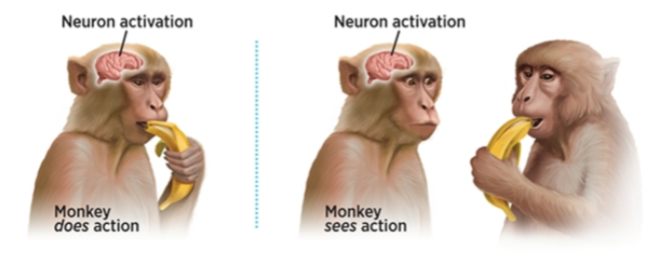
Mirror Neurons. People have a natural capacity to understand and predict other people. This same capacity does not exist with machines (though one time I beat a rock paper scissors neural net with 5 wins, 7 draws, and 0 losses, presumably because it was acting on data from real people). Machines can be way more perfectly random than people. People are very bad at being random.
It’s been shown that humans have a limited ability to predict the actions of other humans under observation, believed to be facilitated with Mirror Neurons, Neurons that fire both when you do something, and when you see someone else do something (or even if you think they’re going to do it, but don’t realize you think it yet). When you expect someone to do something, neurons in your head fire, but you don’t have conscious access to these, rather they bubble up into your conscious mind as a prediction.
There are some people who have no ability to predict other people, and just choose what they think the most unlikely thing is, like Mew2king. There are others who get inside the other person’s head, like PPMD, Mango, or Daigo. Fun fact, autism is suspected to be at least partially connected to a deficiency in mirror neurons (Editor’s note: History hasn’t borne this one out. Mirror Neurons are mostly considered kind of a dead-end these days).
A mind game is about watching people’s responses to situations, then choosing the response that beats theirs in that situation. A mindgame is about conditioning another player to respond a certain way to a situation, then changing it up on them at a critical moment. Repeat conditioning causes people to act pre-emptively and worsens their reaction time for unexpected stimuli.
Mindgaming is about knowing common reactions to certain situations and preying on those or setting up those situations at a critical moment to eke out a win. The thing is, when you’re playing someone else, they’re adapting to you too. So you need to update your log of opponent reactions as they change their pattern or anticipate when they’re going to change their pattern based on what you know about the player’s adaptation speed.
The difference between a read and a reaction is speed. When you read, you act pre-emptively. For this reason, reads are stronger than reactions, because you have more time to get stuff done, but you sacrifice accuracy. When you read, you’re flying blind.
Emukiller was the dude who taught me to react more in Smash. A lot of scenarios have 100% solutions, but only if you react. If you read pre-emptively all the time, then you’re liable to get screwed up when you could have covered all possible outcomes by just reacting. It’s up to you to figure out what the limits of your reaction time are to determine what’s reactable and what’s not.
This combo video is good for emphasizing mindgames. Notice how Darkrain moves preemptively of his opponent’s action. He’s there ahead of his opponent. He knows what they’ll select.
And this is probably the most clear example of a mind game you’ll see all day: https://www.youtube.com/watch?v=qF2S9KeaO2M (for those wondering what it did, it made Combofiend afraid to act and more defensive, allowing Mike “Mike Ross” Ross to get in and pressure him for the KO)
Try playing someone worse than you and beating them just using basic options. I frequently beat beginners using nothing but light attacks in street fighter, or only sweeps, or only crouching strong. If you know exactly when to throw a move, then unless there’s a pure counter for it, you can win every time, even if it’s a bad or unsuitable move. Knowing when to throw it involves reading. Try this versus a friend who is bad to see what I mean.

 Celia Wagar's CritPoints