What Should be Prioritized in a Fighting Game?

What should be prioritized in making a fighting game? Is balance near the top?

The way I like to put it is, Balance is the least important thing that is still important. It’s way more important for the game to be fun than for it to be balanced.

In terms of sales success, I’d say it’s important to have a lot of characters and good single player content. Also looking good is a big factor.In terms of making the game good, it’s about making Rock-Paper-Scissors loops. It’s about making it so there’s a good web of these RPS loops going around everywhere, so you can beat everything in a couple different ways, usually varying by scenario. Continue reading

How to Perform Fighting Game Motions

A lot of beginners have trouble understanding exactly how the motions are supposed to be performed in fighting games, it can be tricky to understand without being shown in person. I’ve seen a lot of people interpret a dragon punch motion like this before:

1421373662196.png

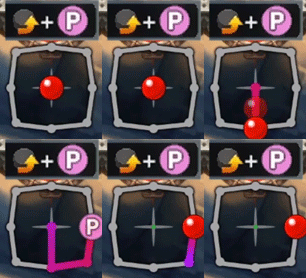
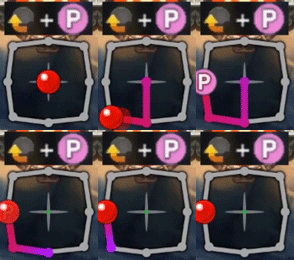
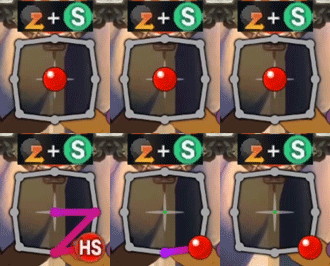
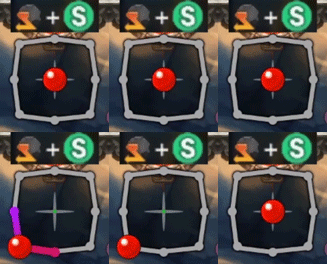
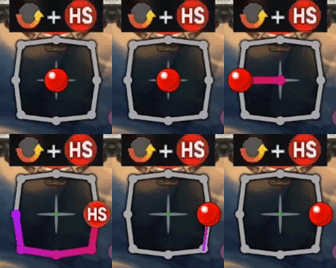
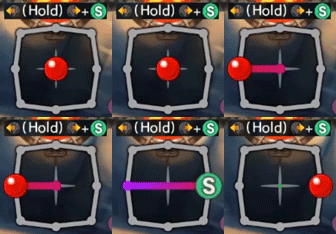
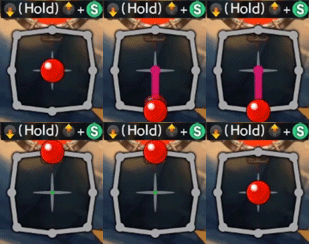
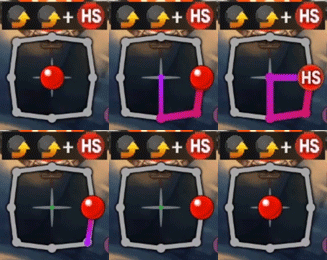
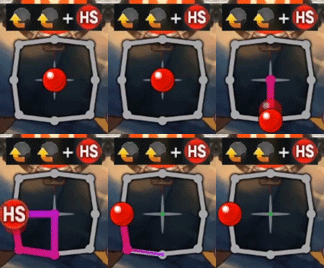
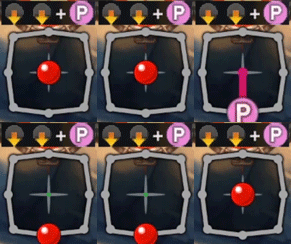
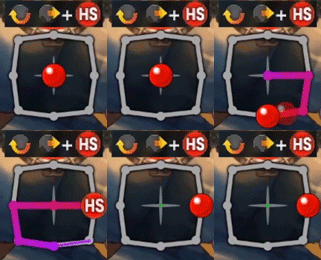
Guilty Gear Xrd Revelator has a great combo trial move that starts off by showing you the motions of every character displayed on a stick, with your inputs juxtaposed directly below the example, so you can compare your inputs to theirs. It even shows when the button is pressed, so you can see that too (more useful if you’re trying it yourself, but still).

This helps side-step a lot of the issues beginners have with learning how to do motions and learning notation. Unfortunately, not everyone has access to Guilty Gear Revelator, so not everyone can learn this way.

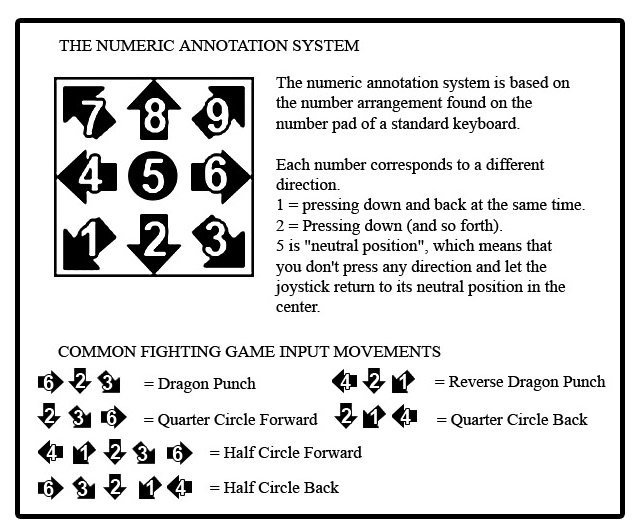
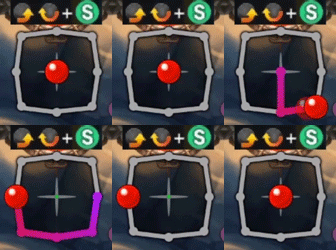
To remedy this, I made gifs of each of the combo trials, with the corresponding motion listed above, so you can have a visual reference for how to do different motions. The buttons are random, whatever I had available from the guilty gear movelist, so please pay more attention to when the button is pressed, rather than which button is pressed. I’ll also list how it’s usually written in notation, so you can be familiar when you run into it. It’s also worth mentioning, all of these assume you’re facing right. I’ll even list them in numeric notation, which is a way of unambiguously specifying which directions you’re pressing. Here’s an explanation of that:

https://pbs.twimg.com/media/DSPIPG3X4AAibPX.jpg

The red ball indicates where your stick/dpad is currently pointing, with the center being neutral, and the 8 dots around the sides being the 8 directions you can point.

If you’re looking to get more into fighting games, consider reading: How to Pick a Fighting Game Character and How to be a Good Fighting Game Community Member

Quarter Circle Forward / QCF / down, down-forward, forward / d, d/f, f / 236

QCF.gif

This is the most basic motion. This is the basis of all the other motions. It’s called a quarter circle, because if you look at the 8 directions you can point in as a circle, it’s 1/4th of the circle. This motion is in every fighting game.

Quarter Circle Back / QCB / down, down-back, back / d, d/b, b / 214

QCB.gif

Same as the QCF, except backwards. You can use a lot of moves just by knowing these two motions.

Dragon Punch / DP / Z-Motion / forward, down, down-forward / f, d, d/f / 623

DP.gif

This is the second most common motion in fighting games, and a stumbling block for a lot of beginners. You’re allowed to input it a bit sloppy, like 63236, just be sure not to accidentally do a double QCF in the process, and to complete the motion before you press attack. 6523 is also a valid way of inputting dragon punch.

Reverse Dragon Punch / RDP / back, down, down-back / b, d, d/b / 421

RDP.gif

Same as the Dragon Punch, but backwards. This motion is really uncommon, but it shows up occasionally, and it’s always bizarrely harder to do than a regular DP, even though you’ll be used to doing DPs on both sides from normal play. This gif also shows off a sloppy way of inputting the DP, 4121, instead of a clean 421. And it’s input a lot faster than the others, showing you can do the motions quickly and they will still come out. 4521 is also a valid way to input a reverse dragon punch.

Half Circle Forward / HCF / back, down-back, down, down-forward, forward / b, d/b, d, d/f, f / 41236

HCF.gif

Less common than a DP, but more than a reverse DP, half circle motions can be  significantly trickier to perform than quarter circle motions, even though they’re only slightly different. These motions are typically used for moves meant to have a bit more impact than a quarter circle move.

Half Circle Back / HCB / forward, down-forward, down, down-back, back / f, d/f, d, d/b, b / 63214

HCB.gif

Same as the Half Circle Forward, just backwards. These are frequently used for weaker command grabs.

Charge Back-Forwards / back (hold), forwards / [b], f / [4] 6

charge-bf.gif

Charge moves involve holding back for about a second, then tapping forwards and a button. They’re usually a bit stronger to make up for this charge time. You can also hold down-back to charge without moving backwards as you charge. Moving the stick to a position that isn’t back will cause you to lose your charge however, so you need to be either immobile, or walking backwards to charge.

Charge Down-Up / down (hold), up / [d], u / [2] 8

charge-du.gif

This charge move involves holding down, then tapping up and pressing attack. Note that if you’re too slow to press attack, you’ll do a jumping attack instead of your special move. Like with charge back-forwards you can hold down-back to charge and block at the same time. This will charge both charge moves simultaneously, so you can choose to use either one. In Guilty Gear, you don’t even need to press straight up or straight forwards to perform charge specials, you can instead press up-back, or down-forwards, letting you hang onto the other charge.

Double Quarter Circle Forward / 2QCF / QCF QCF / 236236

2QCF.gif

This is the most common super input in fighting games. It’s as simple as doing 2 QCFs back to back. It can be rather tricky, and frequently you can get Dragon Punches if you’re sloppy, or get supers if you’re sloppy with your dragon punches.

Double Quarter Circle Back / 2QCB / QCB QCB / 214214

2QCB.gif

Same as double QCF, just backwards. Also a really common super input.

Down Down / 22

downdown.gif

Tap down twice, simple as it gets. Uncommon input in most games, very common in games by French Bread, such as Melty Blood. Frequently used as an alternative to the DP input.

Half Circle Back, Forward / HCB F / 632146

HCBF.gif

This is an extremely uncommon input found only in Guilty Gear, Blazblue, and King of Fighters really. It’s frequently used as a super input in these games, and for command throws.

Quarter Circle Forward Half Circle Back / QCF HCB  / 2363214

QCF-HCB.gif

Another uncommon input except to those 3 games. This is only used as a super input. It can be tricky, try your best.

360 / SPD / 6248

360.gif

A fairly common input, limited to grappler characters usually. Even though the instructions generally say to spin the stick 360 degrees, the game actually only cares if you hit all 4 cardinal directions (in any order you want, as long as it’s a complete rotation). An easier way to perform this move when you’re learning it is to do a half circle back, then tap up. Since you need to tap up at some point during the input, if you’re too slow to press punch, you will jump. This means it’s generally easier to do 360s when you’re already jumping in on your opponent, or dashing, or doing some other action that will prevent you from jumping.

High Risk, Low Reward

What do you think of fighting game reversals?

They’re cool. They’re a very rare feature of games, something that’s high risk, but low reward, however still being a critical part of a rock-paper-scissors triangle. You get to beat the opponent’s attack or throw, but if blocked, you take more damage than you ever would have dealt.

It’s your only want to beat an opponent’s meaty in a wakeup scenario, the only way to really hurt the opponent instead of just sitting there and taking pressure, but it also carries a big risk.

The downside of conventional reversals, DPs, is that only some characters have them usually, so the rest of the cast just needs to sit there and take it when pressured, and they’re kind of simple. They either beat a meaty, or lose if the opponent blocks. Not the most nuanced range of interactions. It would be cool to see more investigation into other reversal options, like reversal tech rolls, reversal counters, etc. Some games like Blazblue and Smash have more options on knockdown to make their wakeup games more complex, which is also cool, but also feel like they dilute the wakeup game a bit from where it sits in street fighter. I’m not really sure how to balance this honestly.

Still, it’s neat to have something that sits in an unconventional place on the payoff matrix. (as long as it’s not low risk, high reward) It’s rare to see things that are so specialized in that way.

Leveling the Playing Field for Unskilled Players

Is it possible or necessary to level the playing field in fighting games between skilled and not skilled players?

Nope to both.

The only way you can level the playing field is by making skill less influential on the outcome of the game. You can do this either by reducing how difficult the optimal outcome is to produce, or by reducing the amount of advantage conferred by the optimal outcome relative to the least optimal outcome. Or you can do this by having randomness be a much stronger determiner of who actually wins the game.

Of course, all of these things will piss off skilled players. You might have some limited measure of success depending on the implementation though. I’ve been arguing that randomized bullet spread has been bad for years and should be replaced with damage dropoff relative to distance to get the same effect and I don’t think anyone agrees with me on that. Continue reading

The Pain of PC Fighting Games

What do you think of this? Should fighting games move to PC to get the sponsorship bucks and move out of the kiddie pool?

There’s an additional issue he didn’t address, the difficulty of setting up controllers on PC. Individual users don’t tend to notice it, because they’ve set up their PCs to run their controllers just fine, they’re not having a conga line of people over to each individually plug in their controller of choice and somehow make it work with the operating system and then with the game.

Continue reading

Fighting on Pad vs Stick

What kind of fight stick/gamepad do you use for fighting games, and why?

I use a Dualshock 3. I mostly use it because it’s what I used when I started playing fighting games (although technically I first used the Wii Classic controller for SF2 Hyper Fighting and Guilty Gear XXAC), and because I really like having a good Dpad in the top position.

Pad means my inputs are mostly silent, and I have very good control over my movement, but not quite as precise control over my directional inputs as I might get on stick. It also means that I have difficulty pressing square + triangle or cross + circle and need to bind macro inputs for those usually, as well as R1 + R2.

If I had a consistent way to, I’d ideally use a dualshock 2 controller. Unfortunately my converter is spotty, so that’s not really a viable option (which sucks, because the converter I bought is known for being reliable too). Probably the biggest downside of the DS3 controller is the analog trigger. It doesn’t feel very comfortable, and it’s difficult to know what distance actually triggers the actuation, but I have gotten used to it over time. The DS4 trigger is much more comfortable, but the actuation distance is further, so it throws off all my timings when I use a DS4 pad. Dualshock 2 has a digital button for the trigger, which is highly preferable. Both the DS2 and DS3 have very rough Dpads, and I have actually rubbed my thumbs raw multiple times playing fighting games. I eventually sanded down the dpads to get a smoother surface to play on. The DS4 starts out smooth, avoiding this problem.

I own a Hori RAP4 fight stick. I tried using it, but didn’t stick it out or put the time in to really get good with it. I hold the stick with the same grip as Daigo, from the bottom, between the ring and pinky fingers. I have a lot of difficulty canceling into 2QCF supers or shoryukens on stick. I still hang onto the stick to let other people use it, and I’ll probably learn to play on it so I can play on arcade machines someday.

I think 360 inputs are probably the hardest input to perform on pad relative to stick. Sticks are much better at half circle motions in general, where I think pads are better for DPs and QCFs. Some older games (like 3rd strike, and older versions of guilty gear and blazblue) only count the cardinal directions as valid for their 360 and half circle motions, so if you miss the down input in a half circle back, (6314 instead of 63214), it won’t read your input. (624 does count as valid, it does not care about the 3 or 1 directional inputs) This can happen by doing the motion too fast on pad, where on stick it’s basically impossible. I learned how to do 360s in 3rd strike only after I went into training with input display and realized this was the case. My technique for doing them on pad is to do a half circle back, then tap up and punch, greatly improving my consistency. Modern games like SF4 and SFV let me churn the butter without needing to worry about inputting the cardinal directions accurately.

What are Option Selects?

Can you define what option selects are in fighting games, what they do, and why they are useful? I looked them up on Google, but I still can’t seem to grasp the concept of them.

Sorry for answering late. An option select is when you input one thing that can have multiple possible resolutions depending on what your opponent does.

Probably the most common type of option select in fighting games is one where the move will situationally have two different effects depending on what happens. For example, in 1 button fighting games, you can either throw by pressing forward + attack, or with that same input, just get an attack. In KOF in particular, across every single KOF game, it’s always been possible to option select between throwing, and some fast close range attack, because either your C or D (KOF’s two throw buttons) has a close range version of the attack bound to that button which comes out extremely fast. So if the opponent is throwable, you get a throw, if they’re not, you get a fast and powerful attack.

Another common type of option select is inputting additional actions that will get eaten depending on whether your first input comes out or not. For example, in Guilty Gear Xrd, you’re allowed to Yellow Roman Cancel command throws, but not Red Roman Cancel them. This means if you do a command throw, you can input the cancel, and it will cancel if you miss, and not cancel if you hit. So if you can cancel them when they miss, this means you can do something else immediately after they whiff, such as jump and attempt an air throw, meaning you can run into someone’s face, and either get a grounded command throw or an air throw, you’re throwing them on the air and ground in extremely short succession, and whichever one connects will continue. This is effectively an unblockable.

Another version of this is inputting things during hitstop. Hitstop puts your character in a state where you cannot act. By inputting when this time would happen, you’re making it so you’ll get actions if you fail to hit, but won’t get actions if you successfully hit. You can use this to situationally follow up depending on whiff or hit.

Hitstop also has another function, acting as the cancel window for special moves. In some games, hitstop is actually different on block and hit. This is EXTREMELY DANGEROUS! If hitstop is longer on hit than on block, then people can precisely target that interval where hitstop is longer and try to time their cancel for right then, because on hit, they will successfully cancel, and on block, they will be inputting too late to cancel. This means you can commit to risky special moves only on hit, making your moves way more powerful without risking anything. In an earlier version of SFV, Ken had this issue. I heard it also existed in MK9.

In a way, special move canceling by itself can be viewed as an option select, since you’ll cancel on hit/block, but not on whiff. Once you realize this, you can poke with cancellable normals, and time your special move buffer on them so it’s done before the move recovers. Then you can use that special move slightly outside where your opponent is standing to catch them if they move forward and therefore cannot block.

Option selects can occur anywhere where one input or sequence of inputs can be interpreted as 2 possible outcomes. Learning to look for cases like this is very tricky.

These aren’t very common in Super Smash Bros, because there’s almost no cancels in Smash Bros, and moves tend to only have 1 consistent effect regardless of what situation they’re used in. The amount of hitstop on whiff, hit, and block are different, but this doesn’t tend to actually be useful for creating option selects in the smash series. There are cases that are very common however in smash bros where you can position yourself in such a way that regardless of what option your opponent picks, you can react to it and perform the counter option. Smash Bros fans call this option coverage. You sometimes see commentators mistakenly call it an option select, but it’s not the same series of inputs every time, it’s the person consciously changing which input they’ll use based on what they see.

One example of a true option select in Smash Bros is in Project M with G&W. Game and Watch’s throws are all identical in appearance, so you never know which way he’ll throw you. He gets his best followups off down throw, but you can defeat that easily by inputting a tech right before his throw ends. This means that regardless of whether he actually down throws you or not, you will always tech it.

Another one has to do with meteor canceling. There’s actually 2 ways to meteor cancel, jumping, and up B-ing. There is an 18 frame lockout window after being meteor’d and trying to input too soon will lock you out from canceling, but jumping and up B both count independently from each other, so you can try both instead of just one. So if you get meteored, you can input jump first, then up B immediately afterwards, and if you screw up the first one, the second one might work.

I hope this makes it more clear. Option selects can be really really varied across games. Guilty Gear Xrd used to have one where you could mash roman cancel during combos between 25% and 50% meter, and it would automatically cancel your combo if your opponent bursted out, because they were no longer counted as being in hitstun. This means if they don’t burst, your combo continues, but if they do burst, you instantly YRC, making you safe from their burst. This was later fixed.

Consistency of Skill in Fighting Games

What do you think of consistency in fighting games? If fighting game players are consistent/not consistent with their results in tournaments, is it necessarily a bad thing?

It’s tough. Consistency is a mixed blessing is about all I can say after some deliberation on the topic.

We have two case examples, SFV where players are allegedly really inconsistent, and Melee where players are super consistent. Continue reading

What Makes a Character Annoying?

What makes a character in a fighting game/ enemy in any video game annoying to fight against as opposed to being fun? What’s the best way to avoid making something in a videogame annoying to deal with?

I don’t tend to get annoyed by characters very much. I used to get annoyed by sheik, I got annoyed by how one specific guy played Chun Li against me in 3rd strike (would rely almost entirely on lows and jump-ins + chun’s 3HK, was good AA practice, but it bothered me that he wasn’t understanding the game).

I’m currently a little annoyed by Millia, in that she can do a corner carry combo into tandem top, mix up on okizeme and repeat the process if she guesses right. I’d rather deal with Urien, and he has unblockables.

I’m a bit annoyed at how my friend plays Terumi in BB, just using 6C and throws. 6C is unsafe as hell, but it’s high priority and damaging as fuck, and ends in knockdown, so I get caught by it all the time, and he mixes up between it and throw and for some reason I just can’t force him to play honest. Continue reading

Tekken 7 Overview

Have you played Tekken 7? If so, what do you think of it?

I’m playing it now, I’m still learning how Tekken works, not really having any 3d fighting game experience and I think I’m starting to get it after a lot of studying, guide reading, and a little play with friends and ranked netplay.

Like, the framedata is REALLY different from the fighting games I’m used to. Nothing faster than 10f startup? Different inputs? Everything except jabs is minus on block? -13 is mostly safe? Block in the standing position by default with lows and throws being the reaction tester guard break options? Pressure with jabs is real and loops into itself, but it can be ducked and whiff punished? Continue reading