Fighting Game Alignment Chart

How would you break down the many different fighting game playstyles such as rushdown, turtling, zoning, or any others you can think of?

A friend of mine (ClarenceMage) came up with a really brilliant way of separating it out actually.

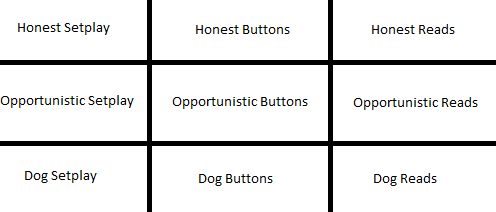
fighting game alignment chart.png

The idea is you have these two scales: Horizontally, you have a scale between Game Knowledge (left) and Player Knowledge (right). Vertically, you have a scale between Safe Guaranteed Play (top), and Risky Unpredictable Play (bottom).

Setplay revolves around setting up situations and capitalizing off of them. Setplay is highly reliant on game knowledge, it’s all about knowing the game better than your opponent. Examples of setplay players would include Armada (Honest Setplay) and Marn (Dog Setplay).

Buttons is about winning the footsie neutral game. It’s player knowledge, part game knowledge, so it falls somewhere between setplay and reads. You gotta know a bit of what your opponent is thinking, but also a bit of how to use your options best to win. Examples of Buttons players would be Hungrybox (Honest Buttons), PPMD (Opportunistic Buttons), and Infiltration (Dog Buttons)

Reads is about knowing your opponent’s tendencies. It’s about attacking at just the right time in just the right place. It relies heavily on player knowledge. Examples of Reads would be Snake Eyez (Honest Reads), Mango (Dog Reads) and Daigo (also Dog Reads).

Playing Honest is about sticking to guaranteed setups with a small chance of failure. Honest players tend to mix in a variety of approaches instead of pursuing a single gimmick and play according to what has the best odds of success. Honest players are the ones that almost always block low on wakeup or tech neutral. Honest players can have this tendency towards safety taken advantage of, but tend to have very consistent performance to make up for it.

Playing Dog is about going for what works and throwing caution to the wind. It’s about dogged persistence to win the way you want to win. Dog players tend to go for high risk high reward options or get killed trying. Dog players will ultra on wakeup, shoryuken in your face, charge the fsmash in the direction you’re about to roll, go offstage for the gimp.

Playing Opportunistic is a mix of Honest and Dog, trying to adapt to how the opponent is playing at that moment, seizing opportunities to grab just a bit more advantage where you can, but sticking to what you know works when the going gets tough. Opportunistic players are flexible, but can psych themselves out trying to follow their opponent’s patterns and be in the wrong mode at the wrong time.

Of course, there are a lot of ways to divide playstyles or categorize them. If you want to get deep down, it comes down to the player’s tendencies to use some options over others and the frequency of that option use, and you can’t totally quantify that.

Stunning Detail: Hitstun in Depth

Not sure if there’s much to talk about on this subject, but care to do a writeup on hitstun in videogames?

Hmmmm, yeah, there’s actually a bunch that could be talked about I think.

The big factors are interrupting attacks, advantage time, and pushback. Other things are knockdown, juggles, counter hits, meaties & multihits, special hitstun states, dizzy, recovery options out of hitstun, control during hitstun, hitfreeze, super armor, no hitstun, and blockstun.

The single biggest thing hitstun does to a game is it allows one character’s attacks to interrupt another character’s. This means a lot. It means that the first person to attack will win, which means you don’t always want to throw out an attack because your opponent might be attacking first. It also means you can’t just attack repeatedly, because eventually your opponent will interrupt you, assuming you can’t infinite them.

Advantage time or frame advantage is basically the difference between when you recover from your attack, and your opponent recovers from hitstun. If you recover first, then you are said to be plus on hit. This is noted as +# where the number is the amount of frames you’re up on your opponent. If you recover second, you’re minus on hit, noted as -#. Being plus means you get to act first, minus means you get to act second. The more plus you are, the sooner you can act, which means you have a higher chance of winning if both of you attack at the same time, and you can afford to throw slower moves since they effectively have less startup time relative to your opponent. If you’re minus then it means your opponent can act that way towards you. Going minus means surrendering initiative to your opponent. If you’re minus enough then it is even possible that you could be hit back by your opponent. Personally I consider it a flaw to allow a move to be minus enough on hit that you can be punished by your opponent. This is fine on block, but on hit it’s unacceptable. If you’re plus enough on hit to have enough advantage time to fit the startup of another move in, then that’s a combo. If you’re plus enough on hit or block to deny your opponent enough time to start up any of their moves, then that’s a frametrap.

Next up is pushback. Pushback is related to frame advantage because if you push something far away enough, then frame disadvantage becomes safe. I suggested with a theoretical 3d zelda that it should have low hitstun and high pushback, so you’re giving initiative to the monsters with each successful attack, but you’re never unsafe to their attacks. The more pushback there is, similarly it becomes harder to follow up when you get frame advantage. This can help keep combo systems in check.

A basic example of this is the smash bros knockback/hitstun system. In Smash Bros, attacks do a certain amount of knockback based on the attack strength and percent. The number of frames of hitstun is the knockback value times 0.4. This means you’re gaining more advantage as you push opponents further away. Eventually you have a ton of advantage time, but can’t catch up with them.

The exception to the rule in Smash Bros is meteors or spikes into the stage. These knock off 20% of the knockback, but keep the hitstun the same. So in Smash the general key to building combos is to at first hit opponents with attacks that have a quick recovery at low percent, then ones with good knockback and good recovery at mid percent, then ones with weak knockback to keep opponents close to you at high percents, then kill them with something really strong.

Knockdown isn’t generally considered a state of hitstun, but it’s pretty similar in a lot of ways. Players or enemies aren’t allowed to act during this state, and it’s generally harder to attack them. In some games they’re entirely invincible until they get up (dark souls, most fighting games). In some games they can be hit, but they take less damage and aren’t sent into a new stun state, effectively having super armor. In some games they can be combo’d off the ground by certain moves, which may have penalties to combo damage or generally be less convenient. In some games the attacking player is allowed to perform special finisher moves on knocked down opponents. In some games the player (or enemy) who is knocked down has multiple options for getting up, like rolls, or getup attacks. Knockdown generally serves as a longer special state of hitstun where opponents can’t do as much, and you can use them being knocked down as setup time to hit them when they get up.

Meaties are when you hit someone with the late part of an attack on purpose. In most games, attacks do the same amount of hitstun no matter what part of them hits, so hitting with a later frame of the attack means you get more advantage time. This is especially noticeable with rushing attacks where a character moves across space with a hitbox out. By hitting with the late portion of an attack, it’s possible to do new combos, or make attacks safe on block with good timing or spacing. Slow moving projectiles can have an effect similar to meaties at a range by allowing the user to recover and move up behind the fireball before it hits.

Multihits are related to meaties, because they’re kind of the opposite of them. Multihit attacks hit with many hitboxes over a period, each one dealing its own hitstun. Multihit moves get a consistent amount of hitstun no matter what part of the attack hits, but they keep the opponent locked down for their duration. This means multihit moves can never be unsafe by hitting with an early portion of the attack, and they usually go on long enough to give the player time to confirm they’re hitting. Fox’s dair versus falco’s dair is a good comparison for meaty versus multihit, except that Falco’s dair is one of the rare examples of a hitbox that stays out for a long period that actually decreases in hitstun the longer it stays out. Jigglypuff’s pound might be a better example.

Some games have special states for hitstun, like in some fighting games such as guilty gear, skullgirls, and third strike, you can hit your opponent reeling back, which makes them vulnerable to throws and command throws, which they normally aren’t during hitstun. Another example would be the dizzy state, where upon hitting an opponent enough, a meter fills up that when full causes the opponent to enter a prolonged state of hitstun, giving you enough time to set up whatever attack you want before they recover. If the opponent is player controlled, then usually they’re allowed to mash to speed this animation up. In Dark Souls, some bosses have special states similar to dizzy once they take enough damage, like the iron golem who can be knocked off balance, or a bunch of bloodborne bosses who will let you visceral attack them once hit enough. Some bosses also have tails that can be cut, triggering a special hitstun when they are. Guard Crush is similar, except it’s triggered when an opponent guards too many attacks, or has a specific guard breaking attack performed on them. This sometimes also awards bonus damage to the attacker (like in dark souls 1) or allows a special followup (dark souls 2 and 3). In the Souls games, The Last Blade 2, Nioh, Soul Calibur 1, and Guilty Gear Xrd you can parry your opponent to put them into a special parried state, which sometimes allows specific followups and in the case of Soul Calibur 1 and Xrd, they can parry you back during this state, at risk of being punished. Guilty Gear has a couple more special hitstun states in the form of the ground slide and wall stick. In some games you can set up special hitstun states that make the enemy weak to certain attacks, like freezing an enemy in metroid prime, then shattering them with a missile.

By far the best known type of special state for hitstun is juggles. Juggles are like an extended state of hitstun, except they have more timing involved than normal hitstun because you gotta time your attacks to hit the enemy on their way down. Juggles can be affected by enemy weight, gravity, or air drift. Juggles can have a lot of different potential trajectories and make use of things like ground bounces or wall bounces. Characters can even follow those being juggled into the air in some games to wail on them up there. The dynamics of a juggle are typically that you need to keep them in the air, or they simply fall into a knockdown or ukemi. Juggles are limited in some games by the natural ending of combos and progressive gravity. In some games characters are capable of “air teching” juggles to return to a neutral state. In God Hand, enemies will flip out of juggles at a slightly randomized angle.

Recovery options out of hitstun are relatively unexplored for most single player games except for the god hand example above. In a number of fighting games (smash, darkstalkers, marvel, blazblue, SFV) you can tech knockdowns to get up faster or roll in different directions. These typically have different amounts of invincibility associated with them. In God Hand, enemies can also block during normal hitstun, but cannot during counterhit/guard break hitstun.

In Bayonetta, enemies are allowed to attack directly out of hitstun, unless it’s a juggle or witch time. In many action games it’s possible to tech the landing or do a getup attack when you’re knocked down. The more recent soulsborne games let you roll out of knockdown, but have less invincibility on knockdown in general. Arc Sys games allow players to air tech from juggles, but the combo can continue if they don’t as an invalid combo. The Smash Bros example is interesting, because it’s possible to beat every option on reaction in what’s called the reaction tech chase. The option your opponent will go for is clear on frame 19 of the animation, allowing you to jab reset if they missed the tech, grab on neutral tech, and dash left or right and grab if they rolled. This might be an interesting avenue for a single player game to pursue in their hitstun design, allowing enemies different ways out of hitstun that sit at the periphery of human reaction time, so you can follow up your combos if you react perfectly. This could keep combos more active and engaging. Some attacks in some games can deal “hard knockdown” which is untechable.

Hitfreeze or hitstop, or hitpause is a short delay that happens at the moment of impact to both the attacker and target before hitstun plays out. In most games this isn’t very serious. In Smash bros you can actually jiggle and move yourself around during this period. In a lot of older games hitfreeze is applied instead of hitstun and only to the damaged enemy. Meaning that hitting an enemy will temporarily freeze it, but will not interrupt what they were doing. This can have a hitstun-like effect, but since it does not interrupt the enemy’s action, you are more vulnerable to what they do. This works well in older games and ones styled like older games because they were more about enemy movement patterns with collision damage on touching you rather than telegraphed attacks, so you can attack them to freeze them temporarily and hold off their assault for a bit in something like a pseudo-combo. The bottle in Castlevania 3 inflicts so much hitfreeze it can stunlock enemies.

Super armor allows characters to ignore hitstun, especially if it’s only for one hit, or below a certain threshold. In most fighting games, super armor works per-hit, so you absorb a certain number of hits before taking hitstun. Skullgirls is a notable exception, as well as smash bros which has multiple types of super armor that all do not follow the per-hit rule, knockback threshold and knockback subtraction armor. Armor that can take an infinite number of hits is called heavy armor. The souls series came up with their own concept of armor called poise, turning hitstun into something similar to a dizzy meter. Once the invisible poise meter is depleted, the target will take hitstun until the meter refills, and the combo ends.

Some attacks, particularly ranged attacks, deal no hitstun, like fox’s lasers and FANG’s poison ball. This is kind of interesting for low startup low damage attacks in systems that normally have hitstun (unlike say FPS games which do this, but don’t normally have hitstun, so there’s no contrast there).

In some games, like most modern fighters after SF3, counterhits, meaning attacks that interrupt an enemy’s startup or active frames, deal extra frames of hitstun. This means that new combo options open up if you can interrupt an opponent’s attack. This is primarily useful for frametrap strings, because the intent is to catch the opponent mashing buttons during the string, at which point the frametrap suddenly becomes a combo and it can serve as a confirm into a longer sequence. In God hand, counter hits carry special hitstun and juggle properties depending on the move. In SFV, certain normals can crush counter opponent’s attacks for bigger combo damage. In Souls games counter hits have no special effect on hitstun, but deal more damage. In Blazblue there are Fatal Counters and Counter Hit Carries. Fatal Counters add 3 frames of hitstun to every subsequent attack in the combo, making comboing off any move more easily. Counter Hit Carries are a property of most multihitting moves, making every single hit of the multihit a combo so there’s frame advantage at the end of the multihit sequence on the last hit, making it more easy to combo off that. In SFIV the level 1 focus attack will cause crumple on counterhit (another special extended hitstun state).

Blockstun is like hitstun except obviously you block the attack. A lot of the same rules of frame advantage apply, though the rules for what you can do out of block may be different per game, like in Smash it takes 15 frames to drop a shield, however you can grab out of it or jump out of it immediately, and your opponent is almost always negative, so the different options out of shield can be a big deal. In games like dark souls, different shields have different amounts of deflection, inflicting special recovery animations on opponents who attack. This is also found in Last Blade 2 for sword attacks versus punches or kicks. In some fighting games there are special blocks like instant blocks in guilty gear which reduce the amount of blockstun taken so attacks can be more readily punished on block, or faultless defense which increases the amount of blockstun along with pushback and prevents chip damage. Smash has similar to the faultless defense with its light shields that increase blockstun and pushback, also its perfect shields which can be canceled directly into actions or in later smash games negate shield drop time.

I think that’s everything I can say on hitstun. All of these are different factors that can be tweaked, tuned, combined, or experimented with to make different effects.

Saurian Dash did an amazing exposition on hitstun states for Transformers Devastation that shows some of how this information can be applied practically to a game. He calls these hit reactions, and later refers to “hitstun” as a special type of hitstun, akin to dizzy in fighting games.

This video shows how hitstun states can be varied between enemies to give them variety.

Counter Picking

What are your thoughts on counter picking?

What part of counterpicking? People who counterpick? The strategy? Games that facilitate it?

Well this came up just after an Overwatch ask, so I think I’ll talk about counterpicking in that. I’m in favor because it means that first off, there is a natural counterbalance to good team compositions, without having to get stuck in a bad matchup for a whole round. Second, sure all the characters are kinda simple, but you get to switch between them frequently so it kinda makes up for it in variety, because they’re fairly dissimilar. Third, there’s an actual extra strategic layer in counterpicking that happens over the course of the match, which is pretty neat.

As for counterpicking in general as an honor sort of thing. There’s no shame in it, it’s another part of the game. If you know your opponent favors a character, there’s absolutely no shame in picking one that beats their common choice. I did a $100 money match with a friend of mine once, and I went entirely Snake instead of my main character Marth. Play to win. With that same friend on another occasion, we did an draft pick Iron man competition in 3rd Strike, where we went back and forth picking characters from the roster. On my first turn to pick, I snatched his best character, Q, and was sure on the second turn to grab my best character, Ken, before he realized that this was the optimal strategy. I didn’t need Q to win, I only needed Ken, but I grabbed his best resource, where I could fall back on a bunch of characters. If counterpicking is the right strategy, go for it.

So sometimes you come up against an opponent that gives you a tough time. You have a bad matchup against their character. Maybe this is a recurring thing, maybe you play Ice Climbers and run into Peach a lot. Should you counterpick? The answer here gets a lot more fuzzy. In fighting games, getting good with a character is a big investment. Being good enough with two characters to be able to pull one out in response to your opponent is tough. In the moment you gotta question yourself, “am I actually good enough with this second character to stand a better chance of winning than if I stick with my primary character in a disadvantageous matchup?” Then beyond that, can you adapt to the new character fast enough to play effectively, and can you switch back to your main when the time comes. You might even have a situation like Infiltration at Evo 2015 where he clearly has a massive bag of characters to pull out and it causes doubt during character selection.

On the game design level though, how much should the game be about picking characters before the round even starts? You get competitive card games which are almost entirely determined by this sort of thing, and some fighting games have so many characters that it becomes purely about who can play more of them, which kinda sucks if you’re a mono-main or a beginner. In that respect, keeping the character count down isn’t an entirely bad thing, if it means that people can just choose a character and stick with it, much like how Smash Bros Melee players do. Having options is cool, but you eventually have to pay a price logistically. This can also be aided not just by making the game really balanced, but by preventing any matchups that are 7:3 or worse, however as more characters are added, that’s harder and harder to do while preserving diversity. Higher levels of investment into characters, such as in Guilty Gear, can also lead to players being less inclined to counterpick or stray from their main.

Beginner Fighting Games

Rising Thunder, Pocket Rumble, Divekick, Rivals of Aether… what’s the point of all these “beginner-friendly” games? Traditional fighting games are overwhelming at first, but you have to keep PLAYING them to git gud. Playing these baby games won’t magically make you a KoF/GG/Melee champion.

How many games do we need to dumb-down (oh, I mean, “simplify”) mechanics for scrubs before we realize that they won’t learn no matter what. Also, enough with “we want to explore the strategic element”. You can do that with all these other games that don’t need some 1 or 2-button control scheme.

The point is, I can bust out divekick and get anyone off the street playing in seconds.

King of Fighters can be overwhelming to someone who only plays Street Fighter, Guilty Gear is overwhelming to anyone who hasn’t played an arc sys fighting game before. Playing Street Fighter won’t make you a champion in those games, but it will give you a leg up, and you’ll certainly be able to wreck anyone starting fresh in those games. I know I’ve picked up random fighting games and been able to fight on par with people experienced in them just using fundamentals.

Having a simpler game to learn allows beginners to focus on the few tools they need to win, like fireball/anti-air, like the basics of footsies, meter management, simple combos, and so on. That’s a game that needs to exist in my opinion. If you don’t have games with a greater accessibility teach people the basics of the harder games, then it becomes a lot harder to get people into those harder games.

I’ve gotten people to play traditional fighting games with me and tried to give them the introduction and they were like, “This is cool, but there’s way too much stuff for me.”

How many games do we need to dumb-down (oh, I mean, “simplify”) mechanics for scrubs before we realize that they won’t learn no matter what. Also, enough with “we want to explore the strategic element”. You can do that with all these other games that don’t need some 1 or 2-button control scheme.

People will learn. Releasing new games with simpler control schemes isn’t harming the games we already have. They’re not establishing a new competitive standard. The further point I made is that these games are unique and do things other fighting games aren’t necessarily doing, which by itself validates their existence.

Being bad at a game does not make you a scrub. It does not make sense to write people off as irredeemable when they could potentially learn. If nothing else, these games are a useful tool to me personally, for introducing people to traditional fighting games in person.

These games teach you more with all their additional mechanics. Why regress. If you feel overwhelmed, there’s always the early entries in a respective series (e.g. SFII).

Except SFII is still too complicated for a lot of people, and on top of that, has the worst input read algorithm next to SFI, making it hard to even play the game at a beginner level unless you’re better at special move inputs than you’d need to be in order to play a more complex recent game.

Depth comes at the price of complexity, and sometimes people need a scaffolded experience or they simply get overwhelmed. It’s a regular pattern, beginners have so much to take in all at once to even play the game, they go a ton of rounds fumbling with the few controls they know and mashing buttons.

Simpler games with more straightforward basic functions can help alleviate this and allow people to develop the basic skills to understand the more complex games. Otherwise fighting games become a genre with no entry point, and that’s dangerous.

And there’s also the part where you glorify sub-SFII games like Divekick and Pocket Fighter. These games aren’t really good for learning either, I don’t care how you spin it. How many people have played those games and then seriously taken up more complex fighters? Usually, people get serious about FGs are actually playing with other people (friends, tourneys). Or through their desire to improve. These types of 1 or 2-button games are just gimmicks that become boring after a short period. They might be worth mentioning because their simplicity lets you easily discuss more fundamental concepts in the genre, but that is about the extent to it. I mean, people don’t discuss level design in NSMBW because it’s obviously too difficult, so they stick to the simpler SMB, and that’s fine for educational purposes, but we can’t keep teaching 1+1=2 over and over, nor should we glorify the work of people who think that coming up with 1 (not even 1+1, but literally just 1, which is what Divekick and Pocket Fighter are) is some revolutionary new idea.
Basically, if someone comes out with a sub-SMB platformer (like an autorunner), we ignore it, correct? So why behave differently for fighting games or any other genre? That kind of started as one ask, but turned into another.

Maybe they’re not good for learning? I don’t know yet. I haven’t had a serious chance to test out teaching people through them. So far I’ve mostly just been going with 3rd strike because it’s free and online.

I don’t really know how well they work as an introduction tool. They’re still pretty new. I admit that I’ve barely gotten to play pocket fighter, and never with another person.

I think they’re worth a try. Maybe I’m wrong and they don’t translate into anything. How about we wait and see?

The other thing is, Divekick is absolutely 1+1. There’s a lot more going on in Divekick than in an autorunner. I know it looks simple to you. Even I thought the concept was kind of stupid when I first saw it, but after playing it with other people it clicked and became interesting. Divekick asks a lot more of the player than any autorunner does. There are a lot more “inferential judgments” going on. (totally coining that term on the spot here, might even throw it in the glossary)

It’s like footsies in a traditional fighting game, it doesn’t make any sense to you when you first start playing, so you just mash, then you wonder why the other guy is hitting you more. I know I’ve had many people get surprised when they actually sit down and play divekick with me and realize that there’s a lot more to it than they initially thought.

And Pocket Fighter is more complex than Divekick, so it probably has more complex strategy to it.

The other thing is, fighting games are way more complex than SMB. If you strip away SMB you have something that is barely a game, if you strip away fighting games, you still have something left that is arguably just as complex as SMB.

Getting Unstuck in Fighting Games

When you get ‘stuck’ in a fighting game, like, say, when you play against a character you don’t know how to fight and you just don’t understand how to deal with them because all of the moves of that character seem to have priority or the char. just has better ledge game (in SSB) or this one move you just don’t know how to counter, what is your process for figuring out how to deal with or counter this character (or a certain tactic)?

I almost never get stuck, because I generally have a good understanding of how the systems work. Mewtwo teleports at me, I know I need to have a hitbox on the spot he’s about to appear before he’s there. I’ve worked out plenty of anti-jank tactics versus snake’s grenades and mines. I’ve spiked lucas players trying to tether to ledge for free. I’ve uppercut dhalsim’s limbs. I’ve faultless defense’d Faust’s blockstring pressure into his unblockable (so he can’t run up into it as fast because FD pushes him away further, and since it’s an unblockable, I can’t jump out like with a throw). I pointed out to my friend in KoF98 that Athena’s hard autocorrect divekick was probably really unsafe on block, because it wouldn’t make sense to be safe on block (turns out, yeah it’s really unsafe).

Everything always has a counter. Either you hit them before they do it, you punish them after they try to do it, or hit them in the middle of it. Good understanding of the system as a whole, good expectation of the trends in the system (like knowing which moves are probably unsafe), being able to recognize what happens with the move in different situations, and thereby being able to diagnose the move’s weakness. Like Dudley’s cross counter in third strike doesn’t counter low attacks. I never read a guide mentioning this, I just played a lot and noticed it as I played.

If I’m having trouble with a character, I usually look up guides for the character I’m having trouble against. Learning how they see things from their perspective is helpful because it also includes their weaknesses and what they need to watch out for. Investigation into framedata can be helpful too, as it was with Necalli in SFV, learning that his blockstrings into the stomp special are tighter with the light stomp, but more disadvantageous on block, and have a gap with the heavy stomp, but more neutral on block.

There’s a large number of resources you can potentially look into in order to learn how to beat characters for any popular fighting game.

I recently played PM after a long time and for the first time against a player and how the FUCK are you supposed to fight Marth? ALL his moves have priority over everything I did (not to mention longer range). I could only beat the player using Charizard and his giant-ass hitboxes with flame-tip and claw sweetspots.

Hahaha, that’s funny. Marth has an advantageous matchup against charizard, because charizard’s tail isn’t disjointed and marth can just whiff punish slash it, also because marth gets good combos on floaties and can space against Charizard in shield really well (and charizard already suffers against shield pressure).

I play with the second best Charizard player in the world actually, and as you may know, I main Marth.

Some key things to remember are, priority doesn’t apply to air attacks. Air attacks cannot clank, so forward air from Marth will cut through your hitboxes.

Marth’s big weakness is that he doesn’t have any attacks that come out particularly fast, and his attacks don’t have great recovery. His fastest ground attacks are jab, down smash, and Up B, all coming out on the 4th or 5th frame.

If your friend is spamming SH double fair, you can either move out of the way, then hit him right when he lands (charizard has an amazing dash dance) either with a grab or forward tilt (charizard’s forward tilt is amazing), or move in closer to him and shield on the spot where he’s going to land, so he’s forced to land in your shieldgrab range. These apply to any character.

Marth’s dash attack sucks, can be beaten by shieldgrabbing or just letting it whiff and punishing it.

Marth’s down tilt is his best neutral move because it has amazing IASA frames, so it effectively has a short recovery. Also has a reasonably fast startup of 6 frames. He can usually dash out of it before getting shieldgrabbed, but it’s still susceptible to whiff punishing.

You want to DI marth’s fair chains out, to avoid getting spiked. His up tilt and dash attack have a trajectory that sends you in at Marth, so you’ll want to DI down and in at Marth. Those three moves are how he sets up most of his combos. His grab is normally useful in combos, but charizard is so heavy it rarely comes into play. Just be sure to DI down and away from him when he forward throws you. On lighter characters, he can also down throw as a DI trap into fsmash, so you’ll have to guess which way to DI to avoid getting fsmashed.

His fsmash by the way, has almost no shield pushback, so you can shieldgrab it no problem. If he’s out of range, then let him whiff the fsmash and you are totally free to run in and do whatever you want to him. I do this to a lot of marth players I know are worse than I am when I feel they’re about to fsmash. Just wait at the very edge of their fsmash range, let them miss the attack, dash in an grab.

As charizard, watch out with your dash dance, your tail lags behind you, and can be slashed if you’re not careful.

Any tips for Ganondorf in PM? I wsa using him and couldn’t do jack to Marth until I picked up Charizard. I’m surprised Charizard has a bad matchup against Marth, though that’s probably because the other guy just wasn’t that good. Also the setup was laggy so that might have given fatso charizard the advantage.

Ganondorf, he’s also on the lower tier side like charizard, hard to say how his matchup against marth goes. I think marth still has the advantage. Luckily I alt Ganon. Ganondorf is all about single hits and spacing, Marth is also about spacing and has disjoint. Ganondorf kills in a few hits, Marth has nice combos, though none of his grab setups work on Ganondorf because he’s too heavy.

Basically, you want to hit him when he misses you. Ganondorf gets great followups off his down throw versus marth. At lower percentages, he can regrab (marth can DI forward or behind ganondorf, so turn appropriately to catch him). At higher percentages down throw gets guaranteed followups into fair or bair depending on DI. Ganondorf can’t move that well to whiff punish grab marth, but he can move in on marth forcing him to land in bad positions and be open for a shieldgrab.

Ganondorf has a nice jab, much faster than any of marth’s moves (one of marth’s central weaknesses is that he has no good fast moves), so that can be useful in a pinch.

Ganondorf’s down B can outprioritize all of marth’s grounded moves, but it loses hard to aerials or shield. Side B is good for shenanigans, when you scare him into shielding you, or if he tries to shield while on a platform and thinks he’s safe (since normally you can’t grab people unless you’re on the same ground they are). Air version gets better followups, ground version has better range and can avoid attacks like Dudley’s short swing blow. Ground version can be teched before ganon can do anything about it, air version does a small juggle which ganon can usually at least jab off of before they get a chance to tech. Up B is also a grab and can shenanigan people in much the same way, grabbing them when they think you don’t have the grab option.

Most of the matchup is going to be moving carefully, and poking at marth before he swings or waiting for him to miss a swing and poking him. You’re just gonna have to get used to reading a lot harder and winning neutral more with worse tools. Ganon has nice range on a lot of his attacks, technically better than marth’s on fair, you need to get better at figuring out when he’s going to attack, avoiding it, and hitting him back. You don’t need to win neutral as many times as marth does, because you get bigger rewards for winning neutral.

I beat a guy playing falcon yesterday every single time while I played Bowser. In Melee. If you have good enough instincts, anything’s doable.
Most Unique Fighting Game Characters

Which fighting characters do you think have the most unique mechanics and why? Feel free to elaborate on each character as well.

You realize this list is going to be like, entirely guilty gear characters?

Lemme think.

Eddie comes to mind immediately, because he has control of a character separate from himself whose every move is controlled by releasing buttons rather than pressing them.

Arakune from Blazblue has a similar mechanic, except he needs to curse opponents, then he’s capable of releasing buttons to summon insect projectiles from all over the screen.

Ramlethal has 3d beat em up style attacks on her punch and kick buttons and remote swords that can be deployed and reeled in

Leo whitefang has a mode where he turns backwards and seriously can’t block or throw, but he can dash throw you and has a bunch of amazing normals with throw invincibility, also a counter move that beats your attacks.

Dhalsim, especially SFV dhalsim. There’ve been clones of him in a lot of other games, but it’s still a rare achetype.

Johnny needs to power up his mist finer by using coins that are a limited resource, and he can stick opponents with a cloud that makes his mist finer unblockable.

Crow in Rising Thunder had a super fucked up pressure game where he can continually hit people with normals, cancel them into close projectile tosses, then do a jumpin, mixup, and repeat until he lands a hit and confirm into a combo.

Jigglypuff is a highly mobile, small, short range poke based character. That’s weird by itself, then jiggs has an instant kill move.

Snake can launch projectiles directly on top of himself, plant mines in the ground, and stick opponents to extend combos or kill them, plus has a ridiculously good drill that can be used in combos and for (weak, but scary) pressure.

Bedman can perform moves, then have a duplicate of himself repeat them later on.

Venom can lay down pool balls and get them to rebound off each other.

Robo-ky has a heat meter and spends tension differently than the rest of the cast. Wants to build up heat and keep it close to the top, but also can blow himself up if he overdoes it.

Peacock has a ton of unique projectile tricks and extremely unique combo paths that rely on setting up projectiles to drop mid-combo.

Ice Climbers, they have the craziest chaingrabs, handoffs, desync tactics, and an infinite.

Yoshi. He’s Yoshi.

Peach, hovering and turnip projectiles for the craziest setups you’ll ever see.

Pikachu, just look at axe and capitulize. This character is nuts.

Magneto in MVC2.

FANG, a slow slow projectile that you can’t block, but which poisons you? Weirdness.

Elphelt, stance dancing weirdness, unblockables, grenades.

Beowolf, can hold opponents, carry them around, hype meter, stance/setup weirdness,

Bishamon, reversal-only DP, weird projectile

Fox/Falco

Kevin from Garou, Also B Jenet

Urien/Oro

Vega SFV

Doctor Strange

Phoenix Wright

Hakumen, weird meter, weird combos, weird counters

Juri, weird fireball

M Bison, head press

Zappa

Definitely others in games I haven’t played. Out of space.

Is it wrong for me to criticize 2D fighting games for being too similar? reasoning: they all carry the same fundamentals and to me personally makes less unique. also for the piece do 3D fighters suffer from this at all?

Yes. Stop.

I can’t say anything about 3d fighting games, I don’t understand them, I can’t play them, but you’re absolutely wrong for criticizing 2d fighting games for being too similar.

C’mon, you gonna criticize FPS games for all having the same fundamentals? or RTS? or Beat ’em up games? Platformers?

2d Fighting games are the most diverse genre I know of, because they have nothing else to fall back on. They can’t diversify by having different stories, different levels. Those aspects are barely a part of the experience. So they’ve had to diversify through making the characters and systems all unique.

http://xenozipnotes.blogspot.com.au/2010/08/fighting-game-mechanics.html
http://lowfierce.blogspot.com/2009/01/combat-systems.html

Here’s two lists of fighting game mechanics. These don’t cover what mechanics individual characters have, which would make a new list 5-10 times as long. Do you think there’s another genre with a list this big?

The fundamental strategy in every fighting game can vary a fair amount, between street fighter with a heavy emphasis on the ground game and block/throw, KoF with a faster game pace and a real high/low mixup game due to hops, anime fighters with air dashing and bullshit pressure games but also tons of defensive options, skullgirls and marvel with ridiculous combo games and team composition.

Consider just the range of projectiles in fighting games and the differentiation between how they’re deployed, how they move, and what function they serve. Do you see that much range in first person shooter games? in action platformer games? in Mobas?

Individual characters in fighting games are so dissimilar that people have trouble jumping between them.

Xrd thoughts

http://www.gamefaqs.com/boards/730873-guilty-gear-xrd-sign-/70952891 This thread. Oh Lord.

I was discussing Xrd last night with that friend who’s way better at fighting games than I am.

His sense is that the new characters have a skewed ratio for effort versus reward, except for bedman who is as hard as a guilty gear character typically is. Leo is okay, because he’s easy, but not great as a character, where Sin and Elphelt are just derp.

His other remarks are that Daisuke Ishiwatari being put in charge of Xrd after another guy did AC lead to a lot of dinosaur-like decisions designwise, like danger time being put in because Daisuke liked the button mash sequences in Samurai Shodown. Also the general reversion to a lot of #reload moves which aren’t as versatile and cool as the AC moves.

His other remark is that he hates the Roman Cancel slowdown, because it makes the game more positional, set-play, knowledge based rather than reads and footsies.

His comparison is between how YRC is used in Xrd now to how FRC was used in GG AC: YRC is used to force respect and both players can react to it trivially, FRC is used to create opportunities that you must act on RIGHT NOW. So one creates mixups, one shuts down your opponent’s options and gives them a chance to react to yours.

Human reaction time is a constant we have to design around and consider carefully, both the average (18 frames), and the upper limits of it (13 frames).

That’s the unique thing about fighting games, frequently occurring unreactable decisions multiple times a second. You don’t really get that in other genres. In RTS, you have hidden information and micro, so there’s counterplay, but in actual encounters, most micro maneuvers don’t really counter your opponent, they’re more about efficiency. You focusing on a fight raises the efficiency of your troops, which helps in critical encounters. In FPS, it seems like there’d be a stronger opportunity for counterplay, but the counters are also soft. Because both of you can shoot and hit successfully at the same time without impeding each other, it’s again about efficiency. The counters are soft, based on terrain and weapon choice. About getting your opponent into a range where you can DPS them really well but they can’t DPS you as well.

And in fighting games, that stuff is a delicate balance, to make a game that has it all and makes it all work. His base point is, the current designers don’t really know what they’re doing and the game is only good because it’s built on top of a rock-solid foundation.

The thread is whatever, a lot of ad hominem insults towards Mike Z, but some people make legitimate arguments for and against his points, and that’s pretty alright. I disagree with some parts of Mike Z’s post, but that’s alright. I mostly cite it in my articles as where games criticism could be. It’s making intelligent evidence-based arguments, which is way better than a lot of other stuff. People won’t agree with all of it, but that’s fine. At least we’re having an intelligent conversation about game design.

What’s Deep as a Fighting Game?

I’ve seen you claim that fighting games are probably the pinnacle of depth. How much of that would you say is related to them being multiplayer–depth being squished out by players themselves? what about strategy games or good competitive shooters? Any SP game you consider to be as deep as them?

Dante from DMC4 is more deep than any individual fighting game character ever. Maybe not more deep than an entire fighting game, but more than any single character in one. The number of options and ways he can combine them are absolutely tremendous. DMC3 dante with the style swapper might be even more deep than that (considering he has more styles, more moves in individual styles and more weapons, he’s almost inarguably deeper), though, shit, something about the way he’s animated manages to make his style swap combos look less impressive. Maybe the lack of color flashes and hud notifications.

Some speedgames are ludicrously deep, like Mirror’s Edge, Half Life 1 and 2 (amazingly in completely different ways), Mario 64/sunshine, Dark Souls 1, ocarina of time (I say reluctantly), Ori and the Blind Forest, Ratchet and Clank, Super Monkey Ball, Metroid Prime, at least one castlevania game, at least one sonic game, F-Zero GX. Though I’d be hesitant to put them on the level of a fighting game.

RTS games absolutely go toe to toe with fighting games, they might be even more deep than fighting games, I don’t really want to make a call there.

Go is up there with fighting games, no doubt, probably chess too (though you could argue that the development of the meta has shifted the relevant field of depth into a smaller range).

Quake 3 and UT 2004 are close, but I think fall a bit below fighting games, less options, less complex neutral.

But I mean, there’s a reason I play fighting games, and it’s because they’re the best games around. They’re games that I can put more research into than any other and have more to verifiably show for it. They’re games that I can confidently say I don’t understand completely and have a lot left to learn, where Dark Souls is one I think I do understand completely.

And is being multiplayer part of why fighting games are so deep?

Being Multiplayer is a part of that, a lot more fine interactions are tested in a multiplayer environment that can’t be tested in a singleplayer environment. Player psychology is a very real thing that can be played with and experimented with to produce favorable results. In a singleplayer game I don’t have to consider my opponents adapting to me, I don’t have to consider common habits that some ice climbers players have and others don’t. I got 2nd place at a tournament last monday, facing an ice climbers player twice, probably the third best ICs in the state. The first time I beat him 3-2, the second time I beat him 3-0. I realized between those games that if I stayed on platforms, he’d eventually get the climbers out of sync, as his offense was too weak to overwhelm me and that was my chance to attack, separating them, and that he loved to shield to bait me into a shieldgrab, but I could run up to him and grab him, usually getting a free followup and there wasn’t a lot he could do to stop me, and he definitely couldn’t wobble me. So the game changed from me poking him a lot and getting wobbled, to preying on split up climbers and fthrow fsmashes. In a netplay match I lost in marth dittos the first round, then won the next two by counterpicking to snake, pure intuition that the player was unfamiliar with the character despite it being an amazing matchup for marth. In street fighter I recently realized that I need to just walk into their range and hit them with mediums sometimes, I need to start comboing into spiral arrow off my light jabs, because I usually get a few of those for free off my pressure setups, but the grab afterwards is less free, and they don’t do much damage by themselves. In multiplayer games, it’s a constant cycle of improvement and thinking about common player tendencies.

This is why icyclam’s claim that bots are better because they’re harder is such bullshit, because human tendencies create depth in the form of bringing game states into relevance that normally wouldn’t be, and computers simply cannot recreate that.

Local top PM players Kysce and Flipp went to Shots Fired 2 recently, teaming in doubles, and Flipp’s Snake plants C4 all the time, leading Kysce to say, “Got ’em!” whenever he does. However Kysce knows Snake well enough to know that sometimes he doesn’t have the stick, but it looks like he does, so he says “Got ’em!” even when the stick isn’t on them, and this occasionally confused the other guy, even enough to make them kill themselves or irrationally shield or airdodge when they weren’t really in danger, opening them up to attacks. I played a friend in third strike, and jumped when I hear him do the fireball motion. AI doesn’t have that sort of internal model of self or other, and Desk’s video on SFV survival shows it. Survival mode itself shows it.

Option Selects are Kinda Lame

I don’t play fighting games but, option selects seem lame. Are they?

Yeah, kinda. I mean, you can cover multiple options with one input, lets you hedge your bets really hard. 3-way option selects are even crazier. For example, the command throw YRC/air throw option select in Guilty Gear Xrd is basically an unblockable, which is bad because unblockables are bad. Continue reading