Dark Souls: Those Silver Knight Archers

Thought’s on this?
Good Design | Bad Design #1: Dark Souls

“The developer is teaching you something, carelessly going into sen’s fortress will kill you”
I dislike hearing statements like this. Carelessly going anywhere in Dark Souls will kill you. The thing they’re teaching you is, floor panels will trigger arrows. (though he does cover this immediately afterwards, so good on him) Then they’re throwing a fairly hard encounter at you, for the level of player heading into sen’s fortress. It’s nice that he notes that you can use the trap on the manserpents.

Also nice that it is noted that the manserpent on the walkway is essentially ramping up the challenge, and noting a few of the options that are denied to you on that walkway.

He makes a fair case with the silver knights. My kneejerk reaction is to say, “that was one of the most memorable moments in the game, how dare you say we remove it, it’s clever in a number of ways and has a lot of potential ways the encounter can go and possible solutions for the player, and they made it easier in a patch because people had so much trouble with it.”

There’s nothing introducing you to the silver knights previously or to dragonslayer arrows previously. The bonfire is really far off. And even if you do overcome them, the bonfire room is behind a closed door, you can’t tell which room it’s in, or even that it’s there at all, creating the potential that it could simply be missed.

To help introduce the Silver Knights, some of the demons on the ramparts could have been replaced with them, without significantly changing the character of the area. Those demons could potentially be relocated to the roof of Anor Londo for a mixed enemy encounter with the silver knights up there. Additionally, the bonfire of Anor Londo could have been placed at the bottom of the elevator instead of the top.

The trouble is, the Silver Knight Archers encounter is a strong piece of game design. This is perhaps one of the best examples why the “teach the player incrementally” school of level design is a negative influence on design.

When every level design tutorial is about slowly introducing players to the elements so you’re sure they know everything before encountering anything really hard, then yeah designing for just a straight challenge is going to be seen as an enigma.

This is roughly the halfway point of the game. The player can handle a challenge by this point. Maybe it’s a bit weird that the difficulty curve is backwards here, but if you remove a moment like this from the game, then you’re cutting out one of the best parts that they never really recreated in the others. This is a unique type of challenge that never really appears in the rest of the franchise. Isn’t it a valuable strategic space unto itself?

tumblr_ly14skzi6m1qb618ko1_1280

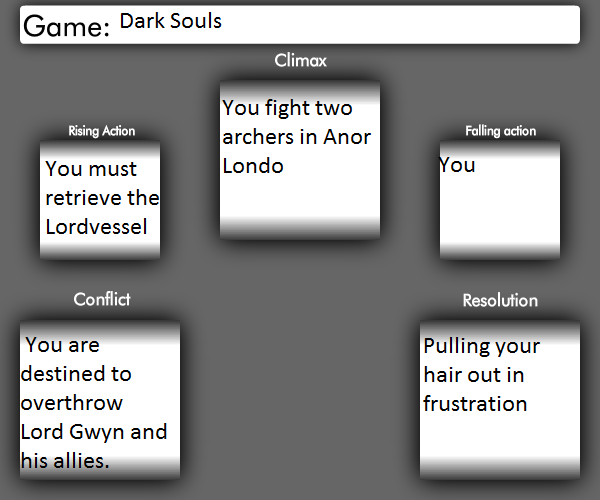
The Silver Knight Archers have a number of components to the encounter that contribute to it being a fair and deep challenge. First, you have a big platform on which you fight two demons, and the knights’ arrows can actually hit you here, but you’re given two pillars to work with. You know the demons’ pattern, so you gotta deal with them and these two additional projectile users in a space where if you get hit, you won’t be knocked off. This is arguably a really hard encounter by itself. You can skip the demons by running past them, which makes the next section slightly more difficult.

You have the initial run up to the column that acts as cover from the knights. On this stretch, you have a little fence that both protects you somewhat (though not completely) from the arrows, and prevents you from running off. If you didn’t kill the demon’s below, they can throw electric spears at you, hitting you from behind. I’ve been hit this way, running serpentine usually safeguards you. You can see both archers and their position while running on this stretch, then you get a big pillar/tower that acts as cover before you have to do the real thing. The next ramp up has no railings, it’s the real thing, so from then on, you need to move without hesitation, setting a different tone for this encounter than most other in the game. Going around the tower to get to the ramp up is itself a risky proposition, but less so than the ramp itself. You’re under fire from one of the archers, and have the ramp/wall to brace yourself against if you’re hit.

Going up the ramp with no railing, the archer on the left has two towers in their way, that can act as cover from one of the knight’s shots. So in some positions you only have to worry about one knight. From the top, you can access both knights. Fighting the knight on the left first will give you a lot of cover from the knight on the right, but it means fighting on another ramp with no railings against an enemy you’re unfamiliar with. The unfamiliarity with the moveset of the silver knights is perhaps the biggest point of unfairness here (because honestly, the arrows themselves are really simple and slow projectiles).

Moving close at the right archer will prevent the left one from firing on you when you reach the top (because the tower is in the way), giving you time to dispatch the right archer. The walls give you a point to brace against the right archers fire with the archer’s outcropping angling him so your back is slightly tilted towards the wall. As you get closer to him, this advantage increases, and you get a corner to work with. There are a lot of ways to beat this silver knight, parrying him, finding a way to push him off, or fighting.

Staying between the two archers at the top of the ramp is the only position where they can both fire at you simultaneously after getting to the top of the ramp. The key point is, you’re not allowed to hesitate here. You need to make a decision and commit to it.
1327274147897

Do you think the souls games would be better if they weren’t rpgs?

I’m inbetween on that. The big benefit the stat systems bring is that characters have this differentiation from one another, you can’t just switch the items, you have stats invested that make you proficient with the items you have. And different characters can approach the game in very different ways with varying levels of efficiency at different parts. That’s pretty cool.

The upside of getting rid of it is, if you have no stat systems and just let people pick whatever armor and weapons they want, and balanced all the areas so they would fit the correct levels of damage for the mono-leveled character, then you can avoid the player grinding and becoming overpowered or underpowered. You’re less forcing the player to make his character good, and more asking them to get good at consistently performing the challenges inherent of the system. Players can’t make areas really easy by using overpowered gear/stats. Players aren’t forced to go grind so they will keep up with the difficulty of the area. This means a lot less wasting of players’ time and probably a more consistent difficulty curve.

These are the benefits of a stat based system contrasted directly with what you gain from doing away with it. I don’t think the Souls games would really benefit from not being RPGs as they are. Also cleverly, the Souls games have that online multiplayer aspect giving players a motivation to not overlevel, because then they will be left behind relative to everyone else (though admittedly this is more of a social contract than anything inherent in the game design).

A game like Ys would receive almost pure benefit for switching, but Souls, not nearly as much.

Do you think level grinding is a poor game design choice?

In general, yes, though recently I have found some good reasons for it. When the player’s needs experience from fighting monsters to progress it can be a motivation to fight otherwise easily avoided monsters in games where the monsters aren’t very good roadblocks, such as the recent Ys games. Another reason is trivializing early roadblocking enemies in nonlinear exploration games. It can be irritating to pass through an earlier area only to be held up by stuff you’ve dealt with before. With big enough number buffs a lot of challenges become trivial.

Despite these good reasons it can still be a pain in the ass to level grind, worrying about being overpowered or underpowered. Some solutions I’ve thought of include limiting the amount of experience you can get in each area by having it be totally static item drops. Like imagine that when you kill an enemy they drop 1 XP token each time up to a maximum of 3. To level up you need roughly 1.5 tokens from every enemy in the area and on collecting that amount you level up. This gives the player a reason to actually fight the enemies and keeps grind time short, also limit in how many times they can grind the same enemy set to level up.

Another solution that can be combined with the above is dispensing the level up on beating the area/boss so it comes at completely static times. If they didn’t get these level up from the enemies of that area then beating the area grants it, erasing the XP tokens of the monsters in the area too.

Are Souls games Metroidvania?

Would you classify the Souls games as metroidvania?

Only really Dark Souls. To me, metroidvania means that the areas are interlinked and you’re required to pathfind, find the shortest route between two points.

Dark Souls lets you from firelink shrine go through the undead burg, undead parish, new londo, valley of the drakes, blighttown, dark root basin, dark root forest, the great hollow, the lake of ash, the catacombs, and tomb of the giants.

Without fighting a single boss you can from firelink shrine access all of the following bosses: taurus demon, gargoyles, capra demon, moonlight butterfly, Sif, quelaag, stray demon, and pinwheel.

Tastefully, dark souls limits its warp points to a few of the most interconnected or important locations, and they’re only available in the latter half of the game when you’re required to quickly travel between the far ends of the game.

Demon’s Souls doesn’t really fit for me, because there are 5 paths that you can progress on linearly, but they are not interconnected, and there is no connection between later levels in an area and earlier ones. Also you can warp between all the major checkpoints, so there’s no point in pathfinding on an area to area level.

Dark Souls 2 has a similar issue because it’s littered with bonfires and you can warp between ALL OF THEM. Not to mention that much like demon’s souls, all the areas are just one way branches off a central path, they don’t reconnect, and there’s only one loop connecting different ends (the eagle and boat which both take you to the lost bastille) So you can pretty much warp to any point you want to.

Bloodborne follows from Dark Souls 2 and Demon’s souls in that you can warp to every single checkpoint. The world is actually really well interconnected all over the place, but the problem is that all the connections need to be unlocked after going through the area that is connected, so the world only really becomes nonlinear after you’ve already gone through it in a linear fashion. The numerous warp points make the nonlinearity further pointless.

Lesson: If you’re gonna have warps, use them sparingly, include looping level design, don’t make it one way to a dead end all the time with shortcuts.

What makes the Souls series so appealing to you compare to other action RPGs?

Other Action RPGs have shitty combat. The vast majority of them do. How many games have better 3d melee 3rd person combat than the Souls series? Not very many, and the few that exist are not in the action RPG category, except maybe severance blade of darkness which I heard people say was better than Dark Souls and Dark Messiah but I haven’t been arsed to play yet. Finding good melee combat is a hard thing to do in the first place.

Beyond that, Dark Souls (and the series in general) is like that Gesamtkunstwerk thing people like to talk about, and I’m not just saying that because Mr B Tongue said it, I’m saying it based on different principles for different reasons.

Souls doesn’t just have a combat system that works on totally flat terrain with one on one enemy encounters, it has a combat system that varies significantly based on the terrain and structures surrounding the player. It varies significantly based on the number and type of enemies fighting the player. And it uses these as an opportunity to create level designs where enemies ambush you, surround you, fight you in conditions that favor them more than you, like tight hallways or from the high or low ground, with ranged reinforcements, and more.

Souls has level designs that are branched and interconnected, yet have a clear progression, beginning and end. It makes use of the Z axis to thread levels back through themselves in a number ways. On a higher level, it has a nonlinear progression between the whole levels, in the case of dark souls it has a multithreaded design that folds back in on itself in a number of places, so you can reach nearly anything in the areas before sen’s fortress with a skip and a jump. That and they just flat-out let you go to places you didn’t really need to early on, like new londo and the catacombs. New Londo even linked into the valley of drakes which links into everywhere else. They have shortcuts in the levels which get unlocked over time to interconnect areas and make runbacks shorter. This creates both a challenge to explore the world, and to route different paths across it to grab the shit you need to get other stuff done, and I like that type of backtracking.

Each game has a ton of different weapons that make the game all different and the courtesy to add massively varied enemies as well. Even the hollow enemies can be devastating, even if they’re a bit weak at higher levels due to more damage resistance. They’re all made in a way where it’s tricky to avoid their attacks, not just caring about doing a ton of damage or having a ton of health.

Not to mention they capitalized on a really unique netplay scheme before anyone else could, and it had the fringe benefit of preventing people in the single player from taking a degenerate strategy and ruining the difficulty curve of the game for themselves.

The Souls games did a lot of things right, they were just each crippled by a few things they critically fucked up.