How to Improve at Mind Games

How can someone become good at playing mind games with their opponent in fighting games?

By practicing it deliberately.

See Also: How to Read a Book: Reads in Competitive Games

Specifically you should watch your opponent’s patterns. What do they keep doing and how can you exploit that? Watch what they do in each situation, get a feeling for their tempo and reaction time. If their reaction time is better than yours, then you need to beat them by acting on the tempo. If they do not adhere to the tempo, then you need to figure out by how much, and either act first to interrupt their options, or act second to punish them.

Watch for common player behaviors and keep a mental record of those. One example of this is, as Marth, I like to run through my opponent, then run cancel with a crouch, and fsmash back at the opponent I passed by. This is because when you run through, many people think they’re safe and do an option out of shield. However this is not foolproof. Players with good reaction time can grab me out of shield before I run through them. Players who are smart can recognize my pattern and either jump out of shield earlier, or hold onto their shield so my fsmash does nothing. At which point the correct response from me is to notice they are doing this and instead do run through, cactaur dash (run cancel and dash opposite direction), grab, because I’ve conditioned them to stay in shield.

Think about how everything you do conditions a response from your opponent and other things you can do instead that beat that response. If you do something that is exploitable, change it up in expectation of your opponent catching on. Watch what you do before you do an action, because that might give it away. Similarly watch for that in your opponent.

Getting good at mindgames is about studying other people, and finding 50/50 scenarios.

Also read this guide.
http://sonichurricane.com/?page_id=1702

Here’s 3 other guides on it as it applies specifically to smash bros (though you can extend these lessons outside of those games too)
https://www.youtube.com/watch?v=273tHua4wGc

And here’s a paper on people’s patterns in Rock Paper Scissors and a basic guide to winning:
https://arxiv.org/pdf/1404.5199v1.pdf
(The short is, winners tend to stick with their choice more often, losers tend to switch more often, and continue switching to unused options.)

Think about what the opponent is actually doing. Remember their responses to scenarios, and keep updating to do the thing that will beat their current pattern. If you have found a pattern that keeps winning, keep doing it, or if it’s just a pure mixup, switch after 2-3 reps, because that’s when your opponent is likely to switch, unless they’re bad and don’t understand the counterplay of the different options.

Of course also look for scenarios in which you can cover all or most of your opponent’s options on reaction and just setplay them. Then you don’t need to guess.

The beauty of competitive games is that there’s a complicated web of counters to different options in different scenarios, with one covering many in many cases, and different ones changing in utility based on the scenario. But to exploit these, you really need to think and pay attention, or you’ll get played.

Don’t Get Mad, Get Good.

What do you think of Spherax’ salty rage quit on Rising Thunder? Does he have somewhat of a valid point beside how bitch he sounds?

This was the MOST HILARIOUS FUCKING THING EVER when it happened. I even told the guy on his twitter to neutral jump the fucking fireballs. Rising thunder was a game that made neutral jumps over fireballs REALLY FUCKING GOOD too! Because all moves were on cooldown, if you neutral jumped a fireball, not only were you not allowed to shoot another until it went offscreen, they had to wait for the whole cooldown to finish!

It also lead to interesting things like if your opponent wasted an anti-air, then you could jump in all you wanted without fear until the cooldown finished.

Also I loved how Chel in that game could cancel sweeps into fireballs. Almost no game does that except Super Turbo.

Like the ironic thing about his whining was, he was playing the best character in the game, Crow. Crow had absolutely ridiculous okizeme pressure, and pressure in general. If he got in close, he could attack, cancel to short ring toss, jump over, crossup, attack high or low, then ring toss again, and so on, then confirm into a combo, into super. Crow was some cool shit, but also evil shit.

In short, No. He does not have a point. All of his whining is completely invalid. He is a bad player who has trouble with a simple low-level playstyle. Chel was not overpowered or broken. Ryu is not overpowered in SF4. Dude got beaten, claims the other player is bad and using a broken character to salvage his ego. It’s as simple as that.

When you get beaten, you need to acknowledge WHY you are getting beaten. You need to understand the faults in YOURSELF. It doesn’t matter if your opponent is using a broken character, you can pick that character too. It doesn’t matter if your opponent is a scrub. You’re a worse scrub for losing to them and being salty about it. If you cannot purge yourself of this mindset then you cannot improve. Developing a mindset like this makes you worse against players you should be beating the most easily.

I played a friend recently who played EXACTLY like this. He’d shoryuken out of everything I did to him after blocking the first hit, be mashing shoryuken in the middle of all my combos in case I dropped. This is a scrubby terrible behavior. I was tired at the time and fucking livid that he was seriously pulling this dumb shit when I was in a mindset where my ability to adapt was slowed down. So I began tapping him once, letting him shoryuken, and doing the crush counter combo. I then did something I don’t do often in SFV and switched characters. I chose a bunch of random characters I never play and beat him with almost all of them (rip zangief). I was annoyed, but I controlled myself enough to not lose to an opponent doing a basic (but bad) strategy.

Zoning is interesting. There’s a lot of ways to zone well, and a lot of ways to get around zoning. If you can’t figure all this out, if you can’t see what’s interesting about it, you’re in a bad mental place.

Understanding Framedata: Combos, Traps, and Turns

Many beginners to fighting games, including myself, get intimidated by frame data. They look at it like this huge spreadsheet of numbers that they think they have to memorize. I originally didn’t get framedata, but wanted to understand how combos were built, how people discovered them, and thought, “will I just have to memorize all this framedata to get it?” It took me a while for it to click. In reality, yeah people pick up a lot of framedata incidentally, but almost no one seriously memorizes all the framedata. People really only look for a few things, which moves are unsafe, which moves set up combos, which can follow up combos, and whether each move is plus or minus on block. Continue reading

Fighting Game Alignment Chart

How would you break down the many different fighting game playstyles such as rushdown, turtling, zoning, or any others you can think of?

A friend of mine (ClarenceMage) came up with a really brilliant way of separating it out actually.

fighting game alignment chart.png

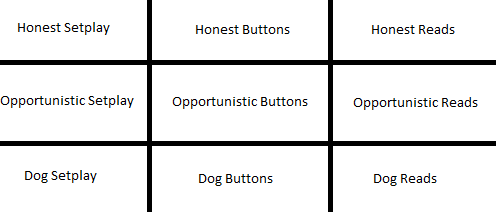
The idea is you have these two scales: Horizontally, you have a scale between Game Knowledge (left) and Player Knowledge (right). Vertically, you have a scale between Safe Guaranteed Play (top), and Risky Unpredictable Play (bottom).

Setplay revolves around setting up situations and capitalizing off of them. Setplay is highly reliant on game knowledge, it’s all about knowing the game better than your opponent. Examples of setplay players would include Armada (Honest Setplay) and Marn (Dog Setplay).

Buttons is about winning the footsie neutral game. It’s player knowledge, part game knowledge, so it falls somewhere between setplay and reads. You gotta know a bit of what your opponent is thinking, but also a bit of how to use your options best to win. Examples of Buttons players would be Hungrybox (Honest Buttons), PPMD (Opportunistic Buttons), and Infiltration (Dog Buttons)

Reads is about knowing your opponent’s tendencies. It’s about attacking at just the right time in just the right place. It relies heavily on player knowledge. Examples of Reads would be Snake Eyez (Honest Reads), Mango (Dog Reads) and Daigo (also Dog Reads).

Playing Honest is about sticking to guaranteed setups with a small chance of failure. Honest players tend to mix in a variety of approaches instead of pursuing a single gimmick and play according to what has the best odds of success. Honest players are the ones that almost always block low on wakeup or tech neutral. Honest players can have this tendency towards safety taken advantage of, but tend to have very consistent performance to make up for it.

Playing Dog is about going for what works and throwing caution to the wind. It’s about dogged persistence to win the way you want to win. Dog players tend to go for high risk high reward options or get killed trying. Dog players will ultra on wakeup, shoryuken in your face, charge the fsmash in the direction you’re about to roll, go offstage for the gimp.

Playing Opportunistic is a mix of Honest and Dog, trying to adapt to how the opponent is playing at that moment, seizing opportunities to grab just a bit more advantage where you can, but sticking to what you know works when the going gets tough. Opportunistic players are flexible, but can psych themselves out trying to follow their opponent’s patterns and be in the wrong mode at the wrong time.

Of course, there are a lot of ways to divide playstyles or categorize them. If you want to get deep down, it comes down to the player’s tendencies to use some options over others and the frequency of that option use, and you can’t totally quantify that.

Frame Trainer Tool & How Long Are Frames?

A lot of people ask me how long a frame is. I reflexively measure timings in games using frames (assuming 60fps), and I have a rather good sense of it. This comes both from being an animator, and experience with games in general.

So I had the idea, why not make a tool that helps show how long a frame can be by giving people an interactive example? So I got into flash, putz’d around for a bit, and ended up with this.

https://www.dropbox.com/s/nt7dbdu6hg56tcu/Frame%20Trainer.swf?dl=1

https://www.adobe.com/support/flashplayer/debug_downloads.html (download the flash player projector and drag the swf from the zip file above to use the frame trainer, since flash is deprecated on every platform ever now.)

To operate it, click the Go button to start the arrow moving from left to right. Press any key, or click the stop button to stop the arrow. The goal is to stop the arrow when it’s yellow, just before it hits the end.

You can configure how long it takes to get from the beginning to the end by changing the Frame Total text box on the left. And you can change how long it turns yellow with the Frame Window text box on the right.

By changing frame total, you can give yourself more or less waiting time before it turns yellow. By changing the frame window, you make it turn yellow for longer.

If you stop it while it’s green, you did it too early. If you stop it while it’s red, you did it too late. Use the arrow getting close to the end as your visual cue.

By default I set it to 40 frames total (to give you a decent amount of reaction time before you gotta press the button) and a window of 7 frames, which is the window for parries in 3rd strike and L Cancels in Melee. Try setting it to all different periods and trying it out. Try setting it for different periods of time just to see how long they are, like 60 frames is 1 second, 30 is half a second, 20 is a third of a second, 10 is a sixth, 5 is a twentieth.

For reference, here’s some other frame windows from various games and my description of how easy/hard they are.

1 frame: Reversal window in Super Turbo and Guilty Gear before Xrd. Kick Glitch Window in Mirror’s Edge. 1 frame link timing. This is the hardest possible single input in a 60FPS game. Obviously combination inputs can be harder. Coincidentally, I had to jerry rig the setup to allow this window (it would otherwise show red on the last frame), and I managed to test it was working successfully on the 3rd try.

2 frames: Reversal window in 3rd strike, power shield window in Melee, throw tech window in guilty gear. Boost Smash/DACUS window in PM. This input is almost perfect, allowing just enough leniency that people can feasibly get consistent at it.

3 frames: Smallest possible window for a link in SFV, reversal window in SFV and GG Xrd, common window for links across fighting games. This one has a tight timing, you’ll feel that it’s really tight. It’s practically the exact moment that the thing hits, except significantly more lenient than 1 or 2 frames. I can do these consistently in SFV. Any mediocre fighting game player can do these in their sleep.

4 frames: Perfect Shield window in Brawl. Slightly less tight, but still enough to be difficult.

5 frames: Reversal Window in SFIV, parry window in DMC3/4. This is where the window becomes wide enough to let you get the input even if you mashed it (unless of course there’s a lockout period to dissuade mashers, like the DMC parry has)

7 Frames: 3s Parry Timing, L Cancel Timing in Melee. There’s a bit of wiggle room here. You’re no longer pressing the button just as you reach the end, just as the fireball is about to hit you, or you’re about to hit the ground. If you do it a bit early, you are forgiven.

15 frames: Average human reaction time. Throw Tech Window in Blazblue.

20 Frames: The Tech Roll window in Melee. This window is so wide, there should be no reason to miss it if you see it coming, it’s completely outside average human reaction time.

30 frames: Half a second. Blazblue has a 27 frame throw break window for throws during hitstun/blockstun. The Parry Window in Metal Gear Rising is this long. The parry window in Rivals of Aether is this long.

50 frames: Seth Killian once said that the counter window in Batman Arkham Whatever is like 40-50 frames. This is so long that it’s practically impossible to miss.

By the way, if anyone wants me to make a 20 fps or 30 fps version of this tool, then I can do so easily. I tried to add another box that let you change the framerate manually, but it didn’t work.

Smash Bros Melee Beginner’s Guide

I get a lot of people asking me how to learn the basics of Melee. Here’s some essential resources for learning how to play Melee:

This video is a great rundown of the basic mechanics, in an order that is good for beginners:

This video is probably the best place to start, it lays out most of the advanced techniques that are still in use today. Some of the terminology is a bit outdated, some of the topics like DI aren’t explained in as much detail as they should be, but it’s still a pretty good guide overall. If you’ve NEVER played before, pay attention to the in-game how-to-play tutorial shown at the beginning of this one.

This channel is SSBMtutorials, it has tutorials for a ton of characters on a great variety of topics. It’s made by a top player and goes into a lot of detail.
https://www.youtube.com/channel/UC46ZTid4t2ctB6osM0WTiJA

This thread links to videos that show every advanced technique for every character in the game with the inputs for that technique on-screen.

This channel contains “trials” videos for the top tier characters (and Captain Falcon for some reason) showing you basic techniques you can practice in training mode that will help you understand your character better.
https://www.youtube.com/channel/UC6R7DuarfdRdJtZvtDRedAQ/videos

This is an article I wrote that explains in depth how the entire grounded movement system in Melee works:
https://critpoints.wordpress.com/2015/12/28/the-smash-bros-movement-system/

This is another article I wrote about how the grounded neutral game tends to work in Melee:
https://critpoints.wordpress.com/2015/12/25/footsies-in-melee/

This last one explains how all the recovery systems in Smash Bros work:
https://critpoints.wordpress.com/2016/04/16/mtm-smash-bros-di-techs-and-meteor-cancels/

This page links to every characters’ hitboxes and framedata:
http://smashboards.com/threads/stratocasters-hitbox-system-new-download-link.283973/

This is a compendium of practically everything you could ever want to know about smash bros.
http://smashboards.com/threads/2014-ssbm-compendium-of-knowledge-updated-1-2-14.339520/

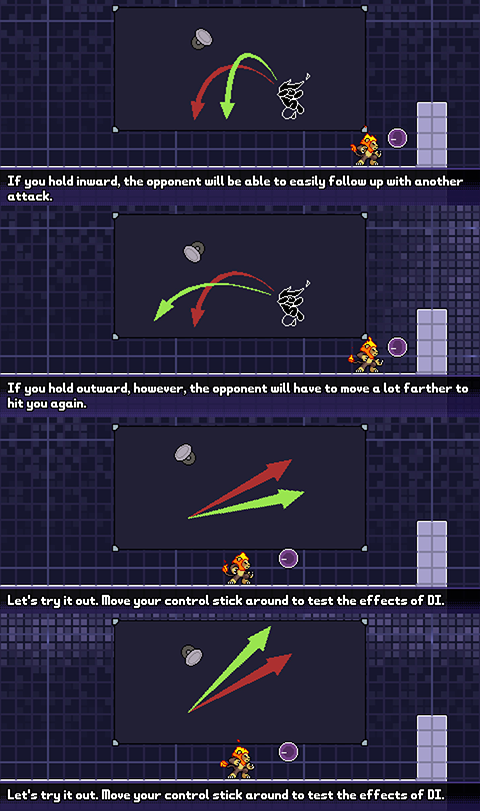
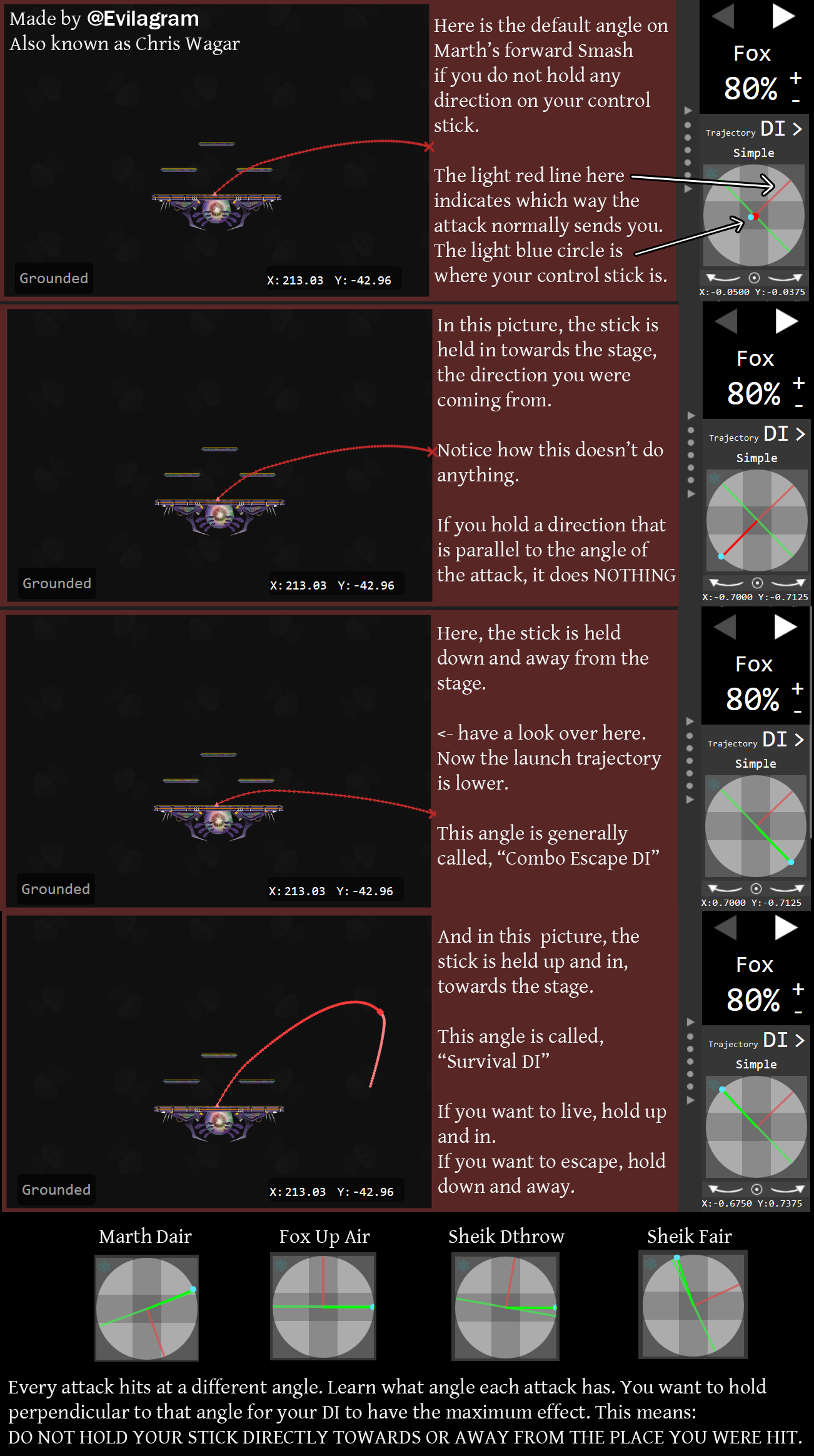
Directional Influence is a subtle mechanic that isn’t explained very well in most tutorials online, here’s some pictures that explain it.
rivals DI tutorial 1rivals DI tutorial 2
directional influence DI infographic tutorial

Beginner Fighting Games

Rising Thunder, Pocket Rumble, Divekick, Rivals of Aether… what’s the point of all these “beginner-friendly” games? Traditional fighting games are overwhelming at first, but you have to keep PLAYING them to git gud. Playing these baby games won’t magically make you a KoF/GG/Melee champion.

How many games do we need to dumb-down (oh, I mean, “simplify”) mechanics for scrubs before we realize that they won’t learn no matter what. Also, enough with “we want to explore the strategic element”. You can do that with all these other games that don’t need some 1 or 2-button control scheme.

The point is, I can bust out divekick and get anyone off the street playing in seconds.

King of Fighters can be overwhelming to someone who only plays Street Fighter, Guilty Gear is overwhelming to anyone who hasn’t played an arc sys fighting game before. Playing Street Fighter won’t make you a champion in those games, but it will give you a leg up, and you’ll certainly be able to wreck anyone starting fresh in those games. I know I’ve picked up random fighting games and been able to fight on par with people experienced in them just using fundamentals.

Having a simpler game to learn allows beginners to focus on the few tools they need to win, like fireball/anti-air, like the basics of footsies, meter management, simple combos, and so on. That’s a game that needs to exist in my opinion. If you don’t have games with a greater accessibility teach people the basics of the harder games, then it becomes a lot harder to get people into those harder games.

I’ve gotten people to play traditional fighting games with me and tried to give them the introduction and they were like, “This is cool, but there’s way too much stuff for me.”

How many games do we need to dumb-down (oh, I mean, “simplify”) mechanics for scrubs before we realize that they won’t learn no matter what. Also, enough with “we want to explore the strategic element”. You can do that with all these other games that don’t need some 1 or 2-button control scheme.

People will learn. Releasing new games with simpler control schemes isn’t harming the games we already have. They’re not establishing a new competitive standard. The further point I made is that these games are unique and do things other fighting games aren’t necessarily doing, which by itself validates their existence.

Being bad at a game does not make you a scrub. It does not make sense to write people off as irredeemable when they could potentially learn. If nothing else, these games are a useful tool to me personally, for introducing people to traditional fighting games in person.

These games teach you more with all their additional mechanics. Why regress. If you feel overwhelmed, there’s always the early entries in a respective series (e.g. SFII).

Except SFII is still too complicated for a lot of people, and on top of that, has the worst input read algorithm next to SFI, making it hard to even play the game at a beginner level unless you’re better at special move inputs than you’d need to be in order to play a more complex recent game.

Depth comes at the price of complexity, and sometimes people need a scaffolded experience or they simply get overwhelmed. It’s a regular pattern, beginners have so much to take in all at once to even play the game, they go a ton of rounds fumbling with the few controls they know and mashing buttons.

Simpler games with more straightforward basic functions can help alleviate this and allow people to develop the basic skills to understand the more complex games. Otherwise fighting games become a genre with no entry point, and that’s dangerous.

And there’s also the part where you glorify sub-SFII games like Divekick and Pocket Fighter. These games aren’t really good for learning either, I don’t care how you spin it. How many people have played those games and then seriously taken up more complex fighters? Usually, people get serious about FGs are actually playing with other people (friends, tourneys). Or through their desire to improve. These types of 1 or 2-button games are just gimmicks that become boring after a short period. They might be worth mentioning because their simplicity lets you easily discuss more fundamental concepts in the genre, but that is about the extent to it. I mean, people don’t discuss level design in NSMBW because it’s obviously too difficult, so they stick to the simpler SMB, and that’s fine for educational purposes, but we can’t keep teaching 1+1=2 over and over, nor should we glorify the work of people who think that coming up with 1 (not even 1+1, but literally just 1, which is what Divekick and Pocket Fighter are) is some revolutionary new idea.
Basically, if someone comes out with a sub-SMB platformer (like an autorunner), we ignore it, correct? So why behave differently for fighting games or any other genre? That kind of started as one ask, but turned into another.

Maybe they’re not good for learning? I don’t know yet. I haven’t had a serious chance to test out teaching people through them. So far I’ve mostly just been going with 3rd strike because it’s free and online.

I don’t really know how well they work as an introduction tool. They’re still pretty new. I admit that I’ve barely gotten to play pocket fighter, and never with another person.

I think they’re worth a try. Maybe I’m wrong and they don’t translate into anything. How about we wait and see?

The other thing is, Divekick is absolutely 1+1. There’s a lot more going on in Divekick than in an autorunner. I know it looks simple to you. Even I thought the concept was kind of stupid when I first saw it, but after playing it with other people it clicked and became interesting. Divekick asks a lot more of the player than any autorunner does. There are a lot more “inferential judgments” going on. (totally coining that term on the spot here, might even throw it in the glossary)

It’s like footsies in a traditional fighting game, it doesn’t make any sense to you when you first start playing, so you just mash, then you wonder why the other guy is hitting you more. I know I’ve had many people get surprised when they actually sit down and play divekick with me and realize that there’s a lot more to it than they initially thought.

And Pocket Fighter is more complex than Divekick, so it probably has more complex strategy to it.

The other thing is, fighting games are way more complex than SMB. If you strip away SMB you have something that is barely a game, if you strip away fighting games, you still have something left that is arguably just as complex as SMB.

Getting Unstuck in Fighting Games

When you get ‘stuck’ in a fighting game, like, say, when you play against a character you don’t know how to fight and you just don’t understand how to deal with them because all of the moves of that character seem to have priority or the char. just has better ledge game (in SSB) or this one move you just don’t know how to counter, what is your process for figuring out how to deal with or counter this character (or a certain tactic)?

I almost never get stuck, because I generally have a good understanding of how the systems work. Mewtwo teleports at me, I know I need to have a hitbox on the spot he’s about to appear before he’s there. I’ve worked out plenty of anti-jank tactics versus snake’s grenades and mines. I’ve spiked lucas players trying to tether to ledge for free. I’ve uppercut dhalsim’s limbs. I’ve faultless defense’d Faust’s blockstring pressure into his unblockable (so he can’t run up into it as fast because FD pushes him away further, and since it’s an unblockable, I can’t jump out like with a throw). I pointed out to my friend in KoF98 that Athena’s hard autocorrect divekick was probably really unsafe on block, because it wouldn’t make sense to be safe on block (turns out, yeah it’s really unsafe).

Everything always has a counter. Either you hit them before they do it, you punish them after they try to do it, or hit them in the middle of it. Good understanding of the system as a whole, good expectation of the trends in the system (like knowing which moves are probably unsafe), being able to recognize what happens with the move in different situations, and thereby being able to diagnose the move’s weakness. Like Dudley’s cross counter in third strike doesn’t counter low attacks. I never read a guide mentioning this, I just played a lot and noticed it as I played.

If I’m having trouble with a character, I usually look up guides for the character I’m having trouble against. Learning how they see things from their perspective is helpful because it also includes their weaknesses and what they need to watch out for. Investigation into framedata can be helpful too, as it was with Necalli in SFV, learning that his blockstrings into the stomp special are tighter with the light stomp, but more disadvantageous on block, and have a gap with the heavy stomp, but more neutral on block.

There’s a large number of resources you can potentially look into in order to learn how to beat characters for any popular fighting game.

I recently played PM after a long time and for the first time against a player and how the FUCK are you supposed to fight Marth? ALL his moves have priority over everything I did (not to mention longer range). I could only beat the player using Charizard and his giant-ass hitboxes with flame-tip and claw sweetspots.

Hahaha, that’s funny. Marth has an advantageous matchup against charizard, because charizard’s tail isn’t disjointed and marth can just whiff punish slash it, also because marth gets good combos on floaties and can space against Charizard in shield really well (and charizard already suffers against shield pressure).

I play with the second best Charizard player in the world actually, and as you may know, I main Marth.

Some key things to remember are, priority doesn’t apply to air attacks. Air attacks cannot clank, so forward air from Marth will cut through your hitboxes.

Marth’s big weakness is that he doesn’t have any attacks that come out particularly fast, and his attacks don’t have great recovery. His fastest ground attacks are jab, down smash, and Up B, all coming out on the 4th or 5th frame.

If your friend is spamming SH double fair, you can either move out of the way, then hit him right when he lands (charizard has an amazing dash dance) either with a grab or forward tilt (charizard’s forward tilt is amazing), or move in closer to him and shield on the spot where he’s going to land, so he’s forced to land in your shieldgrab range. These apply to any character.

Marth’s dash attack sucks, can be beaten by shieldgrabbing or just letting it whiff and punishing it.

Marth’s down tilt is his best neutral move because it has amazing IASA frames, so it effectively has a short recovery. Also has a reasonably fast startup of 6 frames. He can usually dash out of it before getting shieldgrabbed, but it’s still susceptible to whiff punishing.

You want to DI marth’s fair chains out, to avoid getting spiked. His up tilt and dash attack have a trajectory that sends you in at Marth, so you’ll want to DI down and in at Marth. Those three moves are how he sets up most of his combos. His grab is normally useful in combos, but charizard is so heavy it rarely comes into play. Just be sure to DI down and away from him when he forward throws you. On lighter characters, he can also down throw as a DI trap into fsmash, so you’ll have to guess which way to DI to avoid getting fsmashed.

His fsmash by the way, has almost no shield pushback, so you can shieldgrab it no problem. If he’s out of range, then let him whiff the fsmash and you are totally free to run in and do whatever you want to him. I do this to a lot of marth players I know are worse than I am when I feel they’re about to fsmash. Just wait at the very edge of their fsmash range, let them miss the attack, dash in an grab.

As charizard, watch out with your dash dance, your tail lags behind you, and can be slashed if you’re not careful.

Any tips for Ganondorf in PM? I wsa using him and couldn’t do jack to Marth until I picked up Charizard. I’m surprised Charizard has a bad matchup against Marth, though that’s probably because the other guy just wasn’t that good. Also the setup was laggy so that might have given fatso charizard the advantage.

Ganondorf, he’s also on the lower tier side like charizard, hard to say how his matchup against marth goes. I think marth still has the advantage. Luckily I alt Ganon. Ganondorf is all about single hits and spacing, Marth is also about spacing and has disjoint. Ganondorf kills in a few hits, Marth has nice combos, though none of his grab setups work on Ganondorf because he’s too heavy.

Basically, you want to hit him when he misses you. Ganondorf gets great followups off his down throw versus marth. At lower percentages, he can regrab (marth can DI forward or behind ganondorf, so turn appropriately to catch him). At higher percentages down throw gets guaranteed followups into fair or bair depending on DI. Ganondorf can’t move that well to whiff punish grab marth, but he can move in on marth forcing him to land in bad positions and be open for a shieldgrab.

Ganondorf has a nice jab, much faster than any of marth’s moves (one of marth’s central weaknesses is that he has no good fast moves), so that can be useful in a pinch.

Ganondorf’s down B can outprioritize all of marth’s grounded moves, but it loses hard to aerials or shield. Side B is good for shenanigans, when you scare him into shielding you, or if he tries to shield while on a platform and thinks he’s safe (since normally you can’t grab people unless you’re on the same ground they are). Air version gets better followups, ground version has better range and can avoid attacks like Dudley’s short swing blow. Ground version can be teched before ganon can do anything about it, air version does a small juggle which ganon can usually at least jab off of before they get a chance to tech. Up B is also a grab and can shenanigan people in much the same way, grabbing them when they think you don’t have the grab option.

Most of the matchup is going to be moving carefully, and poking at marth before he swings or waiting for him to miss a swing and poking him. You’re just gonna have to get used to reading a lot harder and winning neutral more with worse tools. Ganon has nice range on a lot of his attacks, technically better than marth’s on fair, you need to get better at figuring out when he’s going to attack, avoiding it, and hitting him back. You don’t need to win neutral as many times as marth does, because you get bigger rewards for winning neutral.

I beat a guy playing falcon yesterday every single time while I played Bowser. In Melee. If you have good enough instincts, anything’s doable.
The Smash Bros Movement System

melee-movement-graph.png

This is a companion guide to https://critpoints.wordpress.com/2015/12/25/footsies-in-melee/

Okay, movement in Smash Bros is a tricky topic, there’s a lot of nuances to it that don’t exist in any other game I know of, so lets get down to business.

oaroheq

Up above is an image (made by Kadano) detailing all of the actions possible from a neutral standing state using the control stick alone, assuming you are facing right. When you tilt the stick forward, you will begin to walk forwards, with speed proportional to how far forwards the stick is pressed. If the stick is moved into the dash region within 2 frames of it being in the dead zone, it will initiate the initial dash animation, if after 2 frames it is not in the dash region, a dash cannot be initiated regardless of the movement of the stick until it enters the dead zone again. If the stick is moved back into the tilt turn or smash turn areas, then the character will initiate the turning animation, if it is in the smash turn area on the first frame of the turn animation, then the initial dash animation will be started in that direction.

While walking, you are allowed to perform any standing action, forward tilt, down tilt, up tilt, fsmash, down smash, up smash, and all your B moves. This means walking is a nice and delicate way to move while being capable of performing any attack at any time.

As noted above, when you “smash” forward, you’ll enter an animation state called initial dash. This animation plays for a different number of frames per-character, and if the stick is held forwards, it will transition into the run animation when it ends. If the stick is released, the initial dash animation will continue to play until it concludes, but you will not maintain your speed forwards, with friction slowing you to a halt (this is called a fox trot).

ssbm2bdash-run2bthresholds2bspeed

During the initial dash animation, you are not allowed to crouch, attempting to do so will make you crouch after a fox trot. You cannot perform any tilt or smash attacks during the initial dash animation, except for up smash (because jump cancels into up smash, and you are allowed to jump from all grounded non-attacking states.). If you smash turn during the initial dash state, you will re-enter the initial dash state in the opposite direction. There is a 2 frame leniency for this (unlike the 1 frame leniency for trying to dash in the opposite animation from standing), not reaching the opposite side fast enough will result in a fox trot.

This means that you can rapidly alternate directions to begin the initial dash animation over and over again in the opposite direction. This is called dash dancing. If you allow the initial dash animation to play out completely, entering a run, attempting to turn back will result in a long turnaround animation playing where you lose a lot of your speed and cannot perform any action except jump. Jumping during this animation will orient you in your original facing direction in Melee, and the opposite facing direction in Project M (called reverse aerial rush).

Because the turnaround animation during run is so long, many players elect to stay in dash dance to get the fastest turn times, allowing them to move with more agility than the run animation over a shorter range. The thing to get familiar with is learning how long you can hold dash in a direction before needing to turn around. This means that there is effectively a distance you’re allowed to move before needing to turn back. When you learn this distance well enough, you’ll be able to move at maximum speed over short distances, weaving in and out of opponent’s attack ranges. It’s possible to run across the stage, staying entirely in initial dash by turning back, then forwards every time you’re about to hit the edge of your range. This is a great way to practice using the dash dance purposefully. Varying your dash lengths and having great precise control over your dash will allow you to whiff punish any move.

During the initial dash animation, the only attacks you’re allowed to perform are the dash attack, grab (the running grab animation is slower, it’s recommended that you jump cancel grab to get your faster standing grab), your B moves, and up smash. However every time you turn during the initial dash animation, there is 1 frame where the character is in a neutral standing state. On this single frame, you are allowed to perform any neutral standing option, assuming you have good enough timing and dexterity. Performing an action on this frame is called a Pivot. Pivots are extremely tricky, but allow you to move at maximum speed and attack with impunity. Because they’re so difficult, many people only use pivots for specific applications, like moving in for a quick smash attack.

Once you enter the run state after the initial dash, your options increase a little, because you are allowed to cancel run with crouch at any time, and perform any move you normally can out of crouch (all special attacks, all smash attacks, all tilts). Worth noting is that crouching, then dashing the opposite direction is faster in a run than trying to do the run turnaround. This is called a Cactaur Dash.

Wavedashing is a technique performed by airdodging at an angle into the ground as soon as you leave the ground from jumpsquat. When you hit the ground, there are 10 frames where you cannot act due to landing lag. This means wavedashes effectively have a startup time of 10 frames + your character’s jumpsquat, assuming you do the wavedash frameperfect. You can also do this as you land from a jump or come up through a platform (fastest way to land on most platforms), incurring the same 10 frames of landing lag. The wavedashes of most characters are slower than dashing, with the exception of the characters with the absolute best wavedashes, like Luigi and Ice Climbers. Wavedashes are nice because they allow you to move at dash-like speeds without committing to the more limited set of dash options, as well as retain the same facing direction. So you can wavedash backwards while facing forwards. They help fill in a few holes in most characters’ mobility options. Wavedashes are bad, because they have a longer startup time than dashes and walking. During the jumpsquat, the wavedash inherits whatever momentum you had moving forwards, so dashing into a wavedash will make the wavedash move further.

The angle at which you dodge into the ground also affects wavedash length. More shallow angles that are closer to parallel with the ground will travel further along it. More deep angles that are perpendicular to the ground will travel with less distance. You cannot wavedash perfectly to the left or right, you’ll just get an airdodge, however you can waveland perfectly to the left or right when you jump up through a platform, or land on the ground. You need to do this exactly as you land, close to frame perfect if it isn’t totally frameperfect. Doing this will move you a lot further and faster than a normal wavedash, allowing even characters with terrible wavedashes like Ganondorf to move amazing distances.

If you are facing with your back to a ledge and have momentum, you will slide off the edge. Wavedashes allow you to do this, making them great for grabbing the ledge quickly to edgehog. Sliding off a ledge also can cancel any special animation, allowing you to attack faster, and attack animations can slide off ledges both backwards and forwards. In shield, sliding off ledges will put you into tumble, which can be taken advantage of by opponents.

Footsies in Melee


This is a companion guide to https://critpoints.wordpress.com/2015/12/28/the-smash-bros-movement-system/

Alright, here’s my footsies speech. I wrote this for my local smash group, and now I’m passing it on to you.

A lot of beginners when they learn to dash dance, don’t really know what dash dancing is for. They just do it because they know it’s tech and makes you unpredictable, then they get scraped because nobody’s going to respect someone who just DDs in place. Dash dancing really starts to work for you when you learn how to use your dash purposefully. You gotta understand that dash dancing isn’t just moving back and forth to be less predictable, it’s about your character having a certain range of space on the ground that they can move at maximum speed through, capable of weaving around attacks, and as long as you keep turning back at the periphery of this range, you can keep weave around anything. It’s helpful to be familiar with all the movement states in Melee, I might cover those in a different guide.

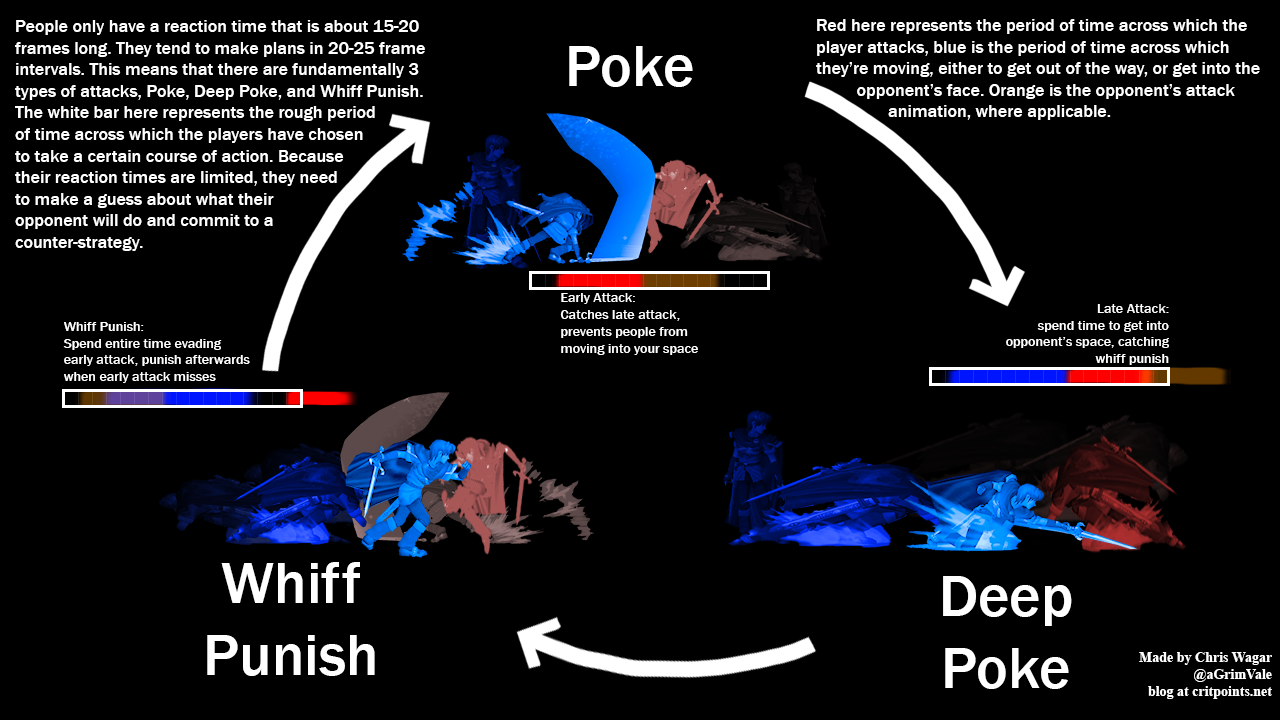
The first component of this is whiff punishing. When someone attacks you, and it misses, there is a period where that attack must recover. Dashes in Smash Bros are so fast that they can get in on people during that period, and usually grab them (depends on the character). So what you can do is, if someone comes at you with an attack, you can stand within that attack’s range, dash out of the range, let the attack whiff (miss you), and dash back in to grab them. This is the basic whiff punish.

You can whiff punish grabs, dash attacks, SHFFLs (on almost all characters), most tilts, most smash attacks, and a lot of other options, as long as you have enough space to move back, then forward, to hit your opponent when they miss. Because whiff punishes work on so many things, they’re extremely useful. They can beat out a lot of air and special move options too, forcing the opponent to respect whiff punishes on the ground.

Your other two footsie options are Pokes, and “Going Deep”. Pokes are moves you throw out to prevent your opponent from moving in on you. Poking too close to an opponent can lead to getting shield grabbed, so you want to poke at max range, while still hitting them. You want to throw pokes into the space your opponent is about to move into. Pokes are almost always fast startup moves with fast recovery and decent range, so Ftilts and Dtilts on many characters apply, as well as many character’s SHFFLs. Pokes get beaten by whiff punishes, unless they connect with either the opponent’s body or their shield.

Pokes can be beaten by other pokes, these are called counter pokes. Like a SHFFL will beat a dtilt frequently, and many ftilts or utilts can beat SHFFLs, but dtilts can go under those or outspeed them, beating those out. Poking before your opponent does will also beat their poke. Again, these options vary by character.

“Going Deep” is the equivalent to Throwing in Street Fighter, the idea is that when your opponent is non-commital, trying to bait something from you to whiff punish. If you go deep, then they need to poke you to force you out, or they get hit. Many attacks are great for this, especially because you can run cancel when you go outside your dash dance range. Dash attacks work for this on many characters as well. The idea is to overlap the space they’re going to dash in with a hitbox.

RPS triangle melee footsies.png

Pokes < Whiff Punishes < Going Deep (< Pokes again)

So you have this counter triangle, Pokes stop your opponent from moving in on you, going deep. Whiff punishes will beat pokes by avoiding getting hit, and retaliating. Going deep will beat noncommittal dash dancing, so it beats whiff punishes. Of course, poking to keep people out of your space can itself be whiff punished, so you can move into people’s space then out of it to bait a poke, and whiff punish that poke. Moving in is pressure, moving out is bait.

The goal is to watch what your opponent is doing, because you get to see what they’re about to do based on the way they move before they do it, then make a read, and try to beat whichever one of these three options they attempt, and convert that into a punish ideally. Figure out which of these three they’re relying on the most, and try to focus on the options that beat their particular play style, as well as read which option they’re going to go for right here and now.

All of these things open you up to risk, none of them are perfectly safe. Everything counts as a commitment in its own way. If you get scared, then you’re not going to make yourself safer by overly committing to any one option. Victory depends on your ability to figure out your opponent’s patterns while they simultaneously try to figure out yours, and both of you adjust on the fly based on what you just saw your opponent do. But this isn’t perfect rock paper scissors, you get hints based on what your opponent does before they actually commit.

So have some fun, change up your patterns, and figure out what theirs are before they catch on to you.

SSBMtutorials by Kira did a video on this topic and has a similar basis to mine with different terms.