Fighting Games don’t attract a lot of new blood. The majority of people who buy fighting games will never attend a single tournament for that game, never post about it online, and never interact with the community in any way. This means that the success of a competitive scene is tangential to the success of the game overall.
Fighting games being unpopular compared to other genres of competitive game is a demographic problem. Demographic problems require systemic solutions, not individual solutions. It’s easy to say that the problem is players who don’t have the drive to improve themselves, but a lot of people just bounce off of fighting games, even though they really want to go on an improvement journey. Fighting games can do a lot structure themselves to get these new players on the right track to understanding the game.
Magic the Gathering went through a similar issue early in their game’s lifespan. At first, they catered to pro players, and the game started to slowly die as MTG became more complex and more irrelevant to beginners. MTG ended up revitalizing themselves by decreasing their investment in competitive play, and instead focusing on creating appealing characters that people could connect to, and an easy introductory experience for beginners.
Wizards of the Coast called the non-competitive kitchen table players, “The Invisibles” because they don’t participate in the broader community, yet they make up the majority of the consumers. This is the case for every game or media product. The majority of a game’s fans will never ever participate in an observable way, but they’re the people who are the backbone of your sales, and they’re the people who filter into the competitive scene. Therefore, having an approachable game creates a more healthy and active scene for everyone.
Making games more appealing to the average consumer is usually associated with dumbing a game down. We’ve seen a lot of recent attempts simplify fighting games in order to make them more appealing to the average consumer, such as Street Fighter V, Marvel Infinite, Dragon Ball FighterZ, and Blazblue Crosstag Battle. These have had mixed success, with only DBFZ really prospering and SFV holding a middle ground.
DBFZ and BBTag both did a good job of layering their complexity so the games were really simple to play at a lower level, but still had difficult advanced techniques for higher level players. However the ease of play didn’t appear to make these games any more or less popular than any of their competitors. Tekken 7 did not include any ease of play additions, yet it’s selling just as well as DBFZ. The popularity of each of these games seems to have no correlation to the ease of play, but rather, the strength of the IP and overall game quality (SFV took a hit here, for a laundry list of reasons).
However, even with DBFZ, we saw concurrent players on Steam fall off rapidly after the release of the game (more than you might expect), suggesting that even with the ease of play changes, such as autocombos, only quarter circle motions, and so on, the game still wasn’t sticking with people. The DBZ IP attracted a ton of buyers, but when they play the game, they don’t want to stick with it. This is probably because they don’t really understand the game on an intuitive level (and also the horrible User Experience with the lobbies).
I believe a big obstacle in retaining players is that fighting games are intrinsically hard to understand, and this comes from their control scheme, along with difficult to understand situations & information like wakeup and framedata. In almost no other genre will you press up to jump, back to block, and need to hold directions or do motions in order to get particular moves. Almost no other genre has so many distinct buttons for attack. No other genre has a nigh-invisible property attached to every attack that determines whether it’s your turn or not like frame advantage. There is no amount of simplification that can remove these barriers without completely changing how fighting games play (Smash Bros did this, and it’s part of why Smash is the best selling fighting game series of all time).
I believe the solution isn’t to make the games easier, it’s to make understanding them easier and to give players more content to chew on that also improves their fundamental skills.
Below is an extensive list of ideas for helping to draw new blood into fighting games, helping to train beginners into intermediate players, and removing pitfalls that make players quit. The bad players of today are the pros of tomorrow, so while none of these factors is decisive alone, every one helps a little (more and more games have been implementing many of these since this was originally published).
Here are the big takeaways: Better In-Match Feedback, Better Single Player Content, More fun non-competitive modes that double as teaching, Better Community building, Better Tutorials
Better Feedback Mid-Match
- Make frame advantage more obvious in-game as people are playing. This can be done with different particle effects, sound effects, different recoil animations on block for unsafe stuff, a la tekken low kicks or last blade 2 when your sword attacks are blocked. Having the + or – frame number fly off like a damage number in an MMO or something could help.
- For a game like Tekken, take the high/mid/low indicators from training and stick them in the main game. (The ⚠ warning sign from Guilty Gear that pop up when you get hit in a zone you weren’t blocking works great)
- Make invincibility frames more obvious, have a whiff effect, particle/sound, that plays when something goes through iframes, similar to Yuzuriha’s 4B or 22 during her stance, have the iframes clearly marked with a white/light yellow outline.
- Provide clear feedback of proration/damage scaling mid-match (such as an indicator for a weak starter like you would for counterhit or reversal. You can have the audiovisual intensity of hits drop off as the combo goes on further)
- Have a fully featured training mode that displays the framedata for every move, startup/active/recovery and frame advantage. Also display hitboxes, let players control the game speed, and have frame advance.
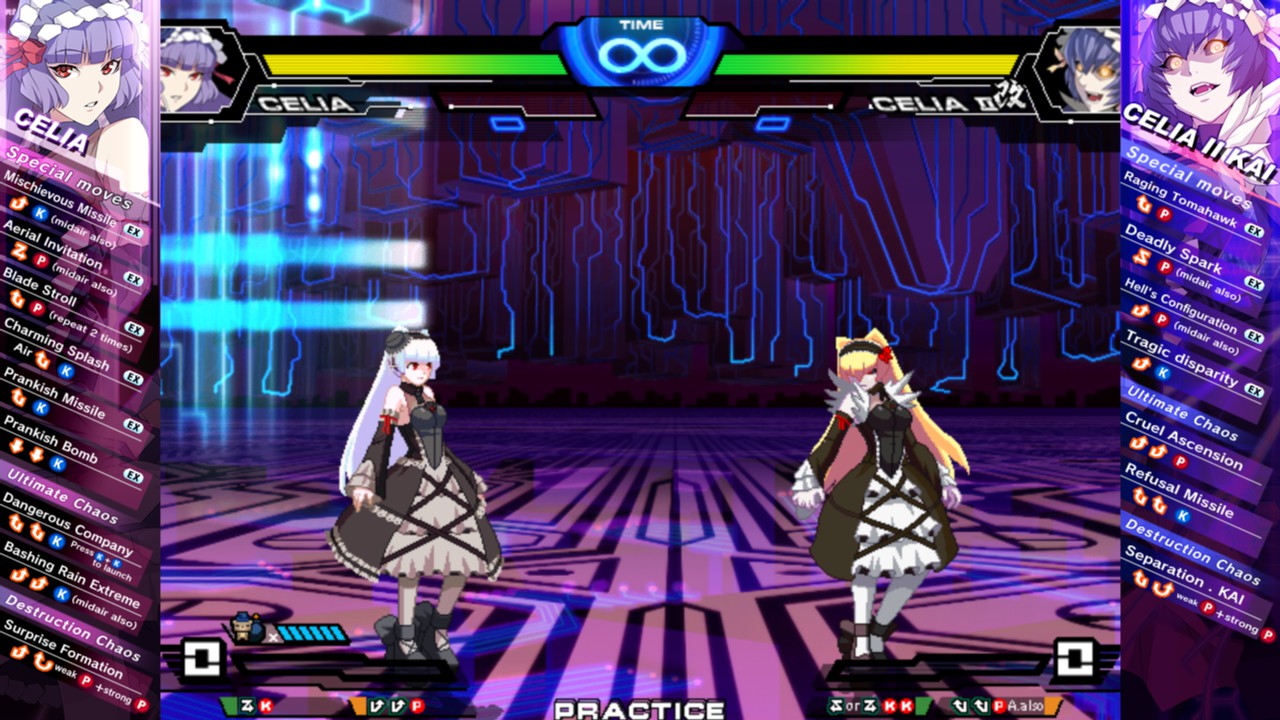
- Show the move list on-screen in single player, and optionally in versus. Highlight the names of moves that you’ve done the command for successfully, with a timer indicating when the motion expires.
- Add more relevant post-match statistics, like how many overheads you blocked, how many times you successfully anti-aired, whether you got hit on wakeup, etc..
- Match analysis based on simple statistical points, keep track of what moves specifically you get hit by, suggest moves that the playerbase commonly interrupts or punishes that move with, for the character played.
Better Tutorialization
- Xrd Mission modes are the gold standard of how a tutorial should be structured. They drill you 5 times in a row, giving you a letter grade on what % you clear.
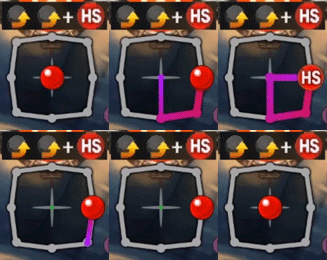
- In tutorial, teach players to do special move motions. Implement a sound effect, like a clicker or the just-frame sound used in the Tekken move list, that clicks every time they do part of the motion correctly, so they can tell they’re getting closer or further from getting the whole thing correct. This could maybe rise in pitch as you get closer to finishing the whole motion. So a QCF would be click like 1, 2, 3, 4 as you do d, d/f, f, P. UNIST had a tutorial for special move motions, but it only explained the motion and had you do it once with no visual feedback indicating whether you were doing it correctly.
- Implement the input display that shows the inputs as you do them like in Arc System Works games (with the 8-way gate with the ball indicating the stick position), but if you do a command correctly, will show you the name of the move connected to that command and the button you need to push, plus a timer for how long you have to press before the command is invalidated.
- http://sonichurricane.com/?p=5849
- For each move in the command list, indicate any special properties of the move, and have a side-bar explaining what the move does, and what it’s useful for, with a video of the move being used. (more games are starting to do this)
- Let players click on the move in the command list in order to see a demo of it, with an on-screen input display.
- Build a tutorial that explains absolutely everything (and not just system mechanics, but strategy). Have buttons displayed as both what they are on the controller and as their short name.
- Anti-air
- punishing blocked unsafe attacks
- Combos (how to perform a link, a cancel, etc)
- Combo trials (I know, it’s a given)
- Blocking high/low correctly
- Reversal DP
- Confirm to super
- Poking
- Whiff punishing & counterpoking
- Tick throwing
- Defending against tick throws
- Block strings vs throw mixups
- Moving in on the opponent grounded (such as moving in, then blocking)
- Using chip damage to chip the opponent out
- Shimmy (knockdown and neutral versions)
- Meaty attacks
- Safe-jumping
- Jumping in on fireballs
- Performing fireball/anti-air
- Teaching players how to perform all the moves
- Jump attack into low (both using and defending against)
- Empty jump throw/low
- Abare (using options out of block)
- etc.
Better Single-Player Content
- Most gamers play games in order to finish their single-player content. Players are more likely to stick with a game that has satisfying single-player content.
- People really liked the single player modes of Soul Calibur 2, Smash Bros Melee, and the recent Mortal Kombat games.
- Having health and meter roll over between fights, and usable items makes players feel like single-player content is more contiguous and
- An RPG adventure mode, where you walk around and run into random encounters (like Them’s Fightin’ Herds or SF6 World Tour) can help provide a sense of place that isolated missions don’t.
- Making more generic enemies designed to be fair (reactable) like single player enemies from other games, rather than designed like another character with unreactable attacks can help people get a grip on basics, without overwhelming them. Them’s Fightin’ Herds made a great attempt at this. Generic enemies can even be designed specifically to teach specific skills by breaking the normal rules, such as only having them be vulnerable on a block punish, only vulnerable to an unsafe (but confirmable) special, etc.
- Particle effect glints on AI to indicate they’re about to do certain unreactable things, so you can learn to predict those things. For example, glinting before throwing a fireball, so you can learn to jump right when the fireball comes out.
- More minigame missions, like Xrd’s better missions, can be added to story mode. Building single-player minigames like these can give players more to chew on, and help them more directly build basic skills, like blocking, reversals, anti-air, confirming, and so on. Guilty Gear Xrd Rev 2 has good missions for learning basic fighting game skills, including:
- 5 (anti-air)
- 7 (air-to-air)
- 8 (Hit Confirm)
- 9 (Air Hit Confirm)
- 10 (Dash and Grab)
- 11 (Tick Throw)
- 15 (Block Random Overheads)
- 25 (survive for 3 seconds when you have low health)
- 26 (Charge Moves)
- 27 (Meaty Attacks)
- 28 (Reversal)
- Ex 1: Sol 1 (punishing DPs)
- Ex 3: Ky 1 (Approaching a Zoner)
- Ex 7: Millia 1 (Blocking Mixups)
- Ex 20: Venom 2 (blocking overheads)
- Ex 24: I-no 2 (Blocking Overheads & Fuzzies)
- Ex 27: Ramlethal 1 (Blocking Overheads)
- Ex 32: Elphelt 2 (Abare)
- Ex 34: Leo 2 (Blocking Mixups)
- Ex 41: Haeyun 1 (Abare)
- Ex 45: Dizzy 1 (Approaching a Zoner)
- AC+R missions mode had some special AI fights, with restrictions like no jumping, no blocking, only combos deal damage, etc. Make some cool missions like this that teach fundamentals through their restrictions. Smash Bros Melee and Brawl’s event modes are also a great point of inspiration.
- Rotating AI boss fights, like SFV, maybe with randomized restrictions and less cheatery.
- AI that targets your weak points and gives you reminders about them.
- Killer Instinct’s Shadow AI system is difficult to implement, and far from perfect, but a feature like this means you can build “dumb” AI that actually play like people and teach fundamentals, and react to how you play instead of them fighting actually dumb AI that play entirely unlike people. This can be used for SO SO MUCH. This gives people a way to practice against human-like opponents of any skill level, and lets you build simple human-like bots that only use one strategy so people can practice versus that one tactic over and over, such as Zoning/Anti-Air or Sweep/Throw, or Pressure.
Community Building
- Put people in lobbies more often, have standard voice chat and text chat features like everything other game on planet earth does. Let you walk up to anyone in the lobby and challenge them, no bullshit involved.
- Have lobby browsers like old online games used to (or like fightcade at least), let people freely talk in lobbies with voice and full text chat, stop restricting them to canned emotes only. Let people make persistent lobbies with custom names and personalize them with persistent customization, so people can grow more attached to virtual places they’ve been, or you could have premade lobbies with different assets and names so they’re unique, a lot like MMO cities. Give people something to get attached to, let them leave a mark on it, and let them associate with other people there.
- Daily trials or missions that reward you if you do a little warmup exercise each day, so you get training in as you get currency.
- Random items that provide buffs that emphasize the core fundamentals of the game, a la james chen’s video.
- Link to a community discord in the game.
- Link to the wiki for the game in the game. Make an official wiki for the game, and invite community members to become moderators (Paradox does this with their wikis).
- Make official forums for your game, and link to them in the game.
Improve User Experience
- For a PC fighting game, make the mouse work in menus so you can change settings and binds easily.
- Let you set all your controls by holding down 2 buttons on any given controller (like fantasy strike), so that as long as the controller is registered by the computer at all, you can always set up the binds easily.
- Combo suggestions, suggest how a combo could be extended, have a training path from simple combos to more complex ones.
- Shareable combo trials and tutorial missions generated by users.
- Indicator you pressed a button too early/late in combo trials, maybe a pocket rumble/skullgirls style framedata display, so you can see it even better. Along with audio feedback to make this more clear.
- Character unlocks (and a secret code on the title screen to unlock all the characters instantly, plus extra secret codes for all colors, costumes, stages, etc). This means casuals can unlock content, which they really enjoy doing, but serious players and tournament organizers can look up the code to get it all instantly, letting them play the real game from day 1.
- Megabuffer mode? Customizable buffer? mode where you have mega-lenience on motion commands, and it detects if a late input on a dropped combo would have combo’d and reverses time to make it combo.
- Good input readers, no bullshit like not recognizing 6314 as 63214 or not recognizing 626 as 623. Not too tight, not too loose.
- Built in replay recording, posting to social media, conversion to video (Smash ultimate has this).
- Make rotations on the same local setup easier, let 3+ people plug in as many controllers as the system supports. Before each round, have each player hit start to confirm who’s in or out. (a lot of games already do this, wouldn’t hurt to have more. It would make games more sociable)
- Add a dedicated rotation mode that automatically swaps between the pool of players that have opted into rotating.
Non-Competitive Multiplayer Modes
- For-Fun Versus Modes where you only have certain core utility moves, like crouching MK, throw, fireball, uppercut, and gotta make do with just those. Maybe stick these on single buttons, akin to Flappy Fighter.
- Add a mode that restricts you to normal moves only, have them deal more damage if you hit with the tip of pokes and base of +frame moves, so people need to use the right moves based on range. Flashy indicator for bonus damage, make the player feel the crunch when they’re successful.
- Crazy modes that are fun to play around in, such as: Mortal Kombat test your luck mode, MVC3 heroes and heralds mode, Smash bros special versus, Project M Turbo mode (where everything cancels into everything), KOF teams mode, sudden death mode (first touch kills), combos mode (only combos deal damage), mode where you lose only if you get cornered for 10 seconds consecutively, a mode where you can only deal significant damage off whiff punishes and throws, a mode where anti-air deals like 3 times as much damage with a loud crush counter style effect.
- Injustice equipment that only works in a special mode for it and becomes cosmetic otherwise.
- Team modes with multiple players where other people can throw in assists of their own volition, and you tag in and out (more like BBTag or 2XKO than DBFZ)
- Keep you off ranked play until you play a sufficient amount of single player content and/or play enough casual matches (unlock ranked instantly if you do a big combo, or input a cheat code)
- Random loot at the end of versus matches, bonus for certain achievements like high rate of overhead blocks, successful anti-airs, throw techs, combos over X hits, or certain criteria for nutty shenanigans. the percentage required to trigger these could be connected to rank.
- Nuttier criteria could include taunting a lot (each taunt raises chance for 1 extra lootbox), wakeup super, blocking wakeup super, etc
- Custom color palettes, tekken costumes (could work in a 2.5d game, like SFV or GG maybe?), customizeable/unlockable taunts
- Explain that the combos in the combo trials are not the only combos
- Actually explain combo theory instead of showing a combo and making new players think that combos are just memorizing arbitrary sequences
- More handicap features, make them available in player matches, add currency/lootbox rewards for undertaking them. Try to weaken the advantages of experts and strengthen beginners in ways that teach good fundamentals. Such as:
- the standard health cut
- increased combo proration
- faster hitstun scaling
- Invincibility after wake-up for like 5f
- Take bonus damage on antiair
- Have minigames, like a ton of enemies that all jump over you and you need to block their ambiguous crossups correctly, have millia blocker, have distinct unlockable rewards for getting over certain scores that can be shown off in online play (better than a high score chart or just a random medal or whatever).
- Some Mortal Kombat X modifiers are good for teaching fundamentals:
- 15 seconds (15 sec)
- Bad jumping (lose health on jump)
- Blocking disabled
- Danger (1% health)
- Fire (you’re on fire, pass it like hot potato)
- Frost Shield (randomly freezes opponent on successful block)
- God fist(reduces opponent to 1hp on next hit, lasts a second)
- Hand to hand (disables special attacks)
- Juggle Kombat (let’s you juggle longer)
- Klose kombats (walls are closer)
- No turtles (disables ducking)
- Overpowered (normals can’t be blocked)
- Quick uppercut recovery
- Slow start(start slow, increase speed as you perform combos)
- Super meter disabled
- Super degen (meter depletes over time)
- Throw disabled
- Triple chip damage
- Wrestling Kombat (throws deal increased damage)
- X-ray instakill
- You’re special (specials deal more damage)
New Player Experience
- Use placement matches to quickly figure out where someone should be ranked.
- Create a super-beginner queue for players who have trouble playing at all. Anyone who does anything obviously skillful gets immediately removed to guarantee the newbie queue has exclusively newbies (you can detect if someone accidentally mashed out a combo by checking if all the inputs in it correspond to the moves getting activated. If there’s a bunch of inputs that have nothing to do with the moves in the combo, you know they mashed it).
- Hide your matchmaking rank. Only show it to people above a certain threshold, like the top 5% players. Global Smash Power in Smash Ultimate is a clever way of refluffing ranking points to be less intimidating, but it’s still aggravating to players. Have for-fun rankings displayed to players (and hidden from opponents) based on their win ratio like rising thunder and hearthstone can be good forgiving feedback.
- Pad out the lower ranks of online play with humanoid bots that mimic weak players (neural network? careful coding? Ideally they spam certain moves so beginners gotta beat that move to move up). Normal skill based ranking systems have the problem that even the absolute bottom level of the ranked queue is still filled with thousands of losers that are better than you. Humanoid bots can help give players the confidence they need to keep playing online.
- Gears of War gives a subtle buff to new players in online play, it lasts until they get like, 5 wins. In a fighting game, this can be a ton of subtle things, see this video: https://www.youtube.com/watch?v=laUAgEUunsI or consider the below:
- Increased damage
- Increased combo scaling so players who know combos deal less damage
- Increased health
- Increased guts (health scaling)
- Automatically block meaties on wakeup sometimes when you wouldn’t, such as mashing on wakeup
- Automatically do a super or DP sometimes when you’re mashing directions and buttons and the other player is in a counterhit state.
- Extra hit/blockstun, not enough to make unsafe moves safe, but enough to tip the scales. +2 or +3
- Making new players invincible on trades/near trades
- Outright make new player attacks unblockable sometimes
- Create an optional simpler input system. Maybe include a QCF or DP input for the super, to ease players into stuff like that. Simple inputs could have a cooldown as a means of balancing the input scheme, and the cooldown can be negated on hit (like Rising Thunder and GBVS).
- Have people regularly switch sides during matches, so beginners get used to doing motions on both sides (Tekken has trouble with this.)
- Detect when someone mashes multiple buttons during other moves and when they mash over a certain threshold: Buffer a taunt, uncancellable. This directly punishes mashing, making it more obviously bad to mash. (Also highly likely to annoy the shit out of players, so take with a grain of salt)
- Add a scoring system in single player that explicitly rewards basic actions, like doing special moves. Every time you do a special move, bonus points. This bonus can drop off, so you don’t break the scoring system by spamming specials until timeout.
Other Stuff
- Strong IP. The roster is the primary thing that draws players into a game, people need to be fans of the characters. Licensing IP is super powerful. Mortal Kombat is a strong IP all by itself, Smash Bros leverages a ton of strong IPs, Dragon Ball and Marvel vs Capcom both leveraged IP successfully, but turned people away in the long run because of the style of game (tag team fighter), and bad User Experience.
Of course none of these ideas can fix the problem alone. They work in tandem and they support each other. Stuff that’s completely unrelated to the game can help boost the game too, like the Netflix Witcher series raising sales of Witcher 3, an already popular game, by 554%, but people won’t stick with the game if it actively repels them.
If we want to see the fighting game community grow, the gameplay of fighting games doesn’t need to change, but a lot of the structure and presentation around the gameplay needs to change in order to help and encourage new players.
 Celia Wagar's CritPoints
“No other genre has a nigh-invisible property attached to every attack”
I’m a fighting games fan, but I can’t agree enough. The properties of attacks are the major problem in understanding the game. Tekken is the worst example (tekken is the worst example in many ways lol) with its tracking left/tracking right moves that are extremely unintuitive and arbitrary. So it comes down to grinding and training your muscle memory, nothing more. There is no thought involved, only testing the properties and training yourself.
And in general fgs being centered on almost identical (to a newbie) attacks makes it difficult to differentiate the attacks and memorize them (I still have problems with memorizing the frame data on SF5 different charge “tackle”-like moves like Urien’s, Gil, Bison, Balrog, etc.).
League of legends is in many ways welcoming for newcomers, but I want to stress the part where every character has a distinct set of skills that are so unique and you can say imaginative that you can easily memorize them. To paraphraze what I just said, in League you deal with more obvious effects like Mordekaizer pulling you into another dimension away from your and his teammates making the fight 1v1, or Zed summoning a clone of himself that he can return to, or Poppy dashing into you and stunning if she succesfully pin you into the wall with her dash, etc. These skills also inspire your imagination – you can guess and find counter-measures intuitively.
While in fgs you deal with some obscure properties like tracking left that may just be not interesting for people – in how they function, in what effect they produce and the training routine you need to undergone to beat the specific move that has nothing to do with another similar move.
LikeLiked by 2 people
Something I might ask here is: what does non-competitive play actually look like for fighting games? In MTG there are lots of well-understood ways to play casually. Some players buy into a booster draft every friday at their LGS, some players build a meticulously constructed 100-card Commander deck to play with six friends every so often, some players (like me) play too much Vintage Cube whenever it comes on MODO, etc. Interstingly daft, commander and other varieties were all conceived ‘bottom up’, devised by players themselves to accomodate casual play, and Wizards began to support them afterwards.
My experience as a casual player of fighting games is something like this: I meet another girl and sooner or later find out she likes fighting games, or at least some fighting game. She’s usually also a casual player. One of us says we should play such-and-such together and we get excited about the idea. We play it every day for two weeks and then we sort of froget about it. “Why did we stop playing Guilty Gear?” “Yeah dude, that game was awesome.” And then we don’t play it again. I never bother with the ladder/lobby because I just don’t want to play with strangers; I want to play with my friends. If other casual players are like me, the drop-off in concurrent players in DBFZ isn’t surprising. In any case, we all still bought the game. It’s possible that if you’re still thinking about how to populate lobbies, you’re not yet thinking casual enough.
Incidentally, for all the people I’ve played with like this (and it is most of my friends!), no one has ever struggled with the button inputs. That is to say, as much as we flub them it’s never a source of frustration. We never bother learning combos. I don’t feel like I need to understand the game any better. I’m just not committed to the game because I only play it socially.
LikeLike
Star Fox/Starwing was not only the very first SNES game we ever got, but it was the first ever video game I ever played. And even though it looks dated now, I still enjoy playing it now and again. And I also play Super Mario World too.
What? No Super Star Wars, Super The Empire Strikes Back, Super Return of the Jedi, Mario Paint or The Mask? Not even as honourable mentions?
LikeLike
What are you replying to? This doesn’t seem relevant to the post at all.
LikeLike