Do you like Rhythm games? If you don’t (since you’ve said you don’t like games with only one way to beat them), how would you make them better?
Nope, you pretty much hit the nail on the head. Low/No depth, despite being challenging. Continue reading
Commentary on Specific Games
Do you like Rhythm games? If you don’t (since you’ve said you don’t like games with only one way to beat them), how would you make them better?
Nope, you pretty much hit the nail on the head. Low/No depth, despite being challenging. Continue reading
Review the combats:
Okay, from its announcement I was interested in For Honor, but also hesitant about it, because it’s hard to tell what’s going on exactly. Like there’s 3 attack stances, controlled by the right stick (what controls the camera when you’re not locked onto a human opponent? What allows you to switch your lock-on between human opponents?) that clearly do different attacks, but the animations don’t have very clear arcs to them, and the UI here clearly indicates your opponent’s block stance as well as your own as a means of compensating for the unclear animations.
The npc rabble appear to go down in one hit, much like enemies in a dynasty warrior title, but also seem to be able to damage you. There are 5 segments of health on each player character, each sword blow seems to deal 1 segment of health, some abilities can deal partial damage to a segment, and some character classes lose partial segments on successful blocks, as seen near the end of the first commentated section of footage. (which makes sense, as they said the assassin’s class doesn’t have good defense)
There appear to be guard breaking moves, and things that have combined animations between both players that move them around, and I have no idea what triggers those or what they really do.
I don’t know how the hit ranges are determined, or whether the attacks are magnetic or not, or how attack animations are determined, and regrettably, that’s what this kind of comes down to. Attacks might be randomly chosen out of a bag for all 3 block zones, they might have predetermined looping sequences for all 3 block zones (preferable). There might be additional actions possible depending on the buttons you press that trigger those extra actions. It’s honestly hard to tell right now.
The other thing that is up in the air is the relationship between the block zones. In 2d fighting games, there are 3 possible properties an attack can have, high, mid, or low. You have 2 block zones, back, which blocks mid and high attacks, and downback, which blocks mid and low attacks. Mids and Lows are allowed to be fast in 2d fighting games, so downback is the default block zone, highs must be slower to allow for reaction time. In 3d fighting games the relationship is different. There are still high mid and low attacks, but a high block in a 3d fighter will block high and mid attacks, an a low block in a 3d fighter will block low attacks, and high attacks will miss, but mids will hit. In 3d fighters, mids and highs are allowed to be fast, but lows are the slow ones.
In this game, all 3 block zones seem to be totally exclusive, so is there a relationship between attack speed and block zone that prioritizes any of them? Dunno. If there isn’t, then it’s a 3-way guessing game, which sucks, but if the attacks are animated well/consistently and you can play the range game footsie dance, then it might work.
If you can’t consistently produce attacks, it’ll suck, guaranteed. It pretty much hinges on that. Can’t tell yet.
Bayonetta doesn’t have a large move list, most of the weapons are pretty same-y. A bit of experimentation will let you figure out which combos are suitable for a given situation (e.g. do you want to launch the foe, do you want range, do you want something quick). And the moveset is pretty flexible so it’s more about understanding the fundamentals of movement and approaching various enemies than memorizing an entire list of combos. I mean, DMC has more moveset memorization than Bayo for sure. Also, none of PG’s other games have much memorization. MGR has a dial-a-combo moveset, but once you understand move properties, you’ll quickly realize which ones are worth using in a given situation. The rest are for showing off.
The trouble is that they’re rather samey despite having so many, and you get punished score-wise for repeating them. I’ve been meaning to give Bayonetta another shot since I beat it the first time.
MGR has more dial combos than I want to memorize, and I did memorize them at one point. It was disappointing because they were so samey (and also useless).
I think dial combos are alright in moderation, but more than 3 on a given weapon in a given stance is overkill. Nero hit the sweet spot there. He has a basic mash combo, then he has 2 special combos, one for AOE, one for damage. Both of those can be extended with good timing.
http://bayonetta.wikia.com/wiki/List_of_Combo_Attacks
Bayonetta has 19 ground combos and 6 air combos!
And you can only see the list of these during training mode, or by pausing during gameplay! (Unless there’s a menu option to enable the training dialogue during gameplay)
The only way to realistically learn all these combo chains is to sit in training mode and try each combo listed one by one until you memorize by rote. The game doesn’t feature a natural process for learning these combos. You aren’t introduced to them one by one and expected to become acclimated to them over a long period of time before more are introduced (the others don’t even have to be locked off, you could have all the moves from the beginning, but guided exercises using specific ones would have sufficed).
The level of complexity here is made very high, but the game does not gain a lot of depth from it, because combos need to repeat moves from intermediary combos, so the more useful moves are functionally chained to the moves that come earlier in the combo.
The average person sees this and probably doesn’t want to put up with memorizing so many sequences. I’ve learned skullgirls B&Bs that are less of a pain than this, because at least every single move in the combo is something I can perform by itself and I know has a functional purpose in the combo. In Bayonetta and games like it, these are completely arbitrary sequences that have no sort of aid or tutorial process for committing them to memory.
In fighting games, there are a bunch of different combos because there are a bunch of different openers and resources that can be spent, as well as different states of advantage the combo can end in. In Bayonetta, those same tradeoffs don’t exist, combos are expected to fulfill the role of functional moves, but because they need to go through all the lower moves to get to the last one that is functional, they end up being samey.
What’s your opinion on the Punch out series?
Okay, I had a short conversation about Punchout on Twitter fairly recently, I think with Jason Brown. It was after I watched the punchout vod from AGDQ. I played the original Punchout for myself, made it up to the third league, about halfway through.
Like, Punchout is weird. I don’t totally know what to make of it. On first glance, it appears to just be a glorified rhythm game with some puzzle elements thrown in (or vice versa). I remember seeing an explanation of all the different fighters’ weak points where punching them would yield a star on G4TV long ago, so at first glance it appears fairly obvious that to win you just gotta punch them when they won’t block or dodge, then punch them at the critical moment to get a star. But then it gets weirder. Continue reading
Any good game design articles on shoot ’em ups? Also, what do you personally thing makes a fun shmup?
None that I know of, besides this which is more of a history article:
http://www.racketboy.com/retro/shooters/shmups-101-a-beginners-guide-to-2d-shooters
and this, which is kind of a beginner’s guide:
https://catstronaut.wordpress.com/2013/02/18/understanding-scrolling-shooters/
I don’t totally know. I have a huge list of shmups to eventually play, but I haven’t gotten very far into the genre.
I’m gonna say the same thing I always say for what makes a good game: Depth and challenge. Interesting choices.
There seem to be two schools on what makes a good shmup, there’s the danmaku school, and the more classic reactive shmup school. From an outsider’s perspective it seems like there’s a division between games that are considered great because they have good scoring systems that are difficult to master, like perhaps Ikaruga, and games that are considered great because they’ll fucking kill you. There’s games that curtain the screen in bullets of all different sizes in intricate patterns that must be weaved through (like touhou), then there’s games where the enemies are reactive to your position and patterns and try to attack you in ways that you need to react to and counter (like mars matrix).
Some basic notes I took on the Touhou scoring system are that its various components require you to choose between one another and put yourself in harm’s way. The most iconic is grazing bullets of course, if you have your character sprite touch a bullet without it hitting you, your graze score goes up, which scores points and acts as a point multiplier I believe. This means you need to get close to bullets to gain points, rising death. Even better to get closer to the bullet’s source where many bullets will pass by you, but that’s dangerous of course. Next, there’s item collection, which can mean weaving across fields of bullets to get in position to collect items. Then there’s the point of collection, a line near the top of the screen where all the items will be collected automatically, but that’s of course where the enemies are, so that’s dangerous, and you can’t shoot them there. Bombs earn score based on how many bullets are on the screen, so more bullets is higher score, which is dangerous for obvious reasons. Intentionally losing lives to get more bombs is advantageous for scoring too, so you’re not allowed to keep all your lives if you want to score the highest, you need to put yourself right next to death at some point. Basically, they really want you to go up close to the bosses and potentially get your shit rocked.
I have written a little about how I’d design a shmup privately, and most of it involves emphasizing the reactivity of enemies, trying to cook up new behaviors for them that emphasize decision making from the player.
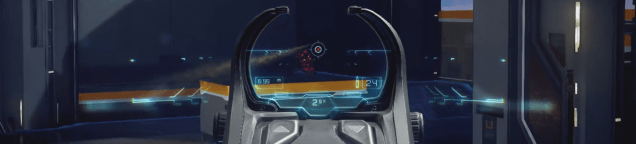
Since the advent of First Person Shooter games on consoles, there have been a number of design trends that have negatively influenced their development. Some of these changes to First Person Shooters were necessary to adapt them to a console setting, while others are arguably arbitrary but have nonetheless become design trends. Continue reading
How do you think Platinum could expand on the combat system of Vanquish to make it even greater for a sequel?
That’s hard.
Add a jump of some kind. Flesh out the melee attack system a little more and don’t have all the melee attacks cost the entire suit meter. More differentiated weapons, perhaps focused on moving enemies closer/further or crowd control a bit. More differentiated cannon fodder foot soldiers (they did a good job with the bigger mechs and romanovs, but those are more mini-boss-ish and I think making the cannon fodder have different types mixed in would be cool). Continue reading
What are the best aspects to God Hands combat system?
Probably the strongest aspect is the core loop. I feel really silly saying that because I generally think the method of describing gameplay as loops is kind of off-point because games mostly don’t follow such clear cut cyclical structures, they’re more like flow charts (which can have loops in them, but they are very irregular, and can frequently just go off into space). Continue reading
How do you feel about adventure games? Is there anything in them thats good or that we could learn from?
In case my prior posts haven’t made it clear, I feel negatively about adventure games. Looking abstractly, I think the structure implied of adventure games is lock and key. This is why Zelda was originally considered an Action RPG, and over time people have come to place it more in the adventure category. Adventure games are games where there are barriers placed in your way that can be opened by application of a key item retrieved from elsewhere. The more such barriers and keys you have, and the less other mechanical elements you have, the more the game matches the adventure game template.
So Doom, with its red, blue, and gold keys as well as myriad switches, has slight elements of this, but the first person shooting is much more heavily focused on, with those elements not functioning as the primary source of interaction or challenge, but rather as staging elements for the primary conflict, elements that make you sweep the level over, encountering the enemies in all sorts of different contexts, from different directions as walls open up or more are warped in to replace the ones you’ve killed already, or to surround and ambush you as you attempt to pursue objectives.
Zelda by contrast has become more and more about matching key to door over time, as almost every element in the game has become subservient to overall progression, and all of the challenges inherent in say the combat or movement systems have become funneled into using the right item on the right enemy, door, switch, or grapple point. You NEED to get Epona, not because you’d like to traverse the overworld a bit faster, or take down monsters in an alternate way that might be more effective on some monsters, but because at some point there’s going to be a gap or a wall that only Epona can jump over.
From a depth perspective, the trouble with adventure games is that none of the elements are interrelated, have much interaction with each other, have multiple uses, can be pushed for a stronger/weaker/variable effect using skill or based on the context of application, and there is little potential for alternate viable strategies, only flat solutions. You can introduce these types of things into adventure games, allowing barriers to be bypassed or unlocked in a variety of ways, improving the adventure game structure, but also making it less focused on the unlocking of barriers, but instead more general mechanical and critical thinking skills, such as in metroidvanias, which use the adventure game structure as a staging mechanism for their platform challenges, but are not usually associated closely with pure adventure games.
The ultimate trouble with adventure games is that when your only mechanic is matching keys to doors, your only means of introducing challenge and critical thought into the game is obscuring the locations of keys, the order in which they must interact with environmental objects, which environmental objects are barriers at all, and so on.
Professor Layton practically isn’t an adventure game for its structure (it still is, it just lacks a lot of their lock/barrier structure for the most part). Advancing the plot in the Layton games is primarily about going to a location, talking to someone, and solving a puzzle. Sometimes the sequence in which people must be talked to is a bit funny, but if you just talk to everyone available, you cannot avoid progressing (assuming you’re good at puzzles). The game is extremely straightforward about what is required to do next, because it’s not trying to hide any information from you, or require you to guess at anything to progress, it just uses the basic adventure game structure as a way to push you into solving a lot of puzzles, which are the core of the game. It’s ever so barely a point and click adventure game, it’s just trying to give you more options in the order you solve puzzles, and create a hint-coin finding metagame that influences how easy the puzzles are, while also creating a definite sense of progression through the game.
Psychonauts by contrast is shackled to its adventure game design. It could have been a great platforming game, instead they decided you should go around collecting all this shit scattered through the levels. You need to collect 5 arrowheads to pay off two kids to progress after basic braining, you need the oarsman badge to go learn levitation, you need the arrowhead dowser to find enough arrowheads to buy the cobweb duster (which means collecting a ton of arrowheads twice), you need to have telekinesis to complete the milkman conspiracy (which means collecting a ton of psi cards and cores, and you also need to do a whole trading sequence in this level), along with the cobweb duster (which is necessary overall to beat the whole game), you need invisibility in Gloria’s Theater (more figments, psi cards and cores). And so on.
The key items/abilities in adventure games should have a variety of uses. That’s what is the case in (good) metroidvania games. You don’t just get the morph ball bomb that can blow up specific blocks, it can also let you jump in morph ball form, depending on the game even multiple or infinite times. The ice beam is used to freeze enemies, allowing them to be used as platforms, which is really involved mechanically, as opposed to just opening ice doors. The high jump boots are cool, but you can also walljump in many places, bypassing the need for them.
Dark Souls has a strictly lock-and-key structure, no new abilities, but there are a ton of low affordance means or alternate means of reaching places. You can pick the master key at the start and go directly to blighttown, you could also go through new londo, killing ingward. You can hop into the lower burg immediately. You can fight Sif early through the back way.
Adventure games by themselves are weak.
Do you think that Kingdom Come: Deliverance could/will be a good game?
It doesn’t seem likely from the initial videos they’ve released describing and showing the combat system.
Combat at 24:00
These are real life sword fighters. They know sword moves, they know stances, and so on, and they are trying to translate the complex system of how our bodies move into a control system with 2 buttons and mouselook.
So they went out and motion-captured a ton of animations, and tried to fit all these animations of actual sword stances and maneuvers into a 5-way strike/guard system. So you end up with things like “combos” of 3 moves you perform on someone’s block, where the third hit is a guardbreaker.
You have these “real medieval techniques” of up attack, left attack, down-right attack. All with animations totally accurate to how soldiers fought on the battlefield in like, the 1400s or something, but systems resembling some person’s conception of competitive Simon Says.
Rather than try to connect with the simulation of space, or the dimension of time inherent in these animations, they have no idea what to do, and made a completely different system that doesn’t reflect any of the animations they captured, because there’s no way you can get that level of finesse in a control scheme like a mouse and keyboard, or a controller, or even a motion controller.
Games like Chivalry, and Street Fighter are very unrealistic representations of combat, but they are able to capture a significant depth by giving their animations significantly different physical properties, like range, hitstun, startup, cooldown, pushback, and so on. In this they have largely uniform properties, except a variable that goes from 1 through 5 for the hit zones.
So sure Chivalry is Spin to Win at the highest level and utterly ridiculous compared to how medieval fighters used their weapons, Dark Souls too, but they’re making the best of their medium to capture a type of depth, a combat dynamic, that isn’t present in real life confrontations, and isn’t present in this even more shallow imitation of real life confrontations.
In short, they probably can’t really do better than this. This is probably the limits of what you can do in attempting to mimic real life fighting styles. It goes to show what the limits are of trying to achieve authenticity, instead of merely deriving inspiration from real life sources in pursuit of something a bit more abstract that will be deep on its own even if inauthentic. They seem to be influenced by an immersion-based mindset judging by their other statements on what the final game will be.
I feel like there’s a lot of unexplored space for first person mouselook melee combat, but it’s limited by the number of buttons on the average person’s mouse, and we need to think a little harder about reasons to look in different places than directly at our opponents and movement.
 Celia Wagar's CritPoints