Counter Picking

What are your thoughts on counter picking?

What part of counterpicking? People who counterpick? The strategy? Games that facilitate it?

Well this came up just after an Overwatch ask, so I think I’ll talk about counterpicking in that. I’m in favor because it means that first off, there is a natural counterbalance to good team compositions, without having to get stuck in a bad matchup for a whole round. Second, sure all the characters are kinda simple, but you get to switch between them frequently so it kinda makes up for it in variety, because they’re fairly dissimilar. Third, there’s an actual extra strategic layer in counterpicking that happens over the course of the match, which is pretty neat.

As for counterpicking in general as an honor sort of thing. There’s no shame in it, it’s another part of the game. If you know your opponent favors a character, there’s absolutely no shame in picking one that beats their common choice. I did a $100 money match with a friend of mine once, and I went entirely Snake instead of my main character Marth. Play to win. With that same friend on another occasion, we did an draft pick Iron man competition in 3rd Strike, where we went back and forth picking characters from the roster. On my first turn to pick, I snatched his best character, Q, and was sure on the second turn to grab my best character, Ken, before he realized that this was the optimal strategy. I didn’t need Q to win, I only needed Ken, but I grabbed his best resource, where I could fall back on a bunch of characters. If counterpicking is the right strategy, go for it.

So sometimes you come up against an opponent that gives you a tough time. You have a bad matchup against their character. Maybe this is a recurring thing, maybe you play Ice Climbers and run into Peach a lot. Should you counterpick? The answer here gets a lot more fuzzy. In fighting games, getting good with a character is a big investment. Being good enough with two characters to be able to pull one out in response to your opponent is tough. In the moment you gotta question yourself, “am I actually good enough with this second character to stand a better chance of winning than if I stick with my primary character in a disadvantageous matchup?” Then beyond that, can you adapt to the new character fast enough to play effectively, and can you switch back to your main when the time comes. You might even have a situation like Infiltration at Evo 2015 where he clearly has a massive bag of characters to pull out and it causes doubt during character selection.

On the game design level though, how much should the game be about picking characters before the round even starts? You get competitive card games which are almost entirely determined by this sort of thing, and some fighting games have so many characters that it becomes purely about who can play more of them, which kinda sucks if you’re a mono-main or a beginner. In that respect, keeping the character count down isn’t an entirely bad thing, if it means that people can just choose a character and stick with it, much like how Smash Bros Melee players do. Having options is cool, but you eventually have to pay a price logistically. This can also be aided not just by making the game really balanced, but by preventing any matchups that are 7:3 or worse, however as more characters are added, that’s harder and harder to do while preserving diversity. Higher levels of investment into characters, such as in Guilty Gear, can also lead to players being less inclined to counterpick or stray from their main.

The Secret Behind Platinum’s Quality?

If you ever get to the new TMNT game by Platinum, what’s your opinion on it?

I played it briefly.

It’s kinda boring. It doesn’t tell you the sequences for the combos for some reason. I checked all the menus. The sequences are the same on all the turtles, but each one has slightly different attack animations at a difference cadence and range and all. All of them can mash light attack in the air to do an air sequence, and press heavy attack for a diving attack. Then they each have slightly different sets of special attacks that do slightly different things. The game has a unique block/dodge/parry system. You can press R1 to dodge, hold it to block while spinning in shell form, then release right as you’re hit to parry an attack. Dodging perfectly lets you circle behind enemies and jump on their back to deal damage by mashing buttons. Speaking of that, there’s a fuckton of mashing in this game. You gotta mash to interact with things, and mash to revive when you get knocked out.

Each stage is a big cityscape with ninjas all over it. Occasionally objectives pop up that you can complete. You can use see-through-walls-vision to find where shit is going on. Beat up ninjas and eventually you get access to the boss.

So, kind of a disappointment overall. It’s a really simple combat system, and meh enemies, with plenty of filler content all over.

What’s interesting is the director. It was directed by Eiro Shirahama, who you might notice was also the director of Legend of Korra. Legend of Korra was probably Platinum’s biggest miss up to this point, which lead to a surprise when Transformers Devastation was amazing. So why was Transformers Devastation good among these three licensed cartoon games? The director of Devastation was actually Kenji Saito, who you might also know as the director of Metal Gear Rising.

So this makes me wonder, what other recurring directors have we had at Platinum Games? The answer is almost none. Almost every Platinum game has a different director. Even ones you’d think would have the same director like Mad World to Anarchy Reigns, and Bayonetta to Bayonetta 2 have different directors (perhaps this explains the difference in quality between Bayo 1 and 2). I’m only really looking at directors here because I know that a lot of the corporate attitude of Platinum is inherited from what Shinji Mikami established back at Capcom, where it’s all about the director’s vision. You’ll notice there are few repeating people in other roles as well though.

Of the recurring directors we have Hideki Kamiya (Bayo 1, W101, Scalebound), Yusuke Hashimoto (Bayo 2, Star Fox Zero), Eiro Shirahama (Legend of Korra, TMNT), and Kenji Saito (MGR, TD). This leads me to think that Kenji Saito is something really special to the company, he may be an even better director than Kamiya. I’d keep an eye on him in particular in the future. It also leads me to think that Hashimoto and Eiro Shirahama aren’t very good directors.

Wii U

What are your thoughts on The Wii U?

Bayonetta 2, Wonderful 101, Mario Maker. Don’t care about anything else on the system.

Nintendo doesn’t release good software. They didn’t exploit the potential of the system that everyone originally saw. Nobody wants to put up with the large controller for games that largely only have tacked on functionality for it. Continue reading

Making Turn Based Battles Actually Fun

How would you make turn based battles more engaging? (Aside from the mechanics that the mario and luigi and paper mario series use?)

In my current opinion the key is to have a much wider separation between optimal decisions and suboptimal or terrible decisions and to have these change on a turn-by turn basis. To really make Turn Based Battles more engaging, you need to make it more about the player evaluating the circumstance and needing to judge what options are best for the situation. These need to change turn by turn so that the player rethinks on a continual basis, so they are engaged in the primary challenge.

How do you do this? First, options need to have tradeoffs versus other options. If you have a clear sorting order, like a bunch of JRPGs that have Bolt1 Bolt2 Bolt3 or something along those lines, you end up with people using the most powerful option most of the time. There need to be other variables and dimensions to options besides how much HP damage they output in order to make them worthwhile over your most damaging option. In SMT, attacks that hit opponent’s weaknesses also gain turns for you, turns are another dimension of advantage that can ultimately translate into more damage than simply your most damaging option at that moment. (though obviously the problem here is that hitting their weakness usually is your most damaging option, then you gain a turn on top of that, so not the best example).

Ultimately what determines who wins in a turn based RPG is who can output the most damage, so everything comes down to either doing the most damage every turn, or setting up a circumstance in the future where you can output even more damage than you are now, while also balancing these against your survival. So the most basic tradeoff is dealing damage versus healing it, then dealing a lot of damage now versus more later, versus healing. Most traditional stat buffs in JRPGs are basically things that allow you to deal more damage in one way or another. You get direct damage buffs, which increase your damage on later turns, speed buffs which mean you attack faster, dealing damage more frequently, ultimately dealing more damage, accuracy buffs, which mean missing less which is more damage, etc.

So the questions to ask are, how can I make an option tempting that isn’t one of these existing options without making that option the only one people want to pick? How can I make people want to pick a different option every turn? How can I make someone want to prioritize different targets every turn? What other resources besides enemy HP and own HP can we make the player compete with enemies over?

Some basic ways of doing this are decay cycles, having things drop off in effectiveness over time, like how buffs in SMT expire after 3 turns, so they need to not only have a turn spent on applying them, but also need to be reapplied periodically, which can eat out of damage output in the short term. The Breath of Death VII and Cthulhu Saves the World games have enemy power grow by 10% every turn to stress efficiency, so if you can’t take out enemies fast enough, you will end up with enemies that can annihilate you, so long term setup strategies are not always as good as getting in that blast of damage to eliminate an enemy damage source this turn.

Other ideas are having things become good and bad on cycles, then making sure the options have orthagonal benefits to each of them so they’re tempting even during cycles where they’re bad over the options which are good that cycle. I’ve never seen this one done before.

Enemies can be spread out and attacks can have different hit areas so that you might be forced to hit certain enemies along with other enemies, and not get the optimal effect where you want it to. So like you might hit the weak to fire enemy with the brunt of your blast, but also the absorb fire enemy gets the second most intense part of the damage splash, healing it, so you might have done a really big net damage to the enemy group, but still healed that one pesky fire absorbing enemy. one ability might only affect every other member of a group, two enemies might be adjacent and needed to be killed on the same turn to die, so you can’t use that ability to kill them, but you can use it to hurt the one that’s ahead in life so they’re within range of each other.

It’s all about coming up with tradeoffs like that, and enemies that play off those tradeoffs.

I kind of like this question because it demonstrates a real predictive quality of game design theory in an area that is very abstract conceptually. I can talk about what the potential answers to this question would look like even without giving specific answers.

Smash Bros Melee Beginner’s Guide

I get a lot of people asking me how to learn the basics of Melee. Here’s some essential resources for learning how to play Melee:

This video is a great rundown of the basic mechanics, in an order that is good for beginners:

This video is probably the best place to start, it lays out most of the advanced techniques that are still in use today. Some of the terminology is a bit outdated, some of the topics like DI aren’t explained in as much detail as they should be, but it’s still a pretty good guide overall. If you’ve NEVER played before, pay attention to the in-game how-to-play tutorial shown at the beginning of this one.

This channel is SSBMtutorials, it has tutorials for a ton of characters on a great variety of topics. It’s made by a top player and goes into a lot of detail.
https://www.youtube.com/channel/UC46ZTid4t2ctB6osM0WTiJA

This thread links to videos that show every advanced technique for every character in the game with the inputs for that technique on-screen.

This channel contains “trials” videos for the top tier characters (and Captain Falcon for some reason) showing you basic techniques you can practice in training mode that will help you understand your character better.
https://www.youtube.com/channel/UC6R7DuarfdRdJtZvtDRedAQ/videos

This is an article I wrote that explains in depth how the entire grounded movement system in Melee works:
https://critpoints.wordpress.com/2015/12/28/the-smash-bros-movement-system/

This is another article I wrote about how the grounded neutral game tends to work in Melee:
https://critpoints.wordpress.com/2015/12/25/footsies-in-melee/

This last one explains how all the recovery systems in Smash Bros work:
https://critpoints.wordpress.com/2016/04/16/mtm-smash-bros-di-techs-and-meteor-cancels/

This page links to every characters’ hitboxes and framedata:
http://smashboards.com/threads/stratocasters-hitbox-system-new-download-link.283973/

This is a compendium of practically everything you could ever want to know about smash bros.
http://smashboards.com/threads/2014-ssbm-compendium-of-knowledge-updated-1-2-14.339520/

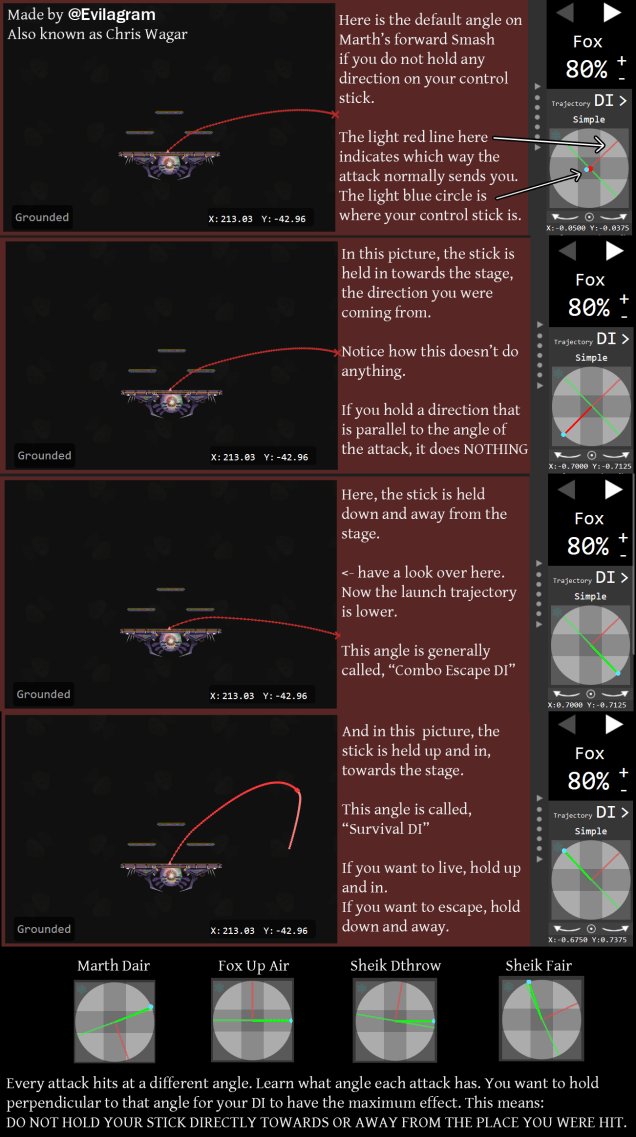
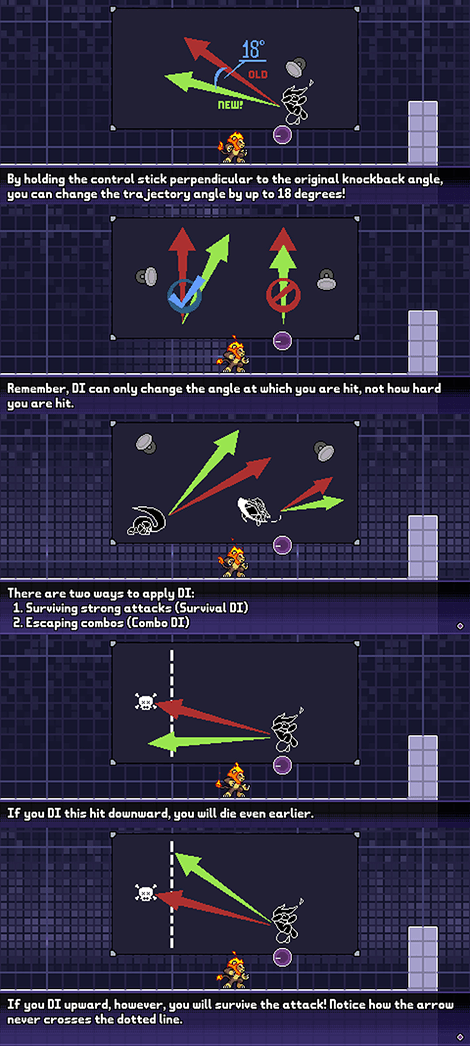
Directional Influence is a subtle mechanic that isn’t explained very well in most tutorials online, here’s some pictures that explain it.
rivals DI tutorial 1rivals DI tutorial 2
directional influence DI infographic tutorial

Beginner Fighting Games

Rising Thunder, Pocket Rumble, Divekick, Rivals of Aether… what’s the point of all these “beginner-friendly” games? Traditional fighting games are overwhelming at first, but you have to keep PLAYING them to git gud. Playing these baby games won’t magically make you a KoF/GG/Melee champion.

How many games do we need to dumb-down (oh, I mean, “simplify”) mechanics for scrubs before we realize that they won’t learn no matter what. Also, enough with “we want to explore the strategic element”. You can do that with all these other games that don’t need some 1 or 2-button control scheme.

The point is, I can bust out divekick and get anyone off the street playing in seconds.

King of Fighters can be overwhelming to someone who only plays Street Fighter, Guilty Gear is overwhelming to anyone who hasn’t played an arc sys fighting game before. Playing Street Fighter won’t make you a champion in those games, but it will give you a leg up, and you’ll certainly be able to wreck anyone starting fresh in those games. I know I’ve picked up random fighting games and been able to fight on par with people experienced in them just using fundamentals.

Having a simpler game to learn allows beginners to focus on the few tools they need to win, like fireball/anti-air, like the basics of footsies, meter management, simple combos, and so on. That’s a game that needs to exist in my opinion. If you don’t have games with a greater accessibility teach people the basics of the harder games, then it becomes a lot harder to get people into those harder games.

I’ve gotten people to play traditional fighting games with me and tried to give them the introduction and they were like, “This is cool, but there’s way too much stuff for me.”

How many games do we need to dumb-down (oh, I mean, “simplify”) mechanics for scrubs before we realize that they won’t learn no matter what. Also, enough with “we want to explore the strategic element”. You can do that with all these other games that don’t need some 1 or 2-button control scheme.

People will learn. Releasing new games with simpler control schemes isn’t harming the games we already have. They’re not establishing a new competitive standard. The further point I made is that these games are unique and do things other fighting games aren’t necessarily doing, which by itself validates their existence.

Being bad at a game does not make you a scrub. It does not make sense to write people off as irredeemable when they could potentially learn. If nothing else, these games are a useful tool to me personally, for introducing people to traditional fighting games in person.

These games teach you more with all their additional mechanics. Why regress. If you feel overwhelmed, there’s always the early entries in a respective series (e.g. SFII).

Except SFII is still too complicated for a lot of people, and on top of that, has the worst input read algorithm next to SFI, making it hard to even play the game at a beginner level unless you’re better at special move inputs than you’d need to be in order to play a more complex recent game.

Depth comes at the price of complexity, and sometimes people need a scaffolded experience or they simply get overwhelmed. It’s a regular pattern, beginners have so much to take in all at once to even play the game, they go a ton of rounds fumbling with the few controls they know and mashing buttons.

Simpler games with more straightforward basic functions can help alleviate this and allow people to develop the basic skills to understand the more complex games. Otherwise fighting games become a genre with no entry point, and that’s dangerous.

And there’s also the part where you glorify sub-SFII games like Divekick and Pocket Fighter. These games aren’t really good for learning either, I don’t care how you spin it. How many people have played those games and then seriously taken up more complex fighters? Usually, people get serious about FGs are actually playing with other people (friends, tourneys). Or through their desire to improve. These types of 1 or 2-button games are just gimmicks that become boring after a short period. They might be worth mentioning because their simplicity lets you easily discuss more fundamental concepts in the genre, but that is about the extent to it. I mean, people don’t discuss level design in NSMBW because it’s obviously too difficult, so they stick to the simpler SMB, and that’s fine for educational purposes, but we can’t keep teaching 1+1=2 over and over, nor should we glorify the work of people who think that coming up with 1 (not even 1+1, but literally just 1, which is what Divekick and Pocket Fighter are) is some revolutionary new idea.
Basically, if someone comes out with a sub-SMB platformer (like an autorunner), we ignore it, correct? So why behave differently for fighting games or any other genre? That kind of started as one ask, but turned into another.

Maybe they’re not good for learning? I don’t know yet. I haven’t had a serious chance to test out teaching people through them. So far I’ve mostly just been going with 3rd strike because it’s free and online.

I don’t really know how well they work as an introduction tool. They’re still pretty new. I admit that I’ve barely gotten to play pocket fighter, and never with another person.

I think they’re worth a try. Maybe I’m wrong and they don’t translate into anything. How about we wait and see?

The other thing is, Divekick is absolutely 1+1. There’s a lot more going on in Divekick than in an autorunner. I know it looks simple to you. Even I thought the concept was kind of stupid when I first saw it, but after playing it with other people it clicked and became interesting. Divekick asks a lot more of the player than any autorunner does. There are a lot more “inferential judgments” going on. (totally coining that term on the spot here, might even throw it in the glossary)

It’s like footsies in a traditional fighting game, it doesn’t make any sense to you when you first start playing, so you just mash, then you wonder why the other guy is hitting you more. I know I’ve had many people get surprised when they actually sit down and play divekick with me and realize that there’s a lot more to it than they initially thought.

And Pocket Fighter is more complex than Divekick, so it probably has more complex strategy to it.

The other thing is, fighting games are way more complex than SMB. If you strip away SMB you have something that is barely a game, if you strip away fighting games, you still have something left that is arguably just as complex as SMB.
My Influences

What are your influences in your work?

That’s complicated. There’s a lot. Between places I’ve been, things I’ve read, games I’ve played, and the experiences I’ve had. The following is not in strict chronological order.

Egoraptor’s sequelitis was an early influence. I wanted to make a game analysis channel with some friends because of him. It showed to me that there was a hidden layer to games that I didn’t really perceive. That’s what made those cartoons so successful I think. That’s why channels like NerdWriter or Every Frame a Painting are successful. It’s the basis of video essays. I had a similar experience early on in college with film theory. My storytelling professor told us about a scene from a film and he recontextualized the scene in a way that was incredible. He also broke down scenes from disney movies like 101 Dalmatians into all the staging and other elements going on in them, things that people see and perceive and pick up on, but don’t consciously examine why those elements are arranged.

Of course being on 4chan /v/ was a big deal. It’s a cesspool, but a bunch of intelligent people pass through and there’s no easier way to stay on top of what’s currently happening as well as get obscure content. I got introduced to extra credits, I found other blogs and resources on game design from amateurs, like Dagda-mor
http://dagda-mor.blogspot.com/

Running into icycalm and the ghetto forum was something that helped me figure out where I stood and develop my ideas, even though I’m not a fan of their practices and my current ideas don’t really derive from theirs in any way. The ghetto ended up introducing a ton of games to me that I wasn’t previously familiar with, and I was able to get good at fighting games and play a bunch of obscure ones thanks in part to them. Got into older games and got a ton of NES recommendations from one guy. Nobody there agreed with my views, and I had to figure out a coherent way of voicing my position, and iterate on my position to really argue with them. From threads on 4chan and other resources I started assembling my playlists of vidya skill videos. I also gained countless infographics, like that old one positioning narratology and ludology as juxtapositions, opposites.


Early Gather Your Party videos like the rise and fall of bunnyhopping as well as instig8’s videos were an influence in presentation formats. Video essays like that are rather common now.

https://wiki.lesswrong.com/wiki/Sequences
I read this a lot in high school and college. It probably helped my analytical thought process more than a lot of other things. In addition to it I read books on influential psychology, the “you are not so smart” blog, other resources on behavioral psychology as applied to human behavior, hypnosis, and neurolinguistic programming.

http://www.gdcvault.com/play/1016632/A-Theory-of-Fun-10
This work more than any others of raph koster’s has influenced my view of fun in relation to games.

I also became familiar with speedruns and TAS, and originally I didn’t like speedruns, only TAS. I had negative experiences with rhythm games, super meat boy, and other really rote score-based games that I did not really get the appeal of speedruns. TAS was cool because it was like pure magic. I eventually came around, I’ve explained that elsewhere. Speedruns have helped me understand a lot of how games are put together, though my own investigations have helped too.
http://tasvideos.org/

http://wiki.shoryuken.com/Main_Page
Fighting games helped that, because they require you to know a lot about their systems. Thankfully Smash Bros Melee was well documented, helping me out with that game.


http://www.sirlin.net/
Sirlin helped out a lot, he’s done a ton of great and practical writing on games.

http://kayin.moe/
Kayin’s written some neat stuff, can be a dick over personal and game politics.

Sean Malstrom has made me think about how fun, arcadey action oriented games might not only be popular, but in the financial best interest of companies.
http://sethhearthstone.wordpress.com/2011/03/01/of-an-eclectic-dialectic/

zeboyd published a bunch of nice stuff on RPGs
http://zeboyd.com/2013/09/10/why-games-like-the-wonderful-101-are-a-poor-fit-for-the-gaming-press/

Radiator has interesting notes on level design, this one in particular
http://www.blog.radiator.debacle.us/2012/07/thief-1s-assassins-and-environmental.html
This is a larger compilation by Hamish Todd, who also independently published interesting articles on gama sutra and even kotaku
http://www.critical-distance.com/2013/10/02/the-art-of-level-design-analysis/

Reading Kirbykid’s writings and disagreeing with a large chunk of them and other stuff has been a big influence on getting me in the right place. Used to participate in google hangout sessions with him and other people affiliated with him. I worked with him on the starseed observatory, but regrettably never contributed a piece to it. I felt like I kind of missed out, because I did have a unique idea for it.
http://critical-gaming.com/

Raph continues to write cool stuff on his blog
http://www.raphkoster.com/2012/01/20/narrative-is-not-a-game-mechanic/

http://www.youtube.com/playlist?list=PLCC5F89938410209E

I don’t know how I found all this stuff, it just comes to me, and I have a lot more stuff I could cite, but I won’t.

Should We Innovate Controllers?

Do you think companies should try to innovate controllers or keep the standard DualShocker format?

Dual analog format.

I assume you’re asking because this video was just put out:

I think the dual analog controller is the best controller for the majority of third person games. The trouble with innovating in controllers is you need to come up with one standard that works for a ton of games. In the arcade days, they could and did make controllers unique to every individual game.

What I think needs innovation is the mouse/keyboard, but it’s also the hardest space to sustainably innovate in. Console creators can set controller standards when they make a new console to whatever they want them to be and customers have to comply. PCs have a ton of peripherals, but apart from joysticks like flight sticks, few have really caught on enough to sustain more than niche genres. You can’t even really assume players have extra mouse buttons like a lot of gamer mice have. (I have a Zowie FK, it has 2 extra buttons on both sides, I don’t get a lot of use out of them and am frankly not even used to using them as a result)

If you’ve tried playing a dark souls game on PC, you’d know how weird it can be. The mouse is like the face buttons on a controller, but you only have 3 buttons instead of 4, and one of them isn’t that easily accessible. You need to sacrifice directional control to get more than 2-3 buttons over on the keyboard side. The total number of directly accessible buttons goes down on PC relative to console, so it’s harder to have a large number of directly actionable commands in FPS games. As a result we don’t have FPS weapons that have 6 different attacks, we have 3 different FPS weapons with 2 attacks each. Back on dark souls, it’s really easy to light attack and heavy attack, but functions like blocking and parrying get put on weird keys, especially considering they need to be held or pushed actively to really be effective.

Games with less emphasis on camera movement and more on direct access to face buttons naturally don’t work at all on PC, like DMC4.

Though…

Of course this only works because he abandoned the mouse, and it’s far from an ideal layout.

I think for controlling the types of games that are most popular today, 3rd person 3d and 2d games where the character is like a rigged up pawn that moves through space playing premade animations on top of its rig, current dual analog controllers are best. To make new types of games though, we might have to branch out.

A friend pointed out to me that VR might actually be helpful there for third person games, because it can free up the right analog stick, allowing more attention to be devoted to the face buttons while you can look around your character in third person. Definitely not consistent with the VR immersion dream, but I reluctantly admit that VR might have some uses.

The further problem with innovating in controllers is, you gotta make a game that uses it fully, like Wii Sports, not tacked on.