10 Years of Critpoints

10 years ago (and 2 months, but who’s gonna nitpick that?) I started this blog, Critpoints. Before that, I had been writing for Gather Your Party, a modest blog that aimed to challenge the establishment of professional games journalism with a staff of volunteers, no advertising, some of the early crop of gaming video essayists, and the tagline, “Honest Gaming Journalism”. For a lot of fairly predictable reasons, we burned out and eventually the site shuttered.

While I wrote there, I authored a column called, “More Than Mashing”, which showcased and explained different advanced video game techniques and play. This translated into a few YouTube Videos, most of which have been lost to time. I later ended up reviving this concept as a Facebook page, which did great until I got bored of it, and ran out of clips. Currently, that idea survives as a channel in my Discord Server, and as the banner in this site’s layout.

Since GYP, I’ve been involved in a few different projects, including Design Oriented, a group of game designers who were interested in exploring a more mechanical angle to video game design. I ended up leaving due to differences in point of view, but one thing I held onto was the name, “Crit Points”, which I had suggested as a potential name for the DO project. I tried combining the different ideas of “critique,” “hit points,” and “critical hit” into one short name. The tagline under the website name is intended to reflect the triple entendre. (Similarities to ActionPts, someone I used to work with, and ContraPoints are coincidental (I didn’t hear about ContraPoints until 2018) ).

Critpoints became my new brand, and I started this blog in March 2015!

Continue reading

Building Counterplay for PvP Games

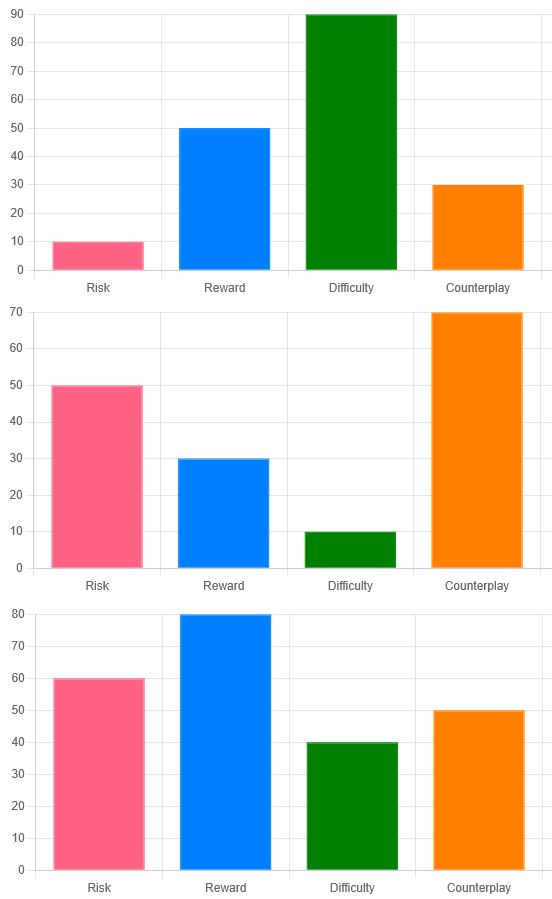
I have a 4 factor model for move/option design in PvP games:

  • Stake (how much you stand to lose by choosing this option, either in costs or penalties)
  • Reward (how much you stand to gain if this option succeeds and stand to gain regardless)
  • Difficulty/Chance (the likelihood that the option will be successfully executed)
  • Counterplay (what range of options this move beats, and how hard/soft a counter)

The purpose of dividing across these 4 factors is to help illustrate to designers the different levers they can pull, instead of focusing purely on a linear risk/reward relationship.

It’s common for a lot of designers to get stuck thinking that everything risky has to have a proportionate amount of reward, and everything rewarding has to have a proportionate amount at stake. Having lopsided stake/reward relationships is possible and healthy when the difficulty and counterplay are considered.

A subtle factor of this model is that cost is a type of risk, and therefore something you put at Stake. When you pay a cost, you’re risking that that investment won’t pay off. Therefore An upside of this model is that it separates Risk from Difficulty/Chance of Success, which are often conflated. “This move is risky, because you’re likely to mess it up.” By separating Risk out into Stake, Difficulty, and Counterplay, we can think more carefully about how each of these different factors play into an option’s design, and we have a wider design space for option design.

Within counterplay there is a lot of nuance to how counters can be designed. I’m going to identify 2 spectrums:

  • Hard vs Soft
  • Wide vs Narrow

A hard counter is one that is guaranteed to always shut down the option that it counters. A soft counter is one with more wiggle room.

A wide counter can beat a wide variety of options. And a narrow counter can only deal with a very specific one.

By dividing counterplay across these two axes, we can see the relative strengths and weaknesses of different moves and intentionally alter the counterplay of moves relative to our needs.

Continue reading

Cost Granularity in Card Games

In Charmed Chains, I chose some early restrictions to emulate some of how Yugioh plays, and over time I’ve been shifting towards different ideas of what I want to do with the game. I chose these restrictions because there are a lot of indie and industry collectible card games that emulate Magic The Gathering (Force of Will, Hearthstone, Lorcana, Final Fantasy, Digimon, etc) in whole or part, and very few that emulate Yugioh (Dual Spirits). When I started making this game, I was really into Yugioh (I’ve recently been swallowed whole by MtG Commander), and I was very much inspired by different facets of Yugioh’s design that I felt could be pushed further (having a defined grid and effects that are based on columns), as well as some aspects of Magic The Gathering (blockers getting a choice in whether to take damage with their creatures, or let it hit them directly).

However, these limitations have lead to some issues with granularity, which I’ve previously discussed. I’m worried that low granularity in creature costs will lead to homogenization in people’s decks, unless I either adopt a resource system more similar to most card games, or start to enforce more strict archetypal synergies, like Yugioh did.

To understand the issues I’m facing, first I’ll need to explain how the resources in Yugioh and Magic The Gathering work.

Continue reading