
Deus Ex is THE game that popularized the Immersive Sim genre. It lived as a cult classic for decades until it was picked up again for Human Revolution and Mankind Divided, then dropped like a sack of potatoes when Square Enix tried to split the plot of Mankind Divided across 2 games in order to get twice the money and the audience decided they didn’t like that.
So what is an Immersive Sim? I think Imsim is a specific design lineage among the developers of Looking Glass Studios and Ion Storm, much like the modern Souls-like subgenre. Many people credit the first imsim as Ultima Underworld, and it was succeeded by System Shock 2, Thief, and Deus Ex, going on to produce later examples such as Arx Fatalis, Dark Messiah of Might and Magic, Bioshock 1 & 2, and the Prey reboot.
Immersive Sims are typically set in the first person perspective, have fairly linear story progression through a series of “mission” levels played in a specific sequence, but many routes that can be taken through each level, and access to these routes is modulated by the RPG skills or upgrades that the player has chosen to invest into. When dialogue with NPCs is possible, there are frequently many different options available, and NPCs and notes found scattered around the world provide a large amount of exposition about the events of the game setting
In addition to this, imsims tend to place a strong focus on systemic interactions between different objects and entities, outside of the player. This can be through physics (stacking boxes), NPC interactions, or other environmental features (Thief’s water and moss arrows). This has the stated goal of provoking “emergent gameplay”, which is something I typically hold in high esteem.
So why don’t I like Deus Ex? I don’t think the game’s various systems add up to all that much.

We can do a straight-forward comparison on two fronts: The Shooting, and the Stealth. If we compare the shooting to half-life, obviously it’s not as good. If we compare the stealth to Thief, obviously that’s not as good either. And this makes sense. Warren Spector has been quoted as saying, “If people compare our combat to Half-Life, we’re dead; if they compare us to Thief’s stealth, we’re dead; if they compare our RPG elements to Bioware’s latest, we’re dead. But if they get that they can decide how to play, to do any of those they want, we might rule the world.”
I don’t think Deus Ex adds up to more than the sum of its parts. I don’t think Deus Ex’s choice of action, stealth, or skills necessarily creates a more deep integrated whole than each of them individually. I believe that depth is created by creating different elements that act upon one another, or which create an interesting choice between them. I don’t think Deus Ex presents interesting choices, so much as different ones. And when each of the gameplay styles are weak, and the game doesn’t create a cohesive whole, I think there’s no choice but to judge it by each gameplay style individually.
Alright, so what’s an example of a similar game that I think actually is more than the sum of its parts here? Crysis and in particular, Crysis Warhead. Both games are First Person Shooters, much in the vein of the modern military style that was becoming popular at the time, but they also take a lot from the ideals of the Immersive Sim genre. The player character is capable of picking up objects, tossing them around, and stacking them. They have C4 charges, which can be attached to objects and tossed around before detonating them. Many buildings can be completely destroyed and turn into physics objects when you do.
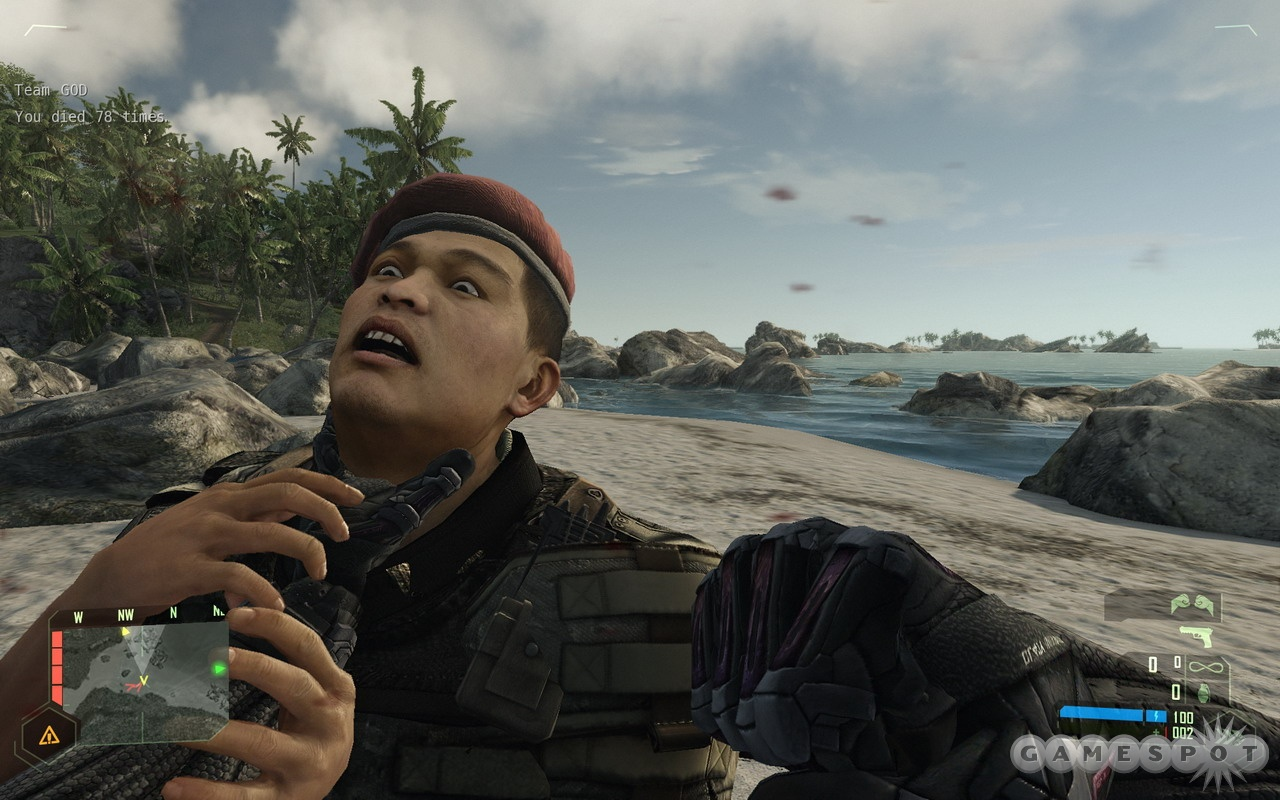
Levels are designed with a wide-open design philosophy, allowing you to pick your angle of approach and pursue multiple routes through the level. Enemies have a full stealth detection system, and the player can cloak to stealth around them. In addition to the cloaking power, the player can also charge super strength to get more accuracy with their guns, punching power, and jump over small buildings. The last power is Super Speed, which lets players move very very quickly.
So you can see that a lot like Deus Ex, Crysis has FPS gameplay, and Stealth gameplay, plus many of the systemic interactions that are common to imsims (it doesn’t have the RPG thing, but I don’t place an incredible amount of stock into that in the first place), and I’d say that neither gameplay style is individually all that special compared to the best FPS games or stealth games.
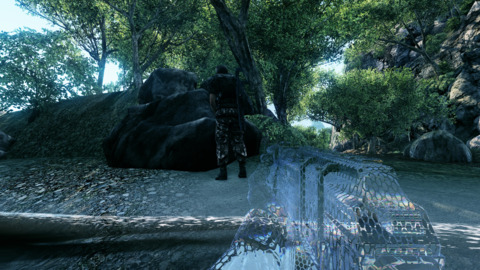
How does Crysis combine these to make them more than the sum of their parts? By letting you choose which one you use not just across the level, but constantly in each combat encounter. Enemies do the standard stealth game thing of keeping track of your last known position, and the instant you go behind cover, they don’t know where you are anymore. This, combined with the cloaking power, allows you to vanish behind cover and reemerge from any angle.
Cloak is kept in check by the suit’s power gauge, which doubles as a portion of your health, preventing you from going completely off the rails and ignoring all the enemies. By deploying these powers together, you can ambush enemies repeatedly during fights from different angles, creating a unique style of stealth/action gameplay that I haven’t seen in any other game. You’re usually outnumbered and outgunned by most combatants, but by stalking them like a Predator, you can take down nearly any enemy.
It’s probably worth mentioning that the level design, and the mission objectives do a lot of heavy lifting here, and Crysis Warhead, also called Syke’s Mod, massively improves over the first game, by choosing to focus on location based objectives more, having more open and less corridor-like level design, utilizing some point defense missions, and upgrading the alien enemies so that they behave more like the human enemies, being more responsive to stealth tactics, and adding a shield generating alien to create a priority target.
In Deus Ex, when an enemy is alerted to your presence, they will become supernaturally aware of you and awkwardly strafe and fire in front of you, before seeking an alarm and alerting the whole level. In typical stealth game form, you can escape into a vent and wait for the alert to die down, but you can’t realistically vanish and ambush the same group of enemies repeatedly before the alert clears. The level design similarly doesn’t support breaking line of sight, then cloaking away to attack from another angle, even though a cloak exists in the game. Instead the game sticks to the more conventional stealth paradigm of: First, try to go completely undetected, and when that fails, fight or run away, then wait patiently until the alert clears.
I could go further into how I feel like Deus Ex’s FPS and Stealth styles of gameplay are lacking, but I don’t think anyone needs convincing about those. A lot of the other aspects the game has is hacking, lockpicking, and disrupting electronics, all of which are simply consumable resources and bars that fill or deplete. Hacking is simply waiting for the computer to open up, then you have a limited time to view its contents, which creates an awkward scenario where the best thing to do is hack a computer, then screenshot all of the emails inside, unlock or disable whatever systems it controls and quit out.
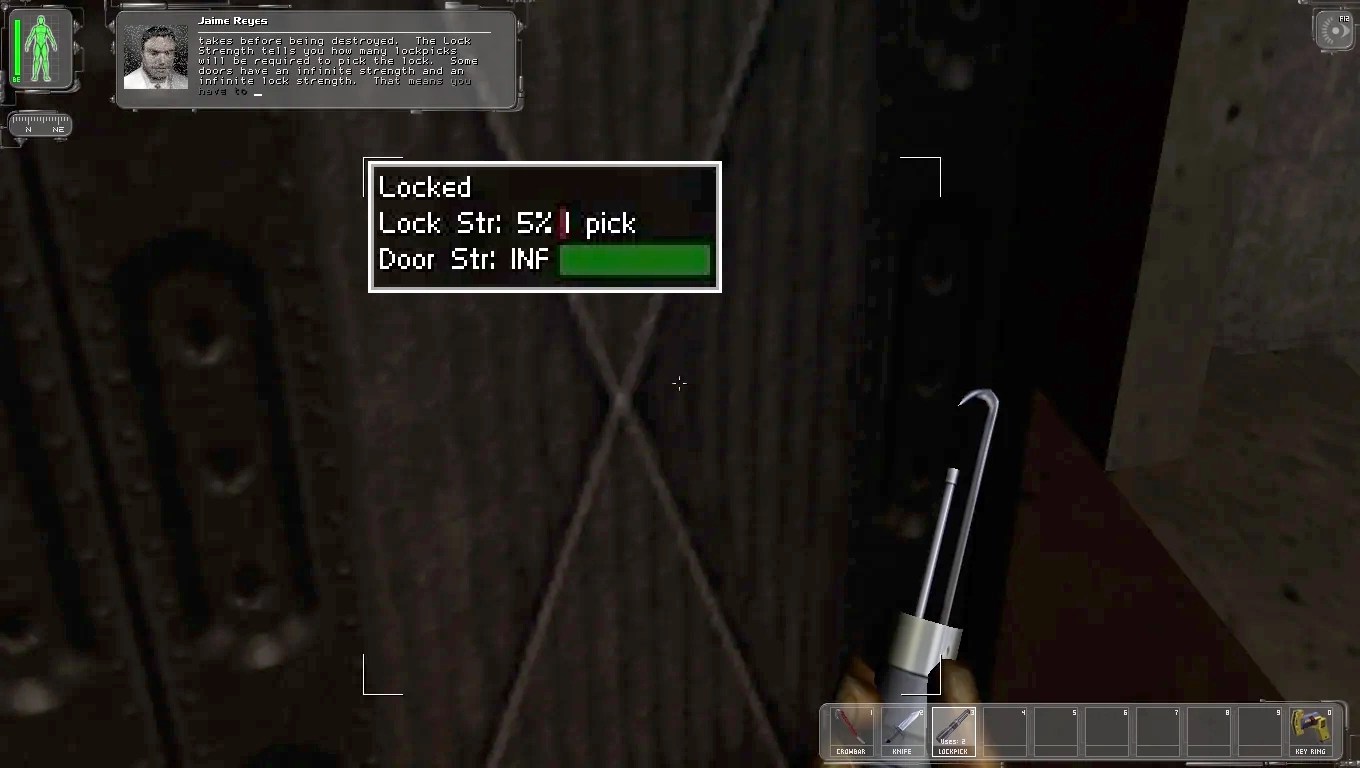
One of the more interesting parts of Deus Ex is the way that some doors can be destroyed, lock picked, or opened with a key. And this can create an interesting economy of resources between multitools, lockpicks, EMPs, and explosives in order to gain access to areas. Why is this an interesting choice when the more core styles of gameplay aren’t?
Interesting choices are created when there is a tension between different objectives or priorities for the player. When the player wants multiple things, but needs to make a choice right now. The player wants to remove obstacles from their path, but only has limited resources to do so, therefore it is an interesting choice which resource they dip into in order to progress. As a test of skill, this is a little flawed, because to make an informed choice, the player would need to have psychic knowledge or at least a good hint of what obstacles lie ahead, but it is still very much a choice! And a player who is replaying the game has a better knowledge of the game’s layout, and it becomes more of an interesting choice for them compared to a first-time playthrough. It’s kind of a shame that this resource system got flattened in the sequel by turning everything into a hacking minigame (though you can certainly still use passcodes, EMPs and Explosives to clear many obstacles).
Crysis creates a tension between eliminating enemies, and safety in stealth. You have the advantage on enemies when you can get the drop on them, but you’re weaker than them when they can focus fire you. So your priorities shift across a combat encounter, causing you to engage with the stealth and the shooting in alternation, which is what ties the entire system together! This is emphasized more as you are stocked with more or less ammo. When you have no ammo, using a Maximum Strength punch from stealth is a great way to take out enemies and steal their guns. When you have plenty of ammo, you can go Rambo on enemies more easily. Priorities shift as circumstances shift, creating interesting choices!
A lot of Imsim games have action and stealth playstyles, but these aren’t constructed as equal spur-of-the-moment choices based on present circumstances, but rather isolated game modes. This is further stressed with the importance placed on being able to ghost through encounters, and avoid enemies. If a game dedicates itself to creating a robust stealth system, this can be a victory entirely on its own. An Imsim could do 2 things well and they could add up to a good game! However, in order to truly be more than the sum of its parts, the different pieces need to work together multiplicatively, creating a larger number of combined possibilities than any of its parts alone.
 Celia Wagar's CritPoints
One thought on “I Don’t Really Like Deus Ex”