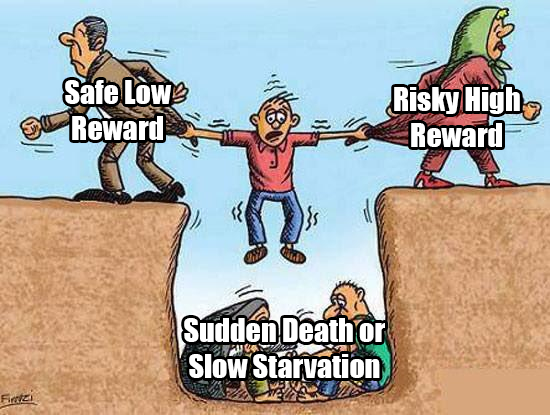
I’ve been teaching my third Mastering Game Mechanics course with GameDesignSkills.com and one of the concepts we talk about is Tension. Alex Brazie, my cowriter for MGM and one of the owners of GDS, likes to explain tension like a rope. A rope is loose and floppy and lacks all tension when it’s not tied to anything. When it’s tied on one end, it hangs straight, but is still easily moved. When the rope is tied tight from both ends, it’s stiff with tension. In order to create tension for players, there need to be at least 2 things pulling on you. This analogy never quite sat right with me. It seemed kind of wishy washy.
As I was writing my article on Deus Ex versus Crysis Warhead something clicked for me. It’s about conflicting priorities or objectives. That’s what creates tension. That’s what creates interesting choices, instead of just different ones. And this, like depth, is reflected fractally at all scales of a game’s design. Technically, this tension is precisely what distinguishes differentiated depth from relative depth. This is what creates Interesting Decisions, as defined by Sid Meier.
Even more accurately, this is what Hegel describes as a Dialectic: a set of contradictions that propel action in search of a resolution. In the most simple terms, there is a Thesis, the desire to achieve an objective; an Antithesis, something that stops you from achieving that objective; and a Synthesis, the line of action that allows you to overcome adversity, achieving your objective. Of course, games ideally employ multiple of these. They create desires for players and simultaneously thwart them, such that any attempt to create a resolution between them is flawed and imperfect, a temporary compromise that meets the demands of the moment, but doesn’t ultimately undo the contradiction.
Conflicting Priorities in Practice
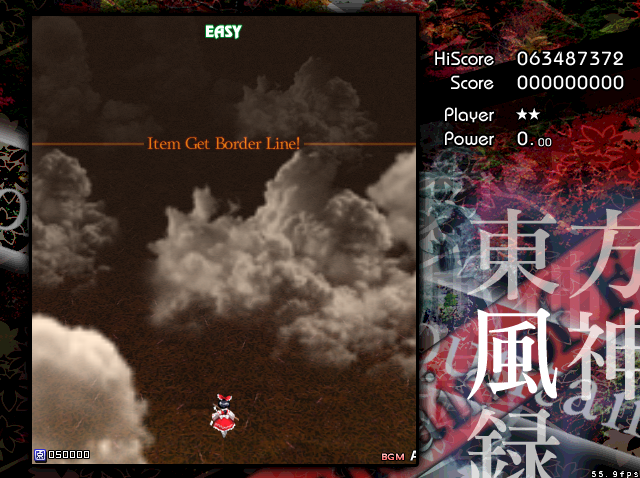
I first noticed this pattern many years ago in Touhou. There are two forms of it in that game series, the item get border line (fans call this the Point of Collection) and the graze mechanic. The point of collection vacuums all the collectibles on the screen to you if you move high enough up the screen. The PoC incentivizes moving closer to enemies in order to grab all the power ups on the screen. Grazing gives you a score multiplier for each bullet you brush up against without being hit. It’s also easiest to do this if you’re close to the source of those bullets, but obviously more risky. These mechanics create a tension between risk and reward. Players with a higher risk tolerance and the skill to survive can earn more rewards, and the game has so many potential rewards that there isn’t a firm upper boundary to how much risk you can take and how much reward you can obtain.
Normally, I advocate against this linear relationship between risk and reward, but when considered from the perspective of Dialectics and Conflicting Priorities, I think it suddenly makes a lot more sense.
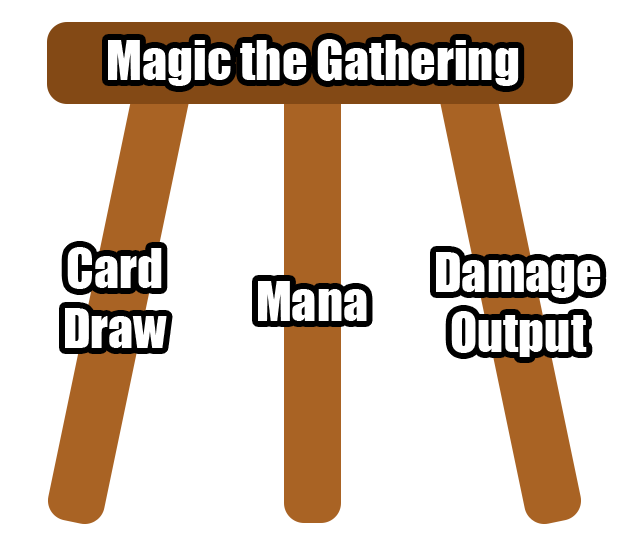
Therefore, having multiple of these priorities active at once is a good recipe for creating a compelling and dynamic game. You want to create a three-legged stool. In Magic the Gathering, you have this kind of 3-legged stool. Different decks tend to prioritize one of these 3 goals: Winning Fast (Red), Drawing Cards (Blue), and Ramping (Green). Different decks will mix these components to achieve different strategies, such as a blue-green deck that aims to draw a bunch of cards and ramp a lot, accumulating an overwhelming amount of value, then overrunning the opponent, but they might go too slow to stop the opponent’s win condition. Blue-Red might try to draw a bunch of cards to assemble a fast win condition, but get constricted on having enough mana to win. Red-Green might ramp to power out hasty big bodies in order to win in an overwhelming way at the expense of not having any cards left to play. There are many other ways to mix these components together, such as interaction, denying your opponent the ability to perform one of these functions, or paying the cost of enabling your opponent to perform one of these functions (like countering a spell, but letting them draw a card, or paying life to draw cards, enabling your opponent to kill you faster).
We can see representations of this tension-oriented philosophy echo up and down through level design, mechanic design, and most other parts of a game. In level design It’s common to put players between a rock and a hard place. Castlevania 3 does this all the time (as do many classic arcade games). Many games love to employ a mix of close range melee enemies in your face, and weaker long-range enemies threatening you from afar; creating tension between dispatching the enemies immediately threatening you while enduring a long-range barrage, and running through the close range attackers to prioritize the long range ones.
Doom’s glory kills create a tension between moving forward to kill enemies, and ducking behind cover to stay safe. As you lose health, you need to risk losing more health in order to heal (and the copious weak enemies littered around the landscape resolve this tension by letting you heal while running away from the real threats).
Modern military shooters create a tension between needing to pop out of cover to shoot and kill enemies, and hiding in cover to restore your health. You risk more by staying out for longer. (I kind of hate this one, but I admit that it is a valid dialectic)
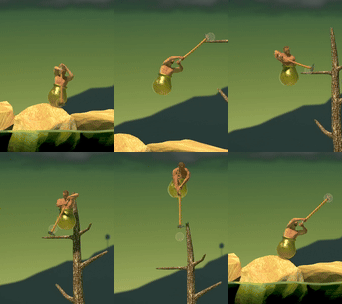
Getting Over it With Bennett Foddy creates a tension between ascending further, and holding onto the progress you have. More wild motions can fling you up faster, but also place you at greater risk of losing everything.
Tetris is a good example of a game that does this in a more subtle way, requiring you to balance a number of different constraints in the pursuit of building shapes that can eventually be cleared. A Tetris novice will aim to avoid gaps at all costs, where an expert will accept gaps when they’re in a convenient place to be cleared later.
In Go, there is a tension between the center and the edges of the board. The center exerts more influence over the board in general, but the edges are easier to reinforce and create living shapes along. Therefore, you must balance moves between survival and ultimate control of the board.
The Failure to Create Contradiction
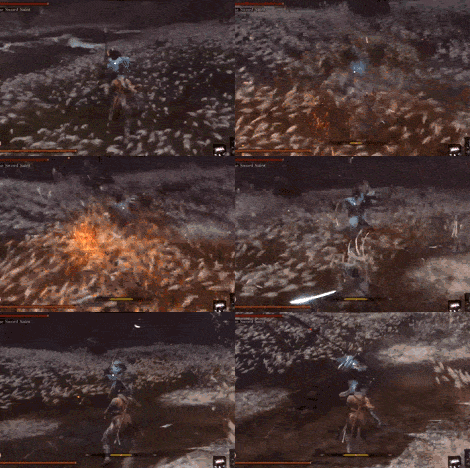
In a lot of melee action games, parry moves are intended to be risky but rewarding, however, for players above a certain skill threshold, they end up resolving tension rather than being a source of it. There is no conflict in priorities: Parry is hands-down the best option. Players below a certain skill threshold will (mostly) ignore parrying, and those above it will parry everything. With the tension resolved, there isn’t an interesting choice, simply a best one. The dialectic is undone, the contradiction is resolved.
In a multiplayer setting, parries usually do not resolve this tension. Parries can be the best choice in a situation, but they can also be the wrong choice, because the other player can simply counter them, with a throw, or hitting from a different angle, or at a delayed timing. Parries are situational, they have weaknesses. They aren’t a simple skill threshold like in a single-player game. They have a role in the larger counterplay of the game. In multiplayer games, parries are a narrow hard counter with moderate stake, high difficulty, and a high reward. In single player games, parries are a wide hard counter with moderate stake, moderate difficulty, and a high reward.
This is an incredibly common pitfall when risk and reward are the only things in a designer’s mind. You need a wider design space, and a broader range of consequences to each move in a player’s toolkit. The counterplay for a high-reward option in a singleplayer game should be softer (more situational) and narrower (options are more specialized).
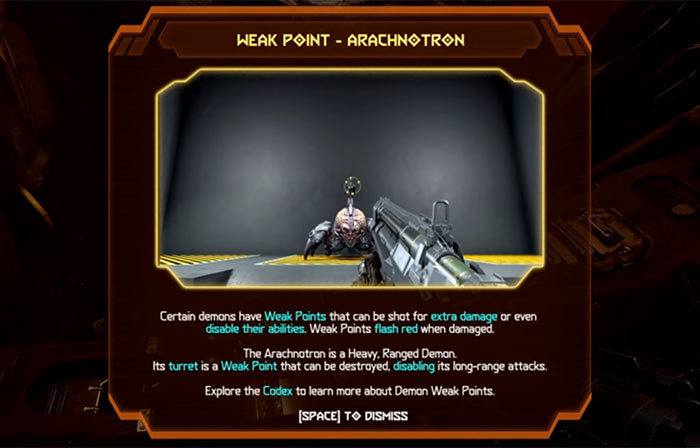
Ironically, Doom Eternal has a fairly compelling dialectic between shooting weakpoints versus taking an enemy out completely, but because they have these little tutorial pop-ups, many players simply took it for granted that the optimal way to play the game was to always target enemy weak points, rather than seeing it as an interesting choice. This lead many players to see Doom Eternal as a kind of rote and rigid game, when they could have experimented and paid attention to find that it isn’t.
A Dialectic of Depth
Relevant depth is created when there isn’t a clear answer as to which of these is better, when there is tension between conflicting priorities and relevant depth collapses when there is a clear winner, an optimal strategy. The possibility space and absolute depth expands as more and more intermediary solutions or situations between these two (or more) extremes are created.
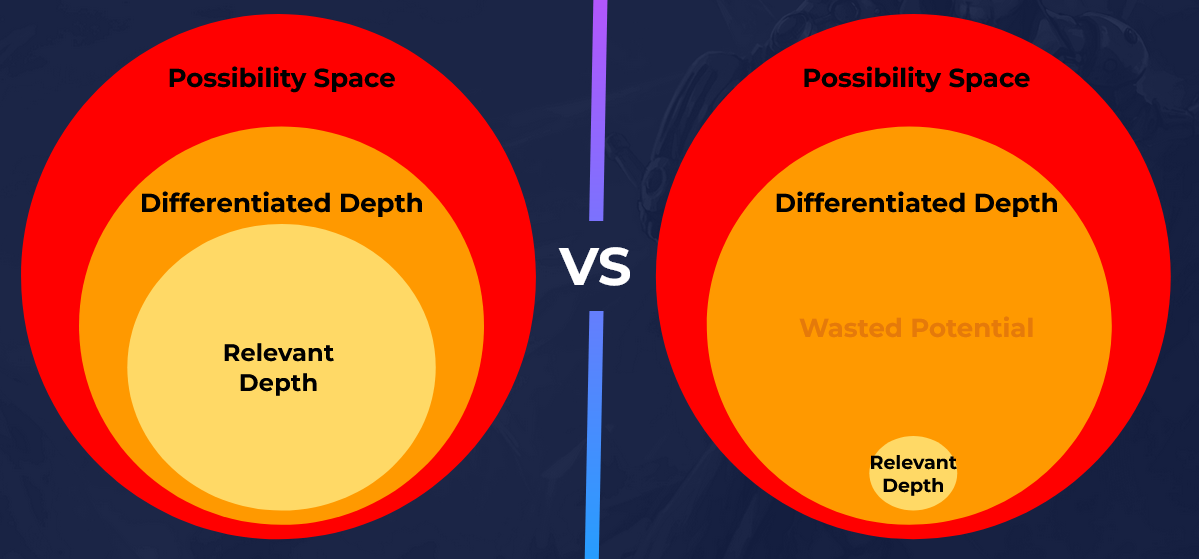
In other words, in our “grand unified depth theory”, relevant depth is created when a system puts tension onto a player through conflicting priorities, and sustains that tension until the player can overcome the challenge. Players need to make choices within the range of options they are granted that move them closer to one priority or another, but never both at the same time. And ideally, the system will have some type of mutation or flux over time to make your priorities shift. For example, which ammo you have available, being forced to move when you dodge, or just the level design and enemy placement progressing across a level.
With the framing of conflicting priorities, the concept of tradeoffs becomes more clear. An option should trade off between satisfying one priority or another, and how much. Choices shouldn’t simply be different, they should satisfy different priorities, without cleanly resolving the tension between making a right choice and a wrong choice. Choices can have tradeoffs, but fail to be interesting when there is a clear correct choice, when you make the same choice every time you come up to that situation.
As a game is optimized, interesting choices are sanded off. Ideally, a game resists this process of optimization, which is why building a strong set of contradictions, as well as dynamic challenges, can help keep a game alive for longer. The choice between consistent low reward and risky high reward tends to be one of the weaker choices in the long run for single player games, because the optimal path is to always pick the riskiest option and either skill it out or gamble on it always working out for you. In other words, this is more compelling when players are bad at a game, and less compelling when players are good at a game.
However, if there’s no upper bound for how much risk you can take on, and there’s a significant amount of input RNG and control sensitivity, then players can potentially optimize further and further forever. Actually creating this in practice is rather difficult though.
Dialectics in Fighting Game Combos
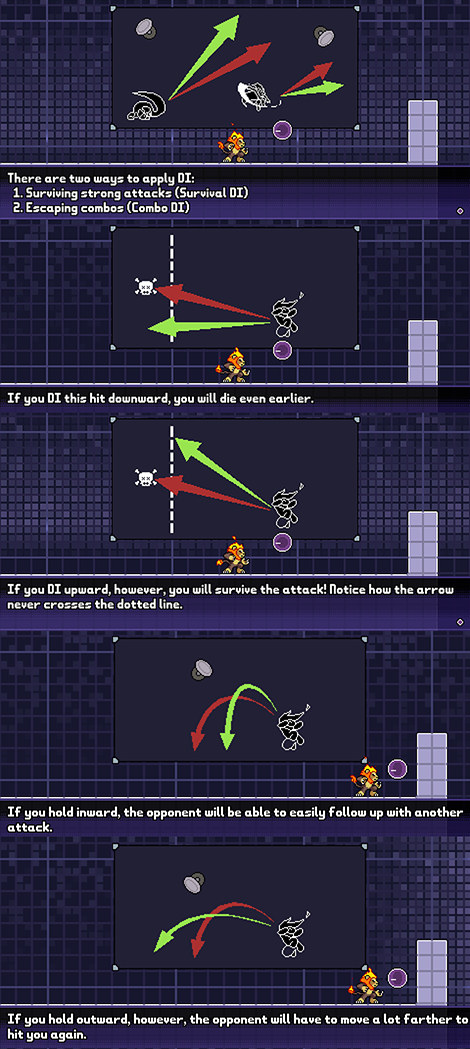
I’ve been working on a fighting game with some members of my discord. The designer, CabalCrow, has been very deliberate about this principle of conflicting priorities (interesting choices) at every level of the game, including the combo system. He did not want any combo to be able to give you everything you could ever want (temporary damage, permanent damage, points, meter, corner carry, Oki). For any combo you will always sacrifice *something*, so each time you hit an opponent, you need to choose what is most valuable to you at that moment. This was helped by his decision to create a wide design space for himself with all these different payoffs for combos, where traditionally, the one true payoff is damage, and sometimes Okizeme (pressure on a knocked down opponent).
A bread and butter combo resolves tension. There isn’t a choice between which combo is best, there is a clear and unambiguous answer. SF6 does a good job of creating more tension by making optimal payoffs highly dependent on the situation. Albeit, this is still usually a question of optimization, more than priority.
Smash Bros is superb at creating this tension in its combo system, because an important tension is baked into how the combo system works: Survival DI vs Combo Escape DI. A player can either try to escape their opponent’s weak hit, or survive their opponent’s strong hit. Both the attacker and defender are simultaneously making choices on each hit of the combo that dictate what could happen next, balanced between different priorities. Plus, the knockdown, recovery, and stage layout systems create a lot of variability (possibility space & absolute depth) in advantage and disadvantage situations.
Conclusion
When the answer is clear and obvious, the situation lacks tension. You are not making an interesting choice. It lacks “dynamism” as I described in Player Skill Tests. The techniques described in that article are all geared towards mutating the circumstances, so that a player must adjust their prioritization, affecting their ability to make clear choices, and overcome the tension between their conflicting priorities.
I have been seriously struggling to put this as clearly as I just did for a long time. I’ve kind of danced around it with terms like, “Fuzzy Evaluations,” “Dynamism,” “Interesting Choices,” and so on, but here I think I’ve finally put it clearly in a format that can be understood and deduced, rather than intuited from context.
Framed as a dialectic, or conflicting priorities, we can more clearly dissect mechanics and situations in order to see where the breakdown is, then adjust our designs to prevent players from finding a clearly best or 100% consistent solution.
 Celia Wagar's CritPoints