Against Immersion: The Holodeck Must Burn

This is not a place of honor. No highly esteemed deed is commemorated here. Nothing valued is here.

For a long time I have been opposed to the idea of immersion in video games, to the idea that people become “immersed” in fictional worlds. I believe there is no specific mental state that can be referred to as being “immersed” in a video game or work of media. I believe the qualities that people describe as immersive are contradictory, limiting, and self-defeating. I believe that sincere belief in the idea of immersion from both a design perspective, and from a player perspective, is harmful to the creation process of video games and the enjoyment of video games. I don’t think we should make appeals to the idea of immersion, or use it as a guiding philosophy for game development.

As research for this article, I’ve been collecting statements for years about what people think immersion is, what traits they think are immersive, and what breaks their immersion. Through this, I hope not just to argue against the conceptualization and prioritization of immersion, but also to show that what I am arguing against is representative of the idea of immersion in the broader public consciousness.

Continue reading

Why Don’t We Know How to Design Games?

There are 4 categories of knowledge: Known Knowns, Unknown Knowns, Known Unknowns, and Unknown Unknowns.

When you are a subject matter expert on something, like a competitive game, or coding, or a lawyer, doctor, or scientist, your knowledge is a known known. You know how much there is to know about the subject, and you are aware of exactly what parts of that subject you have in memory. This is a Known Known.

When you are an experienced professional, like a painter or an athlete, you have an intuitive understanding of your craft that you can’t necessarily explain to other people. You know these things from practicing them, but you aren’t even aware of what has become habit for you. This is an Unknown Known.

When you are a student, being taught by someone who has more knowledge than you, your teacher is able to show you all the things you have yet to learn. You don’t have this knowledge yet, but you know it is out there. This is a Known Unknown.

When you are blissfully ignorant and have no idea that a subject even exists you don’t consider what might even be out there. You don’t know about it, and you aren’t even aware what you’re missing. This is an Unknown Unknown.

Continue reading

Player Agency Doesn’t Make Sense

A commonly invoked concept for video games is the concept of Agency. In real life, Agency refers to the ability of individuals to act upon the world and shape their life outcomes, especially in relationship to other people. I don’t think this concept or framing makes sense for games, and the game The Stanley Parable, kind of lampoons this concept, especially in this trailer.

I don’t think the concept of Agency makes sense for video games, because I view games more abstractly than stories or simulations. If games are self-contained systems of rules and interactions, basically a big bundle of math, then how could you have more or less ability to affect the world or society when there is no world or society to affect? How would you compare the agency of action puzzle games, such as Tetris, Panel De Pon, Puyo Puyo, or Puzzle Fighter II Turbo? How would you compare the agency of sports, such as Soccer, Basketball, American Football, or Tennis?

Am I expressing Agency here?
Continue reading

Boosting Enemy Stats is not “Artificial Difficulty”

I’m sorry for choosing the annoying meme for the banner.

Hollow Knight: Silksong has revived an annoying line of discourse about “Artificial Difficulty”. Artificial Difficulty is ostensibly things that make a game appear more difficult, without actually engaging player skill. However in practice, most people claiming that a game has “Artificial Difficulty” are just complaining that the game is too hard for them, and this isn’t their fault, but the game’s fault. It did difficulty “wrong” in some way.

If we were to take the language of Artificial Difficulty at its face, then we’d consider whether or not a game is engaging in a fair test of skill with you. And in this way, some obstacles in Silksong aren’t fair actually, such as the bench in Hunter’s March that is rigged with a trap, which will damage you when you try to sit on it (I fell for this one). There is a very short tell, the bench depressing like the pressure plate traps in the prior section, giving you a brief opportunity to get off the bench and dash away. Disabling the bench trap requires going through a hidden tunnel and pressing a hidden switch. Silksong has a number of moments like this, which I believe were intended to be funny, because I found them funny and I know other people did too.

Continue reading

Design Space: Dimensions of Game Design

Design Space is tricky to define, because it’s the water we swim in. Mark Rosewater (who probably coined the term) says that design space is roughly how many new cards can be made from a new mechanic. A mechanic that affords a large design space interacts well with the rest of the game and allows them to create a wide variety of new cards. In other words, Design Space defines how many differentiated game elements (cards, weapons, characters, moves, enemies, obstacles, projectiles, etc.) you can create from the base mechanics of your game.

Relative to my 3-filters theory of Depth, Design Space acts almost like a 4th filter, above Possibility Space. Design Space defines which possibility spaces can even be made with the mechanics and attributes you have available to you. Possibility space is all the things that can happen in your games. Design space is all the possible games (or content) that you can make with the mechanics and systems you have chosen. In this way, game designers strive not only to create possibility spaces that are rich with possible game States, but design spaces that will allow them to create elements that enable those possibility spaces to contain a multitude of game states. A more richly detailed character allows for a more richly detailed environment for that character to interact with.

Continue reading

10 Years of Critpoints

10 years ago (and 2 months, but who’s gonna nitpick that?) I started this blog, Critpoints. Before that, I had been writing for Gather Your Party, a modest blog that aimed to challenge the establishment of professional games journalism with a staff of volunteers, no advertising, some of the early crop of gaming video essayists, and the tagline, “Honest Gaming Journalism”. For a lot of fairly predictable reasons, we burned out and eventually the site shuttered.

While I wrote there, I authored a column called, “More Than Mashing”, which showcased and explained different advanced video game techniques and play. This translated into a few YouTube Videos, most of which have been lost to time. I later ended up reviving this concept as a Facebook page, which did great until I got bored of it, and ran out of clips. Currently, that idea survives as a channel in my Discord Server, and as the banner in this site’s layout.

Since GYP, I’ve been involved in a few different projects, including Design Oriented, a group of game designers who were interested in exploring a more mechanical angle to video game design. I ended up leaving due to differences in point of view, but one thing I held onto was the name, “Crit Points”, which I had suggested as a potential name for the DO project. I tried combining the different ideas of “critique,” “hit points,” and “critical hit” into one short name. The tagline under the website name is intended to reflect the triple entendre. (Similarities to ActionPts, someone I used to work with, and ContraPoints are coincidental (I didn’t hear about ContraPoints until 2018) ).

Critpoints became my new brand, and I started this blog in March 2015!

Continue reading

Building Counterplay for PvP Games

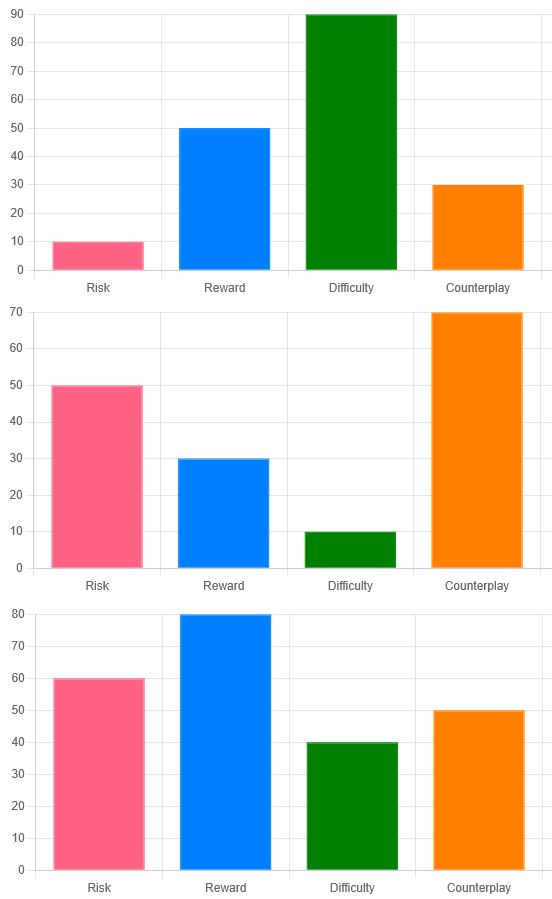
I have a 4 factor model for move/option design in PvP games:

  • Stake (how much you stand to lose by choosing this option, either in costs or penalties)
  • Reward (how much you stand to gain if this option succeeds and stand to gain regardless)
  • Difficulty/Chance (the likelihood that the option will be successfully executed)
  • Counterplay (what range of options this move beats, and how hard/soft a counter)

The purpose of dividing across these 4 factors is to help illustrate to designers the different levers they can pull, instead of focusing purely on a linear risk/reward relationship.

It’s common for a lot of designers to get stuck thinking that everything risky has to have a proportionate amount of reward, and everything rewarding has to have a proportionate amount at stake. Having lopsided stake/reward relationships is possible and healthy when the difficulty and counterplay are considered.

A subtle factor of this model is that cost is a type of risk, and therefore something you put at Stake. When you pay a cost, you’re risking that that investment won’t pay off. Therefore An upside of this model is that it separates Risk from Difficulty/Chance of Success, which are often conflated. “This move is risky, because you’re likely to mess it up.” By separating Risk out into Stake, Difficulty, and Counterplay, we can think more carefully about how each of these different factors play into an option’s design, and we have a wider design space for option design.

Within counterplay there is a lot of nuance to how counters can be designed. I’m going to identify 2 spectrums:

  • Hard vs Soft
  • Wide vs Narrow

A hard counter is one that is guaranteed to always shut down the option that it counters. A soft counter is one with more wiggle room.

A wide counter can beat a wide variety of options. And a narrow counter can only deal with a very specific one.

By dividing counterplay across these two axes, we can see the relative strengths and weaknesses of different moves and intentionally alter the counterplay of moves relative to our needs.

Continue reading

I Don’t Really Like Deus Ex

Deus Ex is THE game that popularized the Immersive Sim genre. It lived as a cult classic for decades until it was picked up again for Human Revolution and Mankind Divided, then dropped like a sack of potatoes when Square Enix tried to split the plot of Mankind Divided across 2 games in order to get twice the money and the audience decided they didn’t like that.

So what is an Immersive Sim? I think Imsim is a specific design lineage among the developers of Looking Glass Studios and Ion Storm, much like the modern Souls-like subgenre. Many people credit the first imsim as Ultima Underworld, and it was succeeded by System Shock 2, Thief, and Deus Ex, going on to produce later examples such as Arx Fatalis, Dark Messiah of Might and Magic, Bioshock 1 & 2, and the Prey reboot.

Immersive Sims are typically set in the first person perspective, have fairly linear story progression through a series of “mission” levels played in a specific sequence, but many routes that can be taken through each level, and access to these routes is modulated by the RPG skills or upgrades that the player has chosen to invest into. When dialogue with NPCs is possible, there are frequently many different options available, and NPCs and notes found scattered around the world provide a large amount of exposition about the events of the game setting

In addition to this, imsims tend to place a strong focus on systemic interactions between different objects and entities, outside of the player. This can be through physics (stacking boxes), NPC interactions, or other environmental features (Thief’s water and moss arrows). This has the stated goal of provoking “emergent gameplay”, which is something I typically hold in high esteem.

So why don’t I like Deus Ex? I don’t think the game’s various systems add up to all that much.

Continue reading

How to Code Fighting Game Motion Inputs

So previously I’ve taught you How To Perform Fighting Game Motions, now lets learn how developers coded them. As far as I know, nobody has documented how to do this before, and it’s essential for anyone making a fighting game, or anything like a fighting game.

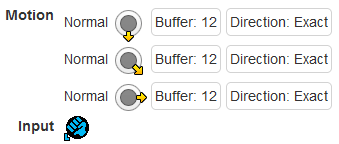
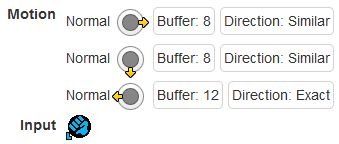
There is a website called SFVSim that catalogues change differences between versions for moves in Street Fighter V. This includes a lot of data on each move, including the input requirements.

This is extremely helpful for determining the logic involved for these motion inputs. The buffer on each direction determines how much time in frames is allowed to elapse before the next input is provided, or the motion becomes invalid. In other words, it determines how quickly you need to do the motion, and how much time you have to press the button after you’ve completed it.

Continue reading

VR is Focusing on the Wrong Things

Disclaimer: This has been on the backburner for a very long time. I’m sorry if some information is out of date, or if I’m missing something.

My original attitude towards VR was skeptical to dismissive. Anyone who knows me knows that I’m skeptical about anything promising “immersion” and pretty much the concept of immersion in general. I got to try a prerelease Oculus VR headset at a showcase in New York City and it was pretty much what I expected, a screen strapped to my face, while I controlled an FPS game like I’ve always done. To me, VR was another type of screen, I didn’t expect it to fundamentally change anything about video games.

First Gen VR devices changed my mind, they brought on motion controls, like the Wii and PS Move. I eventually got to try a Vive headset, with Valve’s The Lab, SuperHot VR, and a couple others, and I saw what the device could do, and it was pretty obvious that there was untapped potential there. VR seems like a way to make motion controls work much more feasibly than they ever had before, and that could lead to some legitimately new game genres!

The Shortcomings of Current VR Games

My trouble is that VR is also couched in this “immersive promise”. People want the holodeck and full-dive like SAO or Ready Player 1. VR Companies promise that VR is the future of immersion into a virtual world, where we can finally enter The Matrix, The Metaverse, Ready Player 1; You get the picture, right? Except, VR as it currently exists is horrible at all of those things. VR isn’t suited for you to walk around virtual worlds at all.

Continue reading