Why Don’t We Know How to Design Games?

There are 4 categories of knowledge: Known Knowns, Unknown Knowns, Known Unknowns, and Unknown Unknowns.

When you are a subject matter expert on something, like a competitive game, or coding, or a lawyer, doctor, or scientist, your knowledge is a known known. You know how much there is to know about the subject, and you are aware of exactly what parts of that subject you have in memory. This is a Known Known.

When you are an experienced professional, like a painter or an athlete, you have an intuitive understanding of your craft that you can’t necessarily explain to other people. You know these things from practicing them, but you aren’t even aware of what has become habit for you. This is an Unknown Known.

When you are a student, being taught by someone who has more knowledge than you, your teacher is able to show you all the things you have yet to learn. You don’t have this knowledge yet, but you know it is out there. This is a Known Unknown.

When you are blissfully ignorant and have no idea that a subject even exists you don’t consider what might even be out there. You don’t know about it, and you aren’t even aware what you’re missing. This is an Unknown Unknown.

Continue reading

Player Agency Doesn’t Make Sense

A commonly invoked concept for video games is the concept of Agency. In real life, Agency refers to the ability of individuals to act upon the world and shape their life outcomes, especially in relationship to other people. I don’t think this concept or framing makes sense for games, and the game The Stanley Parable, kind of lampoons this concept, especially in this trailer.

I don’t think the concept of Agency makes sense for video games, because I view games more abstractly than stories or simulations. If games are self-contained systems of rules and interactions, basically a big bundle of math, then how could you have more or less ability to affect the world or society when there is no world or society to affect? How would you compare the agency of action puzzle games, such as Tetris, Panel De Pon, Puyo Puyo, or Puzzle Fighter II Turbo? How would you compare the agency of sports, such as Soccer, Basketball, American Football, or Tennis?

Am I expressing Agency here?
Continue reading

Boosting Enemy Stats is not “Artificial Difficulty”

I’m sorry for choosing the annoying meme for the banner.

Hollow Knight: Silksong has revived an annoying line of discourse about “Artificial Difficulty”. Artificial Difficulty is ostensibly things that make a game appear more difficult, without actually engaging player skill. However in practice, most people claiming that a game has “Artificial Difficulty” are just complaining that the game is too hard for them, and this isn’t their fault, but the game’s fault. It did difficulty “wrong” in some way.

If we were to take the language of Artificial Difficulty at its face, then we’d consider whether or not a game is engaging in a fair test of skill with you. And in this way, some obstacles in Silksong aren’t fair actually, such as the bench in Hunter’s March that is rigged with a trap, which will damage you when you try to sit on it (I fell for this one). There is a very short tell, the bench depressing like the pressure plate traps in the prior section, giving you a brief opportunity to get off the bench and dash away. Disabling the bench trap requires going through a hidden tunnel and pressing a hidden switch. Silksong has a number of moments like this, which I believe were intended to be funny, because I found them funny and I know other people did too.

Continue reading

Design Space: Dimensions of Game Design

Design Space is tricky to define, because it’s the water we swim in. Mark Rosewater (who probably coined the term) says that design space is roughly how many new cards can be made from a new mechanic. A mechanic that affords a large design space interacts well with the rest of the game and allows them to create a wide variety of new cards. In other words, Design Space defines how many differentiated game elements (cards, weapons, characters, moves, enemies, obstacles, projectiles, etc.) you can create from the base mechanics of your game.

Relative to my 3-filters theory of Depth, Design Space acts almost like a 4th filter, above Possibility Space. Design Space defines which possibility spaces can even be made with the mechanics and attributes you have available to you. Possibility space is all the things that can happen in your games. Design space is all the possible games (or content) that you can make with the mechanics and systems you have chosen. In this way, game designers strive not only to create possibility spaces that are rich with possible game States, but design spaces that will allow them to create elements that enable those possibility spaces to contain a multitude of game states. A more richly detailed character allows for a more richly detailed environment for that character to interact with.

Continue reading

Building Counterplay for PvP Games

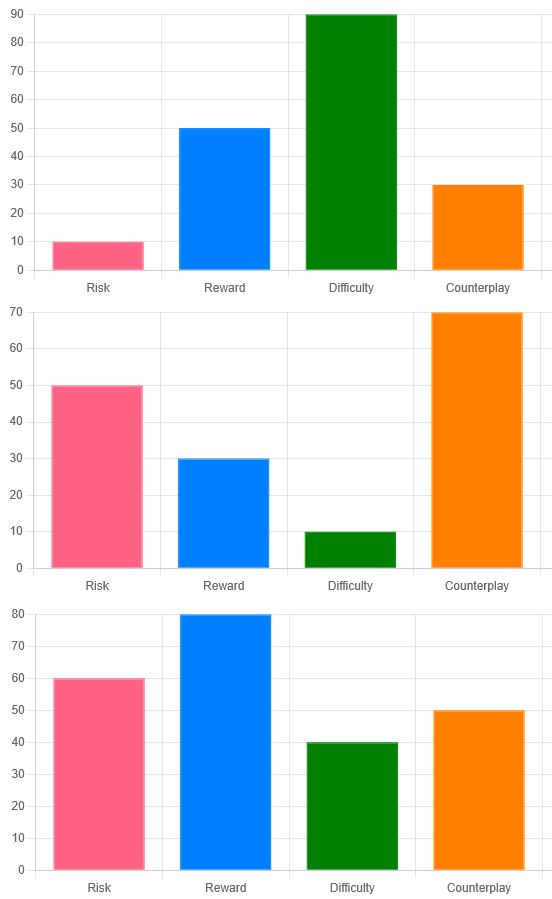
I have a 4 factor model for move/option design in PvP games:

  • Stake (how much you stand to lose by choosing this option, either in costs or penalties)
  • Reward (how much you stand to gain if this option succeeds and stand to gain regardless)
  • Difficulty/Chance (the likelihood that the option will be successfully executed)
  • Counterplay (what range of options this move beats, and how hard/soft a counter)

The purpose of dividing across these 4 factors is to help illustrate to designers the different levers they can pull, instead of focusing purely on a linear risk/reward relationship.

It’s common for a lot of designers to get stuck thinking that everything risky has to have a proportionate amount of reward, and everything rewarding has to have a proportionate amount at stake. Having lopsided stake/reward relationships is possible and healthy when the difficulty and counterplay are considered.

A subtle factor of this model is that cost is a type of risk, and therefore something you put at Stake. When you pay a cost, you’re risking that that investment won’t pay off. Therefore An upside of this model is that it separates Risk from Difficulty/Chance of Success, which are often conflated. “This move is risky, because you’re likely to mess it up.” By separating Risk out into Stake, Difficulty, and Counterplay, we can think more carefully about how each of these different factors play into an option’s design, and we have a wider design space for option design.

Within counterplay there is a lot of nuance to how counters can be designed. I’m going to identify 2 spectrums:

  • Hard vs Soft
  • Wide vs Narrow

A hard counter is one that is guaranteed to always shut down the option that it counters. A soft counter is one with more wiggle room.

A wide counter can beat a wide variety of options. And a narrow counter can only deal with a very specific one.

By dividing counterplay across these two axes, we can see the relative strengths and weaknesses of different moves and intentionally alter the counterplay of moves relative to our needs.

Continue reading

I Don’t Really Like Deus Ex

Deus Ex is THE game that popularized the Immersive Sim genre. It lived as a cult classic for decades until it was picked up again for Human Revolution and Mankind Divided, then dropped like a sack of potatoes when Square Enix tried to split the plot of Mankind Divided across 2 games in order to get twice the money and the audience decided they didn’t like that.

So what is an Immersive Sim? I think Imsim is a specific design lineage among the developers of Looking Glass Studios and Ion Storm, much like the modern Souls-like subgenre. Many people credit the first imsim as Ultima Underworld, and it was succeeded by System Shock 2, Thief, and Deus Ex, going on to produce later examples such as Arx Fatalis, Dark Messiah of Might and Magic, Bioshock 1 & 2, and the Prey reboot.

Immersive Sims are typically set in the first person perspective, have fairly linear story progression through a series of “mission” levels played in a specific sequence, but many routes that can be taken through each level, and access to these routes is modulated by the RPG skills or upgrades that the player has chosen to invest into. When dialogue with NPCs is possible, there are frequently many different options available, and NPCs and notes found scattered around the world provide a large amount of exposition about the events of the game setting

In addition to this, imsims tend to place a strong focus on systemic interactions between different objects and entities, outside of the player. This can be through physics (stacking boxes), NPC interactions, or other environmental features (Thief’s water and moss arrows). This has the stated goal of provoking “emergent gameplay”, which is something I typically hold in high esteem.

So why don’t I like Deus Ex? I don’t think the game’s various systems add up to all that much.

Continue reading

Game “Loops” are an Illusion

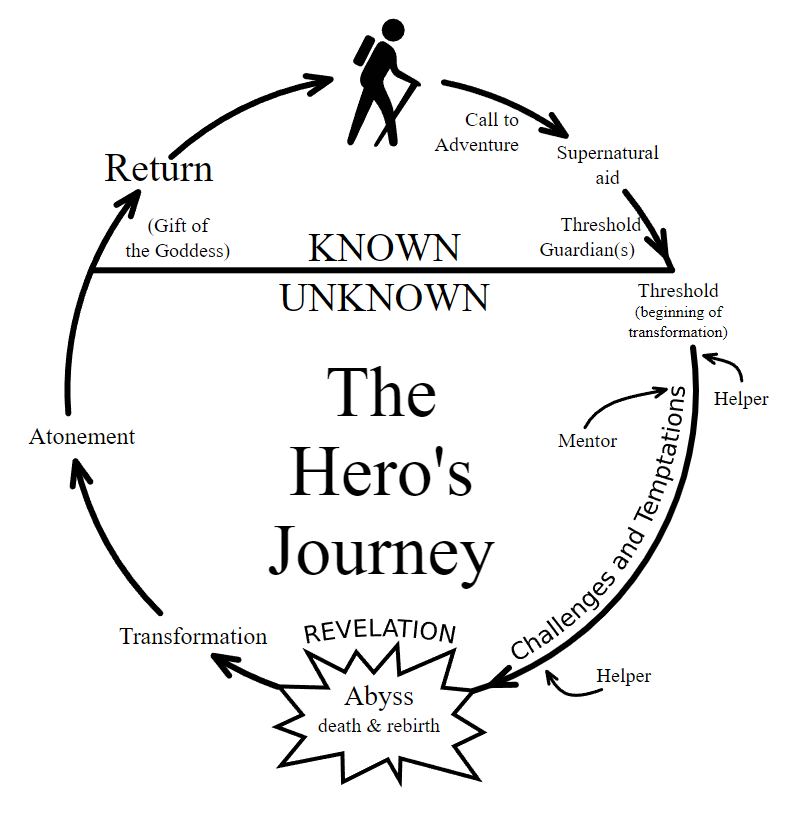
Game Loop has become an industry-standard piece of terminology for video games. It’s taken as a default, a forgone conclusion, or necessary for a game to function. It has a role in game development similar to 3-act structure or the Hero’s Journey in storytelling. These structures are presented as inevitable, ever-present throughout history and culture, and essential to good storytelling or game-making, but many stories and games don’t follow these structures and are still successful and well-regarded.

Some people argue you cannot make a game without loops, or tell a story without 3-acts, or say that the Hero’s Journey is the monomyth from which all other stories derive, but there is nothing definitionally inherent to games or stories that necessitates these things.

Continue reading

It’s Not the Yellow Paint, It’s What the Paint Represents

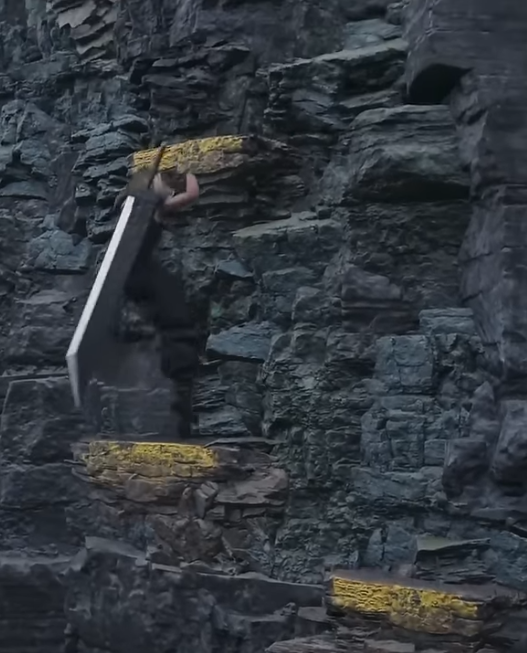
Recently footage of Final Fantasy VII: Rebirth was released, and it contained a shot of The Yellow Paint that we keep seeing to denote objects in the environment that can be climbed or otherwise interacted with. Kayin wrote an article on this, and it inspired me to write my own take.

What’s wrong with Yellow Paint?

So, why do people kneejerk hate the yellow paint? People hate the yellow paint because it “breaks their immersion”, since there’s no diegetic reason why every single ladder, cliff face, or vaultable cover would be splattered in the same yellow or white paint and because it makes them feel like they’re being treated like a child, needing to have the interactable part of the environment highlighted so they can progress.

Continue reading

How do you Set the MAXIMUM LIMIT? (For Health & such)

Almost every game has resources of some type or another, whether that’s health, mana, meter, etc. A topic that is rarely discussed with these is: Exactly how much health should you have, and how much damage should stuff do? What should your resource limit be, how much should stuff cost? How fast should it be built up? The decisions made in each of these can significantly affect the tone and feeling of something.

The most critical technique for thinking about this problem is thinking in percentages. The actual values can be arbitrary, but percentages help you keep track of the actual impact. A combo across different games could deal 8000 damage, 120 damage, or just 6 damage, and in each case, that could be worth 90% of someone’s healthbar. Thinking in percentages helps you weigh the relative impact of something, without getting bogged down in the exact numbers.

This type of thinking also suggests thinking about the resource in terms of how many times it can be tapped before it’s extinguished. If each touch deals about 10% of your health bar, a game will have 10 touches before it’s over. If a touch can deal up to 80%, then it’s a 2-touch game. Consider the range of variability between how much impact each touch makes as well.

In Card Games, instead of touches, it’s measured as a “clock”. The clock is how many turns a player has left before they lose the game. In real-time games with fine-grain health and guaranteed hits, this type of thing is measured in DPS (Damage Per Second) and/or TTK (Time to Kill). In these cases, it’s worth considering what tradeoffs a player should be making in order to get a faster clock, or a lower time to kill. It’s also worth considering how fast the average clock for a match should be, or what the average time to kill is across the game, and watching out when those things end up lower or higher than you originally planned.

Continue reading

How Magic’s Mana System Divides its Design Space

Magic the Gathering invented trading card games, and with it, resource systems in trading card games. Countless games following MTG have mimicked MTG’s 5-color mana system, because of course they did, why wouldn’t they?

In Magic The Gathering, spells and creatures cost “Mana”, a resource that regenerates every turn, and builds up over time as you play “land” cards from your hand. Mana comes in 5 colors, Green, Red Blue, White, and Black. Each of these colors has a mechanical identity associated with it, called a “Color Identity”. Mana is the primary thing that divides the design space in Magic The Gathering, to create different types of decks.

Of course, there are other things, like card types, and creature types, which have effects that reference one another to create synergies. And there are more broadly playstyles, like Aggro (try to kill the opponent before they can get their good monsters out or reach their win condition), Control (destroy your opponent’s threats and eke out a win) Mid-range (shut down aggro and outclass weak aggro threats, rush the control players), and Combo (dig through your deck to assemble exodia in your hand, then win the game instantly or near-instantly).

Mono-color decks focus entirely on a single type of mana, and usually only play a single “basic” land color. This gives them incredible consistency, because their mana supply goes up every time they play a land, but limits what they have access to in the broader card pool. A mono-color deck may lack “answers” to certain types of “threats” generated by other decks, such as red and black having a tough time getting rid of enchantment cards.

Continue reading