5 Games, 5 Jumps

bouncing-ball-7810-460x223[1]

Objects in real life may always jump or bounce in a perfect curve, but in games the designer is free to imagine many different ways for characters to jump around. To allow players greater control over their character, many games incorporate the idea that by pressing the button longer, the character will jump higher. Despite the concept being rather simple, different game designers have implemented this mechanic in a massive number of  ways. It’s worth paying attention to how they did it because each method serves the game it comes from to a different end and gives the player a distinct feeling that they associate with that game. That and it’s interesting how programmers can come to so many different solutions for what a layperson might not ever consciously notice is different.

A short introduction to game physics

velocity-graph[1]

In case you didn’t pay attention in physics class, here’s a quick and dirty explanation of how jumping tends to work in video games. I’ll try to keep the math simple so everyone can follow along. There are four basic numbers you need to keep in mind, the initial jumping velocity (or the force of the jump when it starts), the current velocity (which is how fast the character is going in that moment of time), the character’s position (which is how high up the character is), and how strong the gravity is.

Game time is calculated in something called frames. A frame is the shortest length of time across which something can occur. Most good games run at 60 frames per second, including all the ones in this article, meaning they change what’s onscreen 60 times every second. Every frame the character’s position has the character’s current velocity added to it, meaning they move the distance specified by the velocity. Then the current velocity has the gravity subtracted from it, meaning that if you were moving up, you’re now moving a little less fast up this frame, and a little less next frame until eventually you’re not moving up at all, and instead you’re falling faster and faster.

The initial jump velocity and the gravity are constant, meaning they do not change. When a jump is started, the character’s current velocity is set to the initial jump velocity. Then the character is moved by that velocity every frame, while gravity eventually makes it so that velocity is negative, bringing the character back down again. Together these things create a parabolic curve, which you might remember from algebra class. This smooth curve can be seen in games with simple jumps that don’t let you control their height at all, like Castlevania 1 and 2, Donkey Kong Arcade, or Metal Slug.

With that out of the way, lets get into these jumps.

Megaman
megaman-jump[1]

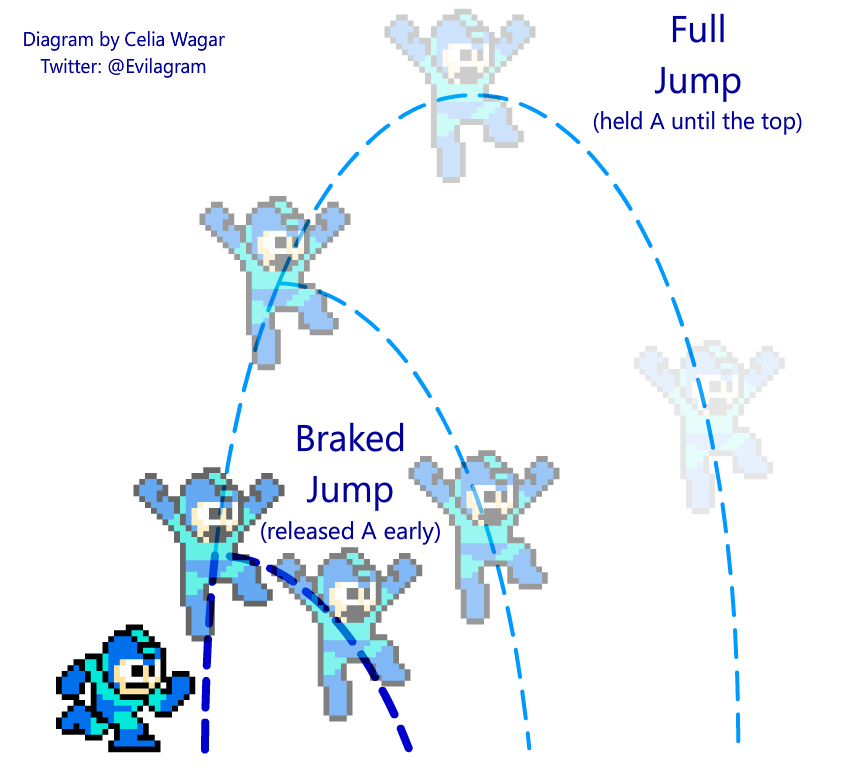
Megaman’s jump is a great introduction to multi-height jump physics because it works in a very simple way. If the A button is held, then you go up, when it is released you immediately go down. Your velocity is set to a slight negative the instant you release! Notable is that Megaman’s jump still has gravity applied to it, so if it’s held down all the way, he’ll jump in a smooth arc, slowing down as he goes up, and speeding up as he comes down. If you’re close to the top of Megaman’s jump arc, releasing the button does nothing, so you always get a smooth curve at the top of his jump, even if it’s a sharp transition otherwise.

Megaman’s jump is useful in his games because players need to jump and shoot enemies that come at Megaman from precise heights. Because his momentum instantly reverses when he starts falling, it can appear very twitchy, but it also lets him do jumps without worrying about going too high or too far at the apex. Similarly this ties into the feeling of the character: Megaman has no acceleration or deceleration, so the control over him is very direct. It’s only fitting that this should be mirrored in his jump.

Mario

mario-jump[1]

Mario’s jump is actually a surprisingly complex solution. Going into writing this article, I expected it to have a constant speed upwards, then you run out of jump time and gravity pulls him back down until he hits terminal velocity for a neat little curve at the top of the jump and that’s that. What actually happens is, while Mario is jumping and A is held down, he has a significantly lower gravity than when he is falling, so he is slowly losing momentum on the way up. When you release A or he runs out of upwards momentum, this heavier gravity kicks in and he suddenly gains a lot of downwards momentum.

In addition to this, Mario has different strengths of jump and gravities depending on how fast he’s going. When he’s going at mid-speed, like when walking, his jumping power stays the same, but the gravity applied to him both as he rises and as he falls are reduced. While walking Mario can jump slightly higher due to this reduced gravity. When he’s going at top speed, like when running, his initial jumping force is increased, as is the gravity applied to him as he rises and falls. This leads to him being able to jump even higher, but rising and falling at a quicker speed as well.

The most natural consequence of this behavior is that players have fairly precise control over how high they jump, yet the jump appears close to a smooth parabolic curve, working well for the level of precision that the developers wanted to give players, but also meshing with Mario’s sense of acceleration and lower friction on the ground than Megaman. Having higher rising and falling speeds while running gives players a trade-off between easy, consistent control and moving faster while jumping to higher heights.

You can see the specifics on Mario’s Physics here.

Sonic

sonic-jump[1]

In Sonic smooth movement and a sense of speed were a priority. They programmed the jump to work completely normal, with an initial velocity that gets pulled down by gravity in a normal parabolic arc as long as the jump button is held down. Where it gets interesting is if you release the jump button before you reach the top of the jump arc.

If the jump button is released when sonic is traveling upwards, it will brake his velocity to a small upwards velocity, so sonic is still traveling upwards but at a slower rate. Eventually gravity brings sonic back down. This means that his movement is in a smooth arc no matter how long the button is held. Because Sonic continues moving up when jump is let go of, it appears he flows smoothly from moving upwards into moving downwards.

You can find more information on Sonic Physics here.

Super Smash Bros.

Melee-jump[1]

Super Smash Bros. uses a completely different solution from all of the above games. Instead of controlling your jump height by holding the button longer in the air, it’s controlled by holding it longer on the ground.
When you press jump in Super Smash Bros., your character actually enters a short squatting animation before they jump. The animation is so short, most people don’t notice it. There are only two jump heights in Smash Bros., which fans call the Short Hop and Full Jump. Which one you get is determined by whether you release the button before or after the jump squat animation. The difference between them is purely how much initial velocity is put into the jump.

Smash Bros. has an interesting solution to the jumping height problem, and it works well for Smash because by freeing up the button while characters are in the air, players can better control what attacks their character is doing and which way they’re moving simultaneously to jumping. That and it still feels to the average person that they’re holding the button into the jump and putting more or less force into each jump. It has the side effect of always creating a perfectly smooth jump arc.

King of Fighters

kof-jump[1]

King of Fighters has a very similar solution to Smash Bros., press up to jump and release it before the pre-jump frames end to do a short hop instead of a full jump. King of Fighters has less pre-jump frames than Smash Bros., so it pulls a sneaky trick to differentiate between Short Hops and Full Jumps: A few frames into the air you can release the up direction and you will still get the Short Hop. The velocity difference between the Short Hop and Full Jump is so small that these frames blend right in.

In King of Fighters XIII this was changed slightly, the pre-jump frames were increased and short hopping is based purely on them. This means KoF XIII jumps feel a bit more “sticky” than its predecessors and it takes slightly longer to get into the air.

King of Fighters having the jump style it does is tremendously helpful to it as a fighting game, it allows people to aggress more safely in the air than in games like Street Fighter where they normally have a huge risk of being anti-aired. It’s helpful to have the stick or directional pad released so people can do special attacks and command normals in the air.

Short Hopping in King of Fighters created a whole new way to mix people up on the ground, because to beat Short Hops, it was best to use standing punches. Then crouching kicks would go under the standing punches to hit the opponent’s legs, but they’d also go under anyone Short Hopping over. This creates a loop like rock paper scissors. This really shook up the standard fighting game formula and became a trademark of SNK fighting games.

In Summary

Between these different jumps are a diverse range of solutions to a common problem, each expressing the identity of the game and playing into its overall design. I hope this offers an insight into the process behind how your favorite game was tuned to feel the way it does and gives you a reason to look a bit deeper at how a game creates the kinaesthetic feeling that defines it, or for what purpose it may do so.

Grind and How to Eliminate It

Grinding is something that nearly every game player is familiar with at one point or another. Grinding is best known from JRPGs and MMOs, and is almost universally reviled.

First, I’m gonna define what grinding is so we can all be clear on terms. Grinding is the repetition of a relatively simple series of actions that do not directly advance the game.

In an article on Critical Gaming, KirbyKid explores what grinding is by attempting to come up with examples of grinding, and ultimately concluded that as long as players are having fun and voluntarily choosing to play there isn’t really any such thing as grinding, and I kind of have to disagree, because I think his examples weren’t really on point.

The first example he gives is repeating Mario levels, and then he argues about how this isn’t grinding, and largely his point is correct. Having mario levels repeat themselves, beating each level twice, isn’t really grinding. But imagine that there were a block in mario that generated a coin every time you pounded it and never stopped (or at least had a very large number of coins). Now imagine stopping and getting a ton of extra lives from that block. You’re no longer progressing in the game or engaging in the game, you are staying in the same place and pressing A for a long time. Grinding is a cessation of progress. A modern example of this, in New Super Mario Bros. no less, is returning to the first level and abusing the giant mushroom to get a ton of 1ups. The result is players repeating the same section ad infinitum until they have enough 1ups. The old infinite life trick on a turtle shell is only vaguely more tolerable because you don’t have to actually stick around for it. A lot of people did similar in Oblivion by making spells that did nothing and binding their keyboard to cast them forever while they did something else and their skill levels rose.

The issue with Kirby Kid’s example is that even with repeated levels, you are still making progress as you play those levels, unlike repeating 1-1 over and over to get extra lives.

A big reason I quit Disgaea is because of institutionalized grinding. I reached a certain stage and realized that to get any further, I’d have to go back and repeat prior stages until my characters’ levels were high enough to continue. Then my items all had levels too, and I had to grind to beat each of their levels. The entire game is built around forcing the player to sink as much time as possible into it. Then the sequels gave you the option to restart from scratch with better base stats. It’s one thing to provide a lot of content, but to require close to mindless repetition in order to access it all is positively painful.

Dark Souls was a huge step up from its predecessor Demon’s Souls because it eliminated a lot of the grind based elements. One of the things demon’s souls players still have nightmares about is grinding for pure bladestone. Dark Souls by contrast seriously eased up on absurd random drops, and gave the player some of the rarest random drop items guaranteed. The big grind issue in dark souls is only really present for people who play online and even then those who lose at online. In dark souls to play online you need humanity, which is an item that is dropped by sewer rats (and gained by defeating an enemy in online play or assisting someone with a boss). This means that to play online consistently, you need to go back to the depths every so often and kill rats and hope they drop humanity. This can be mitigated somewhat. Drop rates on humanity in the last patch were multiplied by 20, and you can use humanity, enter human form, and wear various items to increase your drop rate further. Also an option is to skip beating the boss of the depths, the gaping dragon, allowing black phantoms to invade you while you are farming. All in all this is a step up from the prior method of online play which required you to beat a boss every time you wanted network functions enabled, but it’s stull pretty tedious.

One of the Castlevania series’ advantages after going the Metroidvania route is that they never forced the player to grind in order to beat the game. The level progression enables the player to keep up their health and damage output as they progress through the game and never really fall behind the enemies, meaning that they will never need to grind. The big trouble is though that these games included random item drops, which boiled down to exiting and re-entering rooms to kill the same monster over and over again for hours on end to get rare items, including weapons. Order of Ecclesia eventually solved this problem by having new weapons (in that game represented by glyphs) obtainable by absorbing them when enemies cast spells or at specific hidden locations. It still had randomly dropping items, but these were less required than ever.

The classic deal in every JRPG or MMO conceived is that the entire game has become less about overcoming challenges and more about making your numbers go up. This is why people raid, this is why people battle monsters outside of town for hours on end. The reason for this being popular or people subjecting themselves to this arduous process at all is detailed in my skinner box and sunk cost fallacy essay.

The reason this is bad should be obvious, it’s dull and unengaging. It doesn’t require anything beyond minimal interaction or thought from players. Even in a game with a combat system that has depth, grinding boils down to a tedious repetitive process.

Shin Megami Tensei Nocturne and Digital Devil Saga are great examples of this. They have perhaps the best and most strategic combat systems of any JRPG, but they also practically mandate grinding to succeed, which makes them a lot more annoying to play, which is why on some of the DS titles, I ended up using experience multipliers on new game+ so that I could focus on playing the game instead of wasting time on grinding I had already done.

The next question to ask is, what can be done about grinding? There are a few possible solutions. These include, tying experience gains to plot events, having a finite number of enemies, having anti-grinding algorithms for experience gain, having ability gain be attached to player performance instead of random drops, decreasing level caps, and creating combat systems that enable a low level player to defeat a high level enemy with enough skill.

Tying experience to plot events is something that was done by the original Deus Ex and Vampire The Masquerade: Bloodlines. You gain experience when you finish quests, side quests, or complete objectives. What this means is the player is only capable of gaining experience in proportion to how far along they are in the plot and they cannot farm enemies for experience, and now have no real motivation to do so.

Finite enemies is very similar to tying experience to plot events. This can provide a more direct reward for combat and can similarly prevent infinite grinding. However without regulation it can lead to grinding just the same. On the Rain Slick Precipice of Darkness is a great example of finite enemies done right. Every enemy encounter is given care and instead of grinding, it turns into a game where the player actively looks forward to finding new battles. Players are forced into enough battles to ensure their stats are never particularly low, and it’s impossible to grind your way up and destroy the difficulty.

Anti-grind algorithms would be something along the lines of scaling exp drops in proportion to how strong a character should be at a given point in the story. A diagetic rationale for this would be that a character does not gain much by facing the same enemies over and over again, nor enemies below their skill level. By regulating experience more directly like this, it can limit the effectiveness of grinding and generally keep characters on track with where they should be. Underleveled? Defeat monsters way stronger than you for scaled up experience so you’ll be on track in no time. Overleveled? You’ll earn less and less to prevent you from getting too much of an edge. The big trouble with this method is that it takes a lot of effort to balance on the part of the designers, but difficulty is always hard to balance.

Random drops are a big feature in a lot of RPGs with respawning enemies, and frequently players are required to kill the same enemy for long periods of time to farm a resource or obtain a rare weapon. In general I think systems like this are best left out, attach rare weapons to bosses, or secret locations or puzzles. Don’t waste player’s time, give them real nonrepetitive goals. Dark Souls did this by having every unique item and a lot of rare non-unique weapons be tied to a specific location instead of forcing the player to grind for them. There is no item in the game that requires players to grind in order to get it, and that is a good thing.

Level caps should probably be decreased across the board. High level caps are not inherently good nor bad, but it’s better to have fewer levels and make them count than long gradual progression, which almost seems to demand lazy filler level design and grinding to fill out (see Disgaea).

EDIT: Add Ys solution example with enemy quota.

The final thing that can be done is creating battle systems that enable players to win even when locked to level 1. Examples of games that do this are Dark Souls, Castlevania, and The World Ends With You (notable for people frequently doing level 1 runs). The primary thing that creates a game like this is the ability to avoid damage via rock paper scissors type systems. It’s possible to beat all these games without taking damage. An alternative to this is keeping lethality levels consistent throughout the game (such as in legend of zelda which almost never has an attack that knocks off more than 2 hearts). This can help deal with grinding by largely making it unnecessary. If you do not need to grind to win, then it frequently creates a more natural level progression. Dark Souls in particular is notable for penalizing high level players (200 and above roughly) by preventing them from easily invading and being invaded by other players due to how the matchmaking system works (in demon’s souls matchmaking would fail completely).

Not all of these systems are suitable for every game, but between them they can help empower games to be more capable and interesting while also being less repetitive. Grind based games have always had the particular flaw that the player is not really asked to improve nearly so much as their character improves for them and the game actively conspires to force the player to sit through the same content rather than allowing them to keep moving onto new content. It means making battle systems that are themselves engaging rather than the (dying) trend of trying to sell an RPG on story alone.

Fun Movement Systems

(terribly simple old essay on movement systems, doesn’t really examine what should go into one, just recounts different existing ones)

The thrill of moving fast is awesome. The fluidity and flow of fast movement can be pretty incredible. One thing I’d personally like to see from more games is nice movement systems.

I’m usually in support of rock paper scissors style stuff and interesting choices, but with movement you can’t totally do that. Fast movement is typically just about efficiency, either you’re faster or you’re not, it’s a pretty linear progression. So what can you do to make moving fast interesting? My answer is making it hard to solve. Give players a challenge to figure out new pathways and the perfect methods, give them means to drag themselves forward. Make the game such that it’s paced as fast as they can handle. Whenever they can handle one level of speed, always leave options dangling in front of them to make it faster.

What players really enjoy in games based on movement are when they feel like they have transcended the system. Gunz was a game that allowed players to air dash and run on walls. When players mastered it, the game allowed them to soar.

Throughout history, all the best skill based movement systems have been the result of glitches, such as bunny hopping, snaking, wave dashing, butterfly canceling, skiing. These weren’t exactly anticipated by the designers in every case and they ended up kinda dominating the games they cropped up in, ruining: a lot of the balance. But the question we have to ask is, which is more important, balance, or ascending to a higher level of game? I think that we should recognize how these techniques arose and strive to integrate them into our games to make them greater than before, to introduce new elements of skill and strategy. If it breaks the balance, rebalance it around the new elements, make the new elements more accessible without compromising them.
When I first started snaking in Mario Kart DS, I saw the courses in a new way. It created new paths and forced me to think about the course in new ways and to plan differently. Instead of the trade off between going in a straight line and turning, I had all sorts of new things I had to manage, the angle of my hop, the way the road bent and how wide it was, how fast I could mash left and right, and frankly, I’d rather have a game with all of these things to think about and work with than a balanced one. Snakers broke the game and left a more interesting one in its place.

In Quake 3 derived movement systems the movement mode of choice is strafe jumping. This consists of moving your mouse back and forth like a whip to try to maximize your acceleration on every jump. I’ll explain why and how this works in the next paragraph, but to put it simply, this enables people to move very fast sometimes and makes building and managing momentum as big a part of the game as the shooting and map control.

I confess that I don’t have a complete understanding of strafe jumping (ammended in a later essay (Ammended again in a later later essay)), but from what I know, it’s based on abusing rounding errors. In a lot of older games programmers made the mistake of having the forward button make you move a certain velocity forward and the strafe button make you move a certain velocity to the side. The trouble with systems like this is if you press both forward and strafe buttons at once you move that entire velocity both forward and sideways, which anyone who took physics realizes creates a larger velocity vector than either speed individually. Id however knew better than this and used trigonometry to calculate the velocity at diagonal movement angles. Then they decided to round all non-round results up. This means that every time the velocity is not an integer, it gets rounded to one. Trigonometry almost always results in irrational numbers being produced as results. The goal of strafe jumping is really to force the engine to recalculate and therefore reround your momentum as frequently as possible. This is what produces the acceleration. There are a few things I still do not understand about it yet which I am working on learning, but I believe this is the reason strafe jumping exists and why it works.

What movement systems should strive to do is enable the player to move faster, move in new ways and give them more to manage for doing it. If they can be tied into interesting choices, like rocket jumps and losing health, then do it.

Tribes Ascend (regrettably the only Tribes I have played) has an amazing movement system based on skiing. By skiing you can use slopes to build velocity and slide around then soar through the air. To make matters more interesting, your fired projectiles inherit your velocity, affecting their trajectory. Tribes as a result is a game about building velocity, retaining it, and constantly watching the terrain to keep up speed. It’s about moving to avoid enemy shots and going fast as possible. To win you need to determine where the enemy is gonna move in the future, how they’ll accelerate, how far to lead your shot to connect it, adjust for your inherited velocity, and keep track of which hill you’ll ski down next.

Stealth Game Spotting Deconstruction

This is ultimately a fine-tuned taking apart of how enemies spot you in stealth games. Might read a bit dry, enjoy.

In a conference on stealth, the Monaco developer mentioned that he red to at all times if possible have every bit of feedback to the player and all decisions be completely binary. Either yes or no. This is in contrast to a stealth genre that is seemingly devoted to more obfuscation and more gradient perceptions. His stated reason for this design decision is because in a gradating system players must learn to get a feel for the interactions which makes it difficult for beginners to act with much certainty, where completely binary interactions make it immediately extremely clear how the system behaves. I think this concept of binary versus fuzzy feedback is worth exploring. A companion idea worth relating to this is that as people have more choices they become overwhelmed by those choices and incapable of judging the choices they are making very well. A similar phenomenon might be at play here. Though as a corollary, as more choices are open, the range of expression becomes wider and more precise. I have been a fan of analog information in the past, but it may be worth investigating the benefits of its opposite, digital information. Analog information may be an easy way to create a wealth of meaningful playstates, however the difficulty of reading some forms of analog information may be its downfall. People are hardwired to recognize the rate of descent on falling objects and calculate their future positions, but something like realizing how far sound travels from you is very hard to perce ive in a digital 3D space. It may be that human minds are only good at processing certain forms of analog information and poor at processing others that have less tangible effects. Obvious example being the aforementioned process of objects moving through space, angular velocity, and the affects of physics on them. Worse analog perceptions could include things such as temperature, volume, or something like top speed versus acceleration in F-Zero, as those are represented more abstractly from their real world counterparts in a game, and some of those have no spatial visual representation. It may be possible though to augment our perceptions of those by mapping them to something spatial and visual such as a bar that fills in proportion to the fuzzy value. Back on stealth games, Mark of the Ninja is not as binary as monaco, but almost all its interactions are also extremely distinct with only small gradations where gradations exist at all. If investigations were done of more games in this respect then it may be possible to devise an overarching theory of information feedback for stealth games, or more games where information feedback is especially critical.

Worth noting is this conflicts heavily with my proposed perfect stealth spotting system, which took the complete opposite approach by making all the information as fuzzy as possible.

As a deconstruction, mark of the ninja had only 2 states of light, in the light and in the dark. The guards have 3 vision cones, one for the dark which is extremely close to them (1), one for the light which is further out (2), and one for the light that activates partial spottings, which is even further out (3). Enemies without night vision could only spot you if you were within cone 1 while in dark, or if you were within cone 2 in light. With night vision they use cone 2 all the time. Cone 3 was unused unless you were in light or I think if the guard has night vision, triggering partial spottings. Partial spottings have the guard mark your current location, then they move over to that spot until they see you or are standing on the same X coordinates as the partial spotting point, then they enter a routine where they stand in place and look around, giving up if they don’t find you and returning to their prior positions. Sound is completely binary, emanating from running footsteps and a few other sources. The source of the sound will mark an partial sighting spot, resulting in the same routine playing out. Sounds never result in alarms, only getting seen in cone 1 or 2 triggers an alarm. On normal game mode, cone 1 is displayed visually, as are partial spotting points, and sounds that can trigger guards, such as footsteps, distraction items, grappling, and environmental objects. Between these there is a set of extremely predictable and understandable behaviors while still offering a large range of potential game states.

To compare, Metal Gear Solid 1 did not have states of light, and had only 1 cone of vision, displayed on the minimap. Being in this cone would trigger an alert phase, as would assault of a guard or being seen by a camera. Creating a noise such as by stepping on a loud floor tile or tapping on a wall would trigger an investigation phase for guards close enough to hear it, causing them to move over to check out the source of the sound. If they see the player, they will initiate an alert phase, and if not they will return to the standard route. An additional and case specific example would be creating footprints in the snow, which would cause the guard to enter an investigation phase, following the footprints. This system is even more binary and more simple than Mark of the Ninja’s, and characterized the game’s emphasis on pattern memorization to get through the stealth challenges, with a few additional means such as the cardboard box, chaff grenades, and deliberately creating distractions to draw guards. Metal Gear solid displayed the viewcones and positions of guards on the minimap at all times, except during full alert status, where the radar would “jam”, preventing them from telling where enemies were. The radar would also jam when chaff grenades were used, or in certain areas such as revolver ocelot’s boss battle. The radar’s effectiveness, having both the map and enemies and yourself displayed on it, enabled players to play almost entirely using it alone.

In Dishonored there is a much more fuzzy system in comparison to the two above. The spotting algorithm’s state is clearly displayed above each guard and civilian’s head as a three stage alarm. If the player is spotted from a long distance away, the NPC will stare in the direction of the player and will fill up one or two bars of the alarm meter. Creating a loud sound somewhere in the vicinity of the NPC will cause a stage 2 alert immediately, and they will stare at the source of the disturbance. As they continue to stare at the player, the alarm stage will build up and eventually reach stage 3, at which point they will cause a full alert and chase after the player or alert other NPCs. The rate at which this alert status builds is proportional to the player’s distance from the NPC and the level of darkness they are in, with it being impossible to be completely invisible to the NPC unless they are out of the NPC’s vision cone. NPCs in Dishonored never investigate disturbances by moving around except during full alert, in which they will chase the player based on the last known location, investigate the area for a short while afterwards, and eventually return to their routes. Once an alert has been called all guards on that area of the level are permanently on stage 1 alert status, meaning they will respond to the player much more quickly in the event of a future spotting. If a player appears very close to an enemy there is a grace period before alarm is called where if they can dispatch that guard immediately, such as by assassinating them with the sword, the alarm will not be triggered at all, and they can stealth kill the guard in one hit as if they were doing it from cover. There is a similar grace period on partial sightings where one can blink away and be forgotten. It might even be on full sightings too, but I cannot remember. I’ll need to investigate more if I ever replay the game. Dishonored’s more fuzzy system is more difficult to read than the prior two, which made interpretation of it a bit more difficult for me. To alleviate this, they added an ability called Darkvision, which could be used at the cost of mana to view the vision cones of guards. Darkvision’s mana cost was only 25% of the bar, and was only a temporary cost, so in general you could bring it up at nearly any time at minimal cost. It also allowed you to view guards through walls if they were close enough.

Thief 2’s system is significantly more fuzzy and complicated than any of the prior systems. I do not understand it well enough to evaluate it at this point. I believe there are at least 5 viewcones involved, but I do not understand their operation or ranges. (found this gamasutra article, I guess I’ll have a look through this at a later point. Though I think it got adjusted in the transfer to Thief 2 from Thief 1, as thief 1 had a really irritating detection system that wasn’t very clear, and Thief 2 seemed easier to read.)
http://www.gamasutra.com/view/feature/2888/building_an_ai_sensory_system_.php

One thing worth noting after my playthrough of Thief 1 and most of Thief 2 is my analysis of the different surfaces that can be walked on and the alerting sounds they produce.

Noises have an apparent range based on the type of noise they are, with jumping being the loudest, and having the furthest range. Noises are dampened by doors, and do not operate strictly on line of sight like vision, and can go around corners. The four distinct classes of movement are all crouching movement, standing walking movement, standing running movement, and jumping. Soft surfaces such as Carpet, moss, and grass can be traversed in any form of movement without producing any sound, soft dirt I believe can be traversed in any way except for jumping, which creates noise. Harder surfaces such as soft stone or hard dirt are silent when crouching or walking, but will make noise if you run. Hard stone will make noise if you walk, and I think wood will too, though I am not completely sure. The loudest surfaces, tile and metal, will make noise regardless of the type of motion across them, but can be traversed silently by crouching and mashing the movement keys to continually reset the phase of the walk cycle so the sound never plays. It is theoretically possible to do this at higher rates of movement, but the walk cycle is much shorter the faster the movement is, so the amount of time the key can be held down is shorter as well. I imagine a macro might be able to silent run if it spammed motion keys on alternating frames.

There are three guard states, aroused, investigating, and alert. In the aroused state they will comment on slight sightings or disturbances, and I have no idea how slight this is. In the investigating state they will actively investigate the area that is of interest until the cooldown timer runs out. In thief 1 guards are immune to backstabs and the blackjack in this state, in thief 2 they are vulnerable to both. In the alert phase in both games they cease to be vulnerable. Quieter noises in the investigation state will mark a new place of interest and reset the cooldown timer, and louder noises will cause an alert. Guards in the investigation phase periodically update their place of interest to be wherever the player is at regular intervals, even if the player is perfectly concealed in total darkness. This effectively mangetizes guards to the player’s position, so the player must avoid guards even while cooldowns are going off. On tile floors or bright areas this can be very tricky. In the neutral state, quieter noises will provoke an aroused state, and in that state they will provoke an investigation state, which has the effect of creating an escalation as noises continue. When an alert state and the post-alert investigation state cools off, guards will return to their original patrols in the aroused state, and so are easily provoked, at least in Thief 1. In Thief 2, they seem to be in a neutral state instead.

Physical Information and Counterplay

Physical information is characteristics of an action a character can take in a game that establishes it physically for the player. Physical information provides a closer analogue to the physical act the character is performing and making the action less vague or abstract with relation to the rest of the system. Examples of how an action can be made to feel more physical include giving it anticipation and recovery times, articulated hitboxes that more closely reflect the state the character is in, addition or subtraction of momentum as well as carrying over momentum from state to state. The opposite of imbuing an action with physical information tends to be more arbitrary flags such as type weaknesses, characters snapping onto others (especially if the snap-on range is large), having lock-ons, hitscan, randomized attacks (tend to fit similar design space as each other, function identically), “bad animations”, (list incomplete, think up more examples from games). There is a relationship between what I am coining as physical information and Game Feel or Kinaesthetics. Coincidentally many things that improve Game Feel or Kinaesthetic also give the game a greater tactical depth, which is the focus of this article.

Combat in almost all video games is built on a series of counters (MMOs with their DPS shit can suck a dick). Games are based on a series of what beats what. The most simple possible example is a binary guess, like left or right, and above that, rock paper scissors. Beyond this it is possible to further differentiate options to produce more subtle counters, such as by introducing attacks of different speeds, consisting of different startup frames, active frames, and recovery times. Attacks with short startups are more likely to counter attacks with longer startups if they’re thrown out at the same time, simply because the faster to come out attack will reach the active hitting portion of the animation sooner than the slower to come out attack. Attacks with quick recoveries are less likely to be punished, again because it is harder to attack those fast enough to catch them while they are vulnerable. By diversifying the startups of attacks, one can create a wider range of situations that play out, like interrupting a slow attack with a faster one, punishing a big attack with a slow recovery by starting your medium speed attack late so it just catches them at the end. With a diverse range of attacks time-wise, a more diverse range of counters is possible with less actual moves, because now attacks can counter each other on the basis of how the player times their inputs, so there can be different outcomes for using the same attacks.

To add further diversity, attacks can have different hitboxes relative to each other. One attack may be a low kick done while crouching, another a downward facing attack while jumping, and another might be a standing punch. These 3 archetypes represent the standard triangle of counters in King of Fighters. Jumping attacks done during shorthops go over low kicks, allowing the player to hit opponents who try to crouch and attack. Standing attacks however will punch the opponent out of the air, and typically get good startup times to boot, where jumping attacks take time to first jump then attack. Low kicks however reach really far, and the crouch usually keeps characters below the punch hitbox, countering standing punches. Add into this that there are many variations of these various attacks that all have their own ranges and speeds, and the range of counters possible gets even more dynamic. With variable hitbox positionings, it is possible to beat out faster attacks with slower ones simply by outspacing them, hitting them from afar. Things get more interesting when one considers how attacks may increase the range a character can be hit at, or a character moves during their attack.

Add this: hitboxes getting longer when people do attacks

Of course, all of these principles also apply to 3rd person action games or most other games with melee attacks. Demon’s Souls and Dark souls are really clear cut examples. In Demon’s Souls, I played almost exclusively with bastard sword or the dragon bone smasher (then zwei on my first dark souls playthrough). One thing in common about these weapons is that they all have an R2 attack that is a long range overhead swing that knocks down if it hits. Against lower level enemies, these attacks can be deadly, though they have a long startup. What I got really good at was measuring how fast the enemy was coming at me, and timing my R2 to hit them just as they came into range. Even though I had a speed disadvantage against nearly all enemies, I could triumph over them with good timing. However when I went into PvP play, I found this tactic was not only poor, but almost useless. The overhead swing has a far reach and superb damage, a guaranteed kill in many situations, but against an online opponent who could anticipate it coming, it was far harder to land. Especially because its hit area was only a straight line, allowing people to avoid it easily by moving to the left or right.

Another example from a nonfighting game is Chivalry. Chivalry is a first person melee action game, where players swing melee weapons such as swords, maces, axes, polearms, and flails. Players have 3 attacking options, a broad swing across, a thrusting attack with extra range, and an overhead attack which does a lot of damage. Without a shield, most classes must time their blocks close to when attacks are incoming, and all blocks are directional relative to the angle of defense. Within the same weapon class, most weapons have relatively the same swing speeds, but across classes there are different ranges and swing speeds, from extremely quick daggers, to slow battle axes. The most basic tactic is simply attacking first to catch the opponent in startup and avoid trading blows. Beyond that one can feint an attack and punish by attacking late, moving away from the person while their attack is going on,

Super Armor is another element of creating a more diverse range of counters, because hitstun is an important part of establishing counters in the first place. Super Armor is essentially when an attack is capable of ignoring hitstun (but not damage) usually during its startup or active phases, allowing an attack to out-prioritize other ones. This is sometimes also accomplished with invincibility frames, such as with most rising uppercut moves in fighting games. Super Armor and invincibility frames allow characters to tank or ignore hits, and attacks featuring them usually have other drawbacks to balance them out, such as dragon punches having a short range and long recovery, or super armor being broken by attacks that hit more than once (like in most fighting games) or of sufficient strength (like in smash bros, and dark souls). Attacks featuring super armor are usually given to slower characters, with the idea being that the character may take damage from trading attacks with their opponent, but their attacks are strong enough to come out ahead in the trade, in addition to stunning the opponent, possibly providing combo opportunities for greater damage, and knockdown or other positional advantages after the attack. Focus attacks in Street Fighter 4 have super armor on them, allowing them to absorb 1 hit as temporary damage, but they are powerful attacks and on counter hit or level 2 or 3 of charge, they will crumple the opponent, allowing for nearly any followup attack. Focus attacks can be used to predict incoming single hit attacks, absorb them, and counter attack for a lot of damage. Potemkin in Guilty Gear has a dash attack with a powerful finisher and one hit’s worth of super armor, which allows him to rush at the opponent and crush them, even if they attack back. In most scenarios this can overwhelm an opponent. It also provides knockdown which is really helpful for Potemkin.

It’s important to have hitstun in a game with melee combat because without it, there is no motivation to use any attack other than the one with the highest damage per second and miss as little as possible (in dark souls, that would be the R1 attacks). Having hitstun in place allows attacks to interrupt one another so that counters of speed and timing are even possible. Having the wrong amount of hitstun on an attack can similarly be frustrating, as I can attest to, playing Ganondorf in Smash Bros Melee. Ganondorf’s Down B attack in Melee is powerful, but has relatively low hitstun and long recovery times, especially true for the air version hitting the ground, which has really small quake boxes, so it is tricky to hit people with, and more frequently than not, even on a successful hit, the hitstun would be so low that the opponent could full on counter attack it before ganondorf recovered.

Spatial dynamics for 2d & 3d games

You dislike 2D beat-em-ups, but enjoy 2D fighting games?
 
Absolutely. 2d fighting games have high and low blocks, they have crouching, they have attacks that hit at different heights and moves that go above and below each other. 2d beat em ups have none of these elements, in exchange they have a Z axis that lets characters move forward and back, and no attacks that really move along the Z axis. Characters can’t face forward or back in most of these like you could with an overhead game like zelda, so they can’t attack into the foreground or into the background, so they don’t make use of space.
 
I’m curious about what you said to that guy about spatial dynamics and 2D beat-em-ups lacking them. In what way do 3D brawlers have these dynamics, and before that, what are these dynamics in the first place?
 
it’s it obvious from my explanation? In a purely 2d sidescrolling game game, like metal slug, you have all this shit going on on the 2d plane. you have bullets that move across it, the character can jump and crouch around various obstacles. In a 2d overhead game, like Zelda, Ys (the 3d Ys games too, like Ys Origin), or a shmup, you have a similar thing going on, you can have all these different enemy sizes, projectile sizes, the characters can move at different speeds, a lot of different stuff can go on.
 

In a 2d beat em up, every character is like a flat piece of cardboard, characters aren’t square or circular, they’re more like a line drawn on the ground projected upwards. moves aren’t high or low or mid, they’re all a line projected a fixed distance in front of the character. More than that, the characters can never face backwards in any way. They don’t have 8, 6, or even 4 facing directions, they have two. They can only attack two ways, forward or back, and all their attacks only vary in startup time and strength. They can’t attack across the Z axis at all. Even though 2D beat em ups allow jumping, the lack of spatial dynamic in the rest of the game makes the application of these jumps limited where a game like Ys Origin or Oracle of Seasons can actually have a semblance of aerial combat.


In a 3d brawler game, you can fully move around the 3d environment, the character can attack in any direction and face in any direction. the attacks are capable of having specific hitboxes rather than being a projection of a line stemming off a projection of a line.

 
I don’t get your point about spatial dynamics in 3D brawlers. Spatial awareness is very important in something like VF. Distance is what defines a 2D attack, but in 3D you’ve got stances and positions, e.g. is that roundhouse kick coming from the L or the R. In response you must react or position accordingly.
Aaaagh! No. Virtua Fighter and Tekken get it right! I swear I need to draw some diagrams to demonstrate what I mean. Virtua fighter and Tekken completely have the character’s hitboxes represented in a three dimensional space. I’m saying that in the camera behind the back type of games, if you have a perfect lock-on system that never ever faults, then the only factor that matters is 1 dimension, distance between the two opponents. When you have something like a 2d fighter, you can have 2 dimensions matter, distance + height, which exponentiates the number of possible interactions you can have.
 

Virtua Fighter and Tekken let you move back and forth in 3d space in addition to this, and have moves that sweep across or track the person left, right or both.


The trouble is, this is still kind of a shallow 3 dimensional interaction, rather than it being relative to 360 degrees of possible rotation, you have kind of a left/right/mid thing in addition to the full 2d plane. However when you move into a behind the shoulder type of 3d camera, a common occurrence is you get these lock-on systems, like in the DBZ fighters, or Rise of Incarnates (some shitty PC soul calibur spinoff I played the alpha of) where everything is perfectly locked onto the opponent. Imagine if in a 3d fighter every single move had full left/right tracking, there would be no point in making it 3d or having side-stepping anymore because everything effectively exists everywhere on the Z axis. Extreme lock-ons in behind the shoulder type of fighting games have a similar effect, it converts a 3d game into a 1d game.


Like, compare to Dark Souls, that game’s combat ends up being mostly 2d, because there’s almost no jumping in the middle of combat, especially not over people’s attacks, and there’s almost no ducking under attacks either except in extremely rare situations, there’s also a lockon system, which makes it so you always face your opponent, so dark souls is ALMOST a 1d game in that similar way (barring like terrain shenanigans), but characters become unable to rotate when they start swinging their weapon, so in that short period of time you can move around them. This is why a lot of dark souls matches end up being circle strafing, because if someone swings, the other guy moves around it while one is locked on. So it adds this great dynamic to sometimes not lock-on, and instead free-aim the direction of your slice, making dark souls slightly more 2d than it would be otherwise. In multiple enemy combat, you of course have multiple enemies all in different positions, so that’s very 2d.


https://i0.wp.com/i.imgur.com/hIBzxvZ.png
Here’s a picture I just drew up. I didn’t have time to include examples like DBZ, Dark Souls, Naruto, or Chivalry. (Also those are harder to draw with good perspective.)

 
You can jump over and under moves in those games to. It depends on how defined the combat system it. In Naruto everyone has a sort of generic hitbox, if you will, whereas in VF/Tekken, the characters have very detailed models with specific points and areas on their bodies.
Yes, the naruto point is exactly what I was addressing, happens in the DBZ fighters too, everyone feels like they have a very generic hitbox, probably because they do, and because that lock-on prevents the hitbox shape from really mattering.
 

What I really want to see is someone conquering the whole 3d fighting game thing (not because current fighters are insufficient, but because it would be interesting in its own right), to make a fighting game in full 3d where all the hitboxes matter and you can have that intense level of articulation, but that’s a very tricky thing to do from a control standpoint. I think Chivalry really comes closest to that type of ideal, but it’s simple and awkward in a lot of ways. Blade Symphony works in a similar vein, but both have a weak type of counterplay compared to what you get in traditional fighters and that’s a tricky design problem to solve on PC. DMC or Bayonetta would run into a similar problem if it were made multiplayer, along with the lock-on being too accurate, you’d have to introduce more moves that shoot off into the diagonals or sides to really take advantage of all the space around the players, having them avoid things on the 2d plane that is the ground, as well as try to diversify the block zone thing, because you block omni-directionally, which is lame.


In DMC though, you’d at least get away from the lock-on problem in the up-down thing, like when people jump, because characters don’t angle their attacks upwards or downwards like in DBZ or rise of incarnates. So you can go over other people’s attacks by jumping over them, so you get 2D gameplay on a plane composed of the distance to the other player, and your height. Only Chivalry has distance on both axes, and height involved so far.

I’m not convinced by your argument against 2D brawlers. How many have you played? All the things you accuse them of not having are there. What does “you can’t face backwards” even mean? Look at GH, that game is basically a 2D brawler in 3D.
 
No it’s not. God Hand’s gameplay, if you imagined it from an overhead perspective, does end up being pretty 2D, but it doesn’t abide by nearly the same limitations to its moveset.
 

Here, I ended up drawing a picture to try to illustrate my point.

Godhandversus2dbrawlers

Life Systems

How do you feel about life systems? There seems to be this idea that they don’t belong in modern console/PC game design since they’re a hold-over from arcade games. I’ve feel this idea that there are certain things that just shouldn’t be done anymore to be shallow but I’d like to know what you think

It’s completely dumb. Life systems are just another way that games can checkpoint themselves. The only reason life systems are looked down on is that most modern games featuring them make them superfluous by only setting you back a small amount for losing all your lives, like NSMBW or NSMBU, and the others don’t exist.

The transition away from lives as a type of currency against an overall failure, or being set back multiple checkpoints is concurrent with a transition away from the concept of overall failure and checkpoints that set you back much further than a few feet. Very few modern games, excluding roguelikes, want you to suffer consequences for failure. Suffering severe consequences for failure means the likelyhood of you seeing the ending is very small, when the likelyhood of you seeing the ending in games without severe consequences is already very small.

The other thing is that lives are not immersive. They’re anti-immersive. They’re very blatantly artifice. The industry wants to move away from reminding people that they’re playing a game. The two most common representations of lives are like a shoot ’em up, where you lose a life and the character instantly respawns and you keep going, such as space invaders, touhou, ikaruga, dodonpachi, or a run and gun like contra or metal slug. Losing all your lives will mean restarting the game from scratch or from the beginning of the stage if it’s more of a home console game. Or like in a platformer such as megaman or mario, where you have a limited set, losing a life will send you back to the beginning of the screen or to a mid-level checkpoint, but losing all your lives will send you back to the beginning of the world (mario) or the whole level.

Seeing your character die and instantly come back like in Shmups or Run & Guns, doesn’t make any sense from an immersive point of view. In a game like say an RPG or an FPS, you load from a save, you recover from the last checkpoint, and it’s sort of implicitly taken that the session where you died didn’t really count. The “story” of the game that sticks with people is that the character miraculously defeated swarms of thousands of enemies single-handedly, leading to Gordon Freeman being taken as a messiah in HL2. The alternate takes get cut, those are your story, not the character’s story, and the developers silently hope you forget that story. If you’re dying and respawning, then all illusions that you’re watching and vaguely participating in a story instead of yourself acting are shattered. Arcadey games are the ones most separated from immersion because early games were heavily influenced by the artifice of Pinball. They operated on a more limited narrative syntax, had scores, flashing lights, lives (also carried over from pinball actually, pinball even coined the term 1up).

Modern creators don’t want to create games, they want to create worlds, and in order to do that, lives have to die, no matter what merits they may have.

Re: live systems. Sorry, I didn’t get what you were calling “completely dumb”. Life systems or the industry looking down on them?

The industry looking down on them. I don’t mind life systems at all. It’s just kind of funny that people reject them so hard lately. I really think it’s because of a collective push for immersion, which I’m frankly not a fan of.

Right after answering that I tweeted about this concept: Imagine when you die in a game you get a commander or something pulling you out of the field, and debriefing you, in the process telling you how many chances you have left to complete the mission. Maybe you earn more chances by performing well.

I’m sure that, if written and presented well with a bunch of unique lines of dialogue so people don’t become overly familiar with the commander’s lines, the crowd that dislikes lives would still like this presentation; even though it’s exactly the same mechanic, just a different wrapping paper. The thing they dislike about lives is literally none of the actual operation of lives, it’s the fact that it’s game-y and an artifice. They don’t dislike the concept that you have a counter that ticks down every time you run out of health and undoes one of your checkpoints sending you back to a further one when the counter runs out. They don’t even consider it that way. They dislike that our collective presentation of this in video games is so blatantly artificial and not fitting into the concepts of the fictional worlds in question. “Megaman collects a copy of his own head allowing him to come back from being literally destroyed? Why are Megaman heads littered everywhere? How is he storing his heads? What device is being used to resurrect him?” There’s no answer to these questions but contrivance and these people get mad over that.

I don’t see why lives would matter outside ‘arcade-style’ games. In an FPS you have a checkpoint system, so having lives would be pointless. I mean, say you were playing Half-Life, and ran out of all your lives, what would happen? Would you restart the entire game? That would be terrible pacing.

Most games where you had to restart the entire game when you ran out of lives were games that were only 30 minutes long if you won, like shoot ’em ups or run & guns. The exception is Mario 3, which I think had limited continues, and once you ran out of those you had to start from the complete beginning. Even then, there was a life counter in addition to a continue counter.

You’re thinking too far in the bounds of the games you’ve played before. Most first person shooters create a presentation style where there is no view of a continuous game. You have these save states you can save and load to at any time. Imagine if the presentation style was a bit different for a first person shooter, like how Quake has episodes. Imagine you started a quake episode with a limited number of lives, you couldn’t save or load in levels, and there was a dialogue between levels that automatically saved what level you were on and let you quit out or continue. All restarts were from the start of each level, and when you die it asks if you want to retry the level you were on sans one life or quit out of the episode. When you run out of lives, you have to try the whole episode and the levels inside it over again. Only real issue there is that episodes are maybe a bit long for this type of thing.

In a game like Half Life, all the areas are continuously connected, there’s no overworld or dialogues between levels, from a presentation standpoint it’s not clear where you’d go back to when you die in the first place (made further ambiguous by the crazy save-state system you can use at any time), let alone with a life and game over system in place. In these types of games, you’d need to implement a more clear checkpoint system for it to really make sense. Like how Borderlands and Far Cry have checkpoints you revive at when you die.

Issue with Save States

So what are your thoughts on manual save points?

If you mean saving and loading from any point at any time, fuck it. Most people think It’s a point of convenience, and I think at best that type of thing should be like a suspend state (a temporary save deleted when you load it, so you can put the game down whenever you want and not lose anything), not something you can do at will.

When playing games that allow me to do that, I only use autosave points, or I try to make saves intermittently. Otherwise you end up in savescum territory, which is unpleasant to play, it removes a lot of the risk of numerous interactions by letting you just try things out and not lose anything for dumb decisions. If you have a checkpoint backing up every action you take, then you don’t need to be consistent (ie. good) at anything you do, you just need to be able to do it once by fluke or otherwise.

The thing that has to be recognized is that save systems are not just a user experience thing. They’re a game mechanic as much as checkpoints are, even if from a presentation standpoint they’re kind of presented as a thing outside the game. It may be nice to let people save and load to any point, but it also undermines the challenge and continuity of the game.

The only real exception I make to my save state rule is in games that have tedious things to do that aren’t really skill challenges, like collecting items in Thief, where I’d reload, pick up up the dozen items since my last save, and then get to the fun part with a guard. I don’t think there’s really a way to make that work without save states regrettably, not that I’ve thought about it very hard (maybe a dark souls approach where items you pick up stay picked up and you respawn from a single checkpoint per level? but then that would encourage running around grabbing items and getting bopped on purpose, so you could ignore how the item placements force you to go all around the nonlinear level doing stealth challenges from different approaches). Future Thief style games might just want to tone down the collectathon element so that they have less items to collect and the ones that are there work more in tandem with the stealth challenges. Like, only count the loot collection total from the bigger prizes and allow smaller steals like, pick pocketing, as a bonus.

Comeback Mechanics

Do you believe that comeback mechanics have a place in fighting games or do you believe there’s an alternative in getting new players interested?

I don’t believe comeback mechanics help new players. I think that they just make the results of matches more inconsistent. Comeback mechanics (like ultras or Xfactor) are tricky enough to use that a first time player or even a low level player won’t be using them terribly well.

I think that what will get players into fighting games better is creating more interesting and fun tutorials that teach real skills players need in matches. Also these tutorials should let you fly through them as fast as possible, especially for the easier ones, because it’s boring and frustrating as fuck to have to go through the movement tutorial (literally how to press directions) and have to wait for it to register everything, then sit through a “COMPLETE!” message where your character does a pose at the end and have to hit next and get greeted by a loading screen.

Skullgirls did a lot in making its tutorials more fun by having the challenge of jumping over projectiles by peacock. Like ideally the tutorials stop seeming like tutorials and it becomes single player content that helps people get better at the multiplayer too. We need less random AI patterns and more of teaching people to solve canned setups that can be applied to multiplayer. Guilty Gear XX AC+ style mission modes might be cool too, like they have one mission where you can only win with an instant kill attack, and another where only combos over 2 hits do any damage, so people absolutely need to combo to win. Another where the player is prohibited from jumping.

One of Smash Bros strong points is having great single player content. Like Event mode, Adventure mode, Classic mode. Now it has enough brand momentum that they probably don’t need to do as well with those things anymore.

The lot of improvement to single player modes will be figuring out what the actual skills multiplayer tests and putting them into single player mode in a format that isn’t just rote and dull combo trials, but actually allows people to improvise and gives them positive feedback on things they do right (like imagine a mode where you have to defend against peacock projectile pressure in different ways, or AIs tuned to play with a certain style that’s beaten by playing with another style). The only thing you can’t really teach is reads, because it’s an abstract thing to read an opponent in the first place and computers are truly random, can’t be read. Playing against them and pretending like you’re reading them is a good practice though. PPMD of smash bros fame got good largely doing that (or so rumors go). You pretend like they’re actually a smart opponent and try to read what a smart opponent would do in that situation and cover it optimally.

The big hurdle is really getting people to see the game and go, “Oh, I can play this with my friends.” Most fighting games on a basic level don’t make sense to people just stepping into them. I honestly thought that button-mashers could win against mid/high level players before I got into it

With the Ultra Combos, some people believe that because they’re easily punishable, it doesn’t matter if you gain the most powerful moves in the SF4 by taking damage. Are the Ultra Combos fair or is there another layer of bullshit to this?

What it means is that the results will be less consistent really. Ultra combos don’t help the type of newbie player that might want to get into the game but is afraid, because ultra combos are hard to use and easily punishable. If you give someone a comeback factor, the good players will still be better at using it than beginner players. What this fucks up is mid to high level play because it means leads are less consistent. It means that when you’re ahead, there’s still this reversal of fortune thing they can pull off, by being closer to losing they’re also closer to winning. This means that close matches become more of a tossup. We play sets of 3, sets of 5, first to ten, because we don’t always perform consistently, but we can get a good read if we widen the sample size. Some games like rock paper scissors, since there’s so little to it, are really hard to be consistent in. Games with randomness involved are hard to be consistent in. Games with comeback factors are harder to be consistent in. Because in all of these there’s a really thin line between doing well and throwing it all away.

Ultra combos are a little less worrisome when you consider that you also gain ultra meter by absorbing attacks with focus.

http://xenozipnotes.blogspot.com.au/2013/03/comebacks.html This is another good commentary on the matter.

Why do you dislike Chain Combos?

In beat em up games, characters typically have movelists that look like sequences of punch punch kick punch (like in Bayonetta) and the funny thing is, the later moves in that combo will be different than your ordinary punch. If you mash slash with Dante in DMC 3 times, he will do a different move every time you press the button. This is what beat em up games call a Chain. Rather than having access to all the moves all the time, you essentially have generic context sensitive attack buttons that aren’t bound to specific commands. Bayonetta’s punch and kick buttons don’t refer to a specific punch or a specific kick, they differ based on the context of the punches and kicks that came previously.

In a fighting game, Chain Combos are very different. In fighting games, all the moves do the same thing every time you activate them. Chain combos in fighting games refer to lists of moves that cancel into one another when you hit the opponent. Like in Marvel vs Capcom 3, typically your light attack cancels into medium, cancels into heavy, cancels into launcher. In Guilty Gear, punch cancels into kick, close slash, far slash, heavy slash, dust. Another salient feature of these is that you can actually cancel from any lower move in the chain into a higher one, so you can go directly from light attacks to heavy attacks, skipping anything inbetween. So if I pick up a new character in a game with chain combos, I can see what their moves are, and use them as the situation is appropriate.

The thing is, fighting games have other types of combos too, like jump-in combos (because landing on the ground cancels your aerial attack.), juggles, links (where a move stuns an opponent long enough that you can get off another attack before they can recover), and cancels into special moves.

I think a lot of beat em ups, except Devil May Cry, end up just having you work from a dumb combo list, it’s less trying things out and seeing how you can create a combo off the situation available to you, and more memorizing and reciting whatever is on the combo list to play out the exact combo they intended you to. And for a game like Bayonetta, that combo list seriously long. I want to see more individual hits that work together rather than moves hidden behind these combo chains, because then you get drastically different moves working together rather than only specific moves coming out at the end of a chain sequence.