The Evils of Focus Testing

What’s your opinion on focus testing?

Here’s something I found recently on something like that: http://www.designer-notes.com/?p=1170

I think focus testing and test audiences in general are a tool, and like any other tool, they can be helpful, but also misused. Testing a product with actual people who are unfamiliar with the product is of incredible importance. Especially in the case of a game. Making a game is about creating a possibility space which extends far beyond what you can easily imagine just from looking at the code. You might set up the rules with one intention, then find people completely ignore it, or that your intended method of play is actually boring, or that it’s optimal, or the game suggests to play a different way entirely. Getting first impressions repeatedly is important throughout the development cycle. Getting experienced player impressions is important too.

The downside is that focus group testing is used as a type of insurance in the entertainment industry. When you invest a lot of money into something, you feel a greater pressure to make it a hit. Once you drop something, you can’t take it back. So focus testing is used to gauge whether something will be a hit with a general audience before it actually comes out.

The trouble is that first, a focus group is not a general audience. They might not be representative of the general public. Second, focus groups don’t always word their issues with developers the best. And third, executives have a tendency to take the word of the focus groups over the word of the designers. Working with focus groups effectively is something Valve has always been good at, for better or for worse. It requires watching their behaviors and sussing out troubles that they don’t necessarily vocalize. Take the example of point 5 from this blog post: https://www.platinumgames.com/official-blog/article/1924

Of course, for an example of focus testing gone wrong, we have Fuse (formerly Overstrike)

Kids apparently complained that the game looked too kiddie and said they wouldn’t play it. End result is that we got something totally generic looking that nobody was interested in on launch.

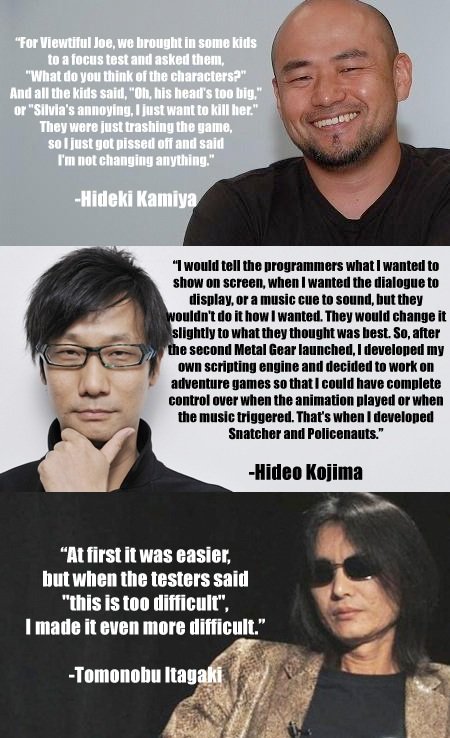
Another arguably negative example might be Hideki Kamiya not listening to feedback on Viewtiful Joe. It wasn’t exactly a big success, but nothing from Clover was. I remember finding the game too hard as a kid. I think it’s a bit rough around the edges even now.
1470788072235.jpg

I remember Itagaki once said that when he got feedback from some game testers saying Ninja Gaiden was too hard, he made the game even harder? Would that also count as a focus testing negative?

I don’t really know. I’ve definitely heard that quote before, and at the time (even with the Kamiya quote) I was like, “Haha, yeah, show ’em!” but on reflection, it might not have been the best idea even if it’s clearly a creator showing authority over the uneducated masses.

Honestly, I’m not even sure about the Kamiya example, except that I remember my experiences as a kid, and replaying it, it’s annoying to slow down time right when enemies shoot at you. I wasn’t used to that arcade type of difficulty as a kid, especially the unforgiving lives system, so I just played other games. Now as an adult, this is all manageable. I was progressing fine through the game last I played it, but I’m an expert. I can quantify how the game works a lot better, so I might not be able to judge it as accurately as someone experiencing it for the first time. And this difficulty of adoption might have lead to its largely unsuccessful sales. Is this a result of focus testing? Who really knows?

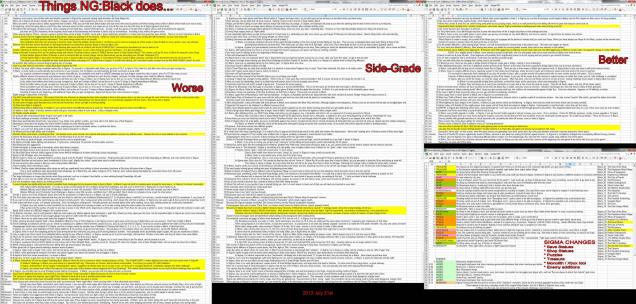
As for Itagaki, I don’t really know. He certainly made the game harder, but look at this version comparison between Black and Sigma. Sigma was made easier in some ways, but harder in others, where black (presumably the game his quote was talking about, or more true to his original vision) has a lot more sections with awkward controls where you’re simultaneously assaulted by enemies, such as in the swimming/water walking sections or some areas where you need to wallrun. Also the tank and horse bosses that need to be killed with arrows that can only be shot in first person view in black.
Ninja Gaiden Comparison Black Sigma.jpg

Mind Games via Mirror Neurons

What’s the difference between a mind game and blind guessing?

https://en.wikipedia.org/wiki/Mirror_neuron#Understanding_intentions

Mirror Neurons. People have a natural capacity to understand and predict other people. This same capacity does not exist with machines (though one time I beat a rock paper scissors neural net with 5 wins, 7 draws, and 0 losses, presumably because it was acting on data from real people). Machines can be way more perfectly random than people. People are very bad at being random.

Picture 2015-02-03 01_00_57.png

https://www.ncbi.nlm.nih.gov/pmc/articles/PMC1044840/ https://www.sciencedaily.com/releases/2015/02/150226132046.htm http://www.fil.ion.ucl.ac.uk/~karl/Predictive%20coding%20an%20account%20of%20the%20mirror%20neuron%20system.pdf

It’s been shown that humans have a limited ability to predict the actions of other humans under observation, believed to be facilitated with Mirror Neurons, Neurons that fire both when you do something, and when you see someone else do something (or even if you think they’re going to do it, but don’t realize you think it yet). When you expect someone to do something, neurons in your head fire, but you don’t have conscious access to these, rather they bubble up into your conscious mind as a prediction.

15ikiOA_rU7xvRsD_riyBW1K9_oLooruRJ7FYrnSzqfkTzVRBbG03fIEkrexqK8U.png

There are some people who have no ability to predict other people, and just choose what they think the most unlikely thing is, like Mew2king. There are others who get inside the other person’s head, like PPMD, Mango, or Daigo. Fun fact, autism is suspected to be at least partially connected to a deficiency in mirror neurons (Editor’s note: History hasn’t borne this one out. Mirror Neurons are mostly considered kind of a dead-end these days).

A mind game is about watching people’s responses to situations, then choosing the response that beats theirs in that situation. A mindgame is about conditioning another player to respond a certain way to a situation, then changing it up on them at a critical moment. Repeat conditioning causes people to act pre-emptively and worsens their reaction time for unexpected stimuli.

Mindgaming is about knowing common reactions to certain situations and preying on those or setting up those situations at a critical moment to eke out a win. The thing is, when you’re playing someone else, they’re adapting to you too. So you need to update your log of opponent reactions as they change their pattern or anticipate when they’re going to change their pattern based on what you know about the player’s adaptation speed.

The difference between a read and a reaction is speed. When you read, you act pre-emptively. For this reason, reads are stronger than reactions, because you have more time to get stuff done, but you sacrifice accuracy. When you read, you’re flying blind.

Emukiller was the dude who taught me to react more in Smash. A lot of scenarios have 100% solutions, but only if you react. If you read pre-emptively all the time, then you’re liable to get screwed up when you could have covered all possible outcomes by just reacting. It’s up to you to figure out what the limits of your reaction time are to determine what’s reactable and what’s not.

This combo video is good for emphasizing mindgames. Notice how Darkrain moves preemptively of his opponent’s action. He’s there ahead of his opponent. He knows what they’ll select.

Or this:

Or here’s a Daigo montage for comparison:

https://www.youtube.com/watch?v=7ob6123gOqk
https://www.youtube.com/watch?v=E8qm96m7YOs

And this is probably the most clear example of a mind game you’ll see all day:
https://www.youtube.com/watch?v=qF2S9KeaO2M
(for those wondering what it did, it made Combofiend afraid to act and more defensive, allowing Mike “Mike Ross” Ross to get in and pressure him for the KO)

Try playing someone worse than you and beating them just using basic options. I frequently beat beginners using nothing but light attacks in street fighter, or only sweeps, or only crouching strong. If you know exactly when to throw a move, then unless there’s a pure counter for it, you can win every time, even if it’s a bad or unsuitable move. Knowing when to throw it involves reading. Try this versus a friend who is bad to see what I mean.

See Also: How to Read a Book: Reads in Competitive Games

The Secret Behind Platinum’s Quality?

If you ever get to the new TMNT game by Platinum, what’s your opinion on it?

I played it briefly.

It’s kinda boring. It doesn’t tell you the sequences for the combos for some reason. I checked all the menus. The sequences are the same on all the turtles, but each one has slightly different attack animations at a difference cadence and range and all. All of them can mash light attack in the air to do an air sequence, and press heavy attack for a diving attack. Then they each have slightly different sets of special attacks that do slightly different things. The game has a unique block/dodge/parry system. You can press R1 to dodge, hold it to block while spinning in shell form, then release right as you’re hit to parry an attack. Dodging perfectly lets you circle behind enemies and jump on their back to deal damage by mashing buttons. Speaking of that, there’s a fuckton of mashing in this game. You gotta mash to interact with things, and mash to revive when you get knocked out.

Each stage is a big cityscape with ninjas all over it. Occasionally objectives pop up that you can complete. You can use see-through-walls-vision to find where shit is going on. Beat up ninjas and eventually you get access to the boss.

So, kind of a disappointment overall. It’s a really simple combat system, and meh enemies, with plenty of filler content all over.

What’s interesting is the director. It was directed by Eiro Shirahama, who you might notice was also the director of Legend of Korra. Legend of Korra was probably Platinum’s biggest miss up to this point, which lead to a surprise when Transformers Devastation was amazing. So why was Transformers Devastation good among these three licensed cartoon games? The director of Devastation was actually Kenji Saito, who you might also know as the director of Metal Gear Rising.

So this makes me wonder, what other recurring directors have we had at Platinum Games? The answer is almost none. Almost every Platinum game has a different director. Even ones you’d think would have the same director like Mad World to Anarchy Reigns, and Bayonetta to Bayonetta 2 have different directors (perhaps this explains the difference in quality between Bayo 1 and 2). I’m only really looking at directors here because I know that a lot of the corporate attitude of Platinum is inherited from what Shinji Mikami established back at Capcom, where it’s all about the director’s vision. You’ll notice there are few repeating people in other roles as well though.

Of the recurring directors we have Hideki Kamiya (Bayo 1, W101, Scalebound), Yusuke Hashimoto (Bayo 2, Star Fox Zero), Eiro Shirahama (Legend of Korra, TMNT), and Kenji Saito (MGR, TD). This leads me to think that Kenji Saito is something really special to the company, he may be an even better director than Kamiya. I’d keep an eye on him in particular in the future. It also leads me to think that Hashimoto and Eiro Shirahama aren’t very good directors.

Wii U

What are your thoughts on The Wii U?

Bayonetta 2, Wonderful 101, Mario Maker. Don’t care about anything else on the system.

Nintendo doesn’t release good software. They didn’t exploit the potential of the system that everyone originally saw. Nobody wants to put up with the large controller for games that largely only have tacked on functionality for it. Continue reading

Should We Innovate Controllers?

Do you think companies should try to innovate controllers or keep the standard DualShocker format?

Dual analog format.

I assume you’re asking because this video was just put out:

I think the dual analog controller is the best controller for the majority of third person games. The trouble with innovating in controllers is you need to come up with one standard that works for a ton of games. In the arcade days, they could and did make controllers unique to every individual game.

What I think needs innovation is the mouse/keyboard, but it’s also the hardest space to sustainably innovate in. Console creators can set controller standards when they make a new console to whatever they want them to be and customers have to comply. PCs have a ton of peripherals, but apart from joysticks like flight sticks, few have really caught on enough to sustain more than niche genres. You can’t even really assume players have extra mouse buttons like a lot of gamer mice have. (I have a Zowie FK, it has 2 extra buttons on both sides, I don’t get a lot of use out of them and am frankly not even used to using them as a result)

If you’ve tried playing a dark souls game on PC, you’d know how weird it can be. The mouse is like the face buttons on a controller, but you only have 3 buttons instead of 4, and one of them isn’t that easily accessible. You need to sacrifice directional control to get more than 2-3 buttons over on the keyboard side. The total number of directly accessible buttons goes down on PC relative to console, so it’s harder to have a large number of directly actionable commands in FPS games. As a result we don’t have FPS weapons that have 6 different attacks, we have 3 different FPS weapons with 2 attacks each. Back on dark souls, it’s really easy to light attack and heavy attack, but functions like blocking and parrying get put on weird keys, especially considering they need to be held or pushed actively to really be effective.

Games with less emphasis on camera movement and more on direct access to face buttons naturally don’t work at all on PC, like DMC4.

Though…

Of course this only works because he abandoned the mouse, and it’s far from an ideal layout.

I think for controlling the types of games that are most popular today, 3rd person 3d and 2d games where the character is like a rigged up pawn that moves through space playing premade animations on top of its rig, current dual analog controllers are best. To make new types of games though, we might have to branch out.

A friend pointed out to me that VR might actually be helpful there for third person games, because it can free up the right analog stick, allowing more attention to be devoted to the face buttons while you can look around your character in third person. Definitely not consistent with the VR immersion dream, but I reluctantly admit that VR might have some uses.

The further problem with innovating in controllers is, you gotta make a game that uses it fully, like Wii Sports, not tacked on.

Precision in VR/AR

How important do you think precision is in fpses? To increase precision, we have to reduce speed (see Doom to Quake to modern shooters), so where do you stand? How do you feel about a fully-realized AR shooter, like virtual paintball, but with different weapon-types? That would have very slow movement speed, but it would create new types of tactical depth that I think aren’t possible with traditional games.

Blah, there’s that word precision again. And used in such a way that it’s not clear what you mean. I think a better phrasing here might be, “to make aiming easier, we have to reduce speed […]” But it’s still not clear what the overall question is supposed to mean.

Speed was reduced in the move to modern shooters because of console controllers, which cannot aim with 1:1 precision like the mouse can. The mouse does not need slower character movement speeds as a concession to make aiming easier. Controllers have difficulty moving fine distances due to the necessity of dead zones at the center of them, and the difficulty of pushing it a slight amount then releasing the stick before the camera moves too far. Continue reading

Game Design Book Recommendations

What do you think of the book on gamefeel?

It’s an awesome book.

Here’s a sample of the types of things it talks about:
http://www.gamasutra.com/view/feature/1781/principles_of_virtual_sensation.php?print=1

In the book it defines the term precisely, as the confluence of spatial simulation, polish effects, and real-time control (which might be better termed, “real-time direct control”, since starcraft is cited as the defining example of a game that lacks only real-time control and no other elements of game feel). It lays out specifically how each of these things looks like individually, and every combination of them short of the whole thing, and lays out how only all 3 make the full sensation of game feel clear. Continue reading

Critpoints Glossary

After some thought, I’ve decided to make a glossary to help people who might not understand some of the terms I use. Some of these are terms I’ve made up myself, those will be noted as such. Rather than being ordered alphabetically like a conventional glossary, I’m ordering this so related terms are closer together, and you can get an idea of a topic from the terms close together.

I’m going to borrow from Critical Gaming’s glossary a little as well as general terminology that is sitting out there. This isn’t meant to be comprehensive, just things that might be a bit out of the way for the common gamer (though I might have gone overboard and included a bunch of obvious entries too). These are the terms you might not know, but probably need to know in order to understand this blog or my writing in general. Continue reading

First Person Fraud

How can you write fps articles without having played the seminal contemporary fps series? Or at least the more popular or better games in the series. You need to play the BLOPS trilogy, MW1, MW3, and maybe Advance Warfare so you can be more thorough in laying the smackdown on these games. Or, are you perhaps afraid that you’ll think these games are not as bad as you’d like to think they are? You might even find them… decent. :O

Okay, lets see, I’ve played Modern Warfare 2, CoD 2, Bioshock Infinite, Takedown Red Sabre, Metro 2033, Deus Ex Human Revolution, Borderlands, Borderlands 2, Far Cry 3, Far Cry 3 Blood Dragon, Crysis, Crysis Warhead, Planetside 2, Battlefield 2142, Brink, Singularity, Halo 1, Halo Online, Metal Gear Online, Spec Ops The Line, Mass Effect, Mass Effect 2, Vanquish, All Points Bulletin, Section 8 Prejudice, FEAR, Just Cause 2, Prey, Peter Jackson’s King Kong.

I’ve played a fair number of contemporary FPS games (and not all of the above list is bad, only maybe like half or two thirds of it). I don’t think I need to go back through Call of Duty. Sure, they might have neat little things like the exosuit and laser weapons in advanced warfare, but that’s not enough for me to put up with the rest of the bullshit I know this series involves.

The better question is why I haven’t played/finished the following games from my priority list:
FPS: Blood, Serious Sam 1 & 3, Doom, Unreal, Duke Nukem 3d, Jedi Knight series, Bulletstorm, Tribes (ascend and starsiege), NOLF, Wolfenstein: The New Order, another Wolfenstein?, Gears of War, STALKER, the Action ______ mods of various FPS, Descent, Wrack, The Darkness, Max Payne, Kingpin: Life of Crime, Socom?, Riddick, Mafia,

These are much more differentiated and mechanically interesting games than most of the contemporary ones listed above. The FPS section of my priority list is the longest section. How can I dare to write about FPS games without finishing all of these? I honestly feel like a bit of a fraud not having played these, enough to shy away from some FPS questions I’ve been asked, and I feel maybe the slightest tinge of regret for not trying out the CoD AW Exosuit.

I’m not afraid, I’m dismissive. I’m also too lazy to play the games I genuinely want to play. Why would I go into a series of games I know I despise, having already sampled that series? Gears of War is on my priority list despite being something I’m not looking forward to because I’ve never tried it before, so there might be something I’ve genuinely overlooked. Call of Duty hasn’t been a thought in my mind.