The Big Catch: Tacklebox Review

The Big Catch: Tacklebox is a demo for an upcoming 3d platformer game, The Big Catch. Despite being only a demo, Tacklebox is closer to a prologue chapter, featuring a different protagonist and entirely distinct areas from the upcoming game! This free “demo” has so much content, that it’s practically an entire game in its own right.

In The Big Catch: Tacklebox, you are tasked with catching fish, who run around on tiny legs around ancient ruins scattered across a desert plateau. You can also collect coins/tokens, which unlock the final dungeon if you collect all 696 of them. Naturally, this is a bit like 3d platformer collectathons of the past, but part of what helps distinguish Tacklebox is that rather than scattering coins and fish around everywhere, they’re in deliberately chosen locations that are difficult to get to. While cleaning up some of the better hidden coins at the end of the game can be a bit of a pain, for the most part, the game focuses on only putting coins in locations that are a challenge to get to, so that they’re closer to optional challenges scattered across the game, rather than simply collectables for the sake of being collectible.

Continue reading

Pseudoregalia Review

Pseudoregalia is an indie 3d platformer metroidvania, a rare combination. And it has the best movement I’ve ever seen outside of a Mario game. It starts off a little slow, but quickly ramps up as you get the slide and wallkick powerups. The game is very short, I was able to beat it in only 5 hours.

Movement & Powerups

There are a number of optional collectibles throughout the game, augmenting your health, regeneration, or giving small buffs, but obviously the movement powerups are the only thing that really matters. Each of the movement powerups allows you to access new areas, but also just enhances the way you move through the game in general. Slide initially lets you slide under small gaps, but eventually gets upgraded into a slide jump that lets you jump across massive gaps, and even bunnyhop to maintain momentum.

Another powerup gives you 3 wall kicks, which push you away from walls if you kick into them directly, requiring you to use them carefully to scale walls. Eventually you get a ground pound, which lets you jump extra high by jumping as you hit the ground, like Mario in Odyssey, and if you jump at the start of the groundpound, you’ll do a backflip, which helps counter the momentum of a wall kick, raising you neatly onto a platform after kicking off of it. This is like the missing link in the movement that really helps it all fit together. Finally, there is a wall run, which is obtained last. It snaps onto walls reliably and generally feels pretty good to use.

Continue reading

Witcher 2 Review

Note: I wrote this up 5 years ago and intended to publish it, but I guess it got lost on the cutting room floor. My bad!

In Witcher 2, you have 2 swords, steel and silver (for humans and monsters respectively), and 5 spells you can cast: Aard, Axii, Igni, Quen, and Yrden.

Aard and Igni are projectiles, dealing damage/stun on impact. Igni deals more damage and burns the target for damage over time. Aard knocks the target back, stunning them, knocking them down, or dizzying them, setting up for a 1-hit kill. Quen is a shield that will block 1 hit’s worth of damage. Axii will convert one enemy into an ally temporarily, but needs to be channeled over time and has a chance to fail. Yrden places a trap on the ground that will stun an enemy who steps on it, holding them in place until it wears off or they are hit out of it. There are upgrades to each of these, Aard and Igni gain range and area of effect, Quen can reflect damage back onto opponents, Axii buffs the opponents you control, and Yrden lets you place multiple traps.

Almost every enemy in the entire game follows a similar template, they run at you, do attacks straight ahead of them, will not rotate while performing attacks, sometimes block moves that hit them from the front, and you can get behind them to deal double damage to their back.

This means fighting enemies is generally a process of rolling around them to get to their backside and hitting them for as much as you can. This can be accomplished by baiting them into doing attacks and moving while they’re occupied. This method of play, rolling behind enemies to backstab them with Quen shields up, is how all the best players play the game, and encouraged by the game design on multiple levels.

Continue reading

Getting Over It With Bennet Foddy Review

Getting Over It: Video Games Meet the Myth of Sisyphus – Professional Moron

Getting Over It With Bennett Foddy (GOI for short) is the absolute limit of how far you can get with a single game mechanic. The only mechanic is moving around a hammer, attached to a man in a cauldron.
With this control scheme you can push and pull yourself along the ground, pull yourself up using holds, fling yourself, swing under holds, pogo to launch yourself, and so on.

This method of control is incredibly sensitive, and fiddly, but the game ramps up to requiring you to use it in extremely precise and demanding circumstances, at high risk of losing your progress.
GOI can be incredibly frustrating, because there are no permanent checkpoints, and many of the toughest challenges set you up to lose massive amounts of progress. Playing the game at all with it’s strange and difficult control scheme seems impossible, so redoing the incredibly precise tricks it has you perform can seem impossible.

Continue reading

Mirror’s Edge Review

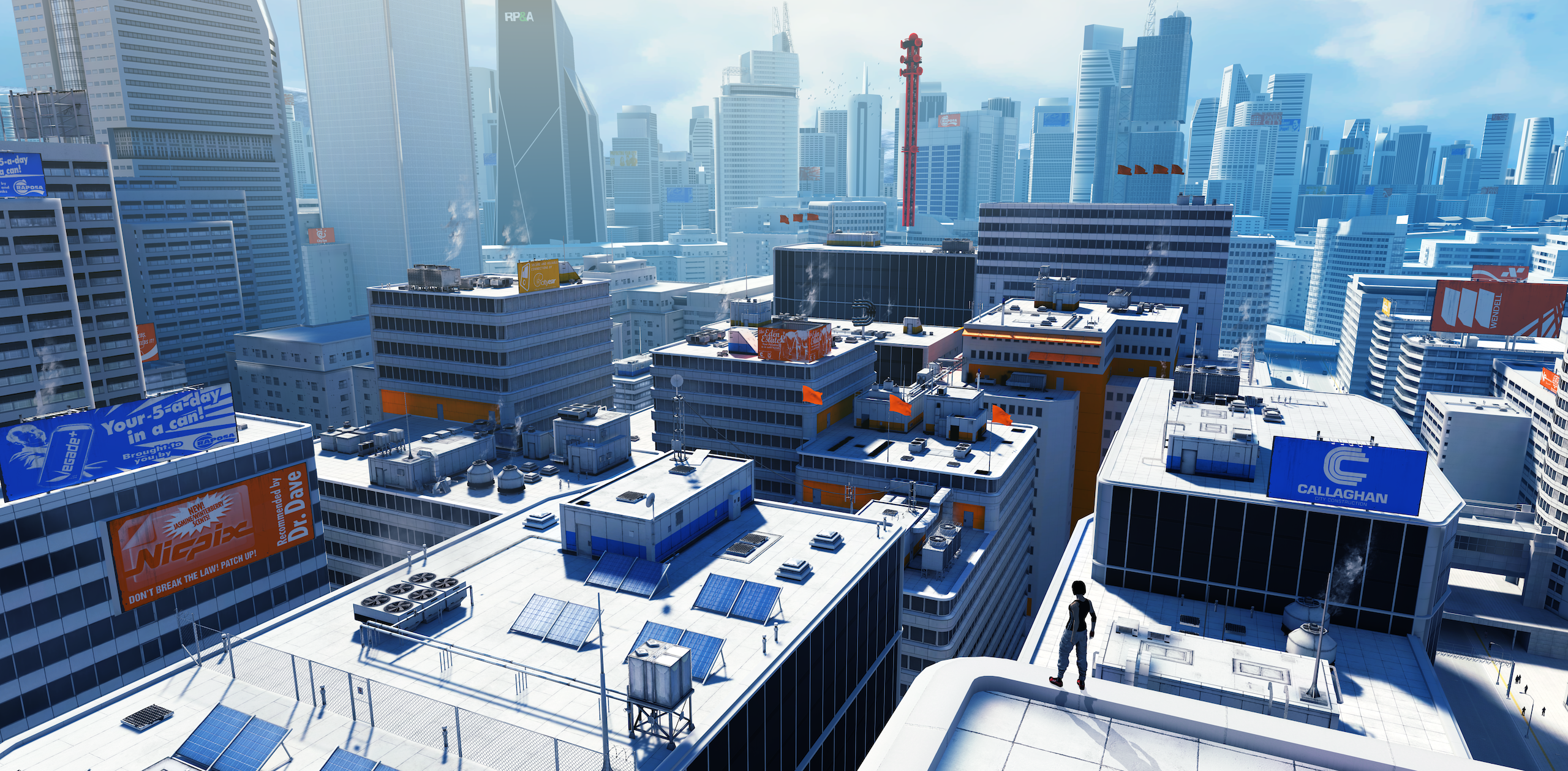
This is part of my 5×5 review series. I’m going to try to review every game in my 5×5, available on the About & Best Posts page. Photos courtesy of Dead End Thrills and gifs courtesy of CabalCrow from my discord.

Mirror’s Edge is one of my most-played games because I used to speedrun it. My best time was about 55 minutes, which isn’t that impressive, but in the process of learning to speedrun it, I learned a lot about what makes an interesting speedgame. I also had a massive amount of fun learning the various techniques involved in the game, from the easy to the hard, and refining my run.

On this blog, I define a game as a “contract” that the player agrees to play under, either a contract with themselves or other players, as in a multiplayer or co-op game. With this in mind, the game isn’t necessarily the software you play with, but rather how you choose to use it, and different players can play different games with the same software. Speedrunners are playing their own game with the software relative to everyone else. For that reason my blog doesn’t tend to focus on the “speedgame” for a piece of software, but rather the “canonical” game that represents more of the lowest-common-denominator idea of what the public thinks the game is, which is usually something closer to what the developers intended than anything else. What’s possible in the speedgame sometimes can influence the “casual” game (what speedrunners call the more default ruleset), but it’s very situational per-game. Continue reading

Doom Eternal Review ft. S.G.S.

Editor’s Note: The original draft and most of the content of this was written by our discord mod, S.G.S. I stepped in to help flesh out sections comparing the gameplay styles of Classic Doom versus Eternal, Resource Manangement, Enemy design, and wrote the Marauder section by myself.

Honestly, I’m nothing short of thoroughly impressed this time around. id Software took the interesting but flawed attempt at action FPS that was Doom 2016, and capitalized on the potential it had in a splendid way.

Doom 2016’s resource management was handled via glory kills for health and chainsaw use for ammo, combined with more “traditional” level design with health and ammo pickups strewn about. This felt like a clash of ideals to me. Classic Doom (and a lot of older shooters) had non-renewable resources that were limited exclusively to pickups around the map, which meant that routing through the map to acquire weapons/ammo/health/armor became an important skill to master. Classic Doom was about resource gathering and attrition, which created a chain of events across a map which had context with each other. Your options later in the level were based on what resources you found, and which you spent, earlier in the level. Various maps tune this balance differently leading to some maps starving you of resources, while others have few weapons to work with; plenty of maps even place weapons in locations that require you to deal with encounters on the way.

Doom 2016, however, had a system in place that showered (heh) you with resources at a moment’s notice, which flew squarely in the face of level exploration as resource management. Combat encounters were decontextualized from one another. You even obtained weapons in a continuous fashion, meaning they were more akin to upgrades rather than resources you locate (or fail to locate) on a map. Eternal pushes this style of resource management further by adding flame belches for armor, which is another layer to manage. As such, the exploration of a level is more for progression and secrets, rather than for resources, and you don’t experience attrition over the course of the level, because infinitely respawning enemies, and infinitely refilling chainsaw/flame belch/glory kill are your source of ammo, armor, and health. Doom Eternal does not deserve to be thought of in the context of Classic Doom, it’s better to think of it as a completely different game series.

Continue reading

Dead Cells Review

Dead Cells for Nintendo Switch - Nintendo Game Details

Dead Cells bills itself as a Metroidvania Roguelike. It’s a 2d platformer, where you find randomized loot and fight through procedurally generated levels. You have 5 slots on your character for items: 2 weapons, 2 tools, and an accessory. Your basic options are to use your weapons or tools, jump, double jump, roll, chug a potion, ground pound, or generic use button.

Dead Cells’ big influence is from Metroidvanias, and I think the influence is definitely positive on the game, but I don’t think it’s really a metroidvania, and I don’t think making it more like a metroidvania would be good for it. Metroidvania is a design pattern across the entire map of a game’s world, where the map loops on itself, allowing areas from later in the game to fold back on areas from earlier in the game, where objectives are dispersed across this map to encourage unique routing. Despite technically not being a metroidvania, the level structure it chose for itself is still extremely effective in its goals.

Continue reading

A Critique of Doom Eternal’s Story

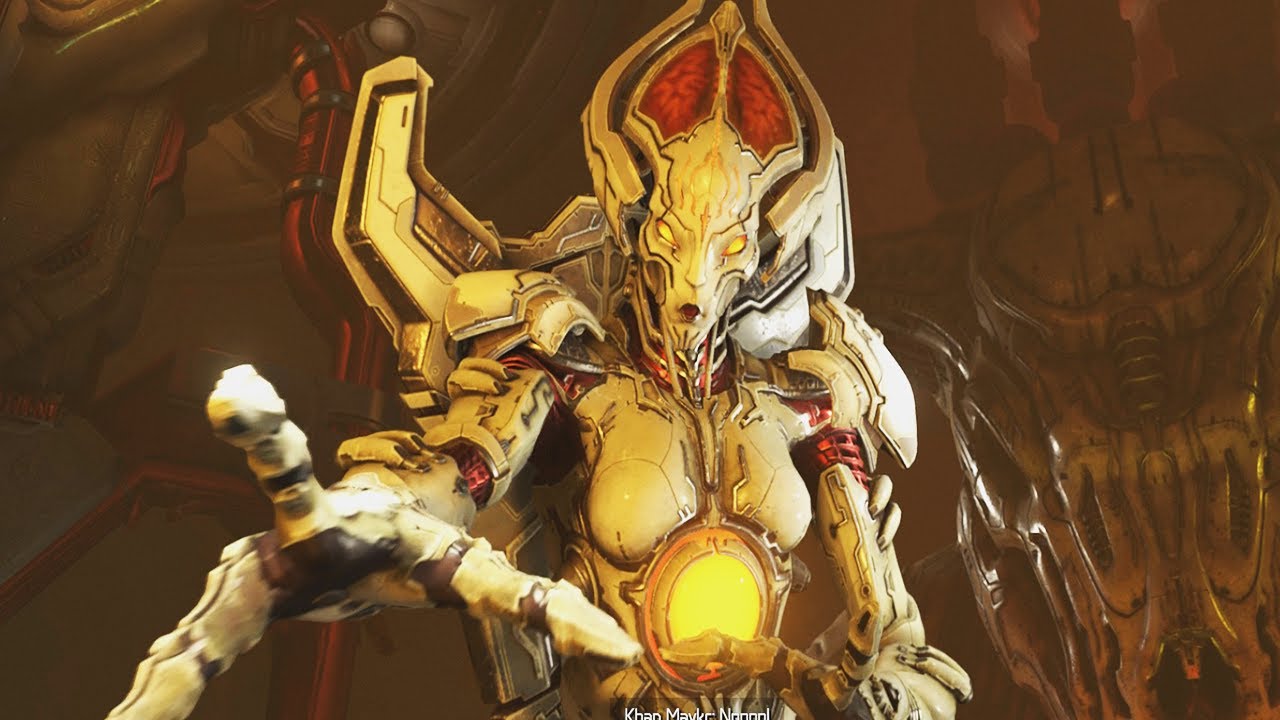
Doom Eternal - Doomguy Confronts Khan Maykr Scene - YouTube
There have been some complaints about the story of Doom Eternal in comparison to Doom 2016, and I’ve gotta say, I agree. Doom Eternal’s story is disappointing, largely because it doesn’t build on the premise of 2016 and introduces a bunch of characters that we don’t get any time to become attached to as villains. That said, this has absolutely no bearing on Doom Eternal’s quality as a game. It’s a vastly better game than its predecessor, and is one of the best FPS games ever released, very possibly the most tightly tuned FPS game ever released, in a way reminiscent of fighting games, in a way stylish action games should be envious of.

I know I have a bit of a reputation for being “fuck story”, but it’s not that I don’t enjoy stories or enjoy analysis of them. I’m willing to put up with an actively bad and obtrusive story in the name of a good game and likewise I can appreciate good stories from bad games (Legacy of Kain Soul Reaver is my go-to example for this). I don’t want to build a platform where I’m expected to have a nonsense hardline position where it doesn’t make sense.

Some people have been complaining about the story of Doom Eternal, and I think their complaints have merits. Anyone saying the lame story makes the game bad can shove it.

I enjoyed Doom 2016’s dismissal of story elements by the main character. I thought the core concept of 2016 was good, corporation leverages hell to power energy crisis earth, devolving into intracompany demon cults going rogue and fucking everything up. Hayden is like, “but energy tho” and Doomguy does not give a single fuck. We have a neat sequel hook of Hayden betraying us at the end, and Eternal just does absolutely nothing with that. Continue reading

Doom 2016 Review (Guest Post by Durandal)

Editor’s Note: This is another guest post by Durandal. Join our discord for more in-depth gameplay discussion. http://discord.gg/EfPY4r9

DOOM (2016) was the first game to mix character action design with first-person shooting. Unfortunately it also half-assed the execution. But, that means there’s plenty to learn from its mistakes.

First, some context. DOOM (2016) plays nothing like DOOM (1993) (henceforth referred to as nuDoom and olDoom). In olDoom combat and exploration intertwined, but most combat in nuDoom takes place in locked-off arenas. This was done to get around the Door Problem in olDoom and encourage aggressive play. Long-term resource management through item placement shifted to short-term by having fallen enemies drop most of your resources. You will spend most of your resources in the arenas where most of the enemies are, so this change makes sense. To make up for the simple enemy AI, olDoom relied on placing the enemies by hand and designing the levels around them. Trying to kill and trying to run past the enemies were equally risky. But in nuDoom, the enemies (and the player) have more movement options. To allow the enemies and player to exert their newfound mobility, the layouts became more circular and vertical. And instead of enemy placement, encounter design in nuDoom relies more on mixing different enemy behaviors. However, enemy design and level design is where nuDoom falls flat the most.
Continue reading

Guest Post: Durandal on DESYNC

Ed Note: This is our first guest post here, from Durandal, about DESYNC, originally posted to the shmup system11 forums. It was written on June 3rd of 2018, and the game has been patched a few times since, so not all the details are correct for the modern version, which has slightly easier to understand language and tutorials, but it should still give a good overview of the game. If you would like to submit a guest post, join the discord and pitch it to me. I do not earn any money from this site and I will credit you as you would prefer to be credited.

I recently tried my hand at a lesser known FPS called DESYNC: a poly-neon arena shooter about killing with skill á la Bulletstorm. It’s so obscure, only me and a handful of other people know how you’re really supposed to play this game. In fact, this post might very well be the most informative source of information about DESYNC on the whole Internet. Continue reading