Criticizing Critics

Thoughts on this Alan Wake video?

Okay, the statement about the flashlight at the beginning. Obviously flashlights don’t work like that, but that’s not a real criticism of the system. So they wanted to make the flashlight a regenerating stun resource, so what?

The statement about regenerating health and low ammo and how it encourages you to run past enemies is more reasonable. Though to be honest, it’s better to run past enemies rather than engage them in most games. He could have been more descriptive with the regen health.

I don’t really understand his description of the ammo system. Wait, I listened to it again and I think it makes sense. A lot of shooter games do ammo like this, where ammo is independent of actual storage space and only the type and limit for that type matters. This seems like another realism complaint, I don’t think having an actual inventory tetris thing really adds or subtracts anything from a game. I don’t like criticisms of “video game logic”, because come on, you know there’s a reason they made it that way.

As for the dodge, it’s a horror game, isn’t it kind of against the point if you can dodge then take a shot? Not to mention, if you dodge early then you’d probably have time to get a shot off. Of course you need to keep your distance, I’m pretty sure that’s the point. They’re scary monsters and shit.

4 weapons, if they’re different in function that’s probably honestly fine, as long as the level design stresses different ways to use them. It is kinda low I suppose, but whether they all work the same is a bit more important than only being 4 of them.

Also lol at the guy mocking a hypothetical detractor, “Oh he’s talking about gameplay, games aren’t about gameplay, they’re about story!” Glad we’re on the same page there.

I really like this video but can come with 2 complaints. Do you have any about it?

https://www.youtube.com/watch?v=6s544sFja5k

After KirbyKid tipped me off to the statement, “…shows the developers put a lot of thought into this” as being a filler statement, appended to filler observations, I’ve been more wary about statements similar to it. He says, “Shows the developers cared a lot about the game,” early on, but whatever, this is extremely minor and doesn’t detract from his point.

“The reason this system of dodging is so tasty is it’s much more organic and interactive than other games”
Bzrrrt! Buzzwords! It’s because each of the dodges has a distinctly different function and are useful in different situations. Weaving is fastest and lets you stay close to enemies and levels you up, but is only invincible for your upper body. Sidesteps are next fastest, and get you out of the way of things, but aren’t as fast and keeps you on top of enemies, and aren’t fully invincible through the whole animation. Backflips are slow, but really invincible, and take the heat off you, but you don’t stay close and get no level benefit. So they all have vulnerabilities in different ways or drawbacks to using them. Weave is obviously the most efficient, but hardest and riskiest to use with the other two moving down in risk versus reward. To be fair, he gives a similar description, but bit less detail. Good on him for mentioning the dodge cancel, that’s obligatory. More obligatory than dodge offset if you ask me. Fairly good description. End of the dodge section is filler fluff, but whatever.

A lot of what he does after this is describe the features of the game rather than what necessarily makes those features interesting. Like, I’m sure we’ve all had this experience of hearing all the features of a game we don’t give two shits about. Even though we know God Hand is a good game, we’ve gotta treat it the same way for the sake of rigorous analysis (and because not everyone has played it/knows it’s a good game). Like, yeah it makes sense to go over the features, but I think you kinda need to describe how they create strategy/depth rather than simply saying they’re there. He could have talked about the enemy cycles and patterns a bit more, the ways you can combine moves and they work together, and tried to describe some of the actual tactics in the game.

Most of the rest of it doesn’t really talk about gameplay. What were your complaints?

1. He frames dodge canceling as an exploit of the system rather than pointing out how it is intentional as you can’t DC every move in the game. 2. He doesn’t point out that the game keeps track of KMS runs or that there is a reward for them and he makes it sound like a self imposed challenge.

1. I don’t really mind that, it’s an easy mistake to make. After all the only moves you can’t DC are ones where you don’t have your feet on the ground.
2. I…. didn’t actually know that. I’ve never completed a KMS challenge. I was working on a KMS, no continues, challenge a long time ago, but I wanted to stream God Hand for some friends and didn’t want them to have to sit through the same level a lot.

You found much better ones than me.

Oh. lol.

Any thoughts? I think it’s probably the worst review I’ve ever seen. http://m.youtube.com/watch?v=4qWw4kVal-g

A LOT of G4’s reviews were like this back then. I should know, I watched the channel. I mean, all this says to me is that game reviews were never good. Like, some people opine for an older time, a better time, where reviews were people’s honest opinion. That time never happened. Older reviews were on the right side ostensibly, they picked the right games (except god hand obviously), but they weren’t descriptive enough to make it matter. Even if you hand the right games 10/10s and the wrong games 4s, you’re not doing a credit to the consumer if you can’t explain why.
http://scar3crow.com/2014/07/this-is-not-how-you-review-games
Here’s an article from a guy I found. When the review covered in this article came out, we were all like, man he stuck it to the EA marketing guys. I admit that I was included in that back then, because fuck EA, fuck marketers, etc. But honestly, both of these are really crappy. I’ll leave it to the article to explain the rest.

The thing I’d like to see from reviews isn’t tacking the correct score on to the end of it, isn’t being positive about good games or negative about bad games in proportion to their actual badness, the thing I’d like to see is better descriptions of the games in question, and hopefully the rest will follow. If the game can adequately be described, then a negative review of a good game is going to make me capable of reading what the game actually has going for it, and more likely to buy the game, and vice versa for a bad game.

If we can get to this state, then we’ll be in a healthier place for journalism. That is the crux of what I described in my tripping on air article.

What do you think of this? Also, I love how buddy fails to mention how dt ups your mobility with trickster and changes the properties on some special moves.
http://m.youtube.com/watch?v=mvkkFwxK27A

He’s vague, he doesn’t get all the details down, he focuses on story and aesthetic elements a lot, he doesn’t really describe how the gameplay works. He’s a nobody.

Sorry for not going into much detail, but this sounds really like every other layman’s review of DMC4 ever, except this layman misses some stuff. So what? There’s bigger fish to fry.

Dark Souls: Those Silver Knight Archers

Thought’s on this?
Good Design | Bad Design #1: Dark Souls

“The developer is teaching you something, carelessly going into sen’s fortress will kill you”
I dislike hearing statements like this. Carelessly going anywhere in Dark Souls will kill you. The thing they’re teaching you is, floor panels will trigger arrows. (though he does cover this immediately afterwards, so good on him) Then they’re throwing a fairly hard encounter at you, for the level of player heading into sen’s fortress. It’s nice that he notes that you can use the trap on the manserpents.

Also nice that it is noted that the manserpent on the walkway is essentially ramping up the challenge, and noting a few of the options that are denied to you on that walkway.

He makes a fair case with the silver knights. My kneejerk reaction is to say, “that was one of the most memorable moments in the game, how dare you say we remove it, it’s clever in a number of ways and has a lot of potential ways the encounter can go and possible solutions for the player, and they made it easier in a patch because people had so much trouble with it.”

There’s nothing introducing you to the silver knights previously or to dragonslayer arrows previously. The bonfire is really far off. And even if you do overcome them, the bonfire room is behind a closed door, you can’t tell which room it’s in, or even that it’s there at all, creating the potential that it could simply be missed.

To help introduce the Silver Knights, some of the demons on the ramparts could have been replaced with them, without significantly changing the character of the area. Those demons could potentially be relocated to the roof of Anor Londo for a mixed enemy encounter with the silver knights up there. Additionally, the bonfire of Anor Londo could have been placed at the bottom of the elevator instead of the top.

The trouble is, the Silver Knight Archers encounter is a strong piece of game design. This is perhaps one of the best examples why the “teach the player incrementally” school of level design is a negative influence on design.

When every level design tutorial is about slowly introducing players to the elements so you’re sure they know everything before encountering anything really hard, then yeah designing for just a straight challenge is going to be seen as an enigma.

This is roughly the halfway point of the game. The player can handle a challenge by this point. Maybe it’s a bit weird that the difficulty curve is backwards here, but if you remove a moment like this from the game, then you’re cutting out one of the best parts that they never really recreated in the others. This is a unique type of challenge that never really appears in the rest of the franchise. Isn’t it a valuable strategic space unto itself?

tumblr_ly14skzi6m1qb618ko1_1280

The Silver Knight Archers have a number of components to the encounter that contribute to it being a fair and deep challenge. First, you have a big platform on which you fight two demons, and the knights’ arrows can actually hit you here, but you’re given two pillars to work with. You know the demons’ pattern, so you gotta deal with them and these two additional projectile users in a space where if you get hit, you won’t be knocked off. This is arguably a really hard encounter by itself. You can skip the demons by running past them, which makes the next section slightly more difficult.

You have the initial run up to the column that acts as cover from the knights. On this stretch, you have a little fence that both protects you somewhat (though not completely) from the arrows, and prevents you from running off. If you didn’t kill the demon’s below, they can throw electric spears at you, hitting you from behind. I’ve been hit this way, running serpentine usually safeguards you. You can see both archers and their position while running on this stretch, then you get a big pillar/tower that acts as cover before you have to do the real thing. The next ramp up has no railings, it’s the real thing, so from then on, you need to move without hesitation, setting a different tone for this encounter than most other in the game. Going around the tower to get to the ramp up is itself a risky proposition, but less so than the ramp itself. You’re under fire from one of the archers, and have the ramp/wall to brace yourself against if you’re hit.

Going up the ramp with no railing, the archer on the left has two towers in their way, that can act as cover from one of the knight’s shots. So in some positions you only have to worry about one knight. From the top, you can access both knights. Fighting the knight on the left first will give you a lot of cover from the knight on the right, but it means fighting on another ramp with no railings against an enemy you’re unfamiliar with. The unfamiliarity with the moveset of the silver knights is perhaps the biggest point of unfairness here (because honestly, the arrows themselves are really simple and slow projectiles).

Moving close at the right archer will prevent the left one from firing on you when you reach the top (because the tower is in the way), giving you time to dispatch the right archer. The walls give you a point to brace against the right archers fire with the archer’s outcropping angling him so your back is slightly tilted towards the wall. As you get closer to him, this advantage increases, and you get a corner to work with. There are a lot of ways to beat this silver knight, parrying him, finding a way to push him off, or fighting.

Staying between the two archers at the top of the ramp is the only position where they can both fire at you simultaneously after getting to the top of the ramp. The key point is, you’re not allowed to hesitate here. You need to make a decision and commit to it.

1327274147897

The Smash Bros Movement System

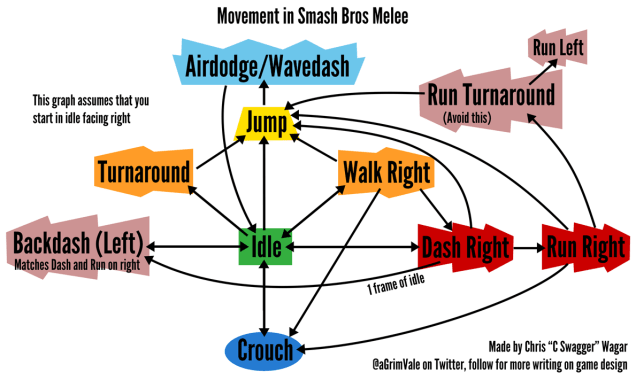
melee-movement-graph.png

This is a companion guide to https://critpoints.wordpress.com/2015/12/25/footsies-in-melee/

Okay, movement in Smash Bros is a tricky topic, there’s a lot of nuances to it that don’t exist in any other game I know of, so lets get down to business.

oaroheq

Up above is an image (made by Kadano) detailing all of the actions possible from a neutral standing state using the control stick alone, assuming you are facing right. When you tilt the stick forward, you will begin to walk forwards, with speed proportional to how far forwards the stick is pressed. If the stick is moved into the dash region within 2 frames of it being in the dead zone, it will initiate the initial dash animation, if after 2 frames it is not in the dash region, a dash cannot be initiated regardless of the movement of the stick until it enters the dead zone again. If the stick is moved back into the tilt turn or smash turn areas, then the character will initiate the turning animation, if it is in the smash turn area on the first frame of the turn animation, then the initial dash animation will be started in that direction.

While walking, you are allowed to perform any standing action, forward tilt, down tilt, up tilt, fsmash, down smash, up smash, and all your B moves. This means walking is a nice and delicate way to move while being capable of performing any attack at any time.

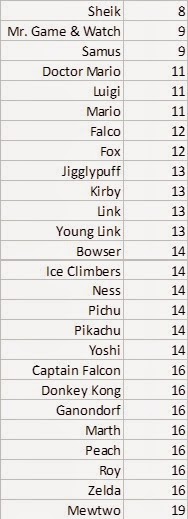
As noted above, when you “smash” forward, you’ll enter an animation state called initial dash. This animation plays for a different number of frames per-character, and if the stick is held forwards, it will transition into the run animation when it ends. If the stick is released, the initial dash animation will continue to play until it concludes, but you will not maintain your speed forwards, with friction slowing you to a halt (this is called a fox trot).

ssbm2bdash-run2bthresholds2bspeed

During the initial dash animation, you are not allowed to crouch, attempting to do so will make you crouch after a fox trot. You cannot perform any tilt or smash attacks during the initial dash animation, except for up smash (because jump cancels into up smash, and you are allowed to jump from all grounded non-attacking states.). If you smash turn during the initial dash state, you will re-enter the initial dash state in the opposite direction. There is a 2 frame leniency for this (unlike the 1 frame leniency for trying to dash in the opposite animation from standing), not reaching the opposite side fast enough will result in a fox trot.

This means that you can rapidly alternate directions to begin the initial dash animation over and over again in the opposite direction. This is called dash dancing. If you allow the initial dash animation to play out completely, entering a run, attempting to turn back will result in a long turnaround animation playing where you lose a lot of your speed and cannot perform any action except jump. Jumping during this animation will orient you in your original facing direction in Melee, and the opposite facing direction in Project M (called reverse aerial rush).

Because the turnaround animation during run is so long, many players elect to stay in dash dance to get the fastest turn times, allowing them to move with more agility than the run animation over a shorter range. The thing to get familiar with is learning how long you can hold dash in a direction before needing to turn around. This means that there is effectively a distance you’re allowed to move before needing to turn back. When you learn this distance well enough, you’ll be able to move at maximum speed over short distances, weaving in and out of opponent’s attack ranges. It’s possible to run across the stage, staying entirely in initial dash by turning back, then forwards every time you’re about to hit the edge of your range. This is a great way to practice using the dash dance purposefully. Varying your dash lengths and having great precise control over your dash will allow you to whiff punish any move.

During the initial dash animation, the only attacks you’re allowed to perform are the dash attack, grab (the running grab animation is slower, it’s recommended that you jump cancel grab to get your faster standing grab), your B moves, and up smash. However every time you turn during the initial dash animation, there is 1 frame where the character is in a neutral standing state. On this single frame, you are allowed to perform any neutral standing option, assuming you have good enough timing and dexterity. Performing an action on this frame is called a Pivot. Pivots are extremely tricky, but allow you to move at maximum speed and attack with impunity. Because they’re so difficult, many people only use pivots for specific applications, like moving in for a quick smash attack.

Once you enter the run state after the initial dash, your options increase a little, because you are allowed to cancel run with crouch at any time, and perform any move you normally can out of crouch (all special attacks, all smash attacks, all tilts). Worth noting is that crouching, then dashing the opposite direction is faster in a run than trying to do the run turnaround. This is called a Cactaur Dash.

Wavedashing is a technique performed by airdodging at an angle into the ground as soon as you leave the ground from jumpsquat. When you hit the ground, there are 10 frames where you cannot act due to landing lag. This means wavedashes effectively have a startup time of 10 frames + your character’s jumpsquat, assuming you do the wavedash frameperfect. You can also do this as you land from a jump or come up through a platform (fastest way to land on most platforms), incurring the same 10 frames of landing lag. The wavedashes of most characters are slower than dashing, with the exception of the characters with the absolute best wavedashes, like Luigi and Ice Climbers. Wavedashes are nice because they allow you to move at dash-like speeds without committing to the more limited set of dash options, as well as retain the same facing direction. So you can wavedash backwards while facing forwards. They help fill in a few holes in most characters’ mobility options. Wavedashes are bad, because they have a longer startup time than dashes and walking. During the jumpsquat, the wavedash inherits whatever momentum you had moving forwards, so dashing into a wavedash will make the wavedash move further.

The angle at which you dodge into the ground also affects wavedash length. More shallow angles that are closer to parallel with the ground will travel further along it. More deep angles that are perpendicular to the ground will travel with less distance. You cannot wavedash perfectly to the left or right, you’ll just get an airdodge, however you can waveland perfectly to the left or right when you jump up through a platform, or land on the ground. You need to do this exactly as you land, close to frame perfect if it isn’t totally frameperfect. Doing this will move you a lot further and faster than a normal wavedash, allowing even characters with terrible wavedashes like Ganondorf to move amazing distances.

If you are facing with your back to a ledge and have momentum, you will slide off the edge. Wavedashes allow you to do this, making them great for grabbing the ledge quickly to edgehog. Sliding off a ledge also can cancel any special animation, allowing you to attack faster, and attack animations can slide off ledges both backwards and forwards. In shield, sliding off ledges will put you into tumble, which can be taken advantage of by opponents.

NES Hard games and the Role of Difficulty in Games

General question; I have my own thoughts on this, but what do you think of the viability of “NES hard” modern games? Few games really kill you, or demand much attention anymore. I think overcoming adversity makes the player feel good, but it’s “medicine” the player doesn’t always know they like.‎

I think most of the modern games pretending to be “NES Hard” are pale imitations. You get stuff like I wanna be the guy, Super Meat Boy, Hotline Miami, etc, where you die in practically one hit and have really short checkpoint/reload times. I’ll give Hotline Miami an exemption here because it does have some actual depth to it, preventing its levels from being repeating the same string of inputs ad infinitum. A lot of these games tend not to feature lives, or care about checkpoints beyond the last one you passed.

Others like Shovel Knight take a different study of NES games, building every single one of its levels with introducing that level’s unique design feature in a safe environment, then slowly building in complexity on it. It’s less like a level intended to challenge you and more like a tutorial. If you read a lot of level design literature, you’ll notice that the majority of it is devoted to teaching the player silently through level designs, almost none of it is on how to actually challenge the player in different clever ways.

Raph Koster has a definition of fun that I think is appropriate, from his book, Theory of Fun. More or less, people respond to achieving something inconsistently. Achieving something inconsistently is more or less what we define as difficulty. We evolved in such a way as to receive a mental reward for achieving difficult things. We’re capable of creating goals for ourselves without reinforcing stimuli such as food, unlike most other animals, whose intrinsic motivation to complete a task quickly fades in the absence of a tangible biological reward. This is what enables us to pursue things like money or psychological stimulation to the detriment of our physical wellbeing.

When we achieve something inconsistently, we have fun. The more rare the success, the more fun we have, the more engrossing it is. If no effort of ours is expended in the process, if the process is randomized, the enjoyment is typically more in the form of desire, than an actual enjoyment of the thing itself. People don’t like it, but they want to continue to do it. Wanting and Liking have been verified to have separate neurological pathways. When you expend your own effort, and occasionally succeed and fail, you tend to come to like the act of doing the thing.

In this way, good games tend to have a lot of big and little things to succeed and fail at. You might not beat the level, you might not get as far through it as last time, but this time you bypassed that tricky part without taking damage, and your consistency at getting criticals or headshots was 40% higher. There are associated skills to master, and they balance against each other synergistically in the overall challenge of beating the level before you.

Games can meet a lot of other psychological pleasures, but of course this is a unique one. I don’t know if it’s medicine players don’t know they want, I think it’s an unmet want in an environment that doesn’t totally know what it’s making.

The point of difficulty is to bring out the depth of the game. The point of depth in the game is to make the difficulty interesting. The two work together. You want to limit the player’s options while also giving them ways forward. Kill the easy strategies, force them to be proactive. Give them lots of tools, lots of ways to use them. Almost never completely eliminate the usefulness of a tool. Just because you want to punish the use of a tool in some way doesn’t mean it should be perfectly countered. If the player wants to do only one thing, give them a reason to want to do multiple possible things. Give the tools themselves drawbacks. Go study Castlevania 3 if you want to go for the retro difficulty thing, that game is a master class in it.

As for commercial viability, I believe people are definitely looking for this sort of thing, however I don’t think you will reach much success piggybacking off those that have made success in this area already. Create an identity for yourself, probably skip trying to cash in on nostalgia. By all means make the individual game challenges difficult, though go ahead and include multiple lives and an actual health bar if you feel those things are appropriate. Most of the actual NES games had those. Demon’s Souls was literally found and saved by the western community by importing a chinese copy of the game because they recognized its difficulty. Beyond that, it’s a lot of guesswork and it depends on your individual implementation.

In a way, the success of NES games is that despite their simplicity, they used the elements available to them in order to give the player interesting choices in how they proceeded through the level, challenging them in the precise ways they executed those larger scale choices. Like in the above video, there was a skeleton below, the guy tried to throw axes, expending resources, but missed. Instead of finding a place to throw more axes, he took up the risky move of jumping down and whipping the skeleton as he went, which succeeded. As fish men popped up out of the ground, rather than wait for them to settle on the blocks, he would jump forward and whip them as they rose up. This certainly has a larger punishment for failure and is a lot more timing dependent, but it is allowed to him.

Footsies in Melee


This is a companion guide to https://critpoints.wordpress.com/2015/12/28/the-smash-bros-movement-system/

Alright, here’s my footsies speech. I wrote this for my local smash group, and now I’m passing it on to you.

A lot of beginners when they learn to dash dance, don’t really know what dash dancing is for. They just do it because they know it’s tech and makes you unpredictable, then they get scraped because nobody’s going to respect someone who just DDs in place. Dash dancing really starts to work for you when you learn how to use your dash purposefully. You gotta understand that dash dancing isn’t just moving back and forth to be less predictable, it’s about your character having a certain range of space on the ground that they can move at maximum speed through, capable of weaving around attacks, and as long as you keep turning back at the periphery of this range, you can keep weave around anything. It’s helpful to be familiar with all the movement states in Melee, I might cover those in a different guide.

The first component of this is whiff punishing. When someone attacks you, and it misses, there is a period where that attack must recover. Dashes in Smash Bros are so fast that they can get in on people during that period, and usually grab them (depends on the character). So what you can do is, if someone comes at you with an attack, you can stand within that attack’s range, dash out of the range, let the attack whiff (miss you), and dash back in to grab them. This is the basic whiff punish.

You can whiff punish grabs, dash attacks, SHFFLs (on almost all characters), most tilts, most smash attacks, and a lot of other options, as long as you have enough space to move back, then forward, to hit your opponent when they miss. Because whiff punishes work on so many things, they’re extremely useful. They can beat out a lot of air and special move options too, forcing the opponent to respect whiff punishes on the ground.

Your other two footsie options are Pokes, and “Going Deep”. Pokes are moves you throw out to prevent your opponent from moving in on you. Poking too close to an opponent can lead to getting shield grabbed, so you want to poke at max range, while still hitting them. You want to throw pokes into the space your opponent is about to move into. Pokes are almost always fast startup moves with fast recovery and decent range, so Ftilts and Dtilts on many characters apply, as well as many character’s SHFFLs. Pokes get beaten by whiff punishes, unless they connect with either the opponent’s body or their shield.

Pokes can be beaten by other pokes, these are called counter pokes. Like a SHFFL will beat a dtilt frequently, and many ftilts or utilts can beat SHFFLs, but dtilts can go under those or outspeed them, beating those out. Poking before your opponent does will also beat their poke. Again, these options vary by character.

“Going Deep” is the equivalent to Throwing in Street Fighter, the idea is that when your opponent is non-commital, trying to bait something from you to whiff punish. If you go deep, then they need to poke you to force you out, or they get hit. Many attacks are great for this, especially because you can run cancel when you go outside your dash dance range. Dash attacks work for this on many characters as well. The idea is to overlap the space they’re going to dash in with a hitbox.

RPS triangle melee footsies.png

Pokes < Whiff Punishes < Going Deep (< Pokes again)

So you have this counter triangle, Pokes stop your opponent from moving in on you, going deep. Whiff punishes will beat pokes by avoiding getting hit, and retaliating. Going deep will beat noncommittal dash dancing, so it beats whiff punishes. Of course, poking to keep people out of your space can itself be whiff punished, so you can move into people’s space then out of it to bait a poke, and whiff punish that poke. Moving in is pressure, moving out is bait.

The goal is to watch what your opponent is doing, because you get to see what they’re about to do based on the way they move before they do it, then make a read, and try to beat whichever one of these three options they attempt, and convert that into a punish ideally. Figure out which of these three they’re relying on the most, and try to focus on the options that beat their particular play style, as well as read which option they’re going to go for right here and now.

All of these things open you up to risk, none of them are perfectly safe. Everything counts as a commitment in its own way. If you get scared, then you’re not going to make yourself safer by overly committing to any one option. Victory depends on your ability to figure out your opponent’s patterns while they simultaneously try to figure out yours, and both of you adjust on the fly based on what you just saw your opponent do. But this isn’t perfect rock paper scissors, you get hints based on what your opponent does before they actually commit.

So have some fun, change up your patterns, and figure out what theirs are before they catch on to you.

SSBMtutorials by Kira did a video on this topic and has a similar basis to mine with different terms.

Undertale Overview

What drew you to get undertale? looking at its trailer, it seems like an amalgamation of different small games mixed up to keep interest, and that made me suspicious of it being shallow, making me not get it.

A friend on facebook that I trust posted that he liked it and people should play it. He then told me to play it directly, and I said I would without looking up any information on the game, and with no further questions, besides knowing there’s a pacifist and genocide route and it was an RPG with shmuplike battles. I did this out of trust to him and general impulsiveness.

It is kinda shallow. All the fights are segregated from one another, and there isn’t much context bridging them. You’re allowed to heal very very frequently with save points, before every big fight. Healing items carry over, and you use money from fights to buy them.

Despite that, it’s a hard game, and the battles don’t have that element of repetition that I hate in games like super meat boy, down to the point where you’re memorizing every single input practically. Even the rhythm game boss integrates a large amount of randomness into her patterns. Many of the enemies have partially randomized patterns. However they still follow a very consistent pattern, and show you what is coming before it hits you, and always allow ways out, so it’s extremely fair in that way.

Beyond that, many of the shmup style avoidance minigames are rather unique. They mix it up a lot and as far as I know try a bunch of unique things. Like some enemies have blue or orange attacks, blue attacks can only be avoided by standing still, orange only by moving through them. The bosses each change the control style of your heart, like one is a platformer, rhythm game, actual shmup where you shoot, and a weird one where there are these 3 lines and you can jump between them instantly, but also move smoothly down each line, and one attack has you race up a bunch of lines to escape from an enemy at the bottom while projectiles are moving all over them. Also interestingly, in normal enemy encounters if you get multiple enemies at the same time, their bullet patterns get mixed together, making more complex bullet patterns.

In a genocide playthrough, you gotta sit through a lot of tedious enemy farming, but it has two bosses that are really intense, a ramped up version of the rhythm boss that is even crazier, and a final boss fight that is still kicking my ass.
I did a little rant on twitter about something I felt was lacking, like it felt like there was no dynamic really guiding when you should heal in battle, it didn’t make sense to heal right before a big attack, or during a lull, since both will drag the battle out for a turn longer, then I realized that because you take less damage when you’re at lower HP, that healing when you’re low effectively allows you to take more hits, because healing is for a static amount. So I learned a new game dynamic right there.

I gotta say that I like the game overall. It’s been really fun in a gameplay way, and it’s not completely shallow and repetitive, and it innovated. The room to grow as a player isn’t very big, but there’s some stuff there, much like an NES game.

NES Hard

This question was asked by Jason “Dapper Swine” Brown, developer of Seedscape

General question; I have my own thoughts on this, but what do you think of the viability of “NES hard” modern games? Few games really kill you, or demand much attention anymore. I think overcoming adversity makes the player feel good, but it’s “medicine” the player doesn’t always know they like.‎

I think most of the modern games pretending to be “NES Hard” are pale imitations. You get stuff like I wanna be the guy, Super Meat Boy, Hotline Miami, etc, where you die in practically one hit and have really short checkpoint/reload times. I’ll give Hotline Miami an exemption here because it does have some actual depth to it, preventing its levels from being repeating the same string of inputs ad infinitum. A lot of these games tend not to feature lives, or care about checkpoints beyond the last one you passed.

Others like Shovel Knight take a different study of NES games, building every single one of its levels with introducing that level’s unique design feature in a safe environment, then slowly building in complexity on it. It’s less like a level intended to challenge you and more like a tutorial. If you read a lot of level design literature, you’ll notice that the majority of it is devoted to teaching the player silently through level designs, almost none of it is on how to actually challenge the player in different clever ways.

Raph Koster has a definition of fun that I think is appropriate, from his book, Theory of Fun. More or less, people respond to achieving something inconsistently. Achieving something inconsistently is more or less what we define as difficulty. We evolved in such a way as to receive a mental reward for achieving difficult things. We’re capable of creating goals for ourselves without reinforcing stimuli such as food, unlike most other animals, whose intrinsic motivation to complete a task quickly fades in the absence of a tangible biological reward. This is what enables us to pursue things like money or psychological stimulation to the detriment of our physical wellbeing.

When we achieve something inconsistently, we have fun. The more rare the success, the more fun we have, the more engrossing it is. If no effort of ours is expended in the process, if the process is randomized, the enjoyment is typically more in the form of desire, than an actual enjoyment of the thing itself. People don’t like it, but they want to continue to do it. Wanting and Liking have been verified to have separate neurological pathways. When you expend your own effort, and occasionally succeed and fail, you tend to come to like the act of doing the thing.
In this way, good games tend to have a lot of big and little things to succeed and fail at. You might not beat the level, you might not get as far through it as last time, but this time you bypassed that tricky part without taking damage, and your consistency at getting criticals or headshots was 40% higher. There are associated skills to master, and they balance against each other synergistically in the overall challenge of beating the level before you.

Games can meet a lot of other psychological pleasures, but of course this is a unique one. I don’t know if it’s medicine players don’t know they want, I think it’s an unmet want in an environment that doesn’t totally know what it’s making.

The point of difficulty is to bring out the depth of the game. The point of depth in the game is to make the difficulty interesting. The two work together. You want to limit the player’s options while also giving them ways forward. Kill the easy strategies, force them to be proactive. Give them lots of tools, lots of ways to use them. Almost never completely eliminate the usefulness of a tool. Just because you want to punish the use of a tool in some way doesn’t mean it should be perfectly countered. If the player wants to do only one thing, give them a reason to want to do multiple possible things. Give the tools themselves drawbacks. Go study Castlevania 3 if you want to go for the retro difficulty thing, that game is a master class in it.

As for commercial viability, I believe people are definitely looking for this sort of thing, however I don’t think you will reach much success piggybacking off those that have made success in this area already. Create an identity for yourself, probably skip trying to cash in on nostalgia. By all means make the individual game challenges difficult, though go ahead and include multiple lives and an actual health bar if you feel those things are appropriate. Most of the actual NES games had those. Demon’s Souls was literally found and saved by the western community by importing a chinese copy of the game because they recognized its difficulty. Beyond that, it’s a lot of guesswork and it depends on your individual implementation.

In a way, the success of NES games is that despite their simplicity, they used the elements available to them in order to give the player interesting choices in how they proceeded through the level, challenging them in the precise ways they executed those larger scale choices. Like in the above video, there was a skeleton below, the guy tried to throw axes, expending resources, but missed. Instead of finding a place to throw more axes, he took up the risky move of jumping down and whipping the skeleton as he went, which succeeded. As fish men popped up out of the ground, rather than wait for them to settle on the blocks, he would jump forward and whip them as they rose up. This certainly has a larger punishment for failure and is a lot more timing dependent, but it is allowed to him.

Jason posted a reply here:
http://www.twitlonger.com/show/n_1snfgkm#_=_

Those parts that are bullshit are some of the most memorable parts of the game for me. Like in Dark Souls, the dragon slayer arrow knights on the anor londo rafters. You’re right, the difficulty is in a big way what makes them rewarding. If you tone those parts down, then it’s no longer really an accomplishment or puzzle. We make these games as artificial impediments you could say, then to tone that down to the level where they’re cleared without effort, kind of ruins the point.

The way I’d relate this to fun theory is, fun is relative to the rate of success versus the frustration of repetition. If you succeed every time you do something, it’s no fun. If you succeed only sometimes when you do something, it’s a bit more fun. If you only succeed once in every 100 tries, it’s an amazing thing that 100th time it finally happens. If you do the same thing every time, it’s not very fun. If it’s slightly different every time, it’s a bit more fun, if it’s really different every time, then it’s really fun. To build on that, increase in consistency is related to fun. If you used to never succeed, but now you succeed 1 in 100 tries, it’s more fun. If you used to succeed 1 in 100 and now you’re 1 in 10, it’s more fun. If you stay at the same rate of success it becomes less fun. If you get to perfect consistency, succeeding every time, then it ceases to be fun. This is related to Depth and difficulty curves. Depth is in a way about giving players a lot of things to succeed and fail at, so they can slowly move up to bigger things after becoming consistent at the little things, which is also what difficulty curves are about. Depth is about creating variation in every playthrough, through the choices allowed to the player, and situations created by the interaction of their choices and the game’s systems (enemies, levels, etc).

A lot of modern games are concerned about accessibility. This tends to mean that the way the game is designed holds your hand, there’s no advanced functions or ways to play that might be hard to use. Western games and western gamers actually love hard mode. From what I heard once in an interview with a japanese dev, that’s something more requested in the west than east, where in japan they like being able to level up and get to the end as long as they are willing to put up with grinding. The thing is that typically hard modes are number buffs on the enemies, not making them more interesting in any way. One line a friend told me is that western hard modes are made for no one, and tested by no one. Despite having a hard mode, and it frequently actually being hard, it wasn’t designed purposefully and doesn’t bring out the depth inherent in the game.

There are of course cases like Portal where the game is playtested to death so nobody ever gets significantly stuck and the levels are always suggesting their solutions to you, which is pretty lame.

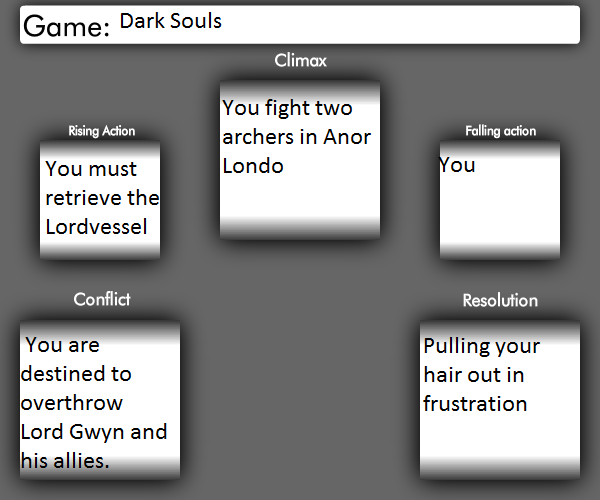
And of course, at the root of any story, there’s a conflict of some kind.

2D vs 3D, what the mediums are “about”

What do you think of i-frame, auto-position, or dodge-in-place types of moves in 2D games? I’m thinking of stuff like Aces Wild and Alien Soldier here. 2D is about movement and positioning, so are these types of mechanics antithetical to the medium? I-framing and homeing moves are practically required in 3D because of wonky collision and imprecise viewing angles (2D screen and all), but what about 2D games? Also, Alien Soldier isn’t really the best example since the Zero Teleport isn’t exactly a true i-frame move and it’s not something you can mindlessly use, I was just using it to give you an idea of what I mean

2D isn’t “about” anything. Using invincibility in a 2d game is not antithetical to the medium in any way. Homing attacks are a problem in general if left unchecked. Don’t make statements on what a medium is “about”, it’s jumping to conclusions, presupposing an answer. There is what works, and what doesn’t work, and sometimes invincibility works. Smash Bros is 2d after all.

Homing attacks can be a problem in a manner similar to lock-on because they usually reduce depth in a scenario that has the potential for depth. I say usually because not all homing attacks are implemented the same, not all are guaranteed to hit, not all are guaranteed to hit at the same angle/time/situation, not all home in the same way. These differentiations can significantly affect the function of the homing attack.

Homing attacks work fine in some fighting games, like Melty Blood, and Dark Stalkers (the pursuit option on knockdown is more frequently used to tech chase rather than get bonus damage by using it slightly too late to connect).

If you have a use for these, then go ahead. If it works, if it has a valid function, then use it. If it can be used to create depth, then go ahead. There is no meaning or purpose to the medium.

Invincibility is not required in 3d games. Homing attacks are usually not required in 3d games. Invincibility is a design choice that makes sense for certain purposes, such as incentivizing waiting to dodge at the last possible moment, rather than getting out of the way at the first possible moment, or as an anti-grab option such as in smash bros, or as an alternate block option that allows you to whiff punish because you’re not being weighed down with blockstun. That type of wait til the last moment skill test is interesting in its own way, which is why Bayonetta went all out with it by implementing witch time.

Homing attacks in 3d games were a compromise in the early days of 3d controls when nobody really knew how they worked, since then people have realized how to implement 3d controls better, so they’re less necessary generally. Not that they were really that common in the first place. How many homing attacks are there? Sonic has one, who else? I’m drawing a blank. Lock-ons and snap-tos are still way more common.

Execution in PM vs Melee

About simplifying inputs; Melee has harder inputs and everything feels so much more satisfying. On the other hand, as much as I like PM, people just throw out special moves without what feels like any rhyme or reason because they know they’ll connect. How many ‘hype’ falcon punches do you see in Melee vs. PM? Or even for moves that are easier to land like falcon kicks or raptor boosts. PM made these moves more viable, sure, but they also reduced the risk of using them (arguable more than these moves warranted). This disproportional (to viability) reduction in execution requirement makes PM less satisfying to play, less impressive to watch, and less hype. So, I would argue that high execution is still important. Sirlin’s idea that fighting games should be all about strategy is not helpful. These are action games first and foremost. Having high execution arguably puts more emphasis strategic play (should I risk it and use this hard move? or in a tight spot, thinking to use an unorthdox move). Also, high execution makes that cathatic release at the end all the more satisfying.

What? Special moves don’t connect more easily in P:M. In competitive play special moves aren’t any more emphasized than they are in Melee. At least, not on a general level. In competitive play we see about the same normal to special move ratio we see in Melee. Easier to connect implies they have shorter startup, bigger hitboxes, which most special moves don’t. Falcon punch has exactly the same number of startup frames in P:M as it does in Melee, the only difference is that you can reverse it now, which allows you to delay the startup a bit.

The risk of using Falcon Punch and Raptor boost has by no means been reduced. Both have the same amount of recovery they did in melee if I’m not mistaken. Raptor Boost is still just as susceptible to shieldgrabbing and counter poking as it always was. Falcon kick had its recovery time reduced and knockback growth changed to make it more useful, especially the air version, because it was a useless piece of shit before. This doesn’t make it easier to use falcon kick, but it does make falcon kick at all useful as something other than a recovery option or kill move.

Falcon was a character that was underpowered in melee relative to the top tier characters. He needed to be improve in order to be viable compared to them. The changes to Falcon were completely warranted with regards to his viability.

The thing making falcon in particular so much more consistent than his melee counterpart is really the removal of stale knockback. Brawl had an extremely horrible implementation of stale knockback, which the PMDT removed completely, thinking they were matching Melee behavior. Turns out Melee has stale knockback too, just more subdued. This makes combos a bit less consistent when percentage isn’t the only thing governing how far someone is hit. Falcon has some relatively simple combos that would otherwise be highly consistent, like his nair into up air string which some people call the air wobble.

The actual factors of execution that were changed in P:M were changed extremely slightly, like by a frame in the majority of cases. Backdashes were made easier by adding the frame of tolerance given to the forward dash input, the dash versus walk range was made larger so it’s easier to end up in the dash range. Shorthops were made easier by fixing the bug where the last frame of jumpsquat doesn’t count for determining shorthop versus fulljump. Various aerials were made easier by the 1 frame physics delay, also probably multi-shining, and chaingrabbing or grab followups. Samus’s super wavedash was given an extra frame on the window.

Then you get things like B-reverse which are still hard as shit, and DACUS which was made harder than in Brawl (2 frame window). Perfect pivots are still frame perfect. Project M decided to make all kinds of edge cancels possible that weren’t before, like Falcon Kick edgecancel, giving players new tricky things to master.

For the most part, the reduction in execution for Project M is extremely extremely tiny. You’re freaking out over nothing.

People still have that type of risk in P:M, like going for a down air as a launcher with Snake instead of Up Air, multiple hits where you need to stay on top of them for the last hit, versus one with more lag afterwards and less ideal knockback. Or Ftilting with just the first hit to get the sticky, which is hard to land, and hard to confirm. In general connecting C4 with Snake is tricky and basically means dropping your combo to do it. Or going for side B combos with Bowser now that there is no super armor on the move, slower than a regular grab, but definitely bigger rewards.

Execution is nice, but it isn’t everything. Something shouldn’t be hard to the point that nobody is consistent at it unless it is something that would ruin the game if someone were consistent at it. Sure Sirlin is crazy for trying to literally remove all execution from games, but saying these are action games or trying to assign a purpose to them or a way they are “supposed to be” is not a good conceptualization. Any sort of statement about how something is “supposed to be” is making assumptions without a basis. It’s like assuming some sort of designer intent without an actual designer. Things either work right, creating a specific effect, or they don’t. Action games don’t need to be about execution primarily, if anything, execution difficulty is a bonus on a decision-making experience. The primary standard of quality I hold for games is depth, and execution by itself doesn’t tend to translate into very much depth.

Having things that require execution to distinguish between outcomes enables a game to create more outcomes in the form of more possible actions that can be performed by the player. Eliminating execution requirements typically means simplifying the game, but frequently it’s possible to make executing easier without a sacrifice, as in the majority of P:M’s implementations of easier execution. Having something be like a 1 frame link instead of a 3 frame link doesn’t significantly impact strategy in the majority of cases, it doesn’t create new outcomes that wouldn’t otherwise exist, it just induces frustration over consistency. If it’s possible to cut corners there without compromising anything, then go ahead. We don’t need everything being as difficult as the super wavedash, because yeah, the guys on top would feel awesome when they pull stuff off, but the other half of the time they’d be frustrated that nothing worked, because nobody can be consistent when everything is that hard.

TL;DR: P:M doesn’t significantly decrease the level of execution necessary to play on anything except borderline impossible shit. None of this affects the possibility space, and thereby depth, of the game. It’s not a significant concern.

Disliking Good Games

How can you dislike good games? Does not compute. Obviously, there are certain subjective criteria (e.g. acknowledging a game’s quality, but not playing it because the aesthetic seriously puts you off), but if a game is good and you acknowledge that, what’s to stop you from liking it?

I don’t view quality as being something consistent with my own preferences. If game quality isn’t something outside of myself, then my ideology is just me trying to enforce my preferences on other people.

Games are characterized by aspects other than their depth. And these things can be things that I or we don’t individually find appealing. In the case of Persona 4 Arena and Blazblue, I dislike that they’re arc sys fighting games that aren’t Guilty Gear. I dislike the style of Blazblue, and can’t find any character in it that I have any particular attraction to. For Persona 4 arena, I dislike its relative simplicity, even though it is technically more complex than a game like SF2. Turn based single player games I cannot stand the long action-less hours of sitting around commanding things to happen. RTS I don’t like the lack of kinaesthetic sensation due to the indirect nature of control over units. Bayonetta I’m turned off by the massive movelist that is largely similar, even though it seems to have a high level of complexity. There are probably a few other games I am forgetting.

I admit these reasons are perhaps a bit shallow, a bit unfair, a bit defined by my personal tastes and expectations, so I recognize that these games are good, even if I do not personally enjoy them much.

If I don’t dislike good games, then my philosophy kinda falls apart, y’know, otherwise I’m just saying that the games I like are good and rationalizing why they’re good to justify my taste. For any sort of concrete or objective theory to make sense, it needs to be something outside myself. We have to recognize that there are facets of games that can be evaluated and shared between people, that our experiences are not so individual that it is hopeless to label any sort of change as progression.

Otherwise we’re right back at the Sokal Affair and the part of history literally named The Science Wars. I know there’s something outside myself with art. I know that there is a thing called quality, and that producing certain effects takes a type of knowledge or technical skill that people do not possess by default. If these claims are not true, then my reason to pursue art is dead.