Has some stealth that isn’t horrible, but also isn’t really amazing, mostly just a timing puzzle, but you can distract guards with the first person projectile. The combat is nonsensical mashing. Has a bunch of lateral thinking puzzles, which I’m not that fond of. Lots of contextual interaction points, which I think were considered fairly new back then. Tries to be like zelda in a lot of ways, like the automatic jumping on reaching the edge of a platform. Has some collectathon elements I’m not fond of. The boss battles are all rather rote in the usual way. No risk/reward element. Has some alright boating sections, some use of physical space in a mildly interesting ways for the various obstacles. There’s some slight overlap in certain mechanics, like the shooting in first person view allowing you to solve certain puzzles and enemy encounters in alternate ways, from points where you normally shouldn’t, like sniping enemy’s cannisters on their backs or picking off small enemies from high ground, but it’s not terribly significant.
It’s been a while since I played it. My standards were lower back then. Isn’t it kind of funny how a ton of 6th gen games, even ones attempting a semi-serious theme like Beyond Good and Evil, went with a cartoony mascot type of theme? The Propaganda song is great though. A game like this, with its theme, definitely wouldn’t be constructed the way this one is. Games in this vein all had a very strong “telos” for absolutely every element in them which limited their depth. That’s part of what makes interactions feel puzzle-y rather than game-y. Like, every enemy is less like a combat encounter of risk and reward, and more like, follow this sequence and you won’t get hurt and the enemy will die. Like the enemies that shoot lasers at you that you need to push into electrical barriers. The pearl collectibles don’t really seem like an optional powerup currency nearly so much as something you need to get all of in order to complete the game, which feels limiting to me. They’re not measures of progress or optional challenges with positive feedback for completing them or something like a currency at all. It’s like, yeah, collectibles are nice, until you need to collect all of them to finish the game.
Probably the strongest thing that it can be complimented on is managing to create so many alternate enemy types and obstacles that are unique in function, but without a deep foundation, deep interactions with any of them individually, or interaction between the parts, it’s ultimately shallow overall. Much like Zelda, it spreads itself too thin trying to accomplish too much.
It is actually one of the best stealth games ever. I was working on a style video for it, but I never got around to finishing it. As I got better at the game, I kept trying to bypass every area without being seen, using only the bamboo dart. The final level is weird though, they put out some of the hardest level designs in the whole game, but give you a ton of grapple points that let you just skip all of them without effort, very high affordance.
It has a really great detection and investigation algorithm, and a large number of tools useful for distraction, including environmental features as well, like lights, gongs, and more. The levels simultaneously create challenges for you, and provide different options for progression. It’s really beautiful how the vision cones of the guards was made to be just barely small enough that you can jump over them in the dark without being seen. Many of the smaller options, like the hover, have a great feel to them.
The feedback about where enemies can see and how far sound travels and your last known location is great for understanding how the system works. I love the NG+ mode that obscures a ton of that information, because by that point you’re already familiar with how all the systems work, which is something I think other stealth games have something of a problem with.
I found that the noise maker tool was a bit overpowered, which is why I eventually did nearly all bamboo dart, because it draws enemies to me directly, it can stun them temporarily, and interact with certain environmental setpieces, as well as being easily usable without needing to focus. There’s a lot of depth to that simple bamboo dart in a way that is also challenging. I also overcomplicated many of my paths through the level for the sake of making it interesting.
One negative remark I’d like to make though is the game really encourages save scumming for perfect stealth. They make it really easy. That and the scoring system isn’t terribly interesting. Also many areas could stand to not give you easy ways out of confrontations, and I don’t like the sleeping gas upgrade of the smoke bomb, which moves it from a rather balanced distraction item to practically OP.
The DLC is great, as well as the DLC character, better level design than much of the main game and I always like nonlethal.
Here’s the rough cut of my best mark of the ninja tricks (I wish I paused a little less to consider my options):
I want to go back to the game some day and get more footage of the later areas.
Any thoughts on the adaptive difficulty of Resi 4?
It’s dumb that it’s more efficient in many places to simply kill yourself to despawn enemy mobs. I’d prefer consistent difficulty at that point. Adaptive difficulty that isn’t God Hand style most frequently feels patronizing to me. God hand is like, “You gotta work your way up, don’t get wrecked while it’s still easy”, where other games are more, “Oh, you died again? Let me give you an easy way out.” In God Hand, getting to the harder difficulty is an inevitability as long as you avoid getting hit, where in most others it’s not something that adjusts rapidly over the course of one life, but rather on how well you avoid death.
From a user experience perspective, it’s really annoying to want to play a game on the maximum difficulty and be told that when you die, you can’t do it anymore and if you really wanted to play on max difficulty, then you should restart the whole game and not die this time. Yes, enemy handicap in DMC4 really pissed me off and the levels are long which makes replaying the whole thing annoying. I want to grind my forehead on the wall until the wall breaks down, don’t switch the wall out on me, don’t make me repeat a ton of shit just to get back to the same wall again.
On the resi 4 devs not mentioning it in any way, it’s security through obscurity. Since almost no one picked up on it, I suppose it worked. Was it a good idea or not? It might have positively affected many casual players in an experiential way (get frustrated at hard thing, keep at it until it’s easy enough to beat it outright, don’t realize the game is rigging it, feel accomplished). Though it’s still a cheap trick in my opinion, and the experience gets wrecked for anyone with a motivation to abuse it or who gets knowingly fucked over by it.
How important do you think tutorials or instruction manuals are? I guess it would really depend on the genre/game. Case by case basis and all.
Nobody reads instruction manuals anymore, and instruction manuals suck these days. The MGS3 instruction manual had a goddamn comic book in it.
Anyway. They’re really important, come on. The more you have to teach people, the more important they become. If you don’t teach people anything and your game requires them to know things to play it, then what the fuck are they gonna do?
Yeah, it does scale by genre/game, because some have more obvious characteristics and less complicated/more intuitive controls, so you don’t have to teach as much directly, but if something isn’t reasonable to intuit, then you gotta teach it.
Fighting games are in a big way brought down because they don’t have good tutorials/single player modes.
Smash Bros has a better single player mode than 99% of other fighting games. The Skullgirls tutorials are kind of fun in their own way because they set up some mildly tricky tasks and have clear completion markers for all of them. Combo trials in other games end up being way too difficult/invariant to represent a solid single player mode for most people. Guilty Gear Xrd has some interesting trials that are similar, and a good grading system on them too, grading for consistency, and their missions mode was cool in AC+R.
Give that a bit more structure, maybe some branching paths between mission unlocks, a bit of story perhaps, and you approach something like the Soul Calibur campaigns in terms of polish. Figure out how AI can be geared to teach players specific fighting game fundamentals (like the blockstring bot in skullgirls), and it will help introduce players to the multiplayer mode, and give them a framework for understanding how the fuck things work.
re: instruction manuals/tutorials. I don’t think those things are important per se. I can only speak for myself, but outside of basic controls, I rarely ever read instructions or watch tutorials. Skullgirls has a great tutorial section, but it’s not like my gameplay is entirely based on it. It’s a decent primer, but what I really prefer is simply having a training room where I can test and figure things out on my own. The character tutorials, for example, are waste on me. Like, it’s nice to see what roles or central strategies the different characters and their abilities/moves might lend themselves too, but actually applying it in battle? Training room + actual matches are far more useful. I mentioned it earlier concerning TEW, but the definition of exploration in games shouldn’t be limited to scouring every nook and cranny in a massive environment. Systems can be explored too.
It’s just that it’s really time consuming for me to teach people how to play these games. I’ve sat in matches with people and acted like one of juicebox’s training dummies before just to help people learn how to play.
There are better ways to teach this stuff, and I really want to see some evolution in that area.
For instruction books and tutorials generally, it depends on the game and how hard it is to figure out all the functions of the game by pressing random buttons and seeing what they do. I watch a TON of tutorials for smash bros and other fighting games personally, and for stylish action games and all sorts of others.
When I say tutorial, I also don’t only mean explicit tutorials, silent ones like in all the valve games are included too. If you don’t do this sort of stuff, then more subtle concepts are likely to escape player notice, and you want that sort of thing to be played with.
The skullgirls tutorials themselves note a lot of things that aren’t immediately obvious, like squiggly’s one inch punch being strike invincible, Robo Fortune’s spin attacks being throw invincible, Eliza’s Osirus Spiral doing a ton of block damage, Big Band’s sound stun effect on certain moves, etc.
You know this better than anyone. People complained that games like RE6, practically the entirety of TW101, or even D. Souls don’t explain anything, which is true, but it makes that “eureka!” moment when you figure something out after experimenting and exploring the systems all the more satisfying.
Yeah. Though there are some things that should have been explained that they didn’t, and some things that are best left up to player experimentation.
Those games still have tutorials in them. I’m not going to suggest that games should totally throw out tutorials, and I think that Dark Souls for one could certainly have a better tutorial than it does, and make the connection more clear for a few things, like the key to the lower undead burg, or location of the entrance to the lower undead burg. That one really stands out to me as the weak link in communication for dark souls. That and I’ve seen a ton of LPs where people have no idea how to kick or when they do figure it out, what kicking is good for. Even intelligent ones like Geop’s LP.
For kicking, should we explain on the tutorial note that you gotta press forward and R1 at the same time? Yeah. Should we stick an enemy with its shield up immediately after the kick message? Yeah. Do you need to explain that kicking breaks enemy’s guards from there? Not really.
Those types of criticisms seem to be predicated on ‘fun’, that having to figure things out and fail in the process is ‘not fun’. And these aren’t necessarily bad players. It seems many appreciate challenges provided they know beforehand each and every rule, and they have no problem failing dozens of times as long as they know the exact manner in which they can manipulate the mechanics to finally reach point B. But god forbid having to experiment and figure things out. There’s obviously a difference between exploration/experimentation and something legitimately obtuse or ambiguous, like a context-sensitive action with no clear instruction. But I don’t think you need each exact action spelled out for you in tutorials or manuals. Just give me a safe area, an open space where I can freely press buttons and try things out before I go ahead and engage in combat.
I’m not proposing games explain everything, but you need a certain amount of knowledge to make informed decisions, to play some games on a basic level. Some types of information are difficult to determine about moves just by doing them, and that information can be really critical sometimes.
If someone doesn’t know how to do special moves with a charge character (or any character for that matter) they’re not going to have a lot of fun at street fighter. On some level, you need to tutorialize, because if you don’t then some players will completely miss out. Letting players experiment with moves and find out new low affordance tricks is a cool thing. I’m not suggesting that players be told from the get-go in dark souls all the different paths open to them from firelink, because that ruins the experience of trying the different paths for themselves, though I would say that they should be pushed a bit more towards the burg because it’s so easy to go the wrong way there.
Being set up to fail because you didn’t know something critical to success isn’t very fun. It’s alright to not tell players everything, but sometimes you just gotta hand them a move list. It’s dependent on the type of information and how easy it is to intuit. You can set up challenges to encourage players to test things to figure them out and that is valid, but if it’s something like pressing the button all the way down while holding an enemy in CQC will make you slit their throat, then that’s something you’re gonna have to explain somewhere, because who the hell is going to recognize that this one game is actually using the pressure sensitive buttons in the controller?
A lot of these criticisms are off point. A lot of them are stupid. There is still a time and a place for tutorials and concepts that should ideally be explained through tutorials. Teaching the player the non-obvious elements of how to play the game are still necessary. And I have had a friend that immediately on starting the demon’s souls tutorial ate all his grass after I shouted at him to stop doing that. I have seen this multiple times. I think I even accidentally ate grass when I didn’t mean to myself because I was expecting a different function there back when I was new.
re: tutorials. I don’t know why you’d ever want to ‘train’ another person in a fighting game. Like, what’s the point? What exactly are you going to teach them that they wouldn’t be able to learn from a basic online guide or playing around in a training room? More nuanced and technical elements can’t really be learned via instant memorization, they’re things that have to be learned organically and are ingrained into your mental knowledge base over time. In other words, you need to practice by playing the game in a natural setting, e.g. against other players. When I first got into Melee, I wondered why players didn’t use this or that move more often. But I only realized why once I played against AI and other players. Not in a controlled setting, however. Sure I lost, but I had a better understanding of what works and why, and I could build upon and use that info for future matches.
I want them to be able to get into fighting games without needing to sit down with an actual human being carefully teaching them concepts for hours in order to understand things. That and if they are taught these things hands on in a setting that is interactive, they will probably learn it better than if they simply read about it without applying it. Practicing things like whiff punishing in the training room is difficult to set up for a beginner. Practicing things like footsies in general is difficult to set up for a beginner who is not familiar with the training room tools or how they can be used.
I have sent people copious tutorials in the past to teach them fighting games, and they do not read these tutorials because they’re fucking long. Skullgirls tutorials? Easy. Blazblue tutorials, easy. Even my little brother who does not really play fighting games was able to complete the persona 4 arena tutorials.
This is why I propose interactive tutorials for fighting games with visual cues like glints that allow players to simulate the act of getting the read on their opponent, with AI crafted to pick between specific options to emphasize how those things work. Skullgirls has you learn what hitconfirming is, how to block high/low mixups, how to defend against tick throws as well as perform them. These are concepts that can be expanded to envelop more of the fighting game experience, including things like frametraps, and footsie scenarios. You can teach players about how to figure out what types of moves are good for what types of things and common move archetypes to watch out for, like dragon punches, pokes, anti-air, crossup, moves with frame advantage, moves that are unsafe on block. When I started out, I thought unsafe on block was a mystical property of some moves, I didn’t understand it was related to frame advantage, which was why I was confused when someone answered that nothing is de facto unsafe on block, it’s a matter of how unsafe it can be. I didn’t know about the relationship between the range of moves versus their startup times and frame advantage (or disadvantage), which is typically imposed as a point of design. Then damage and pushback are other factors on top of that.
Beginners don’t know what to look for, so they won’t be able to identify whether an aerial is a good air to ground, air to air, crossup, or fulfills several of these roles. These are things that can be included into the games themselves. Being so advanced in these games, having had so much time to study and practice we might think these things are intuitive, but they are not. We can intuit them because we have experience in those areas. At minimum we can have interactive overlays on the screen, much like the custom assist selection menu in skullgirls, pointing out which notches they need to hit in which order and what the system reads their current input as.
This isn’t a matter of teaching the more nuanced and technical elements, this is a matter of establishing basic literacy. Most of the information on how fighting games work is scattered to the 4 winds. If we stick this stuff directly in the game, and make it a challenge to be overcome, then we’re a step closer to allowing anyone who picks up a copy of street fighter being able to actually play the game on a basic level without having to consult 9 different websites and extensive google searching.
What’s the cancel rule for normals into specials in street fighter 2, 3rd strike, and skullgirls? In SF2, you can cancel any normal that has 5 or less frames of startup, either during hitfreeze, or during the startup period. In Third Strike, you can cancel any normal into a special on the first frame of the normal, and during hitfreeze if that move is labeled as being special cancelable, regardless of startup time (though this is typically reserved for faster startup moves as a point of design). In Skullgirls you can cancel a normal into special at any time except when it’s active and recovery, unless it hits, then any time.
How do combos actually work? When I first got into fighters I was perplexed by this. I didn’t understand in SF4 that I needed to move the stick simultaneously to the normal attack that was going on so that I could press the button activating the special attack right when the normal connected. I only found out because a video from Eventhubs happened to show the inputs onscreen and explain it the right way.
How do charge moves work? The listings for them show one arrow going back, then another arrow going forward, so I press back forward, and I don’t do the special move. What’s up with that? I eventually learned that you have to hold it back before pressing forward in order to do the charge move. I had to explain this to someone in text that wanted to play as big band in skullgirls recently. He had a bit of difficulty doing it. I once tried to have a girl do it in person and she was genuinely incapable of timing it correctly. She would always hold back, then press forward followed by punch rather than forward and punch simultaneously, as if it had to be in steps. She couldn’t perform fireballs with Ryu either (tried that first, figured charge moves might be easier but they weren’t.)
A lot of people’s problems with performing these are they do not have a clear mental picture of what is going on inside the game system. Many beginners, rather than learn what their characters can actually do, or how to perform moves, just mash until they find a method that produces a special move with reasonable consistency, even if they do not know what the actual input is, or can explain it in any way decipherable to other people, they will repeat this method. I have one friend who told me if he wanted to do shoryuken, he just did 2 QCFs.
I beat King of Fighters 98, Guilty Gear AC’s story mode, and a bunch of other KoF games before I really learned anything about fighting games. I only owned the games because KoF had the most beautiful sprites I had ever seen, and Guilty Gear is fucking awesome (no idea how I came to own it or what drew me to buy it).
AI opponents don’t act like human opponents do, they behave truly randomly and unpredictably. This is a good thing if all their actions are capable of being reacted to, but fighting games and other multiplayer games are built on the basis that it is impossible to react to many actions, so that players can act simultaneously and must predict each other. Additionally, AI opponents don’t behave adaptively.
Against a skilled real life opponent, if you mash, they can simply perform a move that requires a specific counter and repeat it until you die. This is probably why beginners complain so much about fireball spam. If you try to spam, they will continually execute the counter to that spam. The Brood War AI competitions are currently dominated by AI that do not behave adaptively in any way, simply executing strategies that require extremely specific timing pushes to beat to a high level of perfection, then sending units at each corner of the map in order.
In short, if you play an AI, you’ll usually pick up bad habits, they’re only really good for specific types of practice, like doing combos under pressure rather than just in the training room.
However AI can be tuned to provide more a more controlled and limited experience so as to learn a specific aspect of fundamental play, much like the parry basketball trial in third strike, or the tutorials in skullgirls I keep fucking mentioning (sorry, there’s really nothing else like them besides juicebox’s very carefully set up training room recordings).
And a lot of games, including the ones I mentioned before (RE6, TW101, D. Souls) can be played and completed without learning the ins and outs, through sheer brute-forcing. I mean, anyone can bungle their way through these games, gorging healing items and playing in the least efficient way possible , but the great thing is that you don’t have to play the game like a little monkey. You can learn various tactics and experiment with your moveset in order to make the game a much more thrilling or enjoyable experience. Comaplaining that all of that isn’t outlined in a manual is nonsense. Sure, SMB had practically every detail illustrated in the manual, even stuff like infinite 1-ups, but that’s a different story. That was probably because home consoles were relatively new and they wanted to make sure people understood this new technology that were banking on becoming a household product.
And all of those games are a lot more simple than fighting games. They have less moves with less complexity, and require less of the inter-move tactics that fighting games do. Things like block strings and frame traps with tick throws? Forget it! Just hit them with the biggest combo you know and be done with it.
Playing against a live human player is a totally different experience, and establishing basic enough literacy in fighting games to actually play them competently is a lot more complicated. It’s like trying to play Go without a concept of what a living shape is, or what can potentially become a living shape, and having someone who actually knows their shit kill 6-point eye shapes (I painfully had this happen to me once, thinking, “oh, I know 6 point eye shapes are unconditionally alive, so anything he plays I’ll just flush it out,” leading to it becoming a different eye shape that wasn’t unconditionally alive, I think bulky 5, and I had the entire thing completely captured because of my carelessness or at least lost territory).
Moves in these games are a lot more clear in what they do to the uninitiated, because they are a lot simpler in design, or because the reasoning (opponents are over here, lets hit them with something going that way) is simpler. Moves in Melee are a lot simpler to understand compared to fighting game moves in terms of their neutral function, because they all basically just hit in a direction, and everything is unsafe on block if it isn’t spaced properly, barring a few frametraps.
In Devil May Cry 3, you have stinger to close gaps, 2 basic slash combos, one hits an area around dante, one is faster. You have a dive attack in the air, and can shoot guns to keep people in the air or deal damage from afar.
In Street Fighter, you have to learn to not jump, you have to learn how to anti-air people. You need to learn the differences between normal anti-air and special anti-air moves in relation to reaction time on them. You need to learn the difference in function between at least c.LP, all the versions of MK, c.HP, Hadouken, dragon punch, and throw. You need to know that blocks beat attacks, throws beat blocks, attacks generally beat throws.
Even if you know all that stuff, I can simply go up to you and sweep you to death because you still don’t know how to block or the concept of the okizeme game, where I essentially get to throw any attack I want against you and your only option to retaliate is an extremely tight window, assuming your character has an invincible startup move at all.
Chances are even if you do know how to block I can still beat you that way, because I’ve done it to tons of beginners who should know better and instead start mashing as if that will really do anything.
Fighting games have much harsher setbacks on the path to literacy than other genres. I can tell someone who has never played Quake 3 before to hop into a match and we can get something going. If I tell someone to play me in SF Alpha 2, then it becomes a lesson. Many people I know actively avoid fighting games, say it isn’t their thing. I was one of those people until I actually worked to understand them. However I have an atypical personality, I’m very research oriented with a lot of games, and I was that way before getting into fighters. I’m slowly becoming the framedata guy who can just list off however many frames anything important is, as noted by a recent conversation where someone needed to know how fast the startup on something or another was, or maybe some character’s jumpsquat frames and I happened to know offhand and they were all, “of course you’d know that.” Not everyone is willing to scour the web for basic-ass information on how to play fighting games. This is all information that could be reintegrated into the product itself, and “gamified” (to temporarily ignore the negative connotations of that term), in order to help people get an understanding for how the game should be played at all.
To talk about other games with advanced techniques for a second, I’m not complaining that not everything is listed in the manual for every game, however lets be honest, a lot of us find out about these advanced mechanics from instructional guides that other people made outside the game. We’re not discovering everything for ourselves. I’ll admit there’s a certain appealing aesthetic to putting to use things that are “secret knowledge.” Being someone who is as research oriented as I am, I certainly enjoy finding out hidden information on games and being able to apply it. (shoutouts to HM04, who I told about a trick I found where Marth could repeat his side B to lock ROB in the air, but it didn’t work in the current patch, then I was able to pull it off for real on his Mewtwo in tournament bracket recently, also Seagull Joe who I locked in that trick for real back when it still worked, seriously confusing him until he realized he had to airdodge out). It’s cool to find out something that isn’t well known about your favorite game, it’s cool to find things through experimentation instead of being explicitly told about it, which can feel rather patronizing. However if there is a trick like this that seriously augments the enjoyability of the game, it should be something offered up to those who aren’t totally willing or able to experiment, to those who it doesn’t occur to.
I’m not proposing that every consequence of every mechanic be laid out, however sometimes you have concepts that are central to your game that cannot be expressed without simply explaining them (or players willing to stick with it & understand the scientific method on some level).
If simple unobtrusive steps can be taken to ensure people “get” the product, that don’t limit or annoy experienced users, then that is probably something we should do. I mean, I shout every time I see anyone play Mirror’s Edge because they aren’t using the side boost or wall boost and are actually engaging the enemies and they’re going the wrong fucking way.
I’m kind of surprised the mario manual would explain infinite 1ups, that’s one I’d leave in the realm of urban legend. BM canceling I’d have someone mention in a codec call (“try activating blade mode during long moves, sometimes it lets you get out of them sooner, experiment with different moves and timings”).
Or in Ori and the Blind Forest, you kind of need to explain that the super jump from wall can only be done from a wall run/climb, not wall slide. How’s anyone supposed to figure out the triple jump in mario bros if it’s not explained? I figured out the slide flip on my own, and I think the spin jump in sunshine, but the triple jump I’ve never been very good at. I’m glad Quake Live had a bunnyhop tutorial, and rocket jump tutorial.
Yes it’s a concession, but some concessions may be necessary to help people get into the game. The majority of consumers are not very observant, and placing a totally optional tutorial prompt for some things isn’t a serious UX issue for experienced users.
That and seriously, I’d like to get more people into fighting games and they’re not going to learn it from just CPUs, random online play, and training mode. They need a tutor, a tutorial, or to read a huge wall of text, and that last option isn’t very appealing to most people.
Okay, the statement about the flashlight at the beginning. Obviously flashlights don’t work like that, but that’s not a real criticism of the system. So they wanted to make the flashlight a regenerating stun resource, so what?
The statement about regenerating health and low ammo and how it encourages you to run past enemies is more reasonable. Though to be honest, it’s better to run past enemies rather than engage them in most games. He could have been more descriptive with the regen health.
I don’t really understand his description of the ammo system. Wait, I listened to it again and I think it makes sense. A lot of shooter games do ammo like this, where ammo is independent of actual storage space and only the type and limit for that type matters. This seems like another realism complaint, I don’t think having an actual inventory tetris thing really adds or subtracts anything from a game. I don’t like criticisms of “video game logic”, because come on, you know there’s a reason they made it that way.
As for the dodge, it’s a horror game, isn’t it kind of against the point if you can dodge then take a shot? Not to mention, if you dodge early then you’d probably have time to get a shot off. Of course you need to keep your distance, I’m pretty sure that’s the point. They’re scary monsters and shit.
4 weapons, if they’re different in function that’s probably honestly fine, as long as the level design stresses different ways to use them. It is kinda low I suppose, but whether they all work the same is a bit more important than only being 4 of them.
Also lol at the guy mocking a hypothetical detractor, “Oh he’s talking about gameplay, games aren’t about gameplay, they’re about story!” Glad we’re on the same page there.
I really like this video but can come with 2 complaints. Do you have any about it?
After KirbyKid tipped me off to the statement, “…shows the developers put a lot of thought into this” as being a filler statement, appended to filler observations, I’ve been more wary about statements similar to it. He says, “Shows the developers cared a lot about the game,” early on, but whatever, this is extremely minor and doesn’t detract from his point.
“The reason this system of dodging is so tasty is it’s much more organic and interactive than other games”
Bzrrrt! Buzzwords! It’s because each of the dodges has a distinctly different function and are useful in different situations. Weaving is fastest and lets you stay close to enemies and levels you up, but is only invincible for your upper body. Sidesteps are next fastest, and get you out of the way of things, but aren’t as fast and keeps you on top of enemies, and aren’t fully invincible through the whole animation. Backflips are slow, but really invincible, and take the heat off you, but you don’t stay close and get no level benefit. So they all have vulnerabilities in different ways or drawbacks to using them. Weave is obviously the most efficient, but hardest and riskiest to use with the other two moving down in risk versus reward. To be fair, he gives a similar description, but bit less detail. Good on him for mentioning the dodge cancel, that’s obligatory. More obligatory than dodge offset if you ask me. Fairly good description. End of the dodge section is filler fluff, but whatever.
A lot of what he does after this is describe the features of the game rather than what necessarily makes those features interesting. Like, I’m sure we’ve all had this experience of hearing all the features of a game we don’t give two shits about. Even though we know God Hand is a good game, we’ve gotta treat it the same way for the sake of rigorous analysis (and because not everyone has played it/knows it’s a good game). Like, yeah it makes sense to go over the features, but I think you kinda need to describe how they create strategy/depth rather than simply saying they’re there. He could have talked about the enemy cycles and patterns a bit more, the ways you can combine moves and they work together, and tried to describe some of the actual tactics in the game.
Most of the rest of it doesn’t really talk about gameplay. What were your complaints?
1. He frames dodge canceling as an exploit of the system rather than pointing out how it is intentional as you can’t DC every move in the game. 2. He doesn’t point out that the game keeps track of KMS runs or that there is a reward for them and he makes it sound like a self imposed challenge.
1. I don’t really mind that, it’s an easy mistake to make. After all the only moves you can’t DC are ones where you don’t have your feet on the ground.
2. I…. didn’t actually know that. I’ve never completed a KMS challenge. I was working on a KMS, no continues, challenge a long time ago, but I wanted to stream God Hand for some friends and didn’t want them to have to sit through the same level a lot.
A LOT of G4’s reviews were like this back then. I should know, I watched the channel. I mean, all this says to me is that game reviews were never good. Like, some people opine for an older time, a better time, where reviews were people’s honest opinion. That time never happened. Older reviews were on the right side ostensibly, they picked the right games (except god hand obviously), but they weren’t descriptive enough to make it matter. Even if you hand the right games 10/10s and the wrong games 4s, you’re not doing a credit to the consumer if you can’t explain why. http://scar3crow.com/2014/07/this-is-not-how-you-review-games
Here’s an article from a guy I found. When the review covered in this article came out, we were all like, man he stuck it to the EA marketing guys. I admit that I was included in that back then, because fuck EA, fuck marketers, etc. But honestly, both of these are really crappy. I’ll leave it to the article to explain the rest.
The thing I’d like to see from reviews isn’t tacking the correct score on to the end of it, isn’t being positive about good games or negative about bad games in proportion to their actual badness, the thing I’d like to see is better descriptions of the games in question, and hopefully the rest will follow. If the game can adequately be described, then a negative review of a good game is going to make me capable of reading what the game actually has going for it, and more likely to buy the game, and vice versa for a bad game.
If we can get to this state, then we’ll be in a healthier place for journalism. That is the crux of what I described in my tripping on air article.
What do you think of this? Also, I love how buddy fails to mention how dt ups your mobility with trickster and changes the properties on some special moves. http://m.youtube.com/watch?v=mvkkFwxK27A
He’s vague, he doesn’t get all the details down, he focuses on story and aesthetic elements a lot, he doesn’t really describe how the gameplay works. He’s a nobody.
Sorry for not going into much detail, but this sounds really like every other layman’s review of DMC4 ever, except this layman misses some stuff. So what? There’s bigger fish to fry.
“The developer is teaching you something, carelessly going into sen’s fortress will kill you”
I dislike hearing statements like this. Carelessly going anywhere in Dark Souls will kill you. The thing they’re teaching you is, floor panels will trigger arrows. (though he does cover this immediately afterwards, so good on him) Then they’re throwing a fairly hard encounter at you, for the level of player heading into sen’s fortress. It’s nice that he notes that you can use the trap on the manserpents.
Also nice that it is noted that the manserpent on the walkway is essentially ramping up the challenge, and noting a few of the options that are denied to you on that walkway.
He makes a fair case with the silver knights. My kneejerk reaction is to say, “that was one of the most memorable moments in the game, how dare you say we remove it, it’s clever in a number of ways and has a lot of potential ways the encounter can go and possible solutions for the player, and they made it easier in a patch because people had so much trouble with it.”
There’s nothing introducing you to the silver knights previously or to dragonslayer arrows previously. The bonfire is really far off. And even if you do overcome them, the bonfire room is behind a closed door, you can’t tell which room it’s in, or even that it’s there at all, creating the potential that it could simply be missed.
To help introduce the Silver Knights, some of the demons on the ramparts could have been replaced with them, without significantly changing the character of the area. Those demons could potentially be relocated to the roof of Anor Londo for a mixed enemy encounter with the silver knights up there. Additionally, the bonfire of Anor Londo could have been placed at the bottom of the elevator instead of the top.
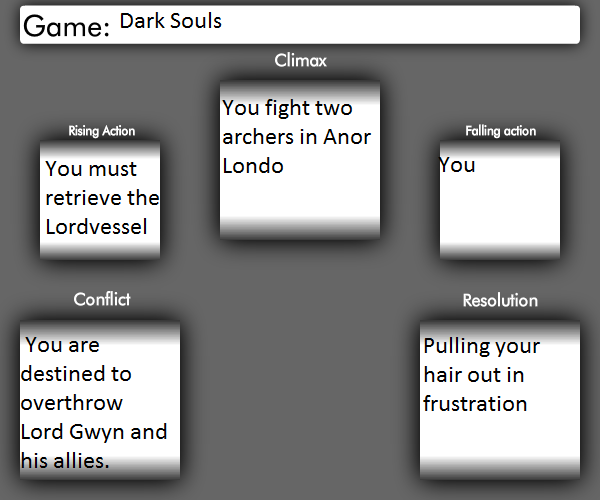
The trouble is, the Silver Knight Archers encounter is a strong piece of game design. This is perhaps one of the best examples why the “teach the player incrementally” school of level design is a negative influence on design.
When every level design tutorial is about slowly introducing players to the elements so you’re sure they know everything before encountering anything really hard, then yeah designing for just a straight challenge is going to be seen as an enigma.
This is roughly the halfway point of the game. The player can handle a challenge by this point. Maybe it’s a bit weird that the difficulty curve is backwards here, but if you remove a moment like this from the game, then you’re cutting out one of the best parts that they never really recreated in the others. This is a unique type of challenge that never really appears in the rest of the franchise. Isn’t it a valuable strategic space unto itself?
The Silver Knight Archers have a number of components to the encounter that contribute to it being a fair and deep challenge. First, you have a big platform on which you fight two demons, and the knights’ arrows can actually hit you here, but you’re given two pillars to work with. You know the demons’ pattern, so you gotta deal with them and these two additional projectile users in a space where if you get hit, you won’t be knocked off. This is arguably a really hard encounter by itself. You can skip the demons by running past them, which makes the next section slightly more difficult.
You have the initial run up to the column that acts as cover from the knights. On this stretch, you have a little fence that both protects you somewhat (though not completely) from the arrows, and prevents you from running off. If you didn’t kill the demon’s below, they can throw electric spears at you, hitting you from behind. I’ve been hit this way, running serpentine usually safeguards you. You can see both archers and their position while running on this stretch, then you get a big pillar/tower that acts as cover before you have to do the real thing. The next ramp up has no railings, it’s the real thing, so from then on, you need to move without hesitation, setting a different tone for this encounter than most other in the game. Going around the tower to get to the ramp up is itself a risky proposition, but less so than the ramp itself. You’re under fire from one of the archers, and have the ramp/wall to brace yourself against if you’re hit.
Going up the ramp with no railing, the archer on the left has two towers in their way, that can act as cover from one of the knight’s shots. So in some positions you only have to worry about one knight. From the top, you can access both knights. Fighting the knight on the left first will give you a lot of cover from the knight on the right, but it means fighting on another ramp with no railings against an enemy you’re unfamiliar with. The unfamiliarity with the moveset of the silver knights is perhaps the biggest point of unfairness here (because honestly, the arrows themselves are really simple and slow projectiles).
Moving close at the right archer will prevent the left one from firing on you when you reach the top (because the tower is in the way), giving you time to dispatch the right archer. The walls give you a point to brace against the right archers fire with the archer’s outcropping angling him so your back is slightly tilted towards the wall. As you get closer to him, this advantage increases, and you get a corner to work with. There are a lot of ways to beat this silver knight, parrying him, finding a way to push him off, or fighting.
Staying between the two archers at the top of the ramp is the only position where they can both fire at you simultaneously after getting to the top of the ramp. The key point is, you’re not allowed to hesitate here. You need to make a decision and commit to it.
Okay, movement in Smash Bros is a tricky topic, there’s a lot of nuances to it that don’t exist in any other game I know of, so lets get down to business.
Up above is an image (made by Kadano) detailing all of the actions possible from a neutral standing state using the control stick alone, assuming you are facing right. When you tilt the stick forward, you will begin to walk forwards, with speed proportional to how far forwards the stick is pressed. If the stick is moved into the dash region within 2 frames of it being in the dead zone, it will initiate the initial dash animation, if after 2 frames it is not in the dash region, a dash cannot be initiated regardless of the movement of the stick until it enters the dead zone again. If the stick is moved back into the tilt turn or smash turn areas, then the character will initiate the turning animation, if it is in the smash turn area on the first frame of the turn animation, then the initial dash animation will be started in that direction.
While walking, you are allowed to perform any standing action, forward tilt, down tilt, up tilt, fsmash, down smash, up smash, and all your B moves. This means walking is a nice and delicate way to move while being capable of performing any attack at any time.
As noted above, when you “smash” forward, you’ll enter an animation state called initial dash. This animation plays for a different number of frames per-character, and if the stick is held forwards, it will transition into the run animation when it ends. If the stick is released, the initial dash animation will continue to play until it concludes, but you will not maintain your speed forwards, with friction slowing you to a halt (this is called a fox trot).
During the initial dash animation, you are not allowed to crouch, attempting to do so will make you crouch after a fox trot. You cannot perform any tilt or smash attacks during the initial dash animation, except for up smash (because jump cancels into up smash, and you are allowed to jump from all grounded non-attacking states.). If you smash turn during the initial dash state, you will re-enter the initial dash state in the opposite direction. There is a 2 frame leniency for this (unlike the 1 frame leniency for trying to dash in the opposite animation from standing), not reaching the opposite side fast enough will result in a fox trot.
This means that you can rapidly alternate directions to begin the initial dash animation over and over again in the opposite direction. This is called dash dancing. If you allow the initial dash animation to play out completely, entering a run, attempting to turn back will result in a long turnaround animation playing where you lose a lot of your speed and cannot perform any action except jump. Jumping during this animation will orient you in your original facing direction in Melee, and the opposite facing direction in Project M (called reverse aerial rush).
Because the turnaround animation during run is so long, many players elect to stay in dash dance to get the fastest turn times, allowing them to move with more agility than the run animation over a shorter range. The thing to get familiar with is learning how long you can hold dash in a direction before needing to turn around. This means that there is effectively a distance you’re allowed to move before needing to turn back. When you learn this distance well enough, you’ll be able to move at maximum speed over short distances, weaving in and out of opponent’s attack ranges. It’s possible to run across the stage, staying entirely in initial dash by turning back, then forwards every time you’re about to hit the edge of your range. This is a great way to practice using the dash dance purposefully. Varying your dash lengths and having great precise control over your dash will allow you to whiff punish any move.
During the initial dash animation, the only attacks you’re allowed to perform are the dash attack, grab (the running grab animation is slower, it’s recommended that you jump cancel grab to get your faster standing grab), your B moves, and up smash. However every time you turn during the initial dash animation, there is 1 frame where the character is in a neutral standing state. On this single frame, you are allowed to perform any neutral standing option, assuming you have good enough timing and dexterity. Performing an action on this frame is called a Pivot. Pivots are extremely tricky, but allow you to move at maximum speed and attack with impunity. Because they’re so difficult, many people only use pivots for specific applications, like moving in for a quick smash attack.
Once you enter the run state after the initial dash, your options increase a little, because you are allowed to cancel run with crouch at any time, and perform any move you normally can out of crouch (all special attacks, all smash attacks, all tilts). Worth noting is that crouching, then dashing the opposite direction is faster in a run than trying to do the run turnaround. This is called a Cactaur Dash.
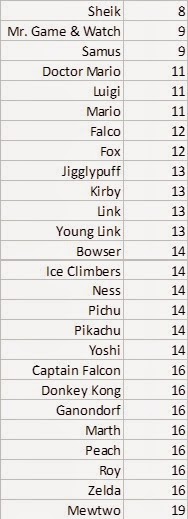
Wavedashing is a technique performed by airdodging at an angle into the ground as soon as you leave the ground from jumpsquat. When you hit the ground, there are 10 frames where you cannot act due to landing lag. This means wavedashes effectively have a startup time of 10 frames + your character’s jumpsquat, assuming you do the wavedash frameperfect. You can also do this as you land from a jump or come up through a platform (fastest way to land on most platforms), incurring the same 10 frames of landing lag. The wavedashes of most characters are slower than dashing, with the exception of the characters with the absolute best wavedashes, like Luigi and Ice Climbers. Wavedashes are nice because they allow you to move at dash-like speeds without committing to the more limited set of dash options, as well as retain the same facing direction. So you can wavedash backwards while facing forwards. They help fill in a few holes in most characters’ mobility options. Wavedashes are bad, because they have a longer startup time than dashes and walking. During the jumpsquat, the wavedash inherits whatever momentum you had moving forwards, so dashing into a wavedash will make the wavedash move further.
The angle at which you dodge into the ground also affects wavedash length. More shallow angles that are closer to parallel with the ground will travel further along it. More deep angles that are perpendicular to the ground will travel with less distance. You cannot wavedash perfectly to the left or right, you’ll just get an airdodge, however you can waveland perfectly to the left or right when you jump up through a platform, or land on the ground. You need to do this exactly as you land, close to frame perfect if it isn’t totally frameperfect. Doing this will move you a lot further and faster than a normal wavedash, allowing even characters with terrible wavedashes like Ganondorf to move amazing distances.
If you are facing with your back to a ledge and have momentum, you will slide off the edge. Wavedashes allow you to do this, making them great for grabbing the ledge quickly to edgehog. Sliding off a ledge also can cancel any special animation, allowing you to attack faster, and attack animations can slide off ledges both backwards and forwards. In shield, sliding off ledges will put you into tumble, which can be taken advantage of by opponents.
General question; I have my own thoughts on this, but what do you think of the viability of “NES hard” modern games? Few games really kill you, or demand much attention anymore. I think overcoming adversity makes the player feel good, but it’s “medicine” the player doesn’t always know they like.
I think most of the modern games pretending to be “NES Hard” are pale imitations. You get stuff like I wanna be the guy, Super Meat Boy, Hotline Miami, etc, where you die in practically one hit and have really short checkpoint/reload times. I’ll give Hotline Miami an exemption here because it does have some actual depth to it, preventing its levels from being repeating the same string of inputs ad infinitum. A lot of these games tend not to feature lives, or care about checkpoints beyond the last one you passed.
Others like Shovel Knight take a different study of NES games, building every single one of its levels with introducing that level’s unique design feature in a safe environment, then slowly building in complexity on it. It’s less like a level intended to challenge you and more like a tutorial. If you read a lot of level design literature, you’ll notice that the majority of it is devoted to teaching the player silently through level designs, almost none of it is on how to actually challenge the player in different clever ways.
Raph Koster has a definition of fun that I think is appropriate, from his book, Theory of Fun. More or less, people respond to achieving something inconsistently. Achieving something inconsistently is more or less what we define as difficulty. We evolved in such a way as to receive a mental reward for achieving difficult things. We’re capable of creating goals for ourselves without reinforcing stimuli such as food, unlike most other animals, whose intrinsic motivation to complete a task quickly fades in the absence of a tangible biological reward. This is what enables us to pursue things like money or psychological stimulation to the detriment of our physical wellbeing.
When we achieve something inconsistently, we have fun. The more rare the success, the more fun we have, the more engrossing it is. If no effort of ours is expended in the process, if the process is randomized, the enjoyment is typically more in the form of desire, than an actual enjoyment of the thing itself. People don’t like it, but they want to continue to do it. Wanting and Liking have been verified to have separate neurological pathways. When you expend your own effort, and occasionally succeed and fail, you tend to come to like the act of doing the thing.
In this way, good games tend to have a lot of big and little things to succeed and fail at. You might not beat the level, you might not get as far through it as last time, but this time you bypassed that tricky part without taking damage, and your consistency at getting criticals or headshots was 40% higher. There are associated skills to master, and they balance against each other synergistically in the overall challenge of beating the level before you.
Games can meet a lot of other psychological pleasures, but of course this is a unique one. I don’t know if it’s medicine players don’t know they want, I think it’s an unmet want in an environment that doesn’t totally know what it’s making.
The point of difficulty is to bring out the depth of the game. The point of depth in the game is to make the difficulty interesting. The two work together. You want to limit the player’s options while also giving them ways forward. Kill the easy strategies, force them to be proactive. Give them lots of tools, lots of ways to use them. Almost never completely eliminate the usefulness of a tool. Just because you want to punish the use of a tool in some way doesn’t mean it should be perfectly countered. If the player wants to do only one thing, give them a reason to want to do multiple possible things. Give the tools themselves drawbacks. Go study Castlevania 3 if you want to go for the retro difficulty thing, that game is a master class in it.
As for commercial viability, I believe people are definitely looking for this sort of thing, however I don’t think you will reach much success piggybacking off those that have made success in this area already. Create an identity for yourself, probably skip trying to cash in on nostalgia. By all means make the individual game challenges difficult, though go ahead and include multiple lives and an actual health bar if you feel those things are appropriate. Most of the actual NES games had those. Demon’s Souls was literally found and saved by the western community by importing a chinese copy of the game because they recognized its difficulty. Beyond that, it’s a lot of guesswork and it depends on your individual implementation.
In a way, the success of NES games is that despite their simplicity, they used the elements available to them in order to give the player interesting choices in how they proceeded through the level, challenging them in the precise ways they executed those larger scale choices. Like in the above video, there was a skeleton below, the guy tried to throw axes, expending resources, but missed. Instead of finding a place to throw more axes, he took up the risky move of jumping down and whipping the skeleton as he went, which succeeded. As fish men popped up out of the ground, rather than wait for them to settle on the blocks, he would jump forward and whip them as they rose up. This certainly has a larger punishment for failure and is a lot more timing dependent, but it is allowed to him.
Alright, here’s my footsies speech. I wrote this for my local smash group, and now I’m passing it on to you.
A lot of beginners when they learn to dash dance, don’t really know what dash dancing is for. They just do it because they know it’s tech and makes you unpredictable, then they get scraped because nobody’s going to respect someone who just DDs in place. Dash dancing really starts to work for you when you learn how to use your dash purposefully. You gotta understand that dash dancing isn’t just moving back and forth to be less predictable, it’s about your character having a certain range of space on the ground that they can move at maximum speed through, capable of weaving around attacks, and as long as you keep turning back at the periphery of this range, you can keep weave around anything. It’s helpful to be familiar with all the movement states in Melee, I might cover those in a different guide.
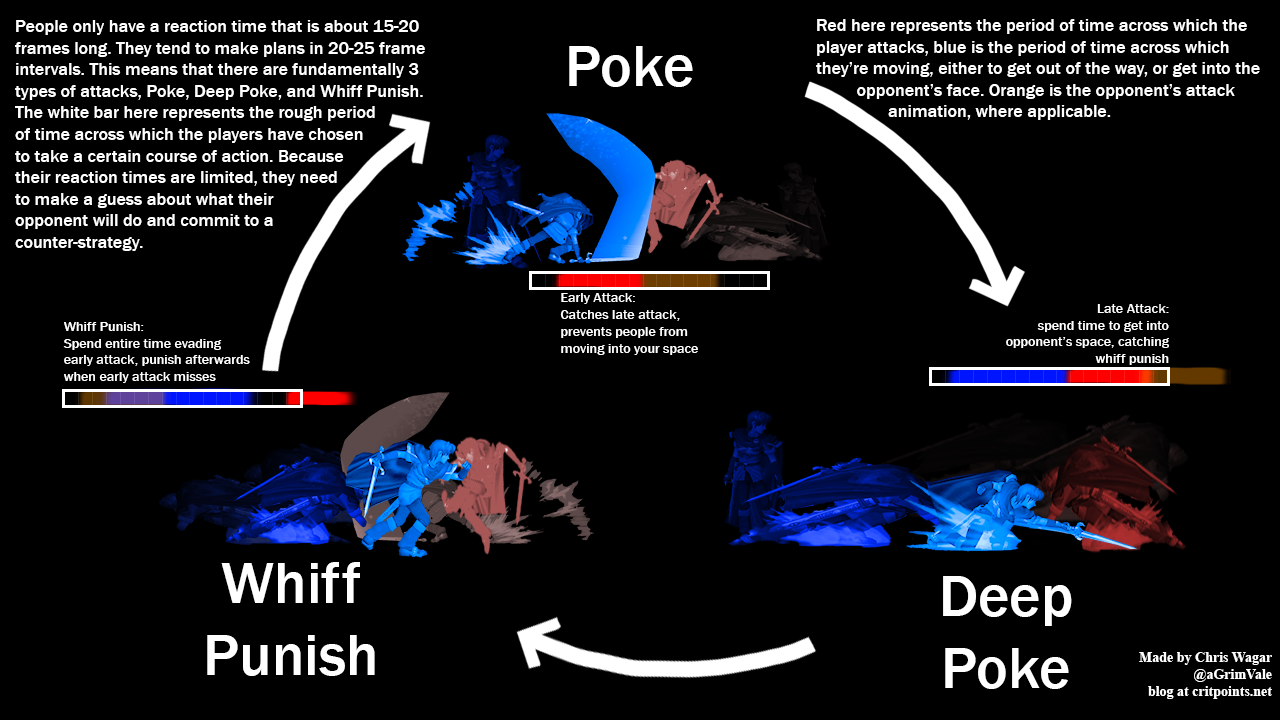
The first component of this is whiff punishing. When someone attacks you, and it misses, there is a period where that attack must recover. Dashes in Smash Bros are so fast that they can get in on people during that period, and usually grab them (depends on the character). So what you can do is, if someone comes at you with an attack, you can stand within that attack’s range, dash out of the range, let the attack whiff (miss you), and dash back in to grab them. This is the basic whiff punish.
You can whiff punish grabs, dash attacks, SHFFLs (on almost all characters), most tilts, most smash attacks, and a lot of other options, as long as you have enough space to move back, then forward, to hit your opponent when they miss. Because whiff punishes work on so many things, they’re extremely useful. They can beat out a lot of air and special move options too, forcing the opponent to respect whiff punishes on the ground.
Your other two footsie options are Pokes, and “Going Deep”. Pokes are moves you throw out to prevent your opponent from moving in on you. Poking too close to an opponent can lead to getting shield grabbed, so you want to poke at max range, while still hitting them. You want to throw pokes into the space your opponent is about to move into. Pokes are almost always fast startup moves with fast recovery and decent range, so Ftilts and Dtilts on many characters apply, as well as many character’s SHFFLs. Pokes get beaten by whiff punishes, unless they connect with either the opponent’s body or their shield.
Pokes can be beaten by other pokes, these are called counter pokes. Like a SHFFL will beat a dtilt frequently, and many ftilts or utilts can beat SHFFLs, but dtilts can go under those or outspeed them, beating those out. Poking before your opponent does will also beat their poke. Again, these options vary by character.
“Going Deep” is the equivalent to Throwing in Street Fighter, the idea is that when your opponent is non-commital, trying to bait something from you to whiff punish. If you go deep, then they need to poke you to force you out, or they get hit. Many attacks are great for this, especially because you can run cancel when you go outside your dash dance range. Dash attacks work for this on many characters as well. The idea is to overlap the space they’re going to dash in with a hitbox.
Pokes < Whiff Punishes < Going Deep (< Pokes again)
So you have this counter triangle, Pokes stop your opponent from moving in on you, going deep. Whiff punishes will beat pokes by avoiding getting hit, and retaliating. Going deep will beat noncommittal dash dancing, so it beats whiff punishes. Of course, poking to keep people out of your space can itself be whiff punished, so you can move into people’s space then out of it to bait a poke, and whiff punish that poke. Moving in is pressure, moving out is bait.
The goal is to watch what your opponent is doing, because you get to see what they’re about to do based on the way they move before they do it, then make a read, and try to beat whichever one of these three options they attempt, and convert that into a punish ideally. Figure out which of these three they’re relying on the most, and try to focus on the options that beat their particular play style, as well as read which option they’re going to go for right here and now.
All of these things open you up to risk, none of them are perfectly safe. Everything counts as a commitment in its own way. If you get scared, then you’re not going to make yourself safer by overly committing to any one option. Victory depends on your ability to figure out your opponent’s patterns while they simultaneously try to figure out yours, and both of you adjust on the fly based on what you just saw your opponent do. But this isn’t perfect rock paper scissors, you get hints based on what your opponent does before they actually commit.
So have some fun, change up your patterns, and figure out what theirs are before they catch on to you.
SSBMtutorials by Kira did a video on this topic and has a similar basis to mine with different terms.
What drew you to get undertale? looking at its trailer, it seems like an amalgamation of different small games mixed up to keep interest, and that made me suspicious of it being shallow, making me not get it.
A friend on facebook that I trust posted that he liked it and people should play it. He then told me to play it directly, and I said I would without looking up any information on the game, and with no further questions, besides knowing there’s a pacifist and genocide route and it was an RPG with shmuplike battles. I did this out of trust to him and general impulsiveness.
It is kinda shallow. All the fights are segregated from one another, and there isn’t much context bridging them. You’re allowed to heal very very frequently with save points, before every big fight. Healing items carry over, and you use money from fights to buy them.
Despite that, it’s a hard game, and the battles don’t have that element of repetition that I hate in games like super meat boy, down to the point where you’re memorizing every single input practically. Even the rhythm game boss integrates a large amount of randomness into her patterns. Many of the enemies have partially randomized patterns. However they still follow a very consistent pattern, and show you what is coming before it hits you, and always allow ways out, so it’s extremely fair in that way.
Beyond that, many of the shmup style avoidance minigames are rather unique. They mix it up a lot and as far as I know try a bunch of unique things. Like some enemies have blue or orange attacks, blue attacks can only be avoided by standing still, orange only by moving through them. The bosses each change the control style of your heart, like one is a platformer, rhythm game, actual shmup where you shoot, and a weird one where there are these 3 lines and you can jump between them instantly, but also move smoothly down each line, and one attack has you race up a bunch of lines to escape from an enemy at the bottom while projectiles are moving all over them. Also interestingly, in normal enemy encounters if you get multiple enemies at the same time, their bullet patterns get mixed together, making more complex bullet patterns.
In a genocide playthrough, you gotta sit through a lot of tedious enemy farming, but it has two bosses that are really intense, a ramped up version of the rhythm boss that is even crazier, and a final boss fight that is still kicking my ass.
I did a little rant on twitter about something I felt was lacking, like it felt like there was no dynamic really guiding when you should heal in battle, it didn’t make sense to heal right before a big attack, or during a lull, since both will drag the battle out for a turn longer, then I realized that because you take less damage when you’re at lower HP, that healing when you’re low effectively allows you to take more hits, because healing is for a static amount. So I learned a new game dynamic right there.
I gotta say that I like the game overall. It’s been really fun in a gameplay way, and it’s not completely shallow and repetitive, and it innovated. The room to grow as a player isn’t very big, but there’s some stuff there, much like an NES game.



 Celia Wagar's CritPoints