I know you hate Borderlands 2 but you also said you were planning on writing that good games make good glitches article… What do you think of this Speedrun of BL2: (https://www.youtube.com/watch?v=t2YYwM1coOU)?
I saw it before, I was impressed. Mostly by the exploit that lets that one guy move absurdly fast by stacking a buff over and over again due to poor netcode.
I wouldn’t call Borderlands 2 a good game, but the point is to describe a tendency in games that give rise to interesting glitches like these. I think there’s a connection, a common thread. There’s a reason new things keep getting figured out for smash bros melee, and it’s not just the dedication of the fans.
A lot of bad games are glitchy too, but not in interesting ways usually. Glitches tend to arise when the programmers or animators or other people putting together the interactive components tend to “over-model” something. Like when they put more detail into something than is strictly speaking necessary. When variables carry over from other places, or certain things have dependencies on other variables.
Like bunnyhopping in Quake, they could have done something simple and just capped the max speed you can go, easy. Instead they decided to do something really silly, limit the amount of acceleration you can obtain on a given frame versus a vector projection of the current velocity vector onto the prior one.
Another example is how a lot of out of bounds areas have collision. Honestly it would take less time and effort to just use a ton of invisible walls, kill volumes, etc. Nobody is ever supposed to get over to those areas or outside the bounds of the game, so it shouldn’t matter if they can walk correctly on OoB areas, yet frequently they’re perfectly accessible.
When something carries variables over, reacts differently in response to different variables, it exponentiates the number of states that a game has. This means more depth, and in the cases of useful glitches, more depth that is actually relevant to the player. This is good game design in a nutshell.
This video is full of stuff I’d normally expect to see in a glitch exhibition. It was made by the game’s programmer, showing off that this ability, Center Stage, is capable of doing a massive number of things. When I first saw it, I thought it was kind of cool that they were playing with the standard fighting game convention of the camera controlling the walls, but never expected such application. I saw a few combos that used it and those seemed kind of cool but gimmicky, however because Mike Z allowed you to set any move as an assist, naturally this is included and clearly can be used for a lot more than basic combos.
This is the type of game design I’d like to see from major companies. Ori and the Blind Forest has it (at least partially intentionally), Axiom Verge doesn’t.
How can a game pique your interest personally?
By giving me the impression that it has some type of potential. What originally piqued my interest for Ori and the Blind Forest was seeing this video:
I was like, “Wow, what the fuck is going on? What’s he doing?” Because I didn’t know how bash worked. I went around, saw some other videos, couldn’t tell much of how the game worked, but I had this hunch that it would be good. Probably not the best reasoning, but my intuition paid off.
Demon’s Souls I got into because I heard yahtzee and other internet people whine about how hard it was, and I was like, “I want in on that.”
God Hand had a good reputation and I didn’t know much about the game other than that it was a cult hit. I was lucky to find it, my brother actually spotted it at a gamestop.
Again, maybe those aren’t the best case examples.
Though for upcoming games, only The Phantom Pain really gives me the impression that there’s something special to it. Kojima has all these systems working together in it, all these things to mess around with enemies using.
I was drawn to Skyward Sword initially actually, because they had implemented a stamina meter, you could run up walls, the item switch menus were in realtime, you could swing your sword in 8 directions and spin attack costing a chunk of stamina. It seemed to me like they were trying to give 3d zelda a depth it didn’t have before. I was really disappointed to say the least when all of these things only really had one purpose, could only be used in specifically designated ways, had no interaction between the different elements.
Do you feel sorry for the guy who makes that one DNSQ show that used to be put out on the shill show (Game Theory channel)? He seemed pretty passionate about games and all though his videos stated the obvious sometimes he clearly wasn’t as much of a hack as the other people on that channel
Alright, I went and watched his videos, tons and tons and tons of filler text. He’s got some insight, but he’s not funny in my opinion, and he wastes a ton of time getting to anything important. Also a lot of his conclusions and premises are vague.
The street fighter interface vid has solid info and is thorough, thought the guy could have condensed the information more. So points for that. Dude should have mentioned the improvement to the meter from SF3 to SF4 in showing how many units of EX attacks you have.
His video on Super Metroid repeats some of this article: http://www.gamasutra.com/blogs/HugoBille/20120114/90903/The_Invisible_Hand_of_Super_Metroid.php in video format, with poor jokes, filler text, and less information. It does talk about the opening, but it kind of begs the question of “Do you really need to go into this much detail?” and “Are these really what the opening teaches?” and “Is the opening even necessary to teach this information?” (I ask this last one a LOT with game analysis themed around how something stealthily teaches you something) He repeats the point about the plasma beam/hi jump boots almost verbatim. I’d like to see a repackaging of the staff interviews he mentioned more than this video really. I hadn’t heard the term perceptible and hidden affordance before though, though I have heard of the concept of affordance. I’ll keep those in mind for the future. As a corollary I’d like to also cite Sean Malstrom’s response to the invisible hand of super metroid: https://seanmalstrom.wordpress.com/2012/08/09/email-the-invisible-hand-of-super-metroid/ I think both the original article and this are important perspectives to keep in mind.
He does a decent criticism of Link to the Past versus the original and how it’s weirdly linear or not linear. Also identifies some of how LttP didn’t really live up to the original design. Kind of the irony of the miyamoto interviews is that Zelda 1 was more popular in the mainstream than LttP. I think it goes to show that people’s efforts to cater to a broad audience by making things easier don’t really work out.
The smash video could have gone a lot more into the alternate constructions between smash and SF. It focused too much on the UI. It does this because talking about game design is hard, especially as you get closer to things like how attacks/movement are actually constructed, and ui design is a totally separate and well documented field.
Now last I heard of him, he’s the video editor for Game Theory now. [2/2] What do you think of his work on DNSQ? Do you think if he improved the show had potential to become something pretty good?
Possibly, his heart’s in the right place. He needs to learn to animate and draw better. Also motion graphic better. I appreciate the effort that went into making motion graphics at all though. Also I think the jokes are just painful. The guy’s not a comedian. Most game reviewer guys aren’t comedians. The jokes are there because AVGN and TGWTG did it back when this schtick was new and others like Egoraptor kept doing it after them. It’s considered obligatory. When I hear a game reviewer/critic/analyst do lame jokes constantly, I’m just like, “please get on with it.”
His info’s not wrong. He makes some actual conclusions. He could totally hack it on his own if he wanted to. I give him a 3/5, or 6/10. Guy needs to think less about the big outside picture and more about the core gameplay to really get anywhere. Most people do. It’s really easy to address big design things and really hard to address smaller ones, but the small ones count for more, they’re what make the game fun at all, where the big ones are kinda nice, but wouldn’t ruin the game if they were done wrong.
On more of his videos:
The survival horror video tries to claim that survival horror is a unique genre for tapping into emotions unlike other game genres and like traditional literature/movie genres and because it doesn’t refer to a specific overall game form like first person, 2d platformer, etc. He does identify some mechanical consistencies between survival horror games though that bridge them together. In this way I’d argue that it’s like RPG as a genre, where we have tons of games with “RPG elements” and Mass effect, Final Fantasy, Dark Souls, and Deus Ex are somehow all RPGs (because your character’s numbers go up persistently). Shallow video.
Earthbound video, don’t really care about it.
Pokemon video, don’t really care.
Tetris video, I wish people would stop with the phony emotional arguments in game analysis, it’s like bad film theory is how I like to put it. Though his overall analysis is good. He has just a few too many buzzwords. I think the video would be better structured if it tried to break down the structure of tetris and determine what strategies it creates and how those strategies can vary in implementation and situationally. Here’s a guy beating tetris for fun: http://www.twitch.tv/kevinddr/c/5983832 and another: NES Tetris “Fastest 999999” by Acmlm in 03:11.78
If he could also try to derive how someone else could replicate tetris’s success in another game, what principles could be learned from tetris, or improve tetris, then it might be better. Probably his best video.
Asymmetry video, should have brought up how player 1 is prioritized in some games like marvel or smash bros for certain things. Also the hypothesis that left handed people have an advantage in a fight. His statement about the sides of a screen for SF is mostly a matter of experience, not actually matchup imbalance. Mostly accurate information overall. Doesn’t seem like it has much of a point.
How do you answer people who ask what Smash does that other FG don’t also do? Or how Smash does certain things better? Or what the difference between Smash and other FGs is (aside form obvious stuff like movement and environment)?
If I had to describe overall differences, I’d say that smash bros versus other fighting games is based a lot more on unclear spacing mixups. Other fighting games tend to have much more clear situations with regards to the timing and spacing of actions because jump arcs are fixed, you always block in specific directions, and you tend not to really be moving as attacks go on. Smash bros information tends to be fuzzier because there are so many different ways to modulate speed and position. Describing the neutral game in street fighter can come down to some simple clear cut rock paper scissors games, but doing the same for smash is a lot trickier in my experience. In teaching people street fighter I find it comes a lot more naturally to describe the right way to play versus smash bros where I found I was at a loss for how to describe the right way to play the neutral game. Not to mention that it varies a lot between characters. Dash dancing creates crazy footsie-like scenarios at high speeds.
More specific things would include the use of sweet spots, moves don’t just have one type of hitbox everywhere that deals a consistent amount of damage and pushback, they have weaker and stronger hitboxes based on both timing and positioning, and people frequently use the weak hitboxes on purpose to knock back less to keep the combo alive.
There’s a level of control during combos with DI that not only allows people to escape, but makes it a mixup situation, because they can’t move closer or further, just tilt the angle. This is why DI wouldn’t work in a traditional fighter, people stay locked to the ground, you could only have DI left or right really, not angular DI, it wouldn’t make much sense to have angular DI, and when you can only DI in two directions it soon becomes clear that either the combo dies or it doesn’t die, there isn’t long enough hitstun or flexible enough movement to make it work otherwise.
The ledge guard/recovery game as an okizeme equivalent. Lots of options there that don’t make sense in a traditional fighter.
Ability to change velocity in the air and inherit velocity from the ground. KoF and Guilty Gear sort of do the last one. Marvel 2 and 3 do the first one on super jumps.
Comboing into grabs and chaingrabs, as well as letting you hold people to pummel them and choose the direction they’re thrown in.
A crazy shield tilt system that degrades over time, requiring you to cover the parts of your body that will be attacked. Also it can vary in density for more pushback/coverage.
SDI and shield SDI
Wavedashing, the idea that you can invest startup frames now to move in a neutral state later.
Sniping people after they double jump to cut off escape options
How do you distinguish that Axiom Verge has no depth against, say, metroid games? do you consider metroid games to have depth? They look very similar mechanically.
To be totally clear, axiom verge has some depth. Rock paper scissors has some depth. I just think that axiom verge has very little depth in comparison to Metroid or Super Metroid. The reason for this is because there isn’t much mechanical interaction between the different parts. I am actually not a fan of super metroid, I think it’s too easy. I beat most of the bosses in the game on my first try. I didn’t have much trouble getting from place to place. However Super Metroid is something you can come back to and play in a totally different way. There are things to learn about the game and things to master.
I have 3 criteria for depth, it’s a simple rule of thumb to keep in mind. Does this mechanic/option/tool have multiple uses? (can it be used to do multiple things? Not just one primary function) Does it have its own niche relative to the other options so it is not overshadowed and so it does not overshadow other options? Can a player change their input to get a variety of results from this tool?
Axiom Verge has like 10 different weapons (IGN says like 20 though). They mostly don’t vary much in damage or DPS. If you’re just trying to take an enemy down, most any weapon will do. The speedruns only pick up 3, the one you start with (normal projectile fire), one you’re required to get to open certain walls (nova, shoots stronger projectile, can explode with mini projectiles in 6 directions), and one that can punch through walls (slightly stronger damage, shorter range). Most of the levels are accommodating enough that the other weapons aren’t really that useful, except for hitting around corners, which nova can do.
Most of the powerups are really self-contained. Laser drill only lets you break bricks and hurt enemies up close. Field disruptor lets you jump higher and that’s about it. Address disruptor lets you glitch enemies and the environment, which sounds cool, but you really only use it to reveal platforms in specific places and glitching enemies isn’t that useful, usually they can still hurt you. In one spot you use glitched enemies as platforms, but that part is optional. The drone deactivates your main body when in use, and has its own self-contained sections, so it’s not something with real synergy with your main abilities, just like an alternate character for some sections. In the late game you can teleport to the drone, and launch it really far, which is cool and creates some actual synergy and depth between mechanics, but by that point it’s too little too late. The lab coat allows you to only go through 1 block thick walls where you can walk into them, so it opens up a few routes, but isn’t good for much else. The trench coat is slightly more versatile, because you can use it anywhere, allowing you to teleport 2 blocks in any direction, and you can teleport up through platforms blocking you from above. Though even this, it’s like the most uninteresting “advanced” movement mechanic I’ve ever seen. A double jump is more interesting.
On the trench coat there’s no factor of acceleration, decceleration, next to no tie or relationship to the environment, no gravity, no way to amplify it. It’s just that you appear two blocks ahead of where you were. An airdash is more interesting. A glide is more interesting. The Mockball in Super Metroid is more interesting, speed booster too. Also the shinespark. Not to mention that it’s obvious application, getting out of bounds, isn’t even applicable in most locations, because almost all the walls in the game are designed to be totally solid and resist attempts to get inside. There’s a few out of bounds spots in some corridor type rooms that let you jump up without being disturbed by enemies.
The grapple has a bit more to it, because you can grab areas above you and swing, so you can get up a bit higher and move along ceilings which is nice, though it’s kind of a pain to use, in the way it controls and grabs onto things, and the levels aren’t designed to give it much application beyond the small area where it unlocks new.
There’s like a glitch bomb, it opens glitched out areas like a lock and key (lame) and glitches all the enemies in the room you’re in (glitching enemies doesn’t do much in the first place).
There’s so little to using all these powerups, and they’re all designed in such a lock-and-key way to just barely allow you to get to areas that you couldn’t before so you can move along to the next boss and piece of the plot.
Compare to the Ice beam in metroid, it was in the original metroid even. The ice beam isn’t just a powerup that opens ice colored doors (no doors responded to specific element beams until metroid prime actually), it allows you to freeze enemies. This has multiple applications. Obviously it makes them easier to hit, but also you can stand on top of them and use them like platforms. This can be used to not only allow progression into new areas, but the player needs to shoot enemies in the right place so they will actually allow them to move up. And it opens up the potential that enemies can be lured into position then frozen to use as a stepping stone to move forwards.
Plus the enemies are lame. A TON of them mob you and stay on top of you without much chance to get away from them on flat ground. There isn’t a lot of give and take with enemies. Most of the time it’s just a matter of killing them before they can reach you, or getting into a spot where you can hit them but they can’t hit you. Compare to metroid enemies which are usually more like passive hazards. Castlevania enemies which tend to be more active but give you a fair chance to avoid their attacks. Megaman enemies, ninja gaiden enemies. The bosses are ULTRA lame. They have massively simple patterns, most of them have relative safe zones. All of them can be massively cheesed in some way or another, many in multiple ways
Any companies that you wish to see improve in terms of quality games and business models?
All of them. I’d like to see people across the board step it up. A bit more specifically than that, I’d like to see Nintendo, Valve, Platinum Games, Capcom, and From Soft step it up.
Nintendo has a ton of great IPs under their belt, but they’ve basically fucked up in managing them. On all fronts they seem to be mismanaging their assets and not playing to their strengths. If they can’t make games that leverage the Wii U’s controller and are actually fun/profitable then they’re fucked.
Valve has fallen short on the gamedev side and they generally seem to be growing more evil by the day as a publisher/distributor. I hope they put the consumer’s interests first soon or we’ll be in trouble and the market might fall out from under them.
Platinum need to stop being losers. Sure, we love them but they never sell well in part because they always have these ridiculous setbacks, like the chain combo systems that nobody wants to deal with, QTEs, Shop systems that encourage grinding, a reputation for making hardcore games, just to throw out some guesses. I think their games could be better and better connect with audiences at large, but I’m no marketing guy.
Capcom are idiots who need to stop milking their customers. They’re generating a lot of ill will for their DLC bullshit, they need to show people that they care and provide value for their customers or they will die. it’s especially dangerous to focus on japan only and mobile like they have, they don’t have IPs that can leverage mobile very well and they have a ton of games that would succeed outside japan.
From are cool, but Dark Souls 2 was a failure from a marketing perspective. They need to keep their shit together and stick to the plan, weed out the big mistakes they keep making each game and stick to improving on Dark Souls’ formula, because it was their best selling game and in my opinion best overall.
I’m inbetween on that. The big benefit the stat systems bring is that characters have this differentiation from one another, you can’t just switch the items, you have stats invested that make you proficient with the items you have. And different characters can approach the game in very different ways with varying levels of efficiency at different parts. That’s pretty cool.
The upside of getting rid of it is, if you have no stat systems and just let people pick whatever armor and weapons they want, and balanced all the areas so they would fit the correct levels of damage for the mono-leveled character, then you can avoid the player grinding and becoming overpowered or underpowered. You’re less forcing the player to make his character good, and more asking them to get good at consistently performing the challenges inherent of the system. Players can’t make areas really easy by using overpowered gear/stats. Players aren’t forced to go grind so they will keep up with the difficulty of the area. This means a lot less wasting of players’ time and probably a more consistent difficulty curve.
These are the benefits of a stat based system contrasted directly with what you gain from doing away with it. I don’t think the Souls games would really benefit from not being RPGs as they are. Also cleverly, the Souls games have that online multiplayer aspect giving players a motivation to not overlevel, because then they will be left behind relative to everyone else (though admittedly this is more of a social contract than anything inherent in the game design).
A game like Ys would receive almost pure benefit for switching, but Souls, not nearly as much.
Do you think level grinding is a poor game design choice?
In general, yes, though recently I have found some good reasons for it. When the player’s needs experience from fighting monsters to progress it can be a motivation to fight otherwise easily avoided monsters in games where the monsters aren’t very good roadblocks, such as the recent Ys games. Another reason is trivializing early roadblocking enemies in nonlinear exploration games. It can be irritating to pass through an earlier area only to be held up by stuff you’ve dealt with before. With big enough number buffs a lot of challenges become trivial.
Despite these good reasons it can still be a pain in the ass to level grind, worrying about being overpowered or underpowered. Some solutions I’ve thought of include limiting the amount of experience you can get in each area by having it be totally static item drops. Like imagine that when you kill an enemy they drop 1 XP token each time up to a maximum of 3. To level up you need roughly 1.5 tokens from every enemy in the area and on collecting that amount you level up. This gives the player a reason to actually fight the enemies and keeps grind time short, also limit in how many times they can grind the same enemy set to level up.
Another solution that can be combined with the above is dispensing the level up on beating the area/boss so it comes at completely static times. If they didn’t get these level up from the enemies of that area then beating the area grants it, erasing the XP tokens of the monsters in the area too.
Were you ever like the top pleb depicited in this image complaining about games you don’t understand?
I used to think a very long time ago that fighting games didn’t involve a significant amount of skill because mid to low level players could be beaten with button mashing. I thought that Smash bros was more legitimate because I felt more in control of all the things I was doing in that game and it felt more natural to operate for me. I felt like in smash bros that I was actually intelligently making choices and couldn’t tell why there were so many different normal attacks in street fighter and what they were even good for or how they were meaningfully differentiated from one another. That and the control scheme was awkward to me, having no jump button and holding back to block, and the way that you couldn’t move during most of your attacks, no IASA frames either. That was some weird shit to my perception.
Eventually I got a PS3 and at a loss for games to pick out for it, got SF4. One day a friend came over and asked me to play in it, so we tried out some characters, and had no real idea what we were doing. He picked like dhalsim one time, and I couldn’t beat the stretchy limbs. He also picked bison and I couldn’t beat the sweep attack. I was like, man, why do you keep picking characters that have these long range attacks? I just didn’t get the game.
So I sat down and tried to figure it out. I knew there were huge tournaments for the game, I knew Daigo was blowing people up as Yun at the time, and I had seen evo moment #37 in my first year of high school, understanding instantly how incredible it was. I knew there had to be a higher level game there, I just couldn’t see it yet. I went into online play and got mercilessly destroyed by all manner of people and looked up beginner tutorials and strategies and other things to try to figure out how the hell the game worked. I tried the combo trial mode and got completely confused about how combos worked at all, or how people even figured out what combo’d into what. It seemed really arbitrary to me what would even combo.
At the time I was connected to this site that is now called Learn to Counter, and I played a bunch of games on supercade with them, which helped me get an idea how to play at all and let me in on a ton of classic fighting games.
This background in fighting games allowed me to see games in general in a new way. It’s like how learning to draw will teach you how to actually see the world around you. I’ve said for a long time, if you want to really deeply understand games on a fundamental level, you need to play fighting games. I know it sounds imperialistic from me, who is practically still a beginner at fighting games, yet people talk of me like I’m some aficionado. Like I’m trying to force my favorite or preferred genre down other people’s throats, but it’s a simple truth. It’s the way of the world.
3D action games with freely rotating cameras need a way to focus on objects of interest, otherwise characters moving around enemies can cause the camera to lose sight of their target. It’s difficult to operate the attack buttons and camera at the same time. It’s also difficult to aim characters facing direction accurately when the camera is at their back, so Zelda: Ocarina of Time came up with the compromise of Z-Targeting, which is known in many games as Lock-on.
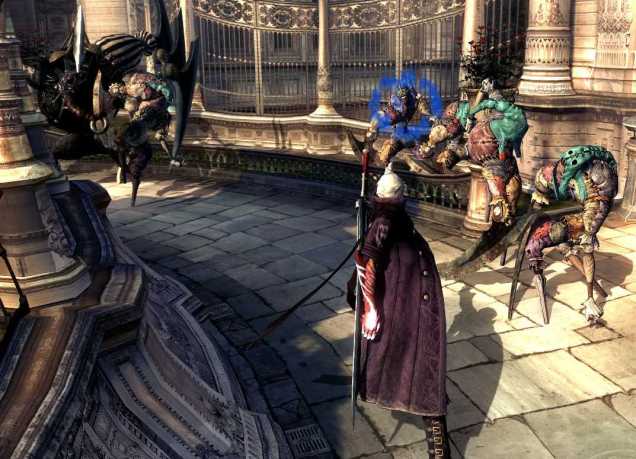
There are three types of Lock-On; Hard-Lock, Soft-Lock, and Camera Lock. Hard-Lock is toggled by holding or pressing a button to typically orients the character and camera to face a target. Hard-Lock can be found in the Devil May Cry series, Bayonetta, Dark Souls, Legend of Zelda, and Metroid Prime. It’s notable that in DMC and some parts of Bayonetta, Hard-Lock functions independent of the camera, so you’re not forced to look at the enemies you’re locked onto, which helps prevent multiple enemies from getting lost off camera. Soft-Lock functions automatically by orienting the character to face enemies when they attack at a close range. Soft-Lock allows players to move in any direction unrestricted, but always attacks accurately. Soft-Lock is used with the guns in DMC when you’re not locked on. It can also be found in Metroid: Other M, Metal Gear Rising, and DmC. Camera lock is when the camera is fixed to look in one direction, but the character’s actions are unaffected by the camera. This can be found in Metal Gear Rising, which allows you to lock the camera, but Raiden’s actions are unaffected by where the camera is locked. Raiden still soft-locks onto targets as normal.
So what type of lock-on is best? In my opinion Hard-Lock provides the most benefits, especially when the button for lock-on is held instead of toggled. It’s helpful to have the character face their target, enabling them to strafe. It visibly identifies which enemy is being targeted, as opposed to soft lock which has no visible indicator of who you’ll attack. The player can lock-on and lock off and manually choose new targets as desired. It also allows the obvious boon of being able to use directional inputs with other buttons, by orienting the character relative to the target. Games without a lock-on in a 3D perspective have no absolute directions because the camera can change orientation. The player can only get relative directions such as in the case of Bayonetta where tapping the directions “forward, forward”, and then the attack button or “back, forward,” and attack uses certain moves like stinger. Bayonetta also had a Hard-Lock in addition to this input method. It can be hard to tap the directions with the correct timing, and even harder to tap those directions the right way to successfully hit the exact enemy you want. With a Hard-Lock, the player can just hold forward and press attack at any time. Dark Souls has a Hard-Lock, but the kick and jump attack commands are designed to work without it. They can be difficult to manually operate as a result, since they’re input similarly to a smash attack in Super Smash Bros rather than the easier DMC method of holding a direction and pressing attack.
The trouble is that once Hard-Lock is engaged, combat becomes about the line between the player and the opponent. It becomes 1 dimensional, literally. The only thing that matters is how far your attacks reach and how far both of you are from one another. Game elements have to be introduced so that there is a value to rotating the camera in 3D space for the player otherwise it stop being 3d in function. If the Hard Lock is perfect the player will always face the player’s opponent and will only need to move to avoid getting cornered. To prevent this, many games lock the aim straight forward or slow the character’s rotational speed or make movement slower. This encourages the player to lock on manually only for precision or special directional inputs, and lock off when they don’t need it.
For this reason there is a draw to combat without lock-on. It’s enjoyable to play Dark Souls without lock-on, and it’s technically more efficient for a lot of tasks as it allows the player to run and dodge in any direction unlike during lock-on. Bloodborne was effective by having the quickstep active in lock-on mode and roll active when not to differentiate the two modes. Non-lock-on combat tends to work better in games with isometric or top-down camera angles like Wonderful 101 since the player can clearly see which way the character is pointed but this will affect level layout. To have complex 3D environments and architecture that players walk up, down, and through some type of camera centering button and/or camera lock function quickly becomes necessary for simple navigation.
This video and others by the same guy can show how useful it is to lock off in Dark Souls.
A Soft-lock camera like in MGR remedies a clumsy camera but when multiple enemies are involved, locking the camera onto one of them can be a death sentence. The MGR camera is so close that enemies frequently get up behind the player and it’s practically biased to force you into corners because it pushes off walls so hard it faces straight into them. I feel like no lock-on combat is more successful in Dark Souls due to better camera design and the attack buttons being on the shoulder buttons, so you don’t need to pull your finger off the right stick to attack.
I want to see future games have characters move more to evade attacks rather than using specific dodge moves to invincibly pass through them, which will mean they need to not use cameras that are incredibly close to the character or low to the ground, so players can see where their character and enemies are in relation to each other. I think Dark Souls is very fun when fighting multiple enemies without using lock-on or when fighting bosses without the use of lock-on, but keeping lock-on as an option makes some actions and situations easier, so it’s more of an optional tool to be utilized rather than something necessary to keep the combat functioning at all (though it probably would be unreasonable to not include it).
Freely moving around enemies has troubles though because when you move away from them, you are no longer facing them. Your attacks will go the wrong way completely. Soft-Lock systems attempt to allow players to move around freely, then attack the enemy accurately regardless of rotation. Unfortunately soft lock is unreliable for targeting, because you can’t tell what you’re going to attack before you hit the button. At worst, Soft Lock ultimately reduces combat to just being about the distance from your opponent in much the same way as too good a Hard-Lock. The other trouble is that in a soft lock system, you can’t just hold a direction and press a button for a command move, because every direction is forward, none are back or sideways. In the future it might be interesting to build an automatic camera AI that is attracted to points of interest like enemies that you’re actively engaged in combat with. This can potentially be annoying to players though because they may not want this functionality, they may misunderstand what the camera prioritizes or actively dislike the camera’s choices of focus.
To build on the intelligent camera idea, my initial thought is that elements should be given a ranking, a priority in the camera’s AI. The player character obviously has absolute priority, so it is always in frame (or of course the camera flat out rotates around the character, so it’s not an issue). Next, a point projected ahead of the player character should receive more and more priority based on how long the character has been heading in that direction (much like how cameras autocorrect to the way you are going in existing games). Enemies should be granted priority based on proximity to you, whether they have caused harm to you, and whether you have recently caused harm to them. Further, elements of the environment can be given priority at the discretion of the designer. The idea is that in combat, the camera will orient to fit all combatants into the scene. When running away from enemies it will orient ahead of you as the priority of the enemies you were just fighting falls off and the priority of the direction ahead of you gets stronger. And when passing through without fighting, the camera priority will already be strong and enemy priority needs to build before they are a significant effect on the camera. Maybe the final effect can be visualized like a heatmap, where the camera points to the area with the most heat? Well, it’s more of a linear algebra thing really.
To break off my camera tangent: Moving around enemies, having them all clearly represented on camera, doing it from a close-to-the-character or behind-the-shoulder perspective most of the time, allowing the character to face towards the enemies without reducing their relationship to a one dimensional one or move without changing facing direction. This is tricky with our current controllers.
The thing is, if it could be pulled of, this would enable a game to have a lot more of moving across a 3D plane, and avoiding 3D enemy attacks, while simultaneously attacking them in 3D. There’s a very high level of depth that could potentially appear in a system that can pull this off. Having something be variable across space/time in a meaningful way is one of the easiest ways of giving a mechanic depth.
Think of a movie, movies can depict complex interactions in space like this very easily. The director can simply choose angles that capture everything relevant at any given moment in the frame. Because movies are not possibility spaces of potential events, choosing the right camera position for any one moment is easy. This is why handing camera control to the player is obviously the easiest solution to most camera problems, but players can’t operate cameras without sacrificing access to the face buttons, which sucks. So a good automatic camera is necessary. The problem is, our intuitive human judgment of the best place to put the camera is very hard to express algorithmically, such that in all possible situations the camera will be in a place that captures everything going on. Furthermore, in a movie shot, the actors can be placed to face any direction and simultaneously move while facing any direction, and rotate arbitrarily as they move. The direction that attacks are oriented is tremendously important to making 3D combat work.
To pick an example from a completely different genre, a game like Smash Bros gets away with having characters face away from one another because you have the C-stick that allows you to instantly attack in the opposite direction and you can jump or wavedash which temporarily fix your facing direction one way while moving. Imagine if there were twin stick action games in the vein of twin stick shooters, where you could use a second stick to control your facing direction. This would require automatic cameras, and if those simply locked directly to the enemy then the point would be lost anyway.
Implementing this into 3D space like DMC, Bayonetta, or Dark Souls is a control nightmare. With current controllers, I think you need to make sacrifices in some area or have an automated system handle the camera suitably (still having issues with the attack facing problem), you can’t have it all.
Fixed perspective games like Ys Origins or Oath in Felghana have good combat by means of avoiding all the camera and lock-on problems altogether, but at the cost of simpler combat systems and environments. This affords them the ability to mimic bullet hell games and have amazing weaving through enemy attacks at the cost of being mechanically simple.
Lock-on can be a tool and a hazard. If implemented too perfectly (such as in the 3D Zelda series), then none of the actual animations of attacks matter except their range and startup time. If not implemented at all, then players can quickly lose sight of enemies, especially when they need to press face buttons to attack, or aren’t used to using 3D cameras. It’s up to developers to implement camera and lock-on systems that help players stay on top of targets without trivializing what can potentially be an interesting part of combat. Hopefully future developments and refinement will allow for smoother camera systems and better gameplay in the future. Half the battle of developing a 3d game is framing it.
Which game should game designers look at when crafting the mechanics for a FPS game, fighting game, and hack n slash/beat em up game respectively?
They should each look at all of the other ones you listed. They should look at the games from the other two genres that aren’t in their own, specifically how elements in those genres make players make decisions and strategize and create counterplay. Try to figure out what sets of mechanics they can outright lift and adapt.
Like for FPS, maybe consider lifting how in the other two genres, attacks interrupt your opponent, preventing them from hitting you, allowing you to fight without taking damage instead of it being a war of attrition. For Fighting Games, maybe consider how beat em ups have different hitstun types frequently and how enemies sometimes still have options in hitstun. For Beat em ups, maybe consider ammo limitations and super meters a bit more, as resources that people are building up and spending for various purposes (though I guess they already do this a fair amount, but there’s still a lot of room to explore).
Then remix it up and try to give it its own twist according to the standard formulas I always reiterate. Consider each element that makes the thing what it is, consider how it can be different, based on motion, area of effect, velocity of the projectile, character, environment, target, etc. Consider how you can make something have multiple outcomes depending on when it’s input, how long it’s input, how perfectly it’s input, what other factors are in play when it’s triggered, position, velocity, meters, how much of the characters/hitboxes/projectiles overlap. Change these all up, find a mix that hasn’t been done before and work out how to put it in balance with everything else so it’s not the only thing the player does and so it’s different from all the other things the player does.
What are the key components when designing challenging enemies and bosses?
Give them options for every scenario, give them a way to punish the player no matter what they’re doing and force the player to never consistently repeat a pattern. Give the player multiple ways to respond to every option the enemy or boss has, make it so some options are more effective against some responses and less against others, so that no set of options overlap, they are distinct from one another. Create synergy and interactions between the behaviors of different enemies to produce a more wide set of resulting states. Enemy options should simultaneously attempt to limit the player’s options and open up a chance for the player to fight back and in turn respond dynamically to various responses to create more possible states. If there is a fastest or simplest way of doing anything, it should be the hardest way.
Make sure at all stages that the behavior of the enemy or boss is telegraphed in a way that the player has at least 15 frames to react to whatever is going on when they are in a situation they can fairly anticipate a certain response (like if they’re waiting for something to happen but don’t know what time it will happen) or 30 frames minimum if they don’t know what to expect. If there is something below these thresholds, signal it in another way outside these thresholds.
Use clear audio and visual cues, double up on them if you can, but don’t make them demand so much attention that they overshadow other important feedback. There are all sorts of hidden pieces of information that are hidden for absolutely no good reason.
Consider the areas, zones, fields, concepts that the enemy threatens the player in. Consider how these can be changed, consider how they can be blocked or evaded. Consider their synergy with the environment, and how the environment can give the player a chance to counter them. Consider where they are vulnerable, when they are vulnerable, to what they are vulnerable. What can shut down or interrupt their attacks.
For example, consider a game that rather than just hitting enemies at startup and recovery of their attacks, they had super armor on startup and recovery, and you had a shield that blocked attacks as you were attacking, so the thing you really want to do is trade hits in order to safely attack them, because they’ll take damage on startup and recovery, and attacking on recovery is still pretty safe, but if you hit on startup you’ll get bashed in the face. This means that rather than try to avoid attacks and hit back, you’re staring them face down trying to line up your own in addition to the usual avoid attacks and hit back business. I was inspired for this by the thunder hammer in Ys Origins.
Consider enemies constantly emanating positively charged bullets or something that sticks out in the environment, but can’t affect you most of the time, then when they melee attack, you can dodge that, becoming unaffected by their melee attack, but opening you up to damage by the bullets hovering around. So many ideas.
DXHR. I played the original prior to DXHR’s announcement, and predicted DXHR would be a complete failure prior to the leak. The leak changed my mind on it, and in time since I think DXHR is actually the better game despite its more narrow focus.
My primary issues with the original Deus Ex are that the gunplay isn’t good, enemies aren’t interesting, the stealth isn’t good, the hacking/lockpicking are one dimensional, there isn’t a significant platforming/area traversal element. Dialogue basically never constitutes a good gameplay challenge, and Deus Ex isn’t an exception there.
On the level of simply the game living up to what it. The game doesn’t really care if you go lethal or nonlethal in any of the missions (after the third one it stops tracking the difference completely). The overall story arc is completely linear, you always have to betray unatco, you always get captured by gunther, you always break out of unatco, go to hong kong, infiltrate versalife, etc, etc. There are tons of invincible NPCs in many of the levels, especially the early ones. You’re required to kill multiple NPCs to proceed (even if there are clever workarounds for all but one of them).
I went into Deus Ex thinking, “Wow, I can do anything.” After successive playthroughs and learning more about the game, I realized, “Wow, I can’t do anything.” My opinion on the game changed over time as my opinions about what made a good game or not became more refined. Deus Ex is complex, but it isn’t deep. There’s a lot going on, but none of it is interconnected, meaningful, or challenging. This is what lead to my change in opinion.
DXHR, it fell flat in a number of areas, lacking features of the original (melee weapons) and having smaller more constrained levels generally, but it had stronger stealth, better gunplay, an actually involved process for hacking, and did pretty alright with the level design in of including multiple paths/approaches, and goodies hidden around. Kinda sucks that the entire world wasn’t like detroit and that SO MUCH CONTENT was cut (upper heng sha, montreal, india).
Plus I’ve speedrun both of them, DXHR is an awesome challenge, Deus Ex is boring cheese. Deus Ex is one of the easiest speedruns I’ve done yet (primarily about memorization of the order you have to do things in and not forgetting steps), DXHR has hard tricks, is a super fast stealth run (one of the rare stealth games to actually have a speedrun about being stealthy instead of just running through every blockade), and it’s tricky to avoid enemies while trying to pass through them ASAP on low/no resources.
Deus Ex still has a crazy complex system, which made for good fun in Illiterate Child’s Glitchy Walk Through, but none of the game is designed to be particularly challenging or mentally involved, so a lot of that ad hoc complexity goes to waste.
![CCwyksvUMAA8c3f[1]](https://critpoints.net/wp-content/uploads/2015/05/ccwyksvumaa8c3f1.png)


 Celia Wagar's CritPoints