Against Immersion: The Holodeck Must Burn

This is not a place of honor. No highly esteemed deed is commemorated here. Nothing valued is here.

For a long time I have been opposed to the idea of immersion in video games, to the idea that people become “immersed” in fictional worlds. I believe there is no specific mental state that can be referred to as being “immersed” in a video game or work of media. I believe the qualities that people describe as immersive are contradictory, limiting, and self-defeating. I believe that sincere belief in the idea of immersion from both a design perspective, and from a player perspective, is harmful to the creation process of video games and the enjoyment of video games. I don’t think we should make appeals to the idea of immersion, or use it as a guiding philosophy for game development.

As research for this article, I’ve been collecting statements for years about what people think immersion is, what traits they think are immersive, and what breaks their immersion. Through this, I hope not just to argue against the conceptualization and prioritization of immersion, but also to show that what I am arguing against is representative of the idea of immersion in the broader public consciousness.

Continue reading

Boosting Enemy Stats is not “Artificial Difficulty”

I’m sorry for choosing the annoying meme for the banner.

Hollow Knight: Silksong has revived an annoying line of discourse about “Artificial Difficulty”. Artificial Difficulty is ostensibly things that make a game appear more difficult, without actually engaging player skill. However in practice, most people claiming that a game has “Artificial Difficulty” are just complaining that the game is too hard for them, and this isn’t their fault, but the game’s fault. It did difficulty “wrong” in some way.

If we were to take the language of Artificial Difficulty at its face, then we’d consider whether or not a game is engaging in a fair test of skill with you. And in this way, some obstacles in Silksong aren’t fair actually, such as the bench in Hunter’s March that is rigged with a trap, which will damage you when you try to sit on it (I fell for this one). There is a very short tell, the bench depressing like the pressure plate traps in the prior section, giving you a brief opportunity to get off the bench and dash away. Disabling the bench trap requires going through a hidden tunnel and pressing a hidden switch. Silksong has a number of moments like this, which I believe were intended to be funny, because I found them funny and I know other people did too.

Continue reading

Design Space: Dimensions of Game Design

Design Space is tricky to define, because it’s the water we swim in. Mark Rosewater (who probably coined the term) says that design space is roughly how many new cards can be made from a new mechanic. A mechanic that affords a large design space interacts well with the rest of the game and allows them to create a wide variety of new cards. In other words, Design Space defines how many differentiated game elements (cards, weapons, characters, moves, enemies, obstacles, projectiles, etc.) you can create from the base mechanics of your game.

Relative to my 3-filters theory of Depth, Design Space acts almost like a 4th filter, above Possibility Space. Design Space defines which possibility spaces can even be made with the mechanics and attributes you have available to you. Possibility space is all the things that can happen in your games. Design space is all the possible games (or content) that you can make with the mechanics and systems you have chosen. In this way, game designers strive not only to create possibility spaces that are rich with possible game States, but design spaces that will allow them to create elements that enable those possibility spaces to contain a multitude of game states. A more richly detailed character allows for a more richly detailed environment for that character to interact with.

Continue reading

I Don’t Really Like Deus Ex

Deus Ex is THE game that popularized the Immersive Sim genre. It lived as a cult classic for decades until it was picked up again for Human Revolution and Mankind Divided, then dropped like a sack of potatoes when Square Enix tried to split the plot of Mankind Divided across 2 games in order to get twice the money and the audience decided they didn’t like that.

So what is an Immersive Sim? I think Imsim is a specific design lineage among the developers of Looking Glass Studios and Ion Storm, much like the modern Souls-like subgenre. Many people credit the first imsim as Ultima Underworld, and it was succeeded by System Shock 2, Thief, and Deus Ex, going on to produce later examples such as Arx Fatalis, Dark Messiah of Might and Magic, Bioshock 1 & 2, and the Prey reboot.

Immersive Sims are typically set in the first person perspective, have fairly linear story progression through a series of “mission” levels played in a specific sequence, but many routes that can be taken through each level, and access to these routes is modulated by the RPG skills or upgrades that the player has chosen to invest into. When dialogue with NPCs is possible, there are frequently many different options available, and NPCs and notes found scattered around the world provide a large amount of exposition about the events of the game setting

In addition to this, imsims tend to place a strong focus on systemic interactions between different objects and entities, outside of the player. This can be through physics (stacking boxes), NPC interactions, or other environmental features (Thief’s water and moss arrows). This has the stated goal of provoking “emergent gameplay”, which is something I typically hold in high esteem.

So why don’t I like Deus Ex? I don’t think the game’s various systems add up to all that much.

Continue reading

Game “Loops” are an Illusion

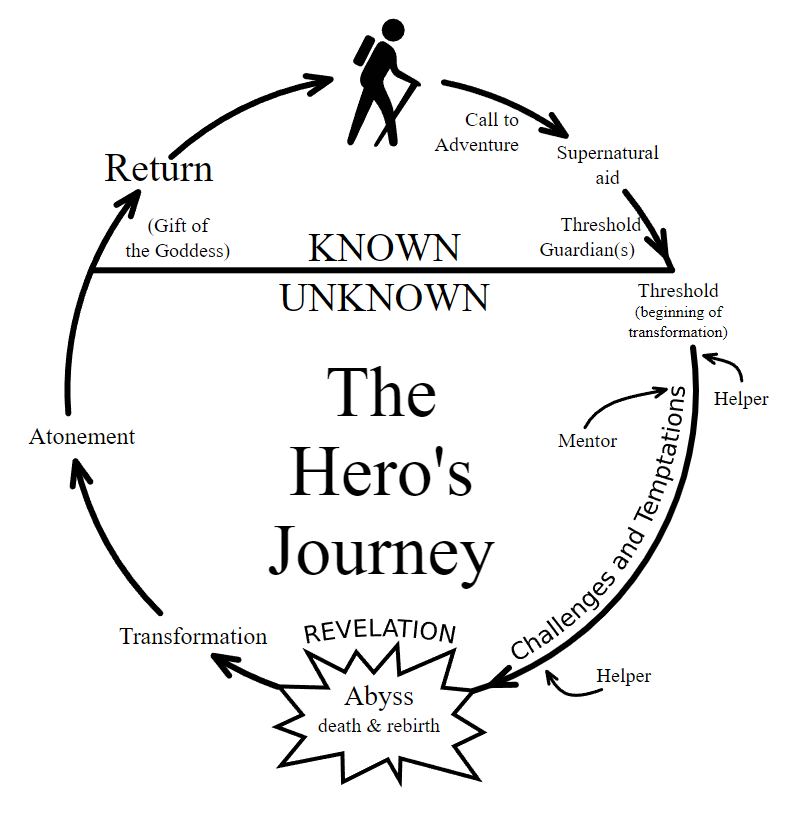
Game Loop has become an industry-standard piece of terminology for video games. It’s taken as a default, a forgone conclusion, or necessary for a game to function. It has a role in game development similar to 3-act structure or the Hero’s Journey in storytelling. These structures are presented as inevitable, ever-present throughout history and culture, and essential to good storytelling or game-making, but many stories and games don’t follow these structures and are still successful and well-regarded.

Some people argue you cannot make a game without loops, or tell a story without 3-acts, or say that the Hero’s Journey is the monomyth from which all other stories derive, but there is nothing definitionally inherent to games or stories that necessitates these things.

Continue reading

It’s Not the Yellow Paint, It’s What the Paint Represents

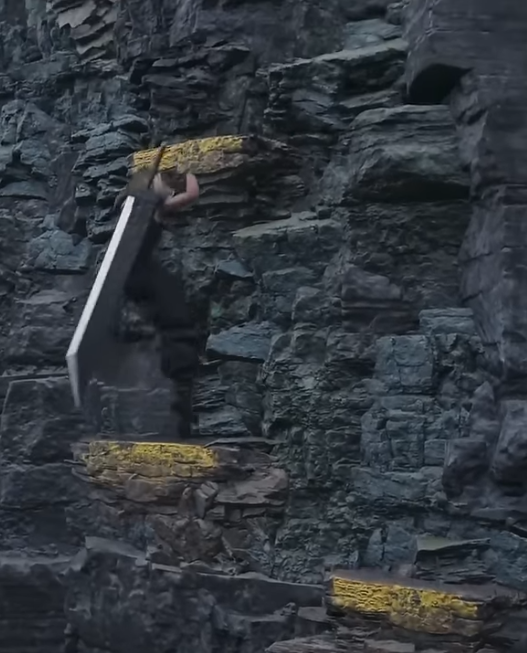
Recently footage of Final Fantasy VII: Rebirth was released, and it contained a shot of The Yellow Paint that we keep seeing to denote objects in the environment that can be climbed or otherwise interacted with. Kayin wrote an article on this, and it inspired me to write my own take.

What’s wrong with Yellow Paint?

So, why do people kneejerk hate the yellow paint? People hate the yellow paint because it “breaks their immersion”, since there’s no diegetic reason why every single ladder, cliff face, or vaultable cover would be splattered in the same yellow or white paint and because it makes them feel like they’re being treated like a child, needing to have the interactable part of the environment highlighted so they can progress.

Continue reading

Celia’s Tips for Clear Writing

A lot of what I’ve ended up critiquing video essayists and other games writers about is the clarity of their writing. I feel like many people are trying to create “Good Writing” rather than communicate effectively. Many video essays are written more like political speeches than they are trying to be direct and informative. It feels like they are informed by what makes good fictional writing more than good technical writing, and try to carry a vibe to the detriment of their message.

Here are the principles I follow to make my writing direct and effective:

Continue reading