A commonly invoked concept for video games is the concept of Agency. In real life, Agency refers to the ability of individuals to act upon the world and shape their life outcomes, especially in relationship to other people. I don’t think this concept or framing makes sense for games, and the game The Stanley Parable, kind of lampoons this concept, especially in this trailer.
I don’t think the concept of Agency makes sense for video games, because I view games more abstractly than stories or simulations. If games are self-contained systems of rules and interactions, basically a big bundle of math, then how could you have more or less ability to affect the world or society when there is no world or society to affect? How would you compare the agency of action puzzle games, such as Tetris, Panel De Pon, Puyo Puyo, or Puzzle Fighter II Turbo? How would you compare the agency of sports, such as Soccer, Basketball, American Football, or Tennis?
Design Space is tricky to define, because it’s the water we swim in. Mark Rosewater (who probably coined the term) says that design space is roughly how many new cards can be made from a new mechanic. A mechanic that affords a large design space interacts well with the rest of the game and allows them to create a wide variety of new cards. In other words, Design Space defines how many differentiated game elements (cards, weapons, characters, moves, enemies, obstacles, projectiles, etc.) you can create from the base mechanics of your game.
Relative to my 3-filters theory of Depth, Design Space acts almost like a 4th filter, above Possibility Space. Design Space defines which possibility spaces can even be made with the mechanics and attributes you have available to you. Possibility space is all the things that can happen in your games. Design space is all the possible games (or content) that you can make with the mechanics and systems you have chosen. In this way, game designers strive not only to create possibility spaces that are rich with possible game States, but design spaces that will allow them to create elements that enable those possibility spaces to contain a multitude of game states. A more richly detailed character allows for a more richly detailed environment for that character to interact with.
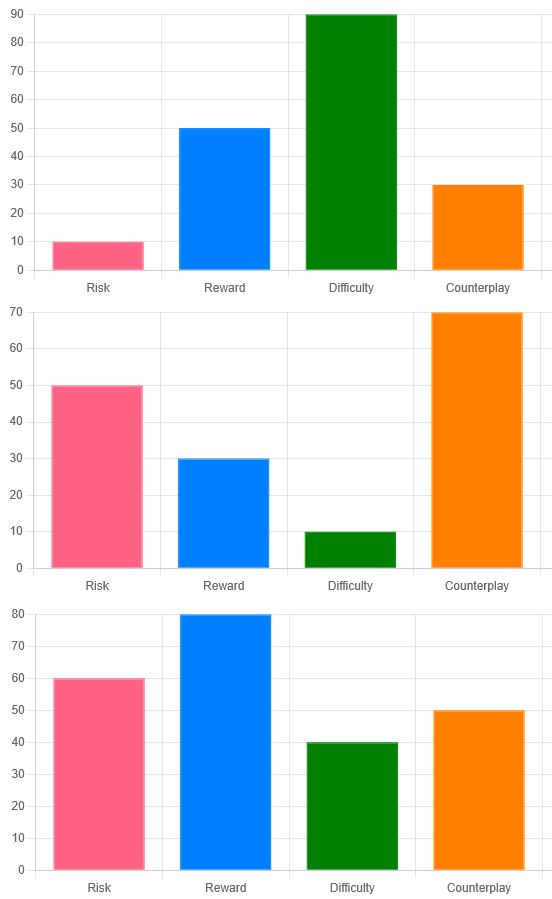
I have a 4 factor model for move/option design in PvP games:
Stake (how much you stand to lose by choosing this option, either in costs or penalties)
Reward (how much you stand to gain if this option succeeds and stand to gain regardless)
Difficulty/Chance (the likelihood that the option will be successfully executed)
Counterplay (what range of options this move beats, and how hard/soft a counter)
The purpose of dividing across these 4 factors is to help illustrate to designers the different levers they can pull, instead of focusing purely on a linear risk/reward relationship.
It’s common for a lot of designers to get stuck thinking that everything risky has to have a proportionate amount of reward, and everything rewarding has to have a proportionate amount at stake. Having lopsided stake/reward relationships is possible and healthy when the difficulty and counterplay are considered.
A subtle factor of this model is that cost is a type of risk, and therefore something you put at Stake. When you pay a cost, you’re risking that that investment won’t pay off. Therefore An upside of this model is that it separates Risk from Difficulty/Chance of Success, which are often conflated. “This move is risky, because you’re likely to mess it up.” By separating Risk out into Stake, Difficulty, and Counterplay, we can think more carefully about how each of these different factors play into an option’s design, and we have a wider design space for option design.
Within counterplay there is a lot of nuance to how counters can be designed. I’m going to identify 2 spectrums:
Hard vs Soft
Wide vs Narrow
A hard counter is one that is guaranteed to always shut down the option that it counters. A soft counter is one with more wiggle room.
A wide counter can beat a wide variety of options. And a narrow counter can only deal with a very specific one.
By dividing counterplay across these two axes, we can see the relative strengths and weaknesses of different moves and intentionally alter the counterplay of moves relative to our needs.



 Celia Wagar's CritPoints