For a long time I have been opposed to the idea of immersion in video games, to the idea that people become “immersed” in fictional worlds. I believe there is no specific mental state that can be referred to as being “immersed” in a video game or work of media. I believe the qualities that people describe as immersive are contradictory, limiting, and self-defeating. I believe that sincere belief in the idea of immersion from both a design perspective, and from a player perspective, is harmful to the creation process of video games and the enjoyment of video games. I don’t think we should make appeals to the idea of immersion, or use it as a guiding philosophy for game development.
As research for this article, I’ve been collecting statements for years about what people think immersion is, what traits they think are immersive, and what breaks their immersion. Through this, I hope not just to argue against the conceptualization and prioritization of immersion, but also to show that what I am arguing against is representative of the idea of immersion in the broader public consciousness.
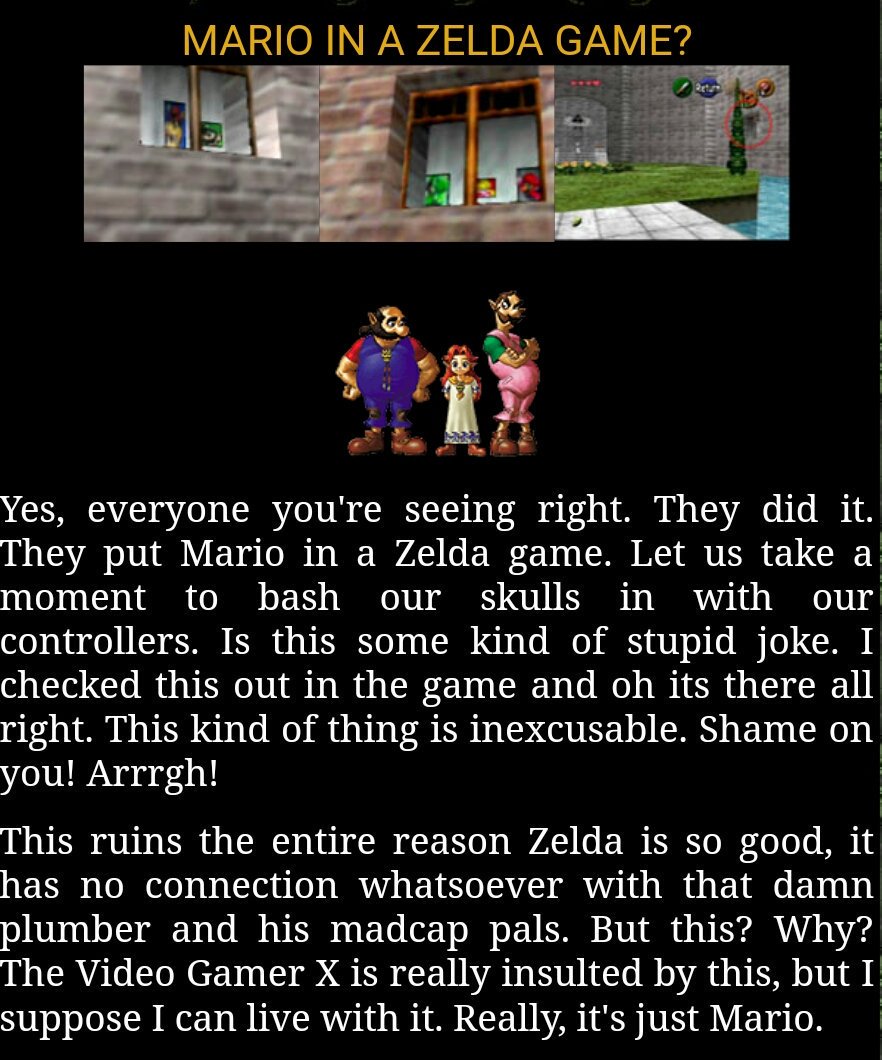


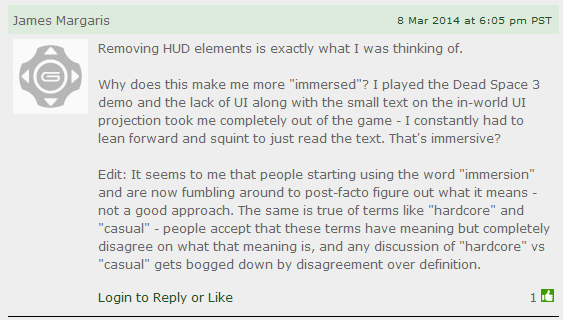
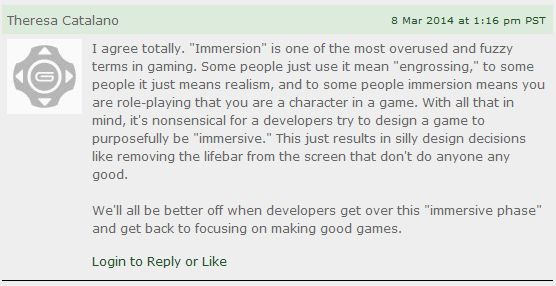




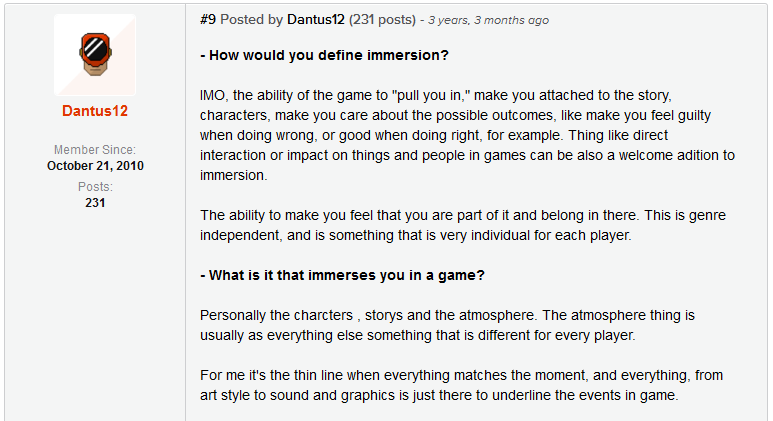


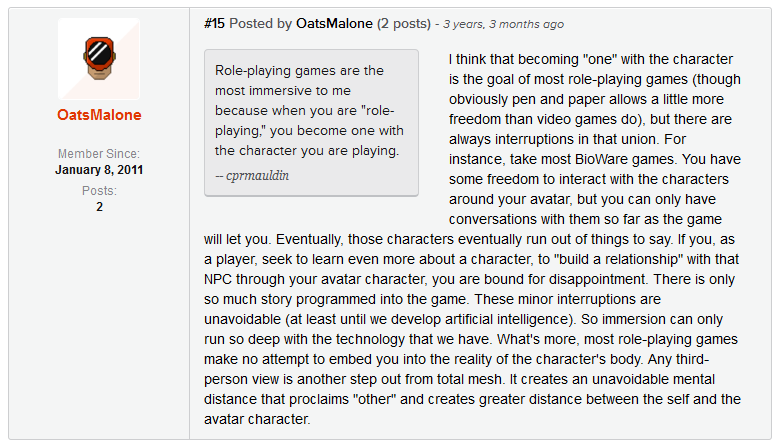











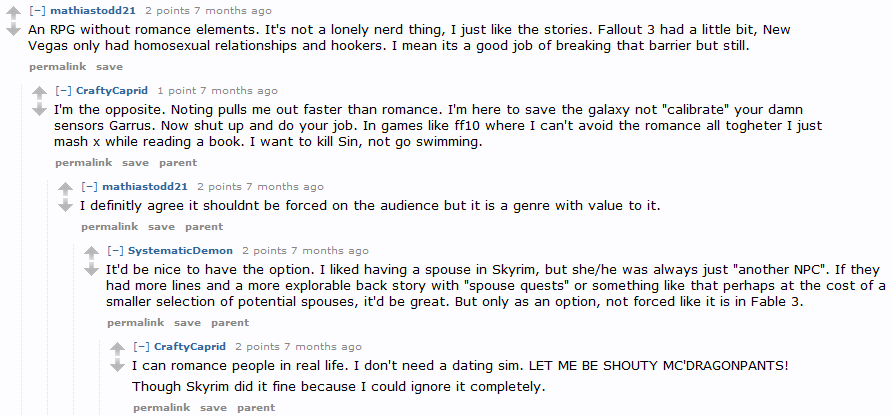

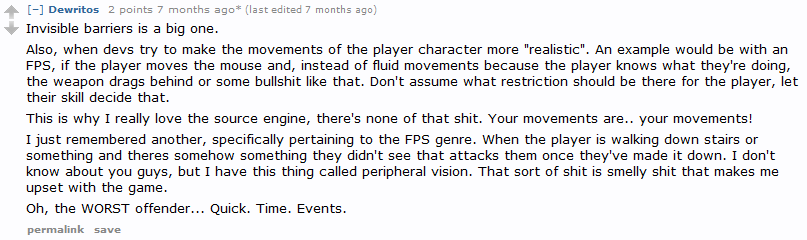





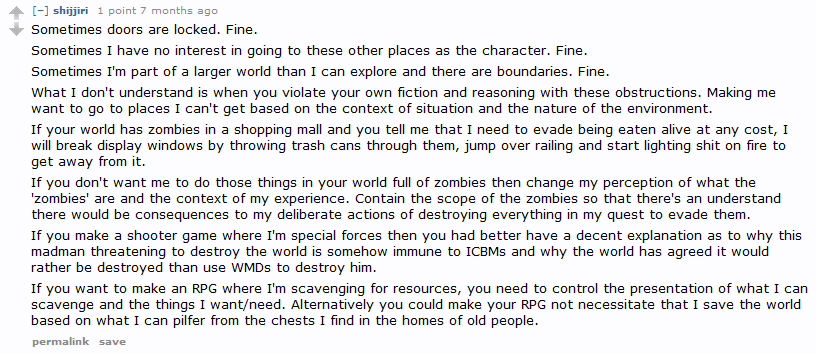








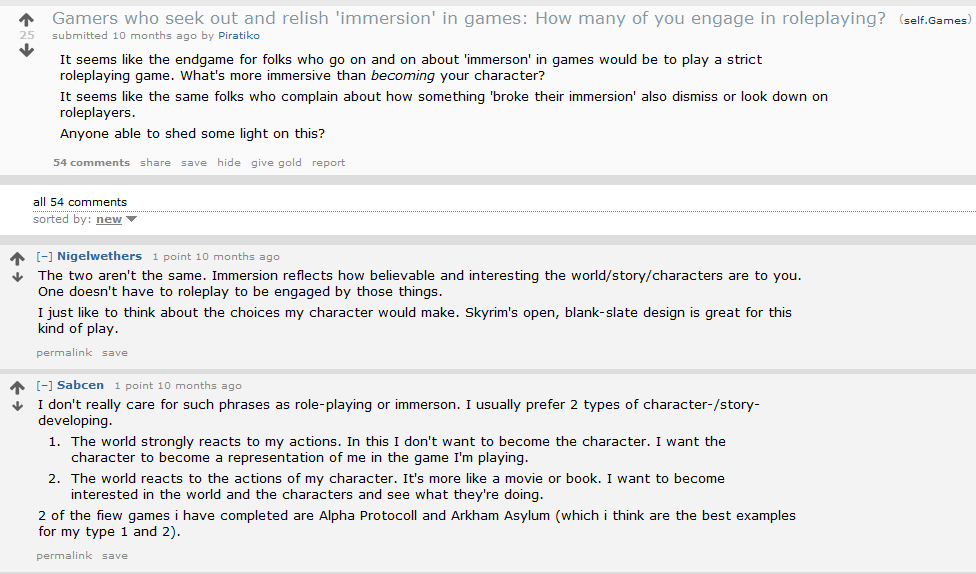
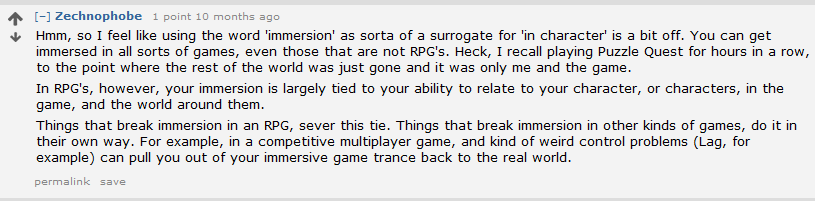
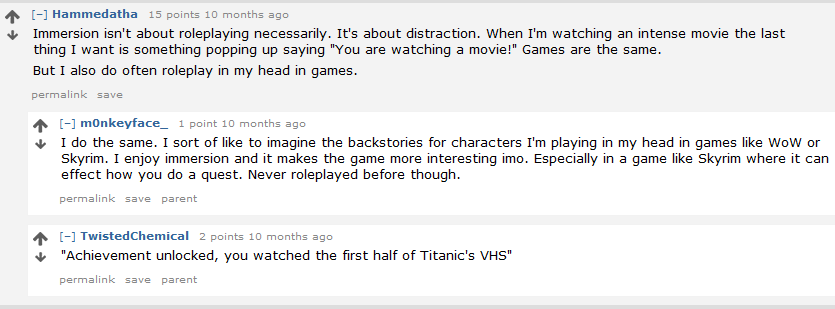

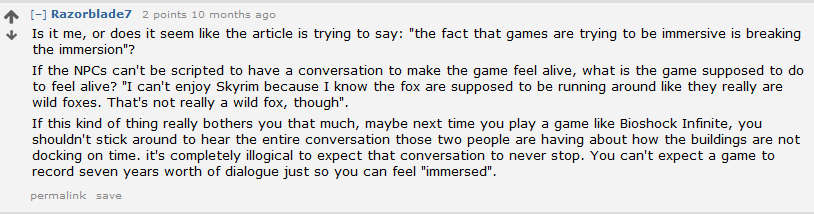


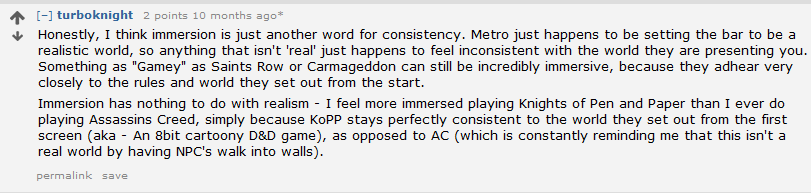
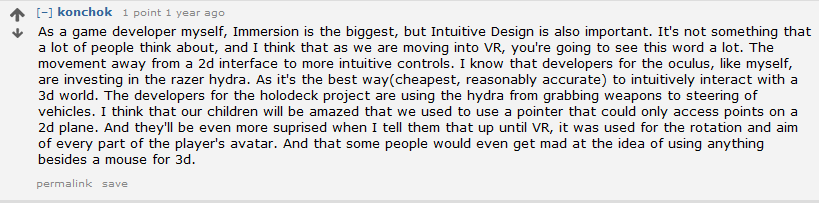





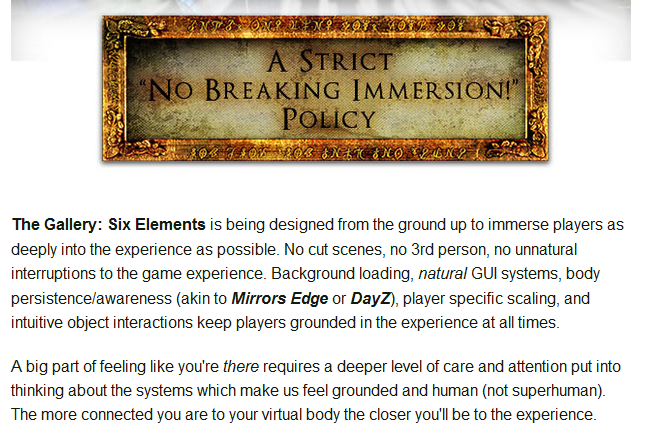
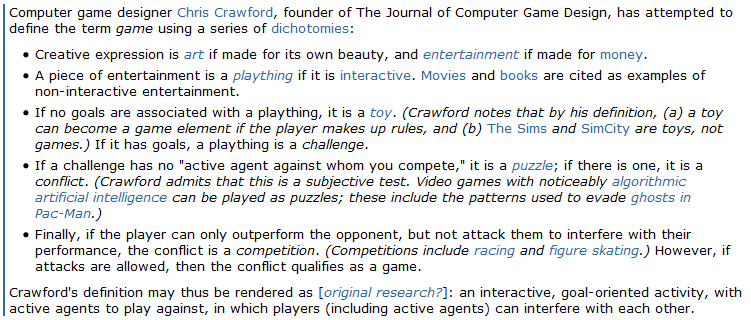
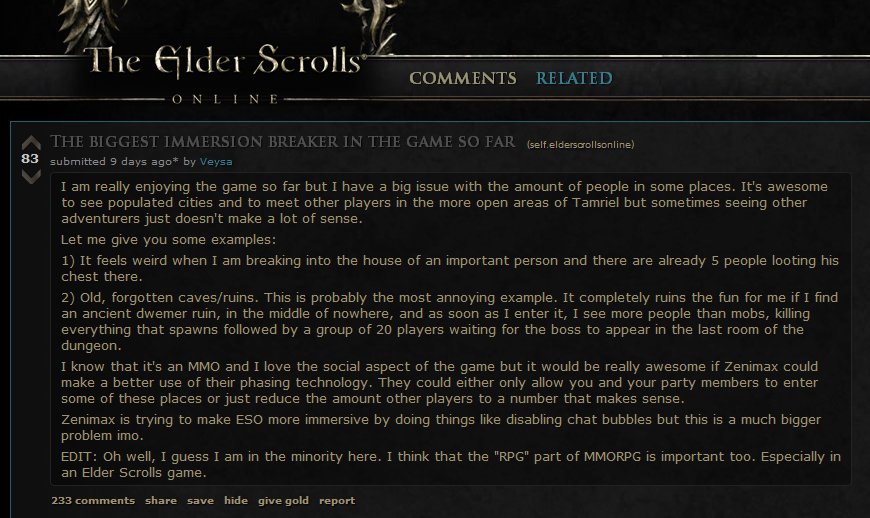
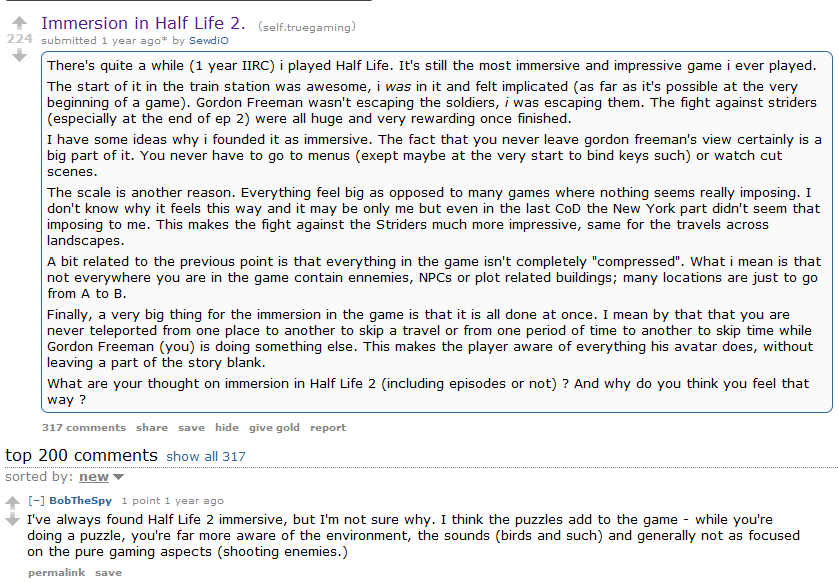

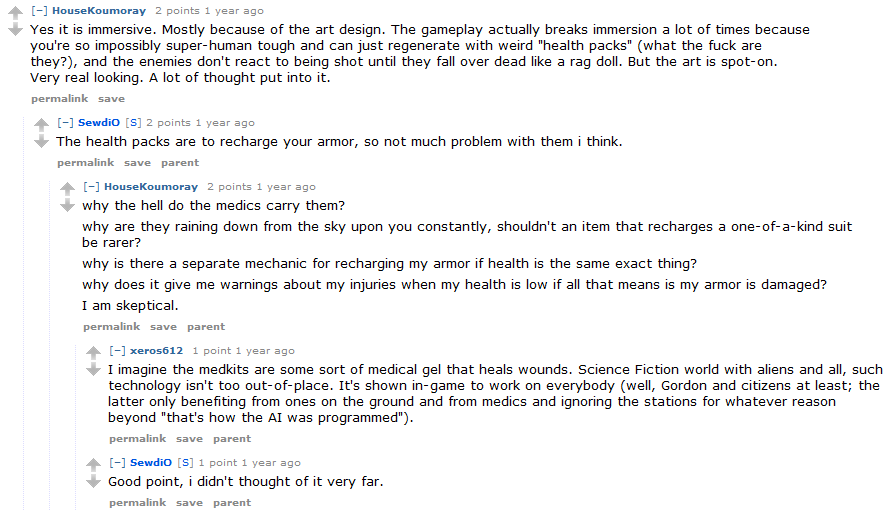
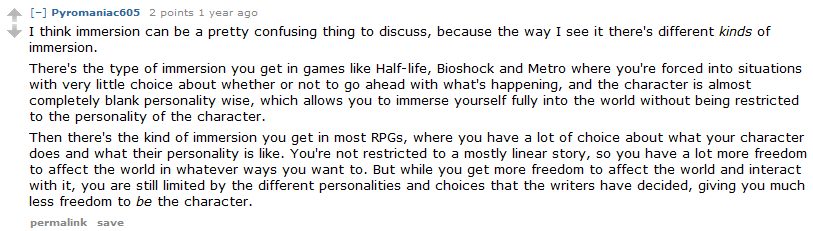







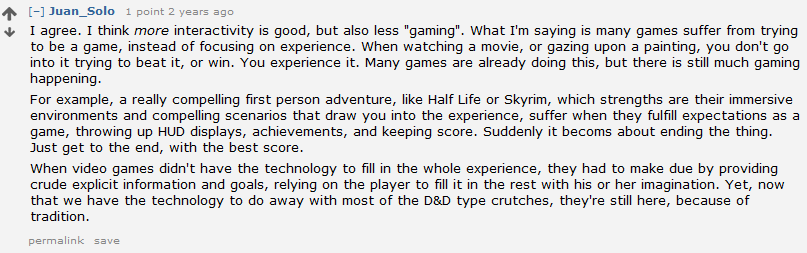
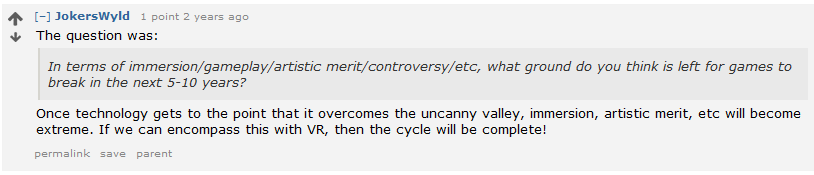
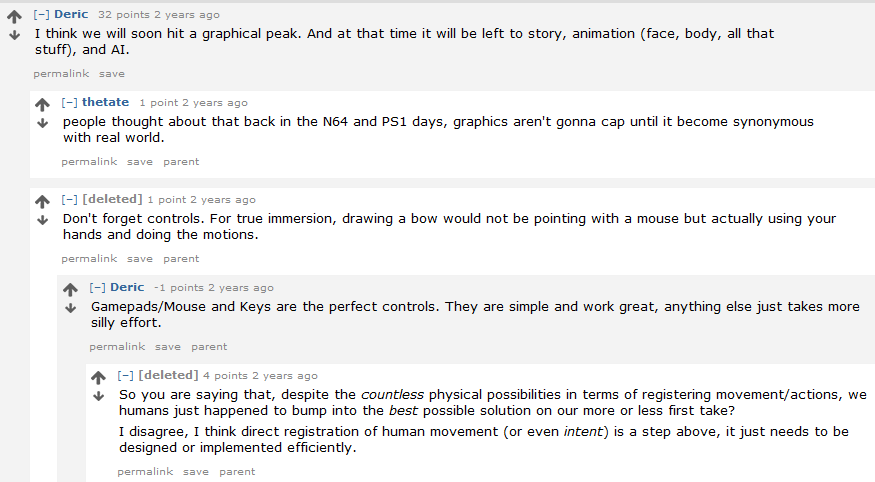
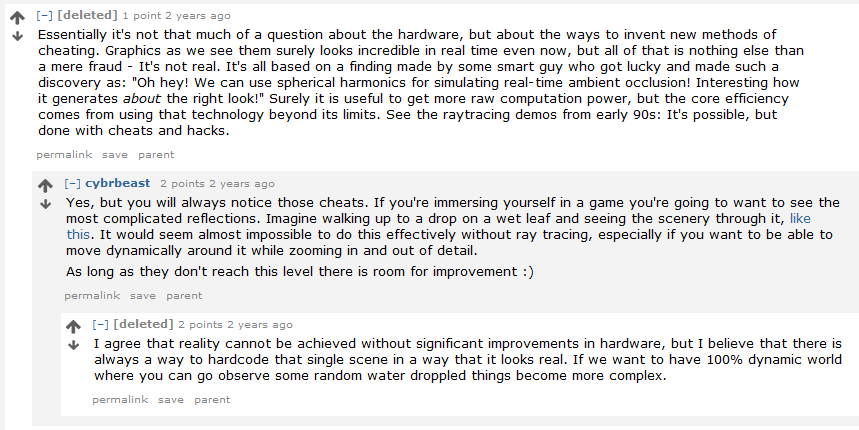


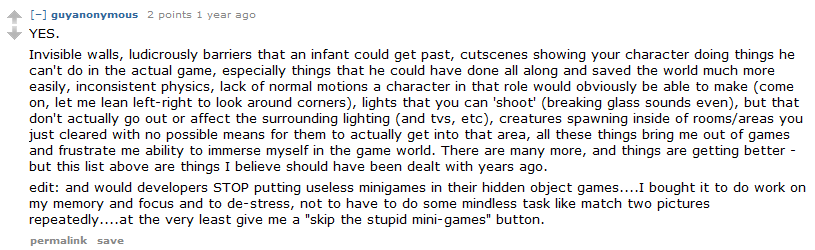
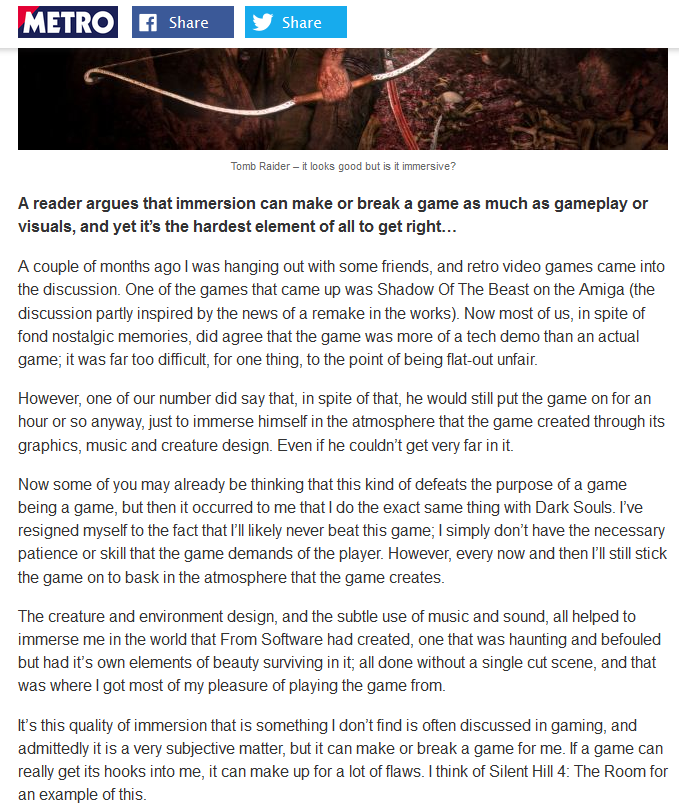

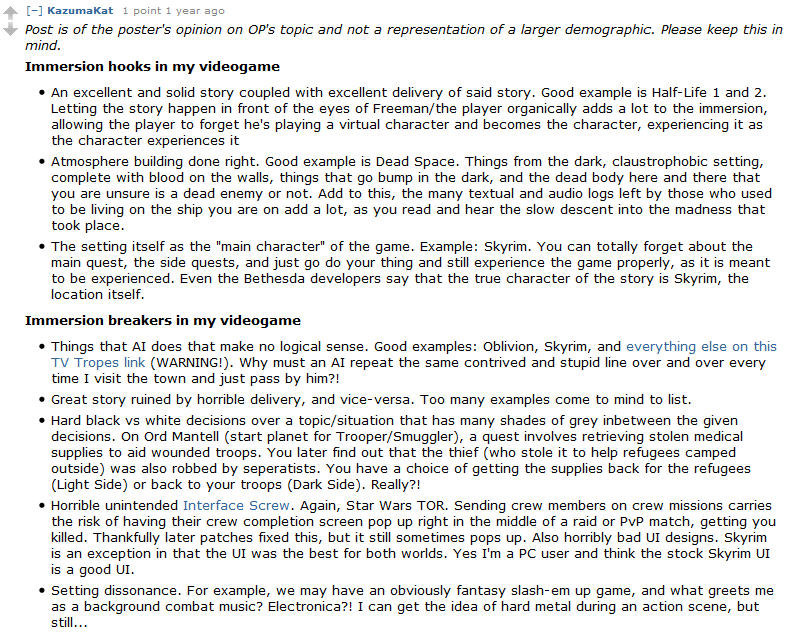
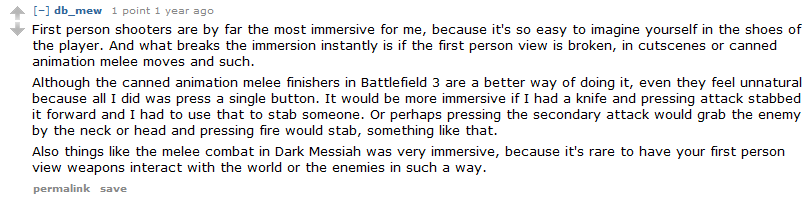


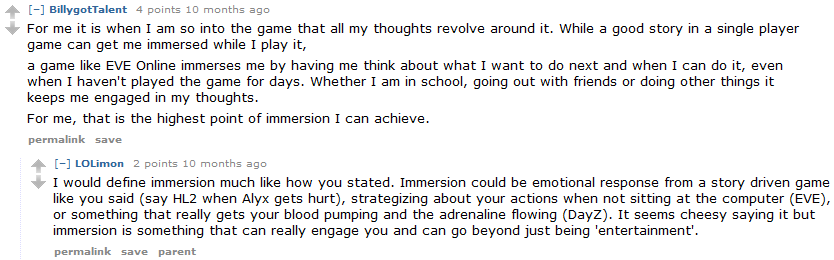
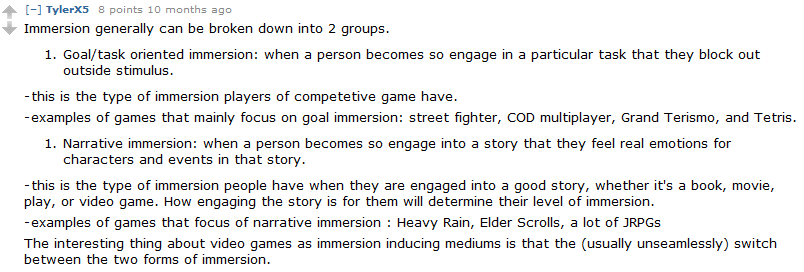
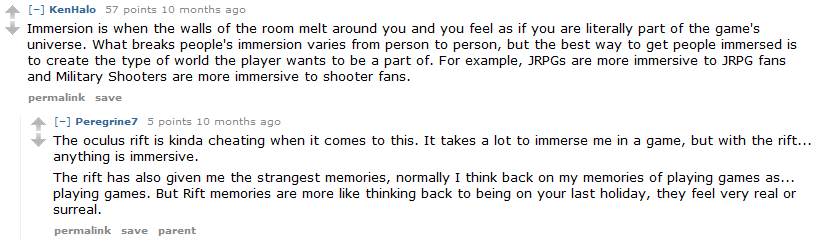

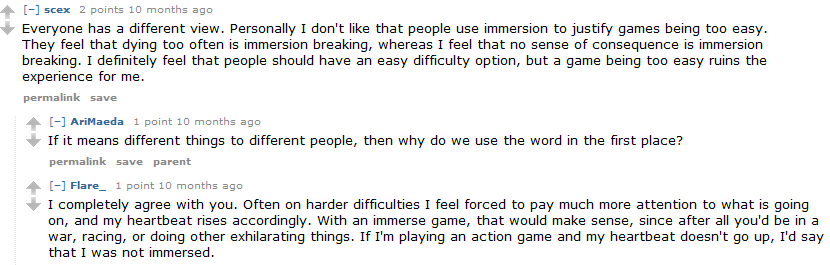
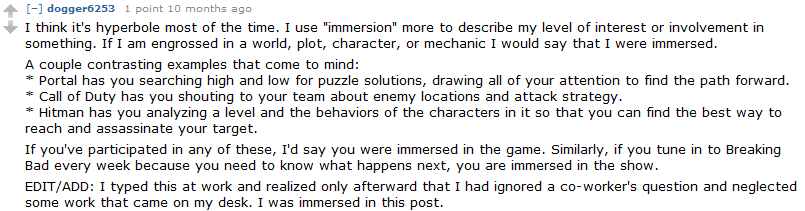
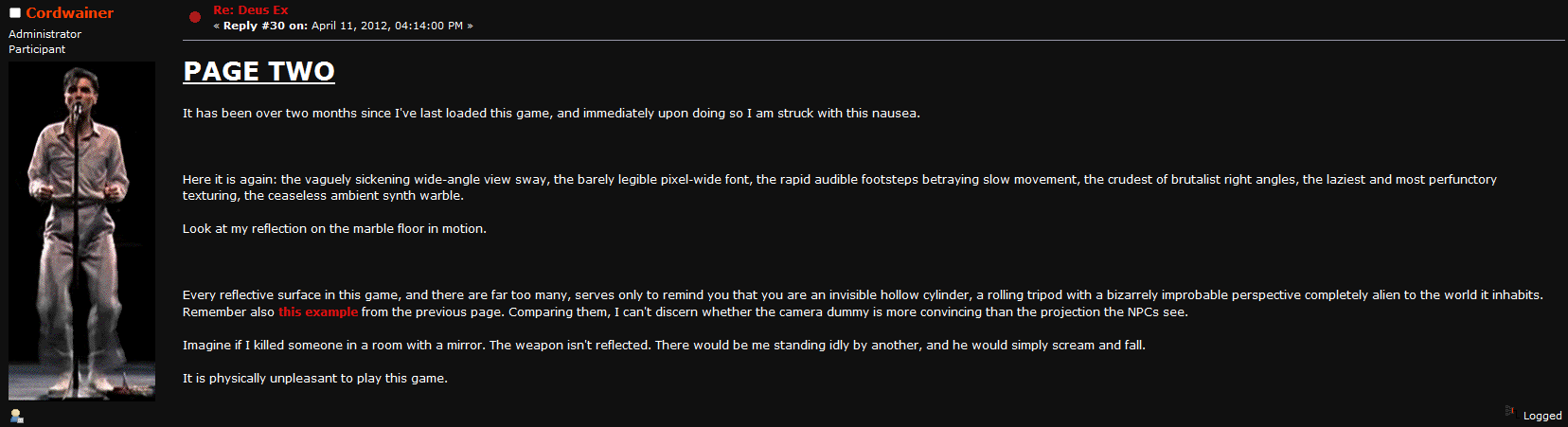
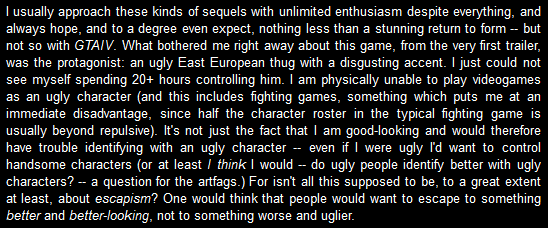






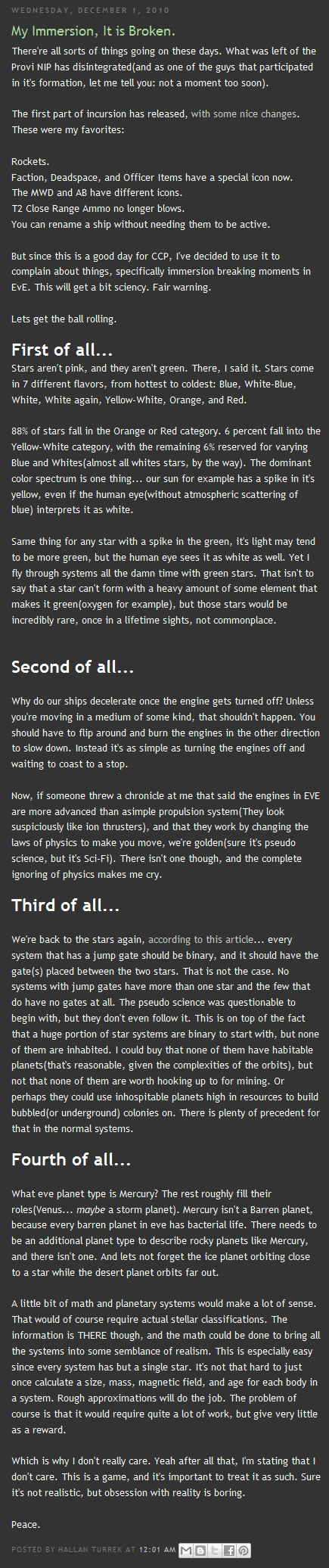
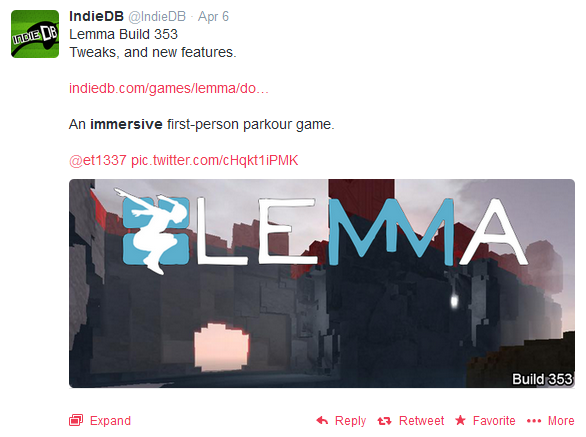
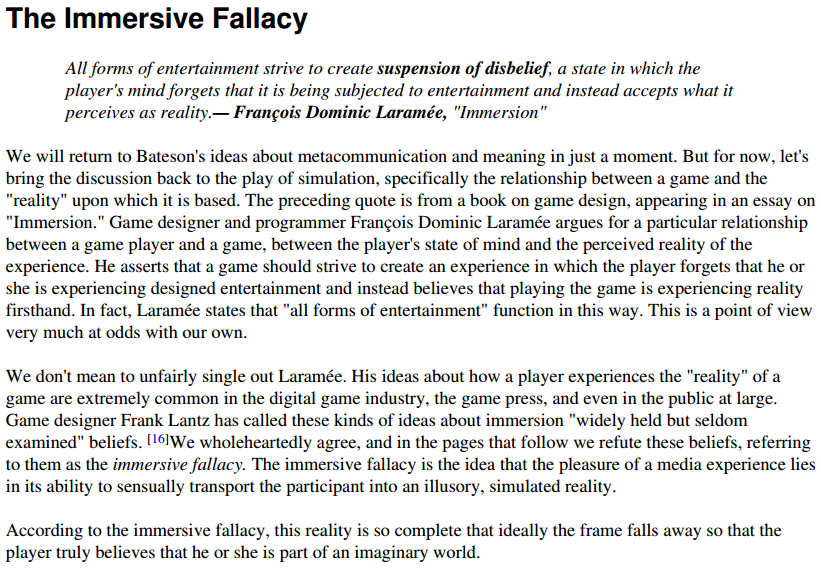
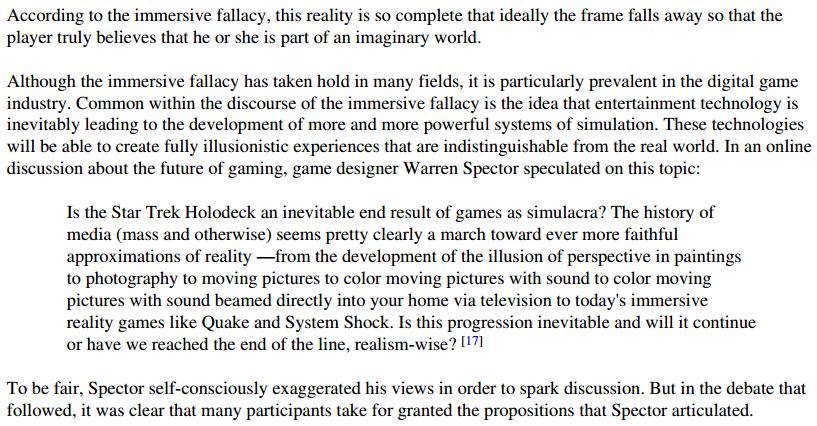

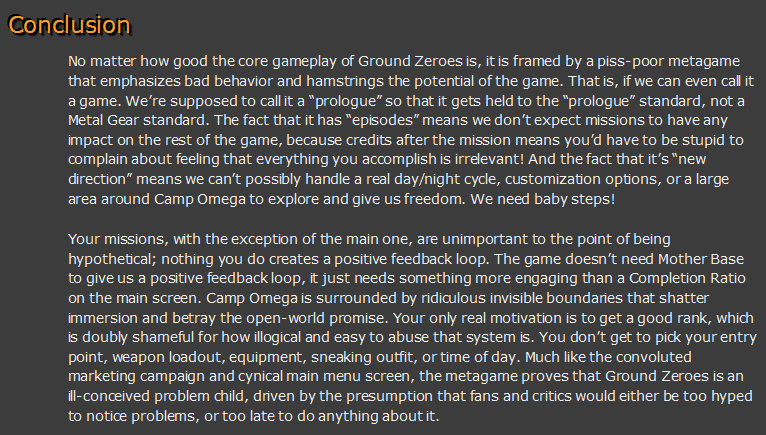



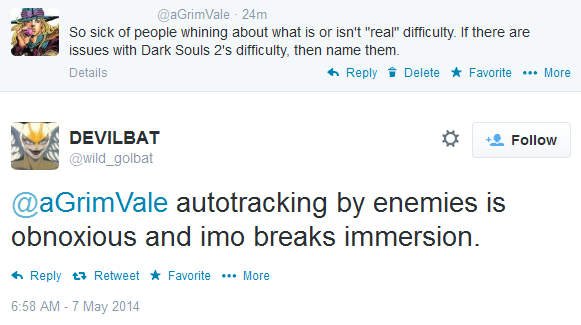






















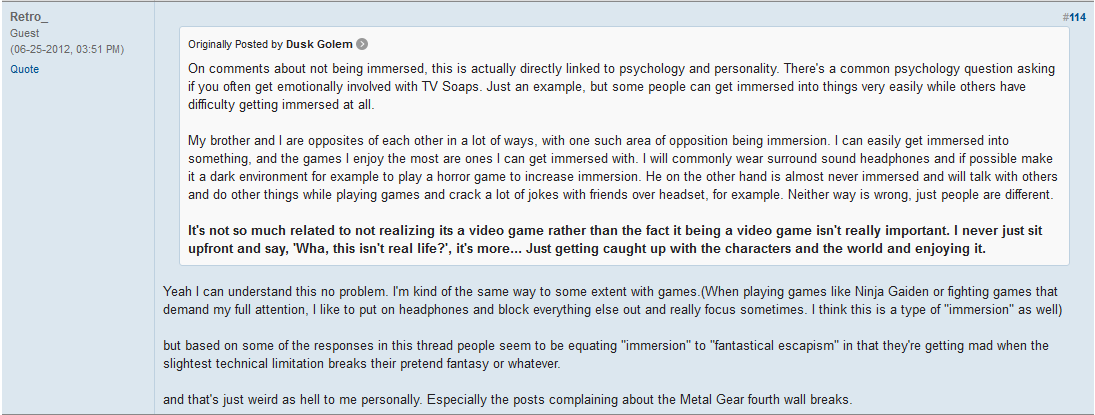









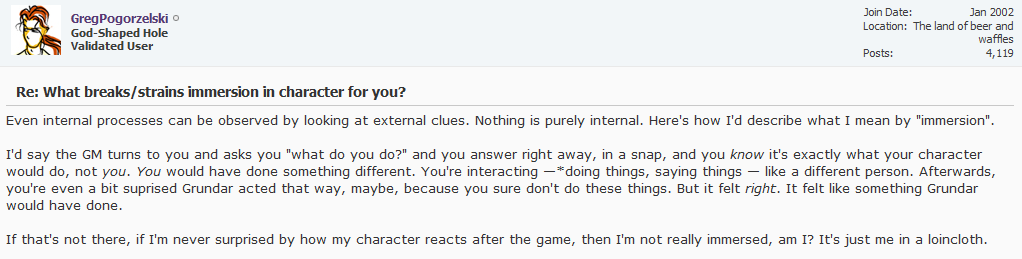




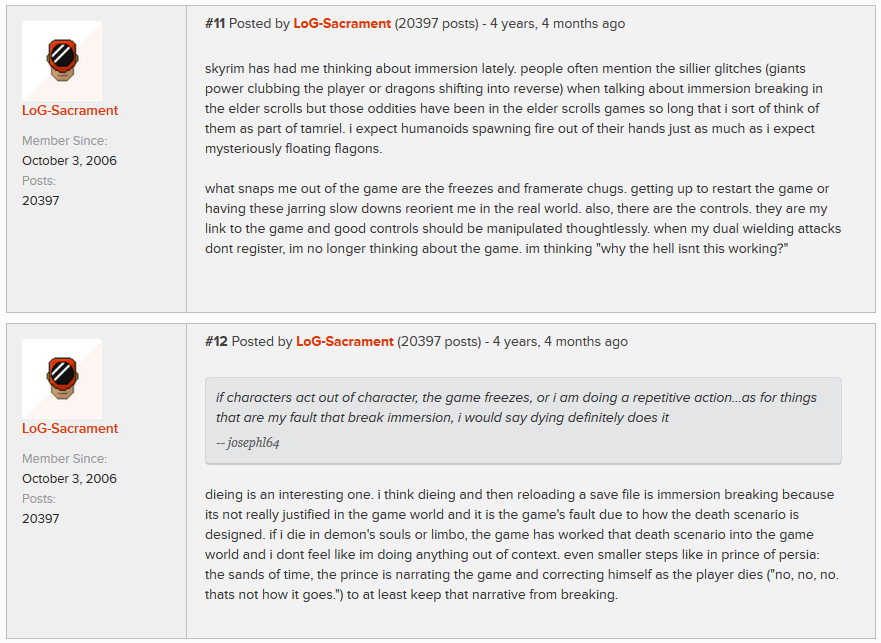






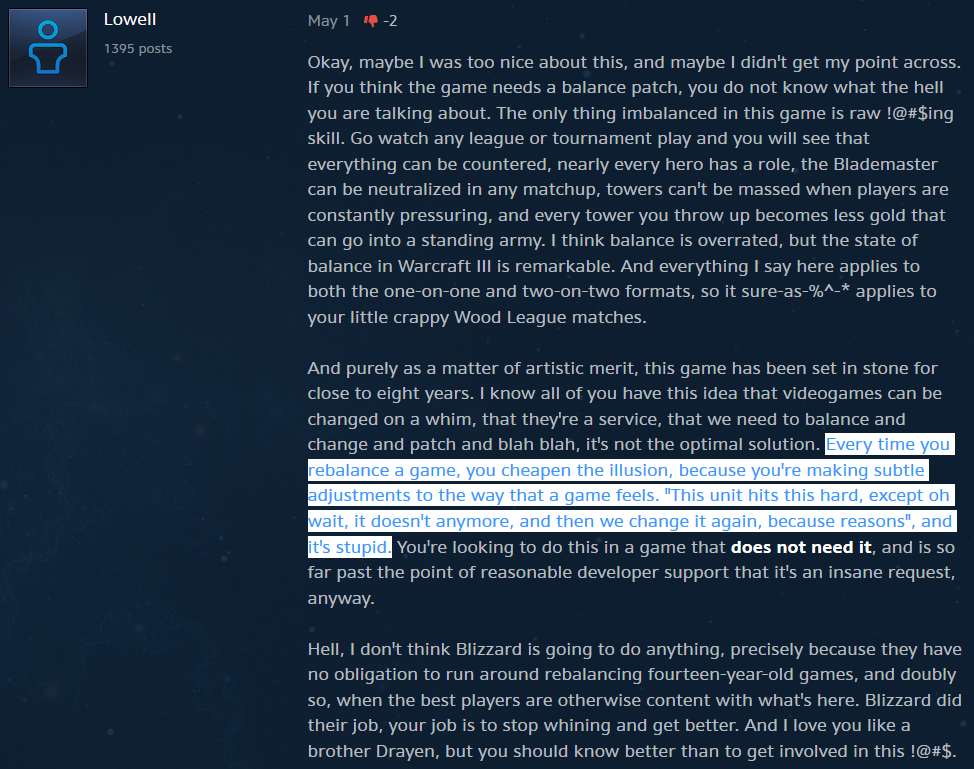



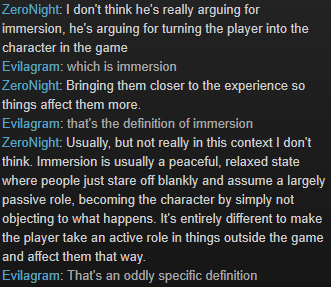

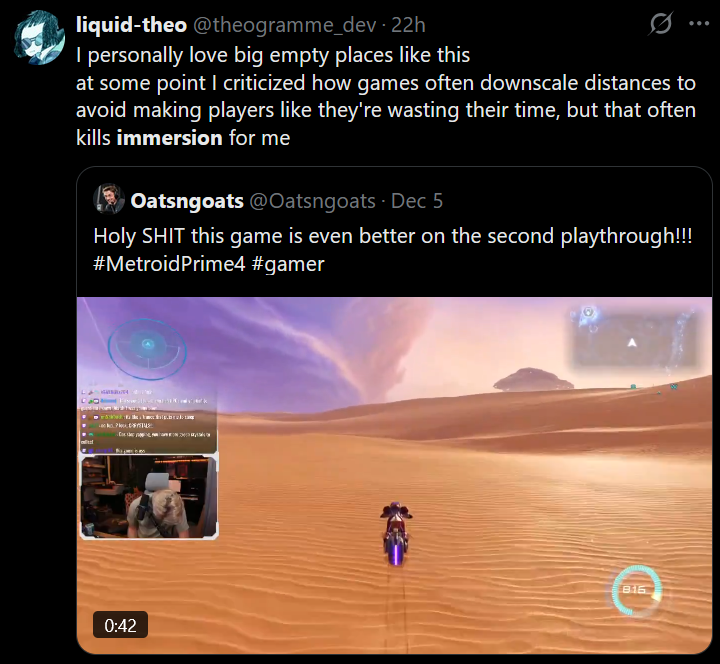
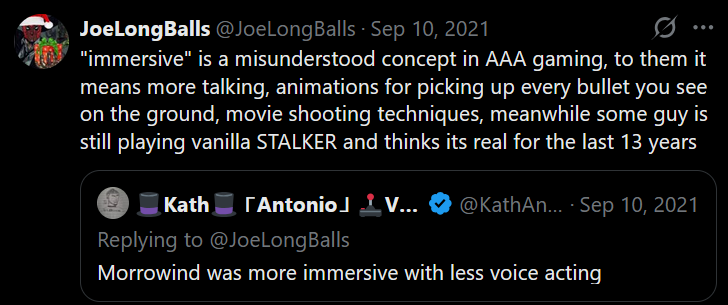

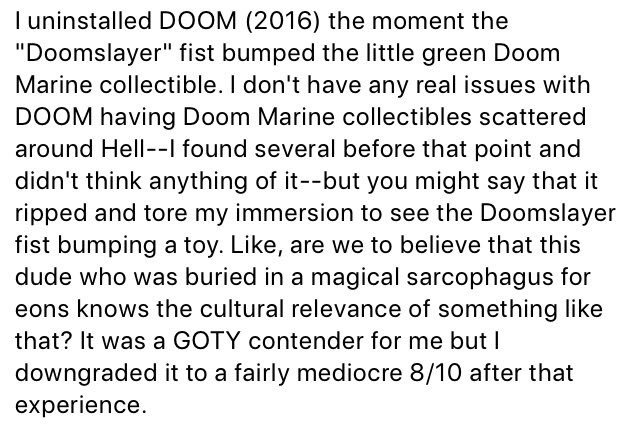
First up, what exactly is immersion? Immersion has been described as a state of total absorption into a work of media, akin to the Flow State. The things that enable this state of concentration are said to be a cluster of different attributes, including: the internal consistency and believability of the setting, realism, the degree of detail in the work, the lack of details that call attention to the artifice of the work (everything is diegetic), difficulty, lack of difficulty, narrative, lack of narrative, graphical fidelity, and so on.
I think that immersion is like believing in a magic trick. It’s believing that the world in front of you is a real place with real people, that you are a part of that world, and doing your best to not ask the wrong questions that would spoil the illusion.
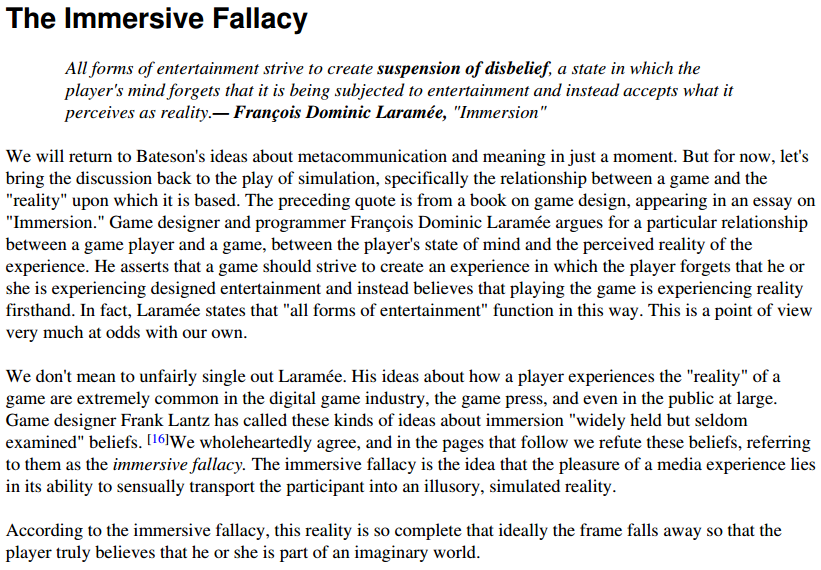
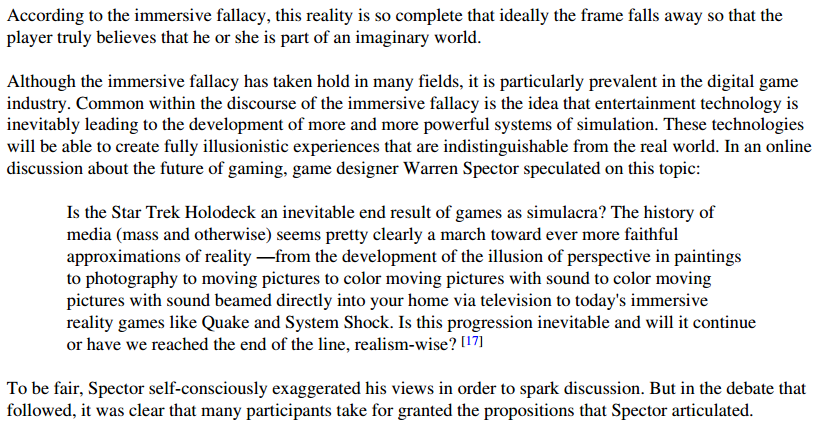
In the classic GNS theory (Gamist, Narrativist, Simulationist), people who advocate for immersion tend to fall most closely on the side of Simulationism. Simulationism is the belief that a game should accurately/believably simulate a process for the sake of accurate/believable simulation. Immersion is about “being there”. It’s an escapist fantasy, like the holodeck. Immersion positions games as a way to experience completely believable worlds, and places value on the amount of detail placed in these worlds, and lack of internal contradictions or obvious artifice.
Notably, people who prioritize immersion are often at odds with people who prioritize stories and narrative, and immersionists tend not to be particularly represented in the gaming press or academia compared to people who prioritize stories and narrative. Immersionists want to see highly detailed feature-complete digital worlds. Narrativists want to see stories, messages and meaning in the text of the game. The wave of short indie games that focused on telling a story instead of gameplay mechanics from a decade ago irritated the immersionists, and the AAA focus on high fidelity open world games lacking in story bores narrativists. Narrativists are entirely fine with the artificial or gamey in the name of a compelling story.
Breaking Believability
One of the most pedestrian critiques of simulationism applied to a fantasy setting is that fantasy itself is not accurate to realism. Using advanced fluid simulations to model a mage throwing a fireball technically isn’t realistic because magic isn’t real. The simulationist response to this is that the important part is believability, not realism (even when they outright say, “that’s not realistic”). After all, realism has constraints and the point is to simulate something that you might not be able to experience in real life. And many works that aim to immerse are fantasies, including cartoon fantasies in some cases.
Immersion is more about coherence and self-consistency, in the service of believability, than strictly realism. Surreal settings can be considered immersive, even if they are explicitly anti-real. What’s important to immersion is groundedness and believability. This response however already exposes one of the issues with immersion: It is dependent upon belief. Whose belief? The audience’s belief. Immersion fails if the audience fails to believe.
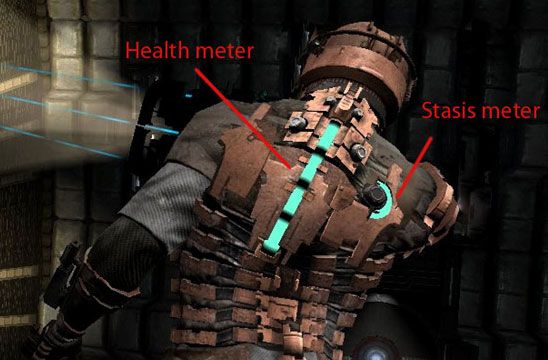
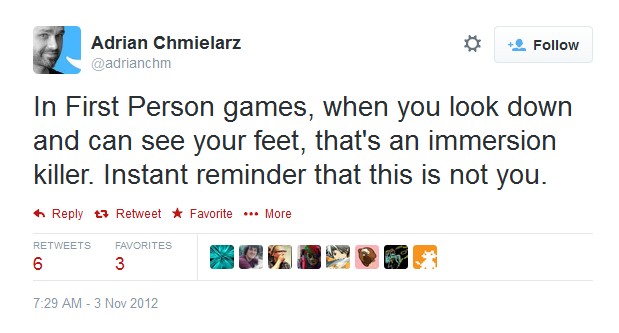
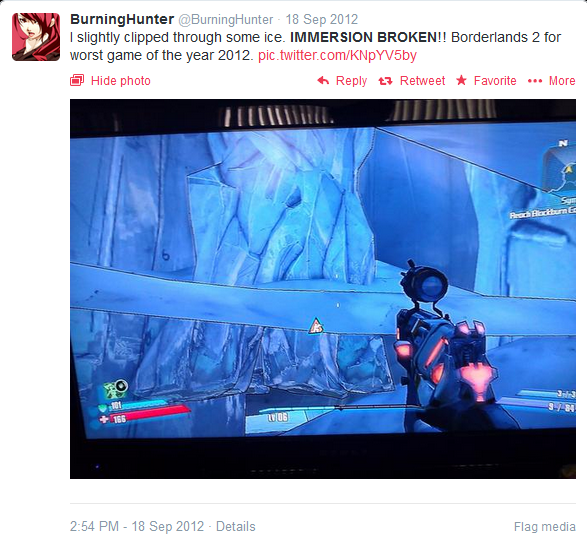
We can see examples of this when looking at what people claim to “break” immersion. People’s immersion is broken when they notice something they do not believe, something that reminds them that this work of fiction was created artificially rather than emerged naturally from the world. Hence, it said to be more immersive when a game does not have many of the conventional artifices used to represent game systems, such as not showing a heads up display. Or when a game goes out of its way to represent something not typically represented in video games due to technical or budgetary constraints, such as showing the player characters legs in a first person shooter.
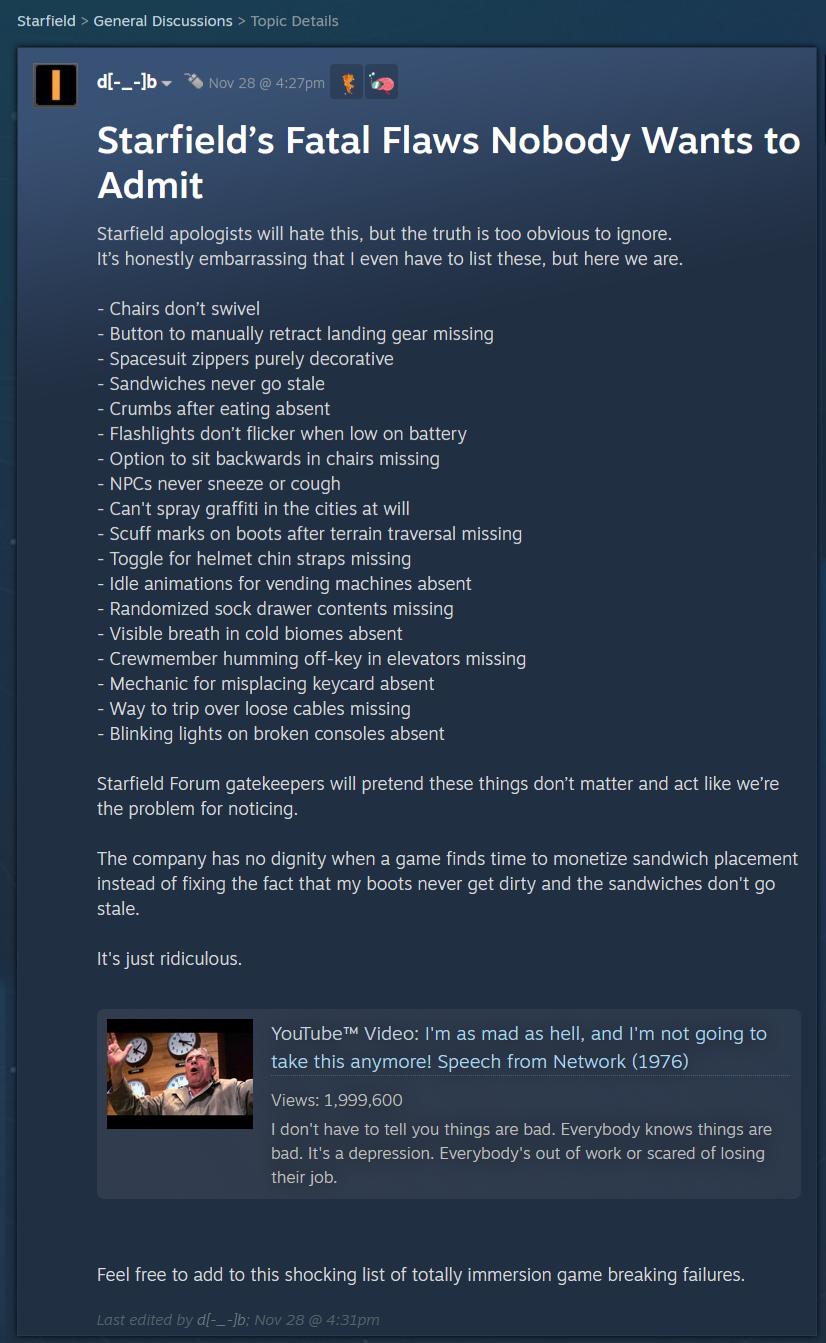
However, there are actually many dissidents who believe that making these types of choices is actually less immersive! Is it more immersive to hide the heads up display if your alternative is a health bar placed on the characters back, where the character themselves couldn’t see it? Or for the screen to look bloodied like someone spread Strawberry jam across it when you get hurt? Some say that the ability to see your legs when you look down in a first person shooter actually reminds you even more that you’re playing a game, because the games that feature that stand out more from the rest of the crowd.
That’s what creates videos like this:
These videos are basically saying:
“All these little particle effects and AI reactions and other things, if your game doesn’t have them, it’s a bad game. Good games are games with all these useless features that don’t accomplish anything. This modern war game is better than this other one because the developers specifically took the time to model fruit and rig it as physics objects, and make unique destruction particles and giblet objects for each of these fruit. When I shoot at a fruit in a fruit stand and it simply resists my bullet, this reminds me that I am playing a game, and I cease to believe that I am actually a soldier inhabiting this world, but merely a player playing a war game.“
What’s even more ironic about the Cyberpunk 2077 clip above is that Cyberpunk 2077 was a game that was panned on release for being “unrealistic” in all sorts of different ways, including many of the things the video highlights as positives. The content of the game hadn’t changed at the point when the video was taken, it’s just less buggy and more polished.
The implication of these types of comparisons, popularized in part by CrowbCat, is that a game is better for the endless hours of developers slaving away on an ever increasing amount of detail. Red Dead Redemption 2 was mocked for highlighting how the testicles of your horse would retract in cold weather, but many gamers have made it clear, they don’t care, they just want the believability of the world to expand outwards in all directions forever, regardless of human cost, or gameplay importance. In practical terms, immersion is an ideology of slavish devotion to details, regardless of impact or importance, and anger when the developers fail to close all possible inconsistencies. The point is to create a completely internally consistent world, which creates absolute belief in its consistency and “magic”.
I don’t think this approach to game development is healthy for the industry. The costs of game development have been scaling exponentially for generations now, and a large component of these costs is all of these associated details. This is directly connected to the culture of crunch that permeates AAA game development. The demand to treat game worlds as more than just set dressing is having a real human cost on the workers expected to make these games.
The GTA6 tweet above points out “mistakes” that are INCREDIBLY small details that most people would never notice. Video games require artists to manually create every aspect of a world, from its visuals, to its animations, to its physics. As game worlds get larger and larger (as demanded by immersionists), there are more and more art assets that need to be perfectly tailored to never contradict reality. To never clip, to never re-use assets, to exhaustively simulate every single conceivable action that could remotely be available to a player.
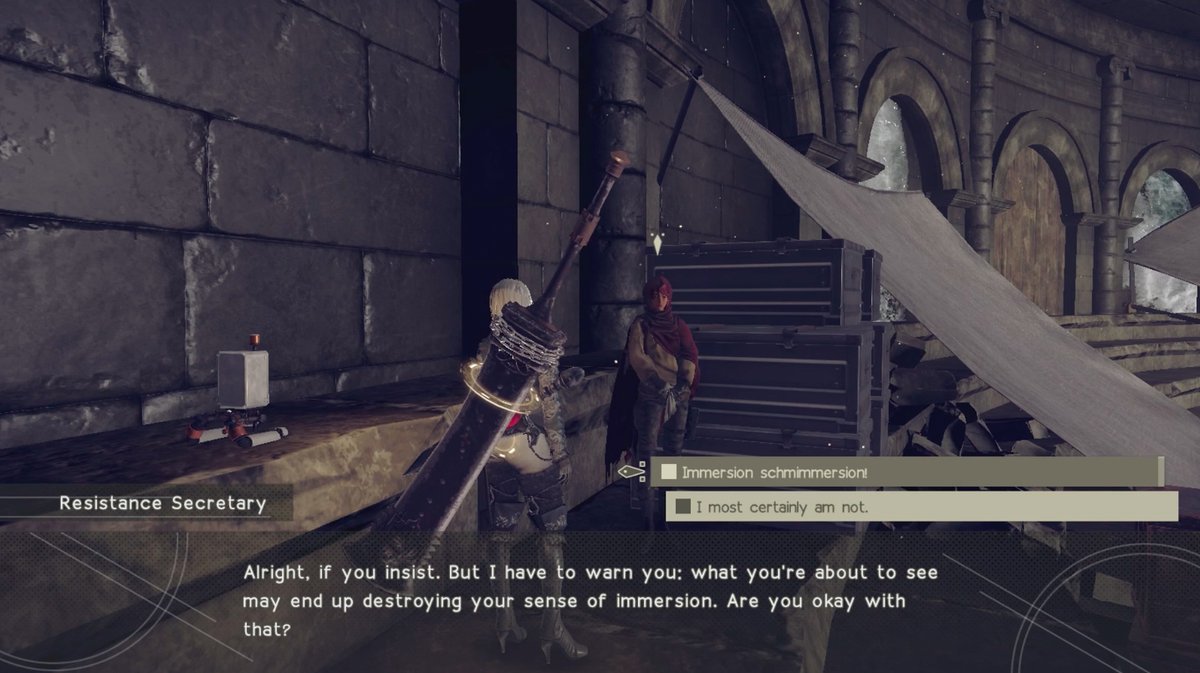
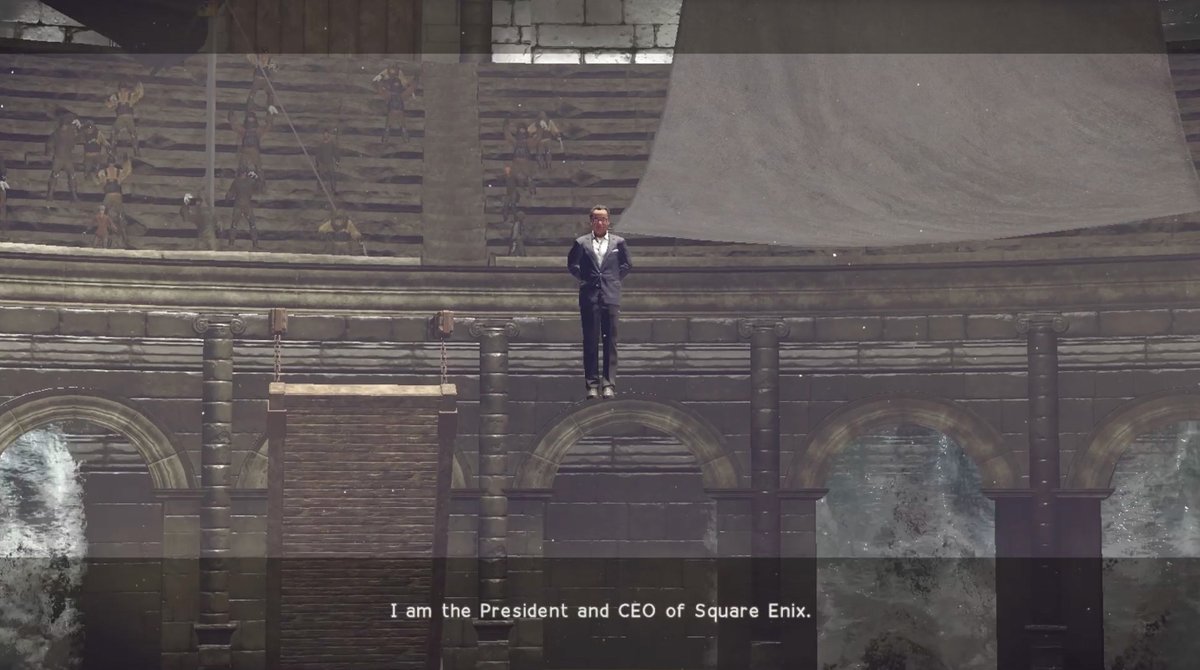

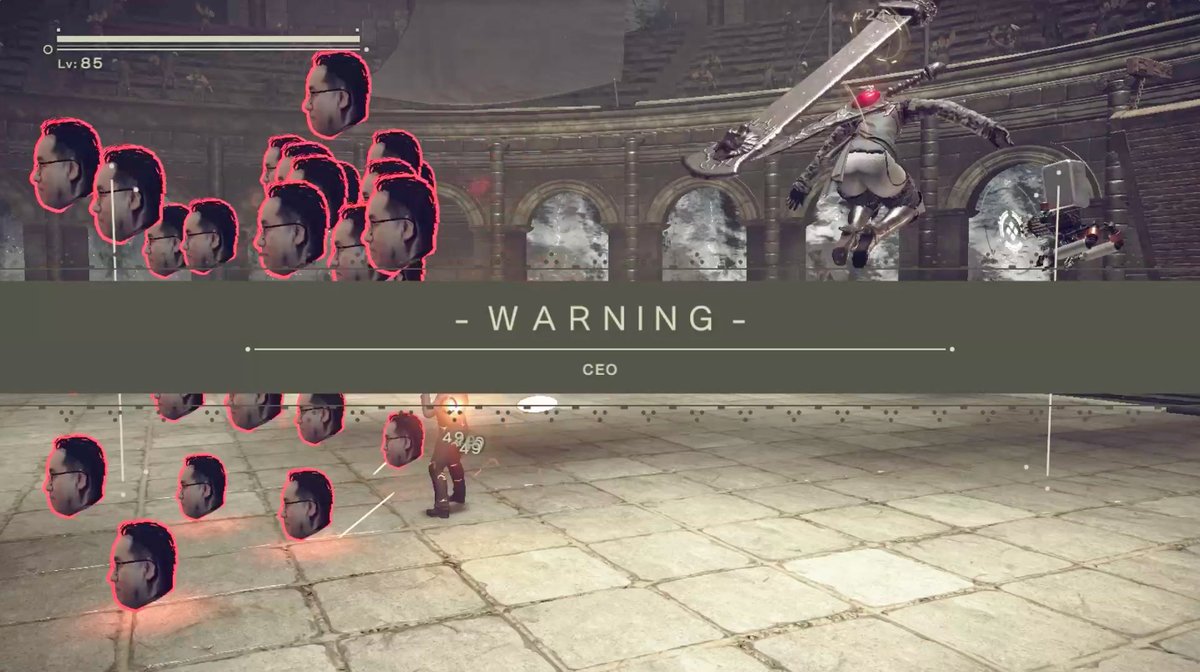
Thus we get to the crux of the issue, belief is subjective and circumstantial. If the implicit goal of immersion is to stop you from thinking about how you’re playing a game; to stop metacognition (thinking about thinking), can any game truly be successful? No game can be endlessly detailed, endlessly self-consistent. No game can erase the context that you bring to it. No game can make you perfectly act with internal self-consistency with the narrative, the setting, and so on.

Metacognition, a break of immersion, might be provoked by anything at any time, and individual people are generally very contradictory to each other about what exactly promotes or inhibits metacognition. Sure, I’m being unfair by pointing out that no game is perfect, but similarly people who complain about having their immersion broken are being unfair by pointing out the limitations of video games as flaws.
You could frame immersion as a worthy pursuit rather than a discrete goal, but it’s still ultimately dependent on people choosing how they’ll engage with a game, and it still requires the creation of an endless treadmill of believability, requiring ever expanding amounts of human effort to fulfill (or the utilization of AI to procedurally generate garbage content).
What We Lose With Immersion
One of the biggest faults with immersion is that it inherently prioritizes elements that are aimed at realism or believable simulation. Immersion devalues elements that are orthogonal or antithetical to those aims, such as fourth wall breaks or “game logic” that is intended to make a game more fun, simple, or improve user experience. Immersion is allergic to anything “gamey”. The most common tweak made to make games more “immersive” is removing or minimizing the HUD, cutting you off from information about the state of the game.
I’m sure everyone reading this has heard someone remark at least once that they didn’t like something in a game that immaculately serves the intention of the game, because it’s “not realistic”. Low kicks in fighting games are absurd and impractical in a real fight, but are absolutely essential for the game systems of a typical 2d fighting game, both in terms of function and conveying useful information to the players. Durability is a core part of Breath of the Wild’s design that people don’t like, because they think a steel sword should be more durable than the game decided it is.
This is cooler than immersion.
I’ve spent entirely too much time around immersion-minded hardcore gamers that had an outright aversion to speedrunning or some facets of competitive gaming, because of the use of glitches. Sometimes they could justify it on the basis of a character being powerful like a superhero, but Mirror’s Edge lets you clip through walls and jump off thin air, so it’s right out. This is a category of experience that is off-limits to them. To that end, this meant that they didn’t actually want to learn too much about games. They didn’t want to learn about hitboxes or frame data, or physics constants. They didn’t want to learn AI patterns or about Perlin Noise. They want to be fooled, like a magic trick, and a deeper understanding of the system is anathema to that. In contrast to Immersionists, I like learning how magic tricks are done. I like seeing how the sausage gets made. I love understanding hitboxes and code and the process of making art. But to them, this is vulgar and disgusting.
In short: “It’s not realistic” shouldn’t be taken as a self-evident criticism of a video game. Realism and believability should not have an overriding veto on all other aspects of a game.
Immersion is Contradiction
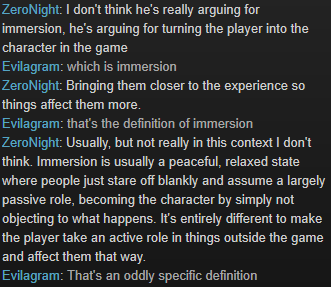
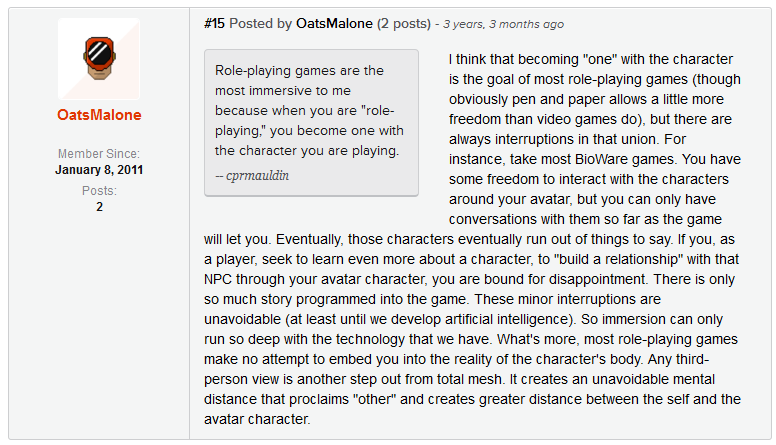
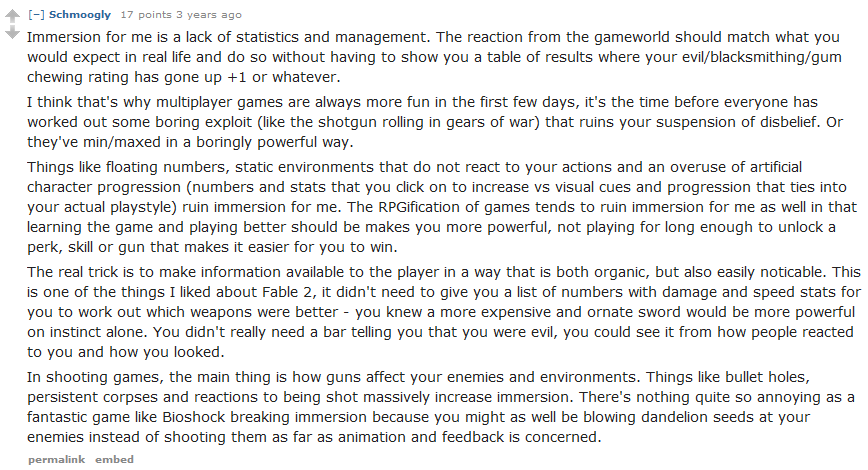
Because immersion is something that is so subjective, I have heard a massive number of contradictory opinions about discrete styles of design that people claim to be immersive or anti-immersive. Because any two people could disagree about immersion for practically any reason, even over-including or not including the same exact feature, targeting immersion as a design goal is practically impossible.
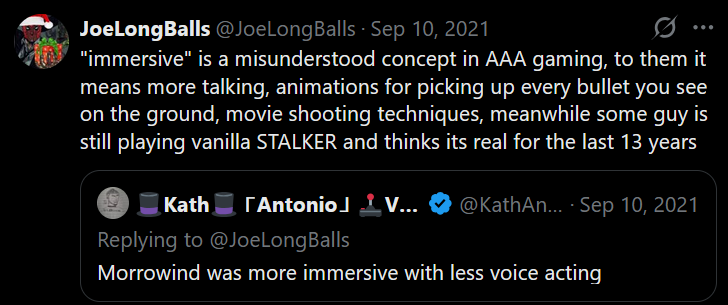
The belief of almost any hardcore immersion purist is that many features intended to create immersion are, in fact, a misunderstanding of what actually creates immersion and their personal sense of what generates or does not generate belief in a games setting is the true standard. I’ve collected a massive number of statements about what people think is immersive or not, and a lot of it is just arguing that what other people think is immersive actually isn’t.
The different components and contradictory beliefs about what immersion is act as a kind of Motte and Bailey when attempting to argue against it (Motte and Bailey is a type of argument where an obviously unreasonable initial premise is retreated from to a more defensible and sound position when the initial position is challenged). Different people will be like, “What do you mean there’s no such thing as immersion? I’ve clearly experienced flow state before.” “I’ve clearly experienced suspension of disbelief before.” “I’ve clearly entered a trance before.” “I’ve clearly appreciated”
All of these different individual components are more measurable and distinct and thus act as a more sound fallback for the more obviously ridiculous sense that you feel as though you’ve actually been inserted into a fictional world that you have some level of belief in, as an escapist fantasy. Immersion is a gang of different beliefs and phenomena in a trenchcoat, and whenever you aim for the head of this phantom, suddenly you’re fighting against something else that is very concrete and real instead of immersion itself, and I ENTIRELY expect to see replies to this article do exactly this.
The Immersive State
So what of the immersive state? What of the feeling of all consuming focus that many immersion advocates claim to feel about a game that is immersive? I believe this can simply be explained as the Flow State or just focus or engagement. Naughtydog even delivered a talk, “Attention, Not Immersion,” on the idea.
Sometimes you get really focused on things to the point where everything else falls away, but that happens all the time for a variety of completely mundane reasons, such as listening to a lecture, driving a car, sewing clothing, lifting weights. Just because you have the subjective experience of total focus on something doesn’t mean that it’s insertion into a fictional world when it happens to be a game (or movie, or book).
Some of the more devoted immersion purists tend to believe difficulty is necessary to create immersion. It’s easy to see an overlap between the hypothetical immersive state and the Flow State (also called, “being in The Zone”, a state of hyperfocus that athletes and skilled workers experience). Of course, it’s also debatable if the flow state is a real psychological state at all, given that its existence has only been established through self-reported studies.
If the immersive state and the flow state are the same, then immersion doesn’t require fictional self-consistency. People enter the flow state for all sorts of non-immersive reasons. The state of flow can be entered while driving a car, while playing a sport, while playing Tetris, while playing Chess, Checkers, Go, or any more competitive and non-representational video game that you can name. The conditions for entering a state of all consuming focus are completely unrelated to fictional self-consistency. If the Flow State is a component, then we can see how Immersion is defined as the absence of metacognition, the absence of distractions, and the choice to believe that a lack of fictional self-consistency should distract you and break your concentration.
Similarly, the feeling of “being” a character can be attributed to Game Feel, which is something you also experience while driving a car, or controlling an RC car. When you have direct real-time control over an object, you tend to project a bit of yourself onto it. When someone sideswipes your car as you’re driving, you say, “They hit me!” and if someone bumps it in a parking lot while you’re standing outside of it you say, “They hit my car!”
Virtual Reality brings with it the idea of Presence, a concept referred to casually as “being there” in a virtual world. I’ve used VR. I’ve written an article on it even. Is this finally the immersion that people have been seeking? I have felt the sensation of presence and the way I’d describe it is: it’s essentially overriding your physiological sense of space. You have this tight link between the position of your head and what’s rendered on camera, practically hijacking your sense of sight and proprioception. Similar to Flow, this doesn’t demand that what’s around you have any type of fictional consistency, or avoidance of artifice, just that objects are projected into 3d space at a sufficient framerate in this motion controlled helmet. I can attest that looking at objects in VR is really different than looking at objects on a monitor, but VR is graphics and hardware, not a world, as immersion would demand.

For immersion enthusiasts, modern day VR isn’t good enough, it’s only a stepping stone to “Full-Dive” VR (coined by Sword Art Online), which would involve a neural interface of some kind to more directly serve simulated sensory experiences, directly overriding all human senses. I have no idea if this is possible or not (currently, I’m leaning on “not”).
In a way immersion can be framed as a contract where the player agrees to enjoy an artificial work based upon its ability to avoid reminding the player that it is artificial. I think this is a toxic attitude to have because you are placing limits on what you are capable of enjoying in games, and choosing to be upset with things for insubstantial reasons, frequently related to the limitations of the medium, or any medium. Many games and other works of art succeed precisely on the basis of embracing their artificiality.
Artifice is Lovely

Edgar Wright films frequently play up their artifice in the way they are shot, in their use of visual metaphors, and choice of soundtracks and sound effects. This is part of the appeal of his filmography. He makes use of the language of cinema in a way that calls attention to the fact that it is cinema. And this is highly charming and enjoyable! His works are not immersive, but are extremely strong works of art precisely for their antithesis to immersion.
To give a further example, art frequently exaggerates things to an unrealistic extent in order to achieve a greater impact than reality can provide. A common example in comic books and animation is where, when depicting a punch or strike, you skip the moment of impact and only showing the followthrough result. Jackie Chan is known in his filmography for cutting right before the moment of impact to zoom in, show the start of the impact, and cut back to a wide shot before the moment of impact to show the full thing and all of its results, as a way of “selling” the strength of the blow. This asynchronous time splitting of the footage helps make the punch look even more powerful when it connects.

Many video games will freeze attacks at the moment of impact, playing a particle effect in real time and perhaps having the characters vibrate to help sell the force of the impact, before releasing the characters to play their recovery animations.
In realistic animation, it’s frequently necessary to exaggerate beyond the bounds of realism, to “break” bones, because without that extra level of exaggeration, realistic motions will actually look stiff and lifeless, looking less realistic than if they had included the exaggeration.
Gunshot sounds in many many works of media are frequently recorded from more aggressive weapons than the ones depicted, because real gunshots end up sounding a bit like a fart, and the audience expects something closer to a small explosion.

None of these are realistic, and yet showing the real thing instead of an exaggeration somehow feels less real. Ironically, this lack of realism creates more believability for the viewers. However, an immersion purist might take issue with this because they are familiar with what a gun actually sounds like, even though it’s more believable and impactful for most people. Immersion purists decide to get upset about these things because of a subjective standard rather than care for the intention or effectiveness of the work. At its most extreme, a preference for immersion is a preference for realism and self-consistency above enjoyment or intentionality.
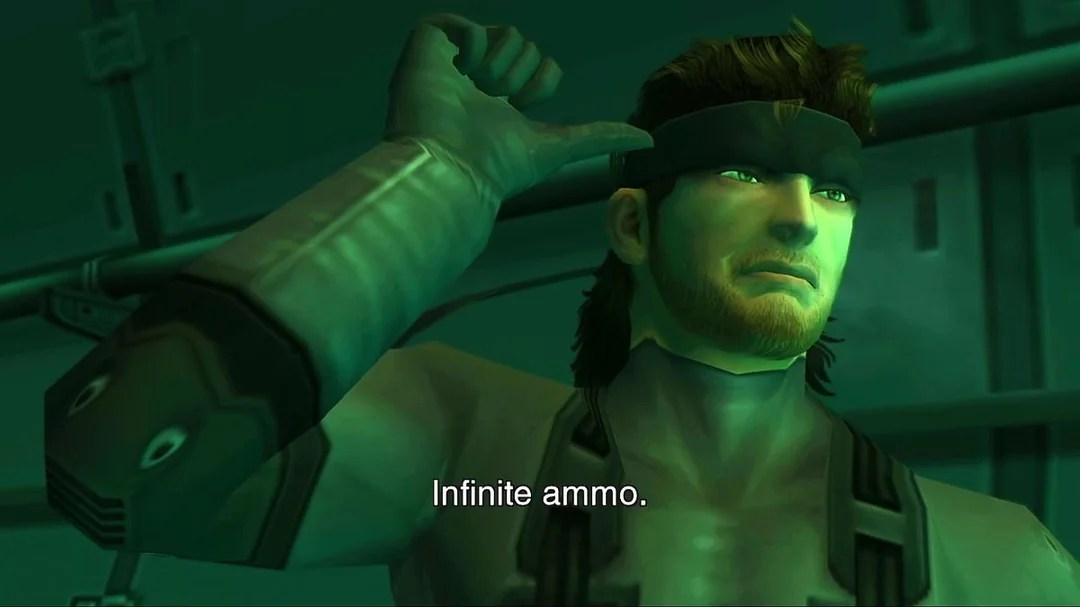
And this is to say nothing about how games can make their own rules, independent of reality, like cancel combos, double jumps, lives, respawns, checkpoints, mercy invincibility, grazing bullets, wrap-around levels, air dodges, air dashes, iframes, charged attacks, ground pounds, wall jumps, contact damage, type weaknesses, attacks that cost health, passthrough platforms, special move inputs, floating platforms, grids, scoring, bottomless inventory screens, fast travel. Games contain a plethora of invented physical interactions and other forms of artifice and I think these things are beautiful and worthy of appreciation.
The Ugly Political Dimension

I have never before mentioned politics on this blog. I have been incredibly careful to never mention politics and to keep my games writing and criticism strictly on the games themselves. I will be returning to this policy immediately after this article’s publication. I think it’s important to mention the political dimension to immersion, and what the priorities of escapism really are.
The stark truth is that black people lived in medieval Europe, but this isn’t believable to many people. In this case, something that makes a game more historically accurate and realistic is actually immersion breaking! Remember, immersion is about the audience believing in the work, and fantasy elements are fine, but political minorities strain believability.
And here’s the rub: The staunchest advocates for immersive games are also the people who do not want minorities to be present in them. They view video games as a way to escape from minorities. The desire isn’t for a realistic game, it’s for a game that doesn’t offend them.
You can find this all over steam. If you go into the community hub for many popular games and search “immersion”, you will soon enough find mention of how black people, “LGTV” people (mocking LGBT), and women break the immersion of someone or another. While I’ve found other uses of “immersion” on steam community forums and reviews, complaining about women and minorities is by far the most common reason immersion is brought up.





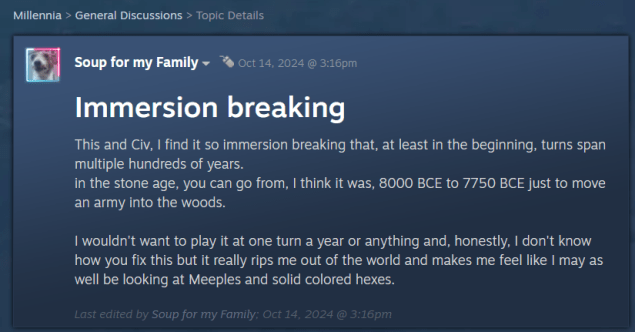
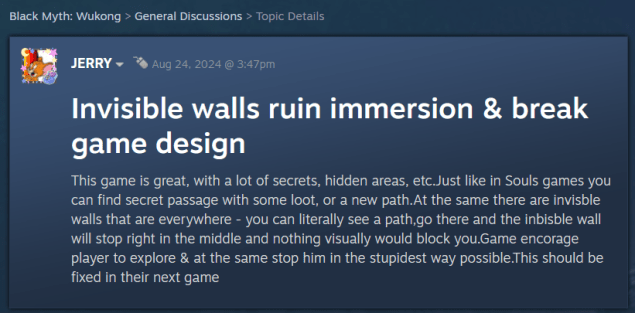


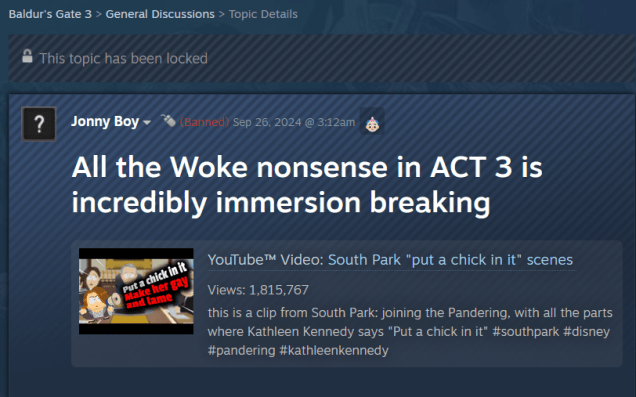




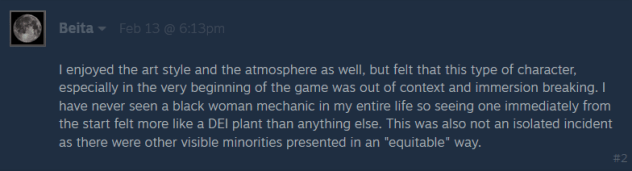







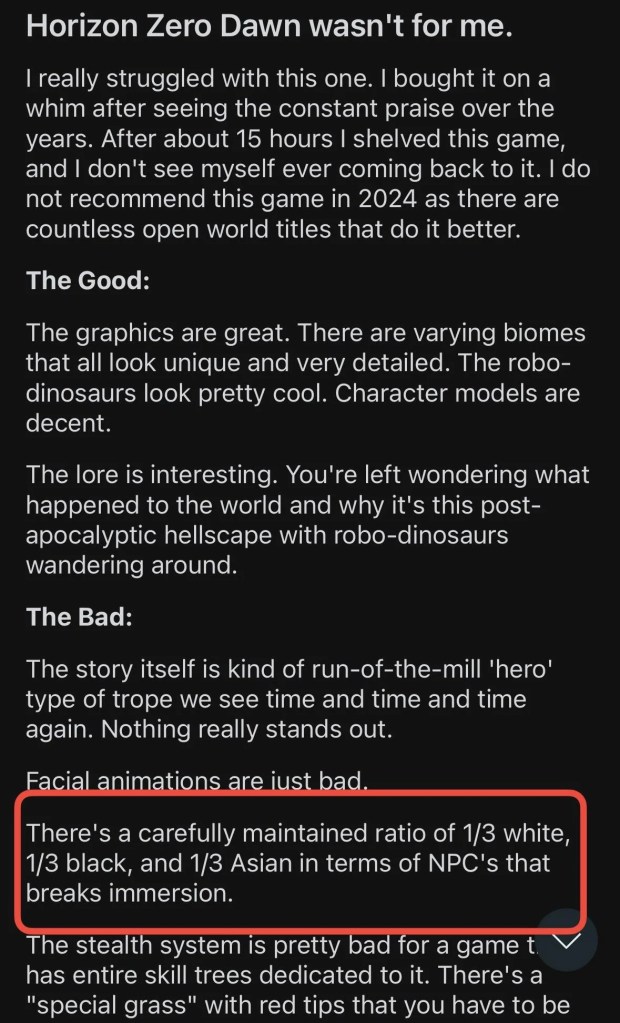

















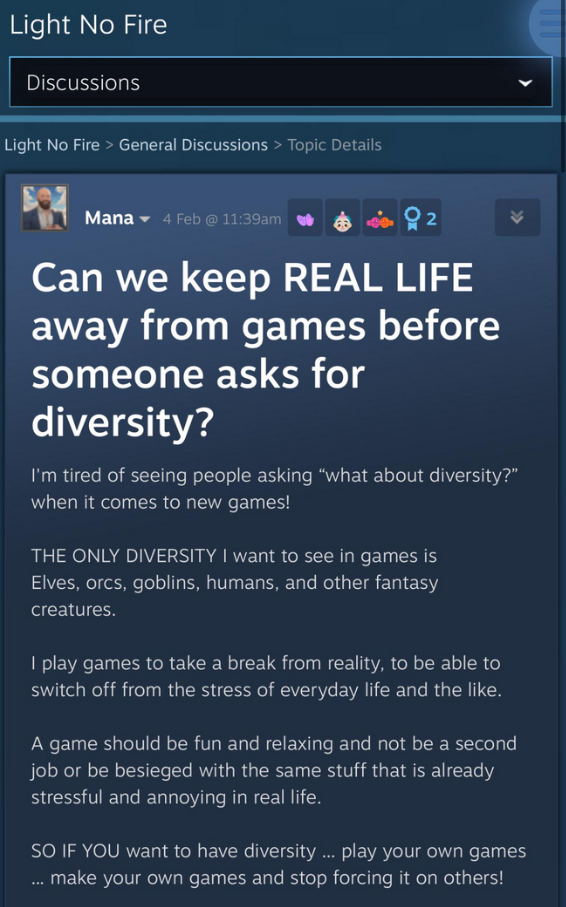

Many games are about alternative history, such as the Assassin’s Creed games, but they attract massive backlash when the protagonists are minorities, even when prior Japanese-made games feature those same historical figures. This is presented as an earnest attempt to create historical accuracy, but it’s incredibly obvious that it stems from an opposition to minority representation in video games.
I don’t think it’s a coincidence that the writer and internet personality who wrote more prolifically about immersion than anyone else, who considered it the sole purpose of all art, is a Neonazi who considers himself the literal Nietzschean Ubermensch and derides people who play games for score as “aspies” (reinforcing how artifice is the enemy of immersion). To him, the most immersive games are First-Person 4X games, essentially inserting yourself into colonial fantasies of conquering lands. (I will not be mentioning him by name, but if you know, you know.)
The policy of Nazi Minister of Propaganda, Joseph Goebbels, was not to use films as purely a vehicle of propaganda, but instead to primarily provide light entertainment to the German populace, escapism. He estimated that only a sixth of Germany’s film production was propaganda and he blamed the loss of WWII on a failure to keep people’s spirits up. Nazis outlawed the promotion of “Degenerate Art” (but also placed it in galleries to be ogled and bawked at), insisting that good art was good craft: Realism.
There is an eerie similarity in the tastes of Nazis, the tastes of immersionists, and the fact that the person I believe to have been more of an immersion purist than anyone was so thoroughly a Neonazi. I don’t think these factors are coincidental. I think that immersion is tied to conservative aesthetics, which we can see in painters like Thomas Kinkade or the hyper-realism of AI images and its ties to the Trump Administration. Broadly speaking, Immersionists and conservatives are incurious people who choose to oppose or ignore messages or themes present in the art they consume. Routinely, I have heard people say, “I play video games to escape, I don’t want politics in video games,” and use this as justification for purging minorities from games (both representation, and minority developers themselves).
Obviously this isn’t everyone or even most people who believe in immersion. Immersion is a part of the broader gaming culture and it’s taken as a de facto part of video games by many completely average or even progressive people (mentions of immersion certainly sneak into the course material at GDS all the time), but I think that the value system immersion puts forward has the potential to radicalize people when they see social progress as harmful or a danger to the immersion they value. And I think that slavish simulationism is an incredibly conservative aesthetic in general.
The Misery of Immersion
In my early experiences in critical games spaces I was surrounded by people who prioritize immersion over everything else. The thing I repeatedly saw from them was the desire to stamp out everything I found enjoyable about video games: exploits, glitches, hitbox manipulation, abstraction, statistics, typically any other form of game-y artifice. They lacked the ability to view the unintentional and emergent as features in their own right, because artifice was simply a flaw to them. No matter how skillful a glitch was to perform or what interesting decisions it enabled, it was always a fault for not being based on something diegetic to the game setting.

The most extreme among them would advocate against learning competitive strategies outside of the game itself, even if it was from the person you were playing with. In fact, the fact that you had to play competitive games with other people at all was a flaw, because there was the potential that they could act out of character with the setting of the game! They would advocate against the use of anything that called attention to the fact that it was a game. They wanted complete diagesis within a fictional world. As one of the most prominent among them put it, “in a perfect game you would not see the mana bar showing you that your mana was out, *your* mana would be out.”
While these pro-immersion ideas and arguments are obviously taking a principle to a logical extreme that cannot ever hope to be self-consistent, the idea of immersion is still an invitation to get upset about artifice in a medium that is highly reliant upon artifice to function at all. And because attempts to conceal artifice are themselves also artifice, immersion purists have a license and an imperative to get upset about literally anything, even if it’s not consistent with their own beliefs.
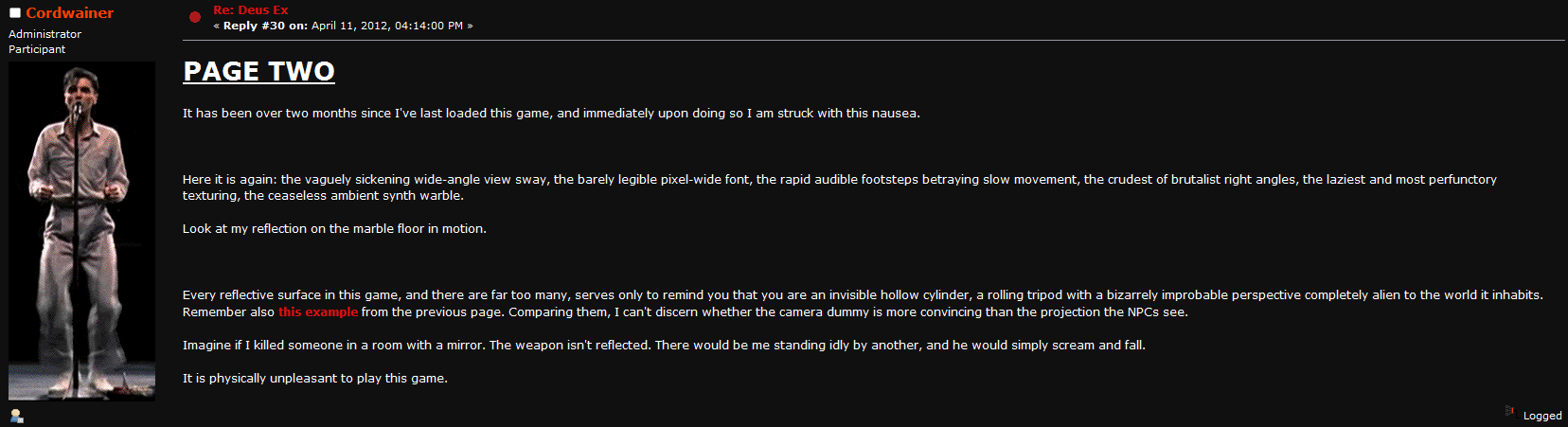
This is why immersion advocates are frequently divided over the issue of seeing your own feet in a first person shooter game. Is it immersive because in real life you see your own feet when you look down, or anti-immersive because you’re now seeing someone else’s feet? Most FPS games don’t feature player character bodies, because it’s a difficult technical hurdle to jump. Does this mean that most FPS games aren’t immersive, or that the few that do feature bodies are immersion breaking because they stand out from the crowd and provoke you to consider something you normally don’t?
My Viewpoint
I am SO tired of this default preference for immersion that affects so many gameplay decisions for so many games. I have been told numerous times that certain gameplay decisions are unacceptable because they’re not realistic, or not immersive.
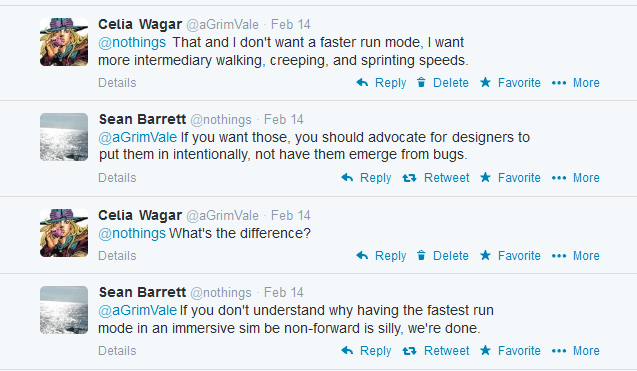
For so many of these immersive details, I can only ask, “WHO CARES!?” I don’t think that pineapples splitting into pineapple chunks and watermelons splitting into watermelon chunks, and so on and so forth actually matter in any discernible way to the quality of the video game. I think that detail for the sake of detail is wasteful and makes no contribution to my enjoyment of a game.
For the longest time, I complained that FPS games focused so heavily on modern military shooters. I hated aiming down sights, slow run speeds, regenerating health, and so on. And I had people straight up tell me, “nah, Counter Strike and TF2 are unrealistic because you run so fast, you can survive too many bullets, and you don’t need to aim.” (meaning: use the sights to reduce bullet spread)
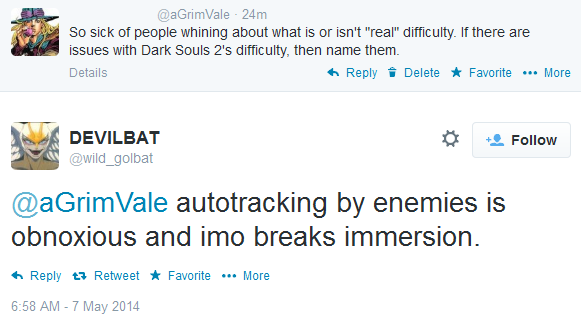
I cannot count the number of times that I have defended a feature or game and been utterly blindsided by someone complaining that a feature that contributes to a more challenging or mechanically rich experience is immersion-breaking and should be removed. I can’t count the number of times I’ve been asked why video games use hitboxes instead of just the character models (Because hitboxes are more consistent and understandable).
I am not playing games to engage in an escapist fantasy about being another person in another world. I play games to have fun mastering mechanics and learning about game systems. I don’t care if it looks artificial or janky or glitchy or immersion breaking, or if every single visual asset never clips once across the whole game. And I don’t think you should choose to make those things a deal-breaker with your gaming experience.
Immersion has no part in my experience of video games or art, but it’s constantly bandied around as a weapon to combat what I find enjoyable about games and art. I think that everything we can do to improve video games has nothing to do with immersion.
Your Experiences Are Still Your Own
By all means please enjoy whatever you enjoy about video games and other works of art! If you enjoy their stories or fictional worlds or the internal self-consistency of their setting and gameplay, please go ahead and do so. My intention isn’t to criticize someone enjoying art that prioritizes realism and believability, just to ask that this lens isn’t seen as the be-all end-all. I think that games that deprioritize realism or believability shouldn’t be seen as inherently flawed, as is so often the case. I don’t think that works should be endlessly interrogated for an unachievable standard of realism or believability. I don’t think that these elements should be called “Immersive”. I don’t think that this taste should be mythologized as a heightened state of consciousness, or an ideal for all games to live up to.
Simulation can be fertile ground for mechanical inspiration. I think that a lot of the reason that some games stumble into being good when they lack a coherent design philosophy is a commitment to simulation. Simulationism necessarily values possibility space in a way that narrativism doesn’t. I take issue with it when it comes to breaking from the simulation for the purposes of fairness or ignoring realism or believability to create even further depth in the form of artifice. The trouble is when modeling a phenomenon accurately or believably is more important than what that model is accomplishing relative to creating skill tests and interesting choices.
Enjoy what you enjoy instead of looking for reasons to be upset about it, especially when your reasons for getting upset are elements that improve the work of art or are simple limitations of the medium. Please learn to enjoy some artifice. Artifice isn’t bad for being artifice and artifice creates a lot of what is enjoyable about art. While I am capable of enjoying other aspects of video games, the core of what I enjoy about video games: skills, systems, and competition, are entirely artifice. Thus I cannot abide by an ideology that is antithetical to what I enjoy about games.
I think that you should enjoy games as they are, for what they are, rather than hoping that one day they’ll finally invent Full-Dive VR and seeing everything we have now as a kind of stepping stone to that.
Conclusion
In summary, I don’t believe immersion is a unique psychological state. I don’t believe it is ever possible to completely prevent metacognition. I don’t think it’s helpful to remove or conceal artifice from works of art. And I don’t think it’s healthy or productive to choose to sacrifice your enjoyment of a work of art over something as trivial as whether it provokes you to think about it as something other than an all-encompassing fantasy.
I don’t think that we should be using immersion as a rubric for games, given how fuzzy and indistinct it is, and because of the negative tendencies it brings out in people. I think that we should break down immersion into its core components and talk about them individually, rather than trying to appeal to an ideal that is semi-mystical in the reverence it receives.
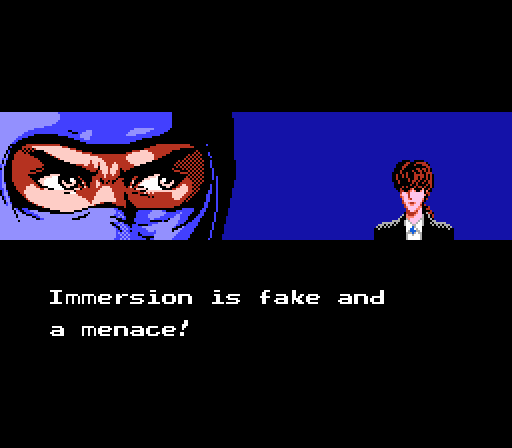
Further, I think that when we prioritize immersion, it implicitly comes into conflict with fun and enjoyment. Given the definition of immersion as an absence of metacognition, people who prioritize immersion are implicitly scrutinizing games for a reason to stop having fun.
In other words:
 Celia Wagar's CritPoints
Thank you for writing this. Immersion was always so difficult to discuss in open forums, and it’s refreshing to see an argument against it written so intelligently on a public facing platform. It was also refreshing to see my argument that non-immersive elements are what lead to a flow state made by someone else.
LikeLiked by 1 person
I’ve found this attitude endemic in the RTS space, most commonly in ways that discount the UI as a part of the game (see most complaints about Blizzard RTS games), and that discount competitive play. UI and control systems in RTS games is consistently seen as antithetical to “strategy”, as opposed to a dimension of it, namely attention management.
I’ve had someone, I think in comments for one of my YouTube videos, say something about dreaming of a full-immersion VR RTS where you control everything with thoughts, thinking that would solve all of the pesky mechanical aspects of controlling an RTS game and let them just out-think their opponent. I shot that down immediately, pointing out that cognitive load is always a thing, so that even if they had full mastery of the interface by default, being able to quickly orient themselves as the game state changes is as important a skill, if not moreso, than hatching clever plans.
An extreme case, to be sure, but in terms of direction is a universal complaint I’ve seen leveled at the genre: that it’s too focused on APM. While that’s usually misunderstood as just clicking fast; even the accurate understanding, that it’s about rapidly processing and responding to the game state, managing attention, and pushing your opponent’s mental stack into overflow while keeping yours in check, gets dismissed as beneath consideration. In this case, the immersion being sought is some kind of fantasy of unparalleled intelligence expressed as having the most clever and intricate military plans. The actual process of executing on those plans is seen as a vulgar interruption of their “genius” and should be removed as much as possible to be any kind of serious strategy game.
Unsurprisingly, RTS communities are often quite a bit more reactionary in the “no politics” way you describe, that immersion obsession aspect sadly tracks well.
LikeLike
So first of all, you’re being really contradictory in this article, especially in the disclaimer at the end where you say:
“By all means please enjoy whatever you enjoy about video games and other works of art! If you enjoy their stories or fictional worlds or the internal self-consistency of their setting and gameplay, please go ahead and do so. My intention isn’t to criticize someone enjoying art that prioritizes realism and believability, just to ask that this lens isn’t seen as the be-all end-all.”
But then you spend much of the rest of the article drawing comparisons between immersionists and Nazis, claiming that a focus on immersion is “harmful” or at least “useless” to game design and the appreciation of games, that immersion is basically tied to reactionary or conservative political views(which are bad), and that prioritizing immersion as a feature of games fundamentally comes into conflict with making fun games. I think many of these assertions don’t actually hold up, but more importantly you seem to be claiming simultaneously that immersion is a bad value in game design and appreciation and that it is also okay to value whatever you want. Which is it?
Saying that realism as a whole is basically conservative is particularly irksome because the Realist Movement in the 19th century was one of the most politically progressive movements in western art history. It was a response to romantic and classical idealization, hero worship and religious-flavored art. Courbet once said that he would not paint angels because he had never seen one – which is about as far from conservative as you could get at the time. Realism was seen as deeply dangerous by social elites for ennobling every day individuals and locations – farmers, craftsmen, the countryside – rather than depicting nobility, warriors and religious figures like the romantic and classical art it was responding to. I’d also point out that the political movement that most explicitly endorsed realism in art was Communism.
As for the topic itself, you hit the nail on the head by pointing out that the whole idea of “immersion” is contradictory and unclear. Different people often have wildly different ideas about what is “immersive” or not. I agree that tying immersion to “realism” is silly, considering that many games championed as being most immersive are often quite fantastical – like Morrowind or the S.T.A.L.K.E.R. games, as you mentioned. I don’t think that attention to realist detail really achieves any sort of gain in “immersion”, but rather that people are mistaking the things that cause this “immersive” feeling in them when they play a game. They might think a game is immersive when it is realistic, but it’s pretty clear that isn’t the case.
But I do think that there is something real to talk about here when we discuss “immersion” – not that I necessarily think it should be called that – as something distinct within games. My reasoning is more or less empirical. I played a game called Lunacid recently, a solo indie first-person adventure project inspired by the King’s Field games. I didn’t really like the game since the gameplay was incredibly basic and boring, the RPG systems were so basic as to be completely unimportant, and it got really boring really quickly to walk slowly around a massive first-person dungeon filled with non-threatening enemies with a total dearth of interesting gameplay features. But with that said, I would still say that the game brought about a feeling that the average gamer might call “immersive” in me. This is largely thanks to the game’s excellent aesthetic direction, which made great use of sound, music and visuals(not graphics, since it’s graphically primitive, but more just the visual artistic sense and cohesion of the game).
So for me it is painfully obvious on the level of experience that there is a strong difference between what I get out of a game like S.T.A.L.K.E.R.(a series I am a fan of) and what I get out of playing +R, DJMax or Nioh. I don’t think this “immersion” feeling is the same as a flow state since flow is expressed – or experienced? – through activity of a certain quality, whereas I can experience this “immersion” feeling even when sitting at an empty campfire in S.T.A.L.K.E.R. 2 just to listen to a fellow Stalker play a guitar. The things that are typically understood as bringing about a flow state in a game are: a careful balance between challenge and skill, clear goals, immediate and meaningful feedback on your actions, consistent rules. None of these things are applicable to what I experience when I play an “immersive” game.
I guess even if we accept that this “immersion” state is actually just a type of flow, I think it is meaningfully distinct from the sense of flow engendered by well designed gameplay, and is an important feature of many types of perfectly legitimate games. In my opinion we just need to reflect on what this feeling or state actually is, dispense with the rhetoric and ideas around it being tied to “realism”, and think about how we can actually bring it about without squandering countless dev hours on “realistic” features or details. Lunacid was made by one person, after all.
Anyway, I love your blog and appreciate the thoughtful posts. Please just refrain from insinuating that I’m some sort of subliminal Nazi because I think “immersion” might be something meaningful! /s lol
LikeLike
Celia didn’t call you a Nazi, buddy. You might want to do some self reflection if your mind immediately went there.
LikeLiked by 2 people
It was a joke, but thanks for the pointless ad hominem. I would point out that Celia absolutely wrote:”I don’t think it’s a coincidence that the writer and internet personality who wrote more prolifically about immersion than anyone else, who considered it the sole purpose of all art, is a Neonazi…”If the link between radical conservative views and an interest in “immersion” is not coincidental, this indicates that there is some underlying link between the two, that having an interest in immersion is necessarily linked to a conservative worldview. This is something she expands upon later:”…but I think that the value system immersion puts forward has the potential to radicalize people when they see social progress as harmful or a danger to the immersion they value. “If there isn’t a necessary link between regressive worldviews and immersion, why even include this section in the post, after all?Obviously I don’t seriously think that they think every “immersion” enthusiast is a neonazi, and I think that is pretty obvious based on how I wrote my post. But it is a little reckless I think to try to draw connections between two very different things – realism and “immersion”, on the one hand, and “conservative aesthetics” on the other – particularly when the link between the two is weak and has the potential to make really shitty implications about other people.Anyway, thanks for trying to be a dick when I was just trying to engage with a post that I actually like overall.
LikeLike
Wow, wordpress really messed up my post formatting. Woops.
LikeLike
It’s complicated.
I definitely think there is a strong overlap between a desire for immersion and conservative tendencies, but I don’t think this is the overriding or dominant view of immersion in the broader culture. I think that leftists tend to be narrativists more commonly than immersionists.
But an overlap isn’t necessarily a link.
We’re seeing this with the bizarre politics around 1950s advertisements. Does loving 1950s advertisements make you a Nazi? No. But a lot of Nazis love 1950s advertisements, and the narrative of, “They took this from you,” is a means of radicalization, which we’re also seeing happen with video game immersion. “The feminists and SJWs took away your immersive worlds and are inserting minorities into them!” And from my value-set and point of view, this is kind of immaterial. It has no relationship with what I value in a game, gameplay.
When someone develops a connection to something that is reflective of a certain worldview, it’s pretty common for them to radicalize when they are confronted with something that seems to threaten the thing they are attached to.
Media tends to reflect the ideologies and politics of the climate in which it was made, and calling attention to that reflection can radicalize people. That doesn’t mean that people who create or enjoy media that reflects these values necessarily believe consciously in those values. However, when those values are pointed out, people have a choice to either accept that the viewpoint of that media isn’t totally neutral, or become a reactionary. A lot of media has problematic undertones, but a largely unproblematic audience, like the colonialist tendencies of Dungeons and Dragons.
Narrativists tend to accept that their work has meaning and are willing to earnestly engage with the meanings of different works, where immersionists tend to be escapists, or in some cases actively anti-meaning. “It’s not that deep.” And when they get challenged on that, then suddenly they feel like they’re under attack or their favorite media is under attack, and that’s a basis for radicalization.
LikeLiked by 2 people
Conservatives need to preserve traditional myths about their history and culture in order to justify their values and sustain their sense of self. When you challenge these myths, you directly or indirectly challenge who conservatives are. If women weren’t always child-bearers and damsels-in-distress in medieval times, what does that mean for their ideas about womens’ “natural” place in society today?
Engaging with media is one of the chief ways in which people share and reinforce these collective myths, so I suppose seeing depictions of those myths and stories that do not match their own (highly inaccurate and nostalgic)version of how things were feels like having their identity hijacked and misrepresented.
I think the only reason these complaints are framed as being about “realism” or “immersion” at all is because conservatives are, ultimately, trying to appeal to the idea that their history narrative is grounded in fact. If their ideas about the past are not historically accurate, the values and way of life predicated upon them cannot be presented as natural or necessary. It also helps them that saying “there wouldn’t be black people in medieval Europe” is more politically palatable than “I don’t identify with black people and want them gone from my power fantasies”.
Anyway, while I think I agree now about a connection between reactionary worldviews and immersion, I don’t think immersion as a value or paradigm is objectionable by association with regressive politics.
Interestingly, when I see gamers whining about how modern games have changed for the worse it isn’t usually centered on things like immersion or anti-woke stuff, but rather how big budget gaming has become bloated, shallow, and manipulative. Most of these gamers – who often read as vaguely reactionary or right wing – are actually wishing for games with a much stronger emphasis on mechanical design and gameplay. But this is probably just indicative of what bubble I find myself in, lol.
LikeLike
Hi, maybe 1/5th of the article mentions the political aspect of this topic, not “the rest of the article” as you put it. I am not insinuating that you are a subliminal Nazi for valuing immersion. I know that “immersion” is a much larger part of the gaming cultural zeitgeist than just the nazi-adjacent minority. Thank you for highlighting the realist movement of the 19th century.
I understand how it can seem contradictory for me to say, “hey, you do you” after I put so much work into trying to tear it down, and maybe I am being a little contradictory. However, what I’m trying to say is that I think people should like things in an authentic way instead of liking things in the absence of their particular triggers. And I know that it’s a charged topic, and I don’t want to go all in on, “you’re having fun wrong!”
You highlight another contradiction of the flow connection for immersion, that many or most people feel immersed in relaxing situations, not just stressful ones. I highlighted flow because a certain community tended to predicate immersion on difficulty, though I know this is in contradiction to the more broad sentiment about immersion. There are a variety of different states of focus or trance that we could lean on besides flow specifically.
I tried not to lean too hard into immersion = realism in the article, because immersive settings can also be surreal, and obviously fantasy is a big part of immersive fantasy too, but even in surrealism, immersion tends to be focused on a type of grounding in reality. Internal consistency and coherence. I really enjoy Dungeon Meshi for how grounded the world feels, between the ecology of the dungeon, and the relationships between the different races and party members. I was also looking to try out Lunacid and Morhta because they looked intriguing and I like unique fantasy worlds. I wouldn’t describe myself as immersed in these, just entertained. I enjoy the lore of Elden Ring and how it’s communicated environmentally through the architecture of the different ruins and crypts, to the point where archaeological analysis produces coherent results.
When I say, “enjoy what you enjoy,” this is what I’m talking about. I see immersion less as a thing to enjoy, but as the absence of a stop sign. Immersion is the practice of predicating your enjoyment on avoiding stop signs you’ve set for yourself. And from this lens, I don’t want people to stop enjoying things they find interesting or relaxing. I want them to stop setting stop signs for themselves and then judging media based on the presence or absence of these arbitrary personal stop signs.
LikeLiked by 2 people
Okay, that’s fair. I can see that people do tend to treat immersion as a catch-all excuse for why they don’t like any given game, usually in the absence of any well-considered critique. It’s so annoying!
I also worded my objections kind of poorly. The statement about “the rest of the article” wasn’t solely aimed at the political dimensions – although I do mention it twice in a redundant way, lol – but at the various points attacking immersion as a whole. But where you meant to critique immersion as a hollow, unconstructive objection to allegedly “non-immersive” design elements, I was thinking in terms of immersion as a positive feature and design element or philosophy. My bad for misunderstanding.
I will say about Lunacid that it really nails the feeling of being lost in a strange, fantastical place. I personally couldn’t get past the gameplay for more than a couple hours, but that just might be a problem with my level of patience.
LikeLike
Great essay. In response to these gamers who assume “immersion” should be treated as the central value of video games, I’d suggest that there can be great value in art that disrupts your sense of focus, undermines your conception of reality, and forces you to disbelieve in the world it produces. Indeed, some have argued that that is the most important thing that art does. I think the concept of defamiliarization is particularly potent with regard to the weird race thing, which is a situation where a lot of these immersion fans could benefit from exploring the sense of confusion and destabilization they’re experiencing in the face of the disruption of their preconceived beliefs, rather than running away from it as fast they can.
LikeLike
I’ve been following your blog since 2019 and this is my favorite article to date. I still think flavor and multimedia elements are important to games, but this cuts to the heart on nothing-designs that deride “gameyness”. I’ve hit some of my most intense flow states while trying to improve my 40-line time in tetris and that wouldn’t happen without lighting-fast response times combined with satisfying gameplay.
LikeLiked by 1 person