Some multiplayer games have inherent differences between player 1 and player 2. Chess is the classic example of this, the player going first has a slight advantage over the player going second. Counter Strike has Terrorists and Counter-Terrorists. TF2 has offense and defense. Nearly all TCGs have one player go first and the other draw.
Tennis figured out a way of compensating for this asymmetry: You cannot win without a lead.
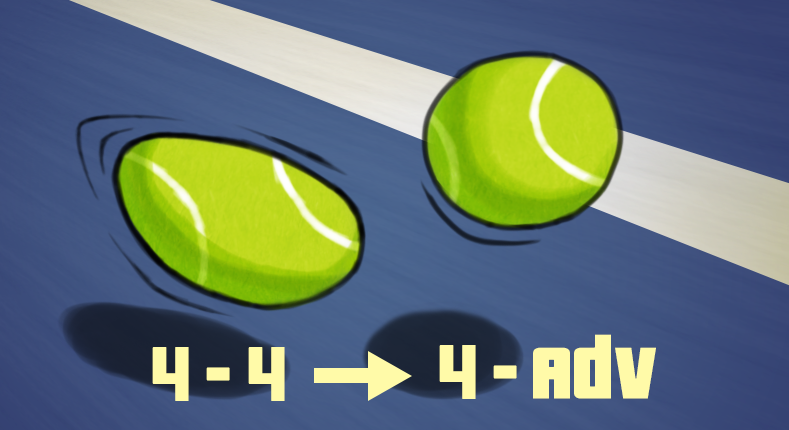
Tennis has an asymmetry inherent to the design of the game, one player must serve the ball and the other must return that serve. The player serving is generally considered to be at an advantage, but it’s debatable and not really important. Each game is played to 4 points, and each set is played to 6 games with players alternating who serves each game. Importantly, if you don’t have a 2 point or a 2 game lead, you keep playing tiebreaker rounds or games until you win with a lead of 2. If the score is tied up at the win threshold, then the next player to score a point has “advantage” and scoring another point wins the game. For that reason, I’m going to call this pattern, “Playing to Advantage”.
This has the result that Tennis games are very strongly determined by player skill level, with starting court not having a strong impact on the outcome. If you play to 6 games, and you serve in half of them, assuming you hold all the games where you serve, you need to “break” your opponent’s serve in order to win the set. In other words, you can’t simply serve first, win all the games where you serve, win 6 games and walk away with the set.
This is a pattern that a lot of asymmetric games can adopt (or any game concerned with producing an outcome that is determined by skill instead of other factors). Obviously the downside of this pattern is that it can potentially extend games or matches indefinitely. Tennis matches take 1 to 5 hours on average, limiting how quickly a tournament can take place. Many shooters and Trading Card Games take 20 to 40 minutes for a game or match, and playing to a 2 game lead might make it take significantly longer to run tournaments.
One way of resolving this can be running shorter tournament formats, such as Swiss instead of Round Robin, Double Elimination instead of Swiss, or Single Elimination instead of Double. It can be a compromise in determining a definitive winner and getting in a large number of matches, but playing to advantage can make up for the lost accuracy in determining who is more skilled overall, by more accurately determining it for each match.
Of course, this article assumes that you value determining a match based on skill rather than luck of the draw in determining who goes first (or other random factors). This obviously isn’t the only priority in games, or in tournaments. Part of the fun of swiss or round robin brackets is the opportunity for beginners to play a large number of games, and get a large amount of serious practice. And allowing tournaments to go on potentially indefinitely can be a serious logistical drawback, especially for a format like Swiss, which cannot progress until all the winners of the prior round have been determined.
Still, Playing to Advantage can be a useful tool for any designer, or any casual player or tournament organizer looking to balance an asymmetric game. I hope you find it helpful next time you’re frustrated by player 1 & 2 asymmetry!
 Celia Wagar's CritPoints
This is a neat discussion, though I hoped you were going to discuss more than one way of balancing asymmetry
I think Go does a good job by just giving player 2 a few extra points. Prismata does something similar, giving player 2 an extra worker unit (so they start with a number inbetween what player 1 has on turn 1 and turn 2).
An interesting one applicable to many turn-based games is the pie rule: one player makes a move for player 1, and then the other player decides whether to be player 1 or 2. Used in Hex.
Another one I like (but it requires the game to have some kind of granular score or resource system) is auctioning: players bid on how much of an advantage to give up in return for going first. I’m not aware of any games where this is widely used, but in Go for example you’d bid a number of points. I saw it proposed for Prismata since people complained that the extra worker was too big or too small in some situations but it was never implemented.
LikeLike
Oh, true. My original title mentioned tennis outright, but I ended up stripping that, so I can see how it’s disappointing
LikeLike
TCGs where one player plays-first and the other draws-first isn’t the asymmetry, its the attempt at balancing for the asymmetry of playing first or second, no? As opposed to a game like chess that simply does not compensate.
LikeLike
So, playing first is asymmetry, and play vs draw is also asymmetry. There’s an attempt to compromise (a lot like the Komi rule in Go), but playing to advantage is a true negation of that asymmetry.
LikeLike