Dont know how much you know about boxing. But is it possible to have a beat em up action game centered around boxing? I have hard time seeing a deep boxing game in 3D. Like how can you fight multiple enemies at once for example. For me boxing make sense 1v1.
Nah, don’t really know anything about boxing. What elements of boxing do you not see so clearly in a video game?
My thought is, isn’t God Hand pretty similar to boxing? You tend to punch forwards, you have the weave dodge, sidesteps, and a lot of the attacks are punches. ARMS seems like another example, you can control your fists as they go even, and move around the punches of your opponent.
Perhaps an interesting way to make a boxing game would be to copy god hand’s tank control scheme, and right stick dodging, but move all the punch buttons to the shoulder, so you have right hand on right shoulder buttons, left hand on left shoulder buttons. The buttons could be light punches, the triggers could be heavy punches, and you could have different tekken styled strings based on the order you press them in. Instead of a ninja sidestep, or a full backflip, maybe have dodging be more like a sway, displacing your hitbox, and full invincibility to the opponent’s fist on the opposite side (sway right, invincible to their attack coming from the left, like their right handed hook). Weave dodge would probably have to be reworked to fit in, because if the enemies only use their fists, then there’s less lower body attacks, and the point of weave dodging was that it could beat any number of high attacks, but lost to lower attacks. Not sure how to fix that and keep the same appeal of the original weave dodge.
If you haven’t played God Hand yet, I highly recommend it, of course.
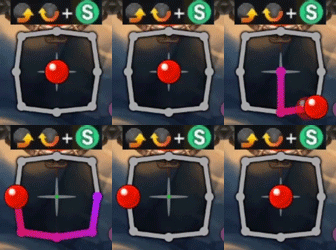
A lot of beginners have trouble understanding exactly how the motions are supposed to be performed in fighting games, it can be tricky to understand without being shown in person. I’ve seen a lot of people interpret a dragon punch motion like this before:
Guilty Gear Xrd Revelator has a great combo trial move that starts off by showing you the motions of every character displayed on a stick, with your inputs juxtaposed directly below the example, so you can compare your inputs to theirs. It even shows when the button is pressed, so you can see that too (more useful if you’re trying it yourself, but still).
This helps side-step a lot of the issues beginners have with learning how to do motions and learning notation. Unfortunately, not everyone has access to Guilty Gear Revelator, so not everyone can learn this way.
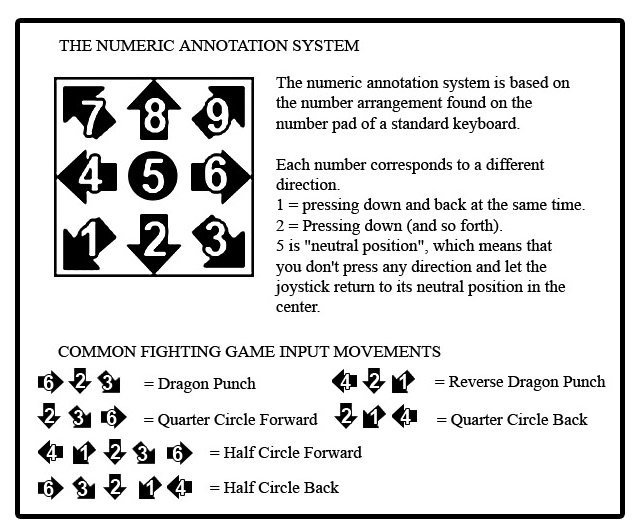
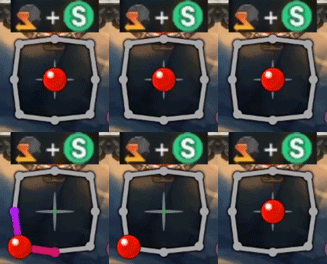
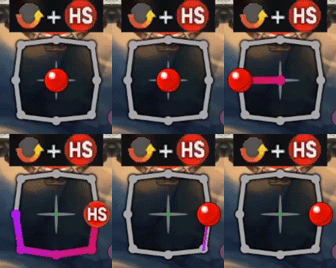
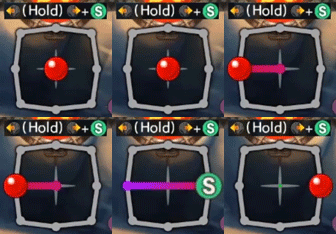
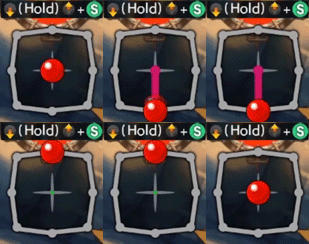
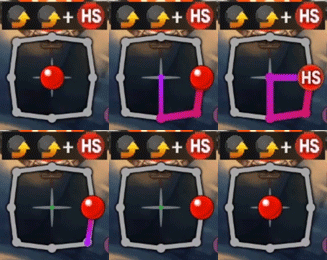
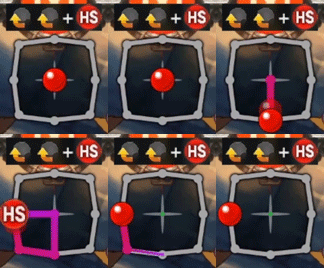
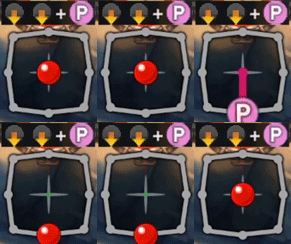
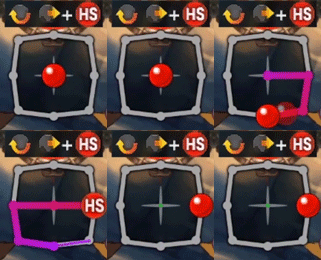
To remedy this, I made gifs of each of the combo trials, with the corresponding motion listed above, so you can have a visual reference for how to do different motions. The buttons are random, whatever I had available from the guilty gear movelist, so please pay more attention to when the button is pressed, rather than which button is pressed. I’ll also list how it’s usually written in notation, so you can be familiar when you run into it. It’s also worth mentioning, all of these assume you’re facing right. I’ll even list them in numeric notation, which is a way of unambiguously specifying which directions you’re pressing. Here’s an explanation of that:
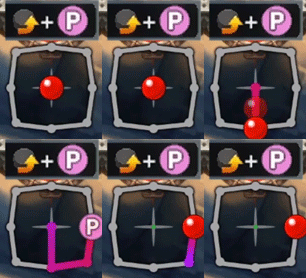
The red ball indicates where your stick/dpad is currently pointing, with the center being neutral, and the 8 dots around the sides being the 8 directions you can point.
Quarter Circle Forward / QCF / down, down-forward, forward / d, d/f, f / 236
This is the most basic motion. This is the basis of all the other motions. It’s called a quarter circle, because if you look at the 8 directions you can point in as a circle, it’s 1/4th of the circle. This motion is in every fighting game.
Quarter Circle Back / QCB / down, down-back, back / d, d/b, b / 214
Same as the QCF, except backwards. You can use a lot of moves just by knowing these two motions.
This is the second most common motion in fighting games, and a stumbling block for a lot of beginners. You’re allowed to input it a bit sloppy, like 63236, just be sure not to accidentally do a double QCF in the process, and to complete the motion before you press attack. 6523 is also a valid way of inputting dragon punch.
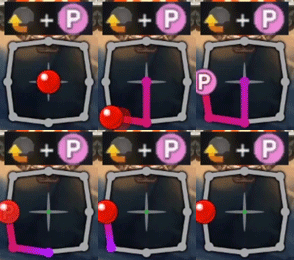
Same as the Dragon Punch, but backwards. This motion is really uncommon, but it shows up occasionally, and it’s always bizarrely harder to do than a regular DP, even though you’ll be used to doing DPs on both sides from normal play. This gif also shows off a sloppy way of inputting the DP, 4121, instead of a clean 421. And it’s input a lot faster than the others, showing you can do the motions quickly and they will still come out. 4521 is also a valid way to input a reverse dragon punch.
Half Circle Forward / HCF / back, down-back, down, down-forward, forward / b, d/b, d, d/f, f / 41236
Less common than a DP, but more than a reverse DP, half circle motions can be significantly trickier to perform than quarter circle motions, even though they’re only slightly different. These motions are typically used for moves meant to have a bit more impact than a quarter circle move.
Half Circle Back / HCB / forward, down-forward, down, down-back, back / f, d/f, d, d/b, b / 63214
Same as the Half Circle Forward, just backwards. These are frequently used for weaker command grabs.
Charge Back-Forwards / back (hold), forwards / [b], f / [4] 6
Charge moves involve holding back for about a second, then tapping forwards and a button. They’re usually a bit stronger to make up for this charge time. You can also hold down-back to charge without moving backwards as you charge. Moving the stick to a position that isn’t back will cause you to lose your charge however, so you need to be either immobile, or walking backwards to charge.
Charge Down-Up / down (hold), up / [d], u / [2] 8
This charge move involves holding down, then tapping up and pressing attack. Note that if you’re too slow to press attack, you’ll do a jumping attack instead of your special move. Like with charge back-forwards you can hold down-back to charge and block at the same time. This will charge both charge moves simultaneously, so you can choose to use either one. In Guilty Gear, you don’t even need to press straight up or straight forwards to perform charge specials, you can instead press up-back, or down-forwards, letting you hang onto the other charge.
This is the most common super input in fighting games. It’s as simple as doing 2 QCFs back to back. It can be rather tricky, and frequently you can get Dragon Punches if you’re sloppy, or get supers if you’re sloppy with your dragon punches.
Double Quarter Circle Back / 2QCB / QCB QCB / 214214
Same as double QCF, just backwards. Also a really common super input.
Down Down / 22
Tap down twice, simple as it gets. Uncommon input in most games, very common in games by French Bread, such as Melty Blood. Frequently used as an alternative to the DP input.
Half Circle Back, Forward / HCB F / 632146
This is an extremely uncommon input found only in Guilty Gear, Blazblue, and King of Fighters really. It’s frequently used as a super input in these games, and for command throws.
Quarter Circle Forward Half Circle Back / QCF HCB / 2363214
Another uncommon input except to those 3 games. This is only used as a super input. It can be tricky, try your best.
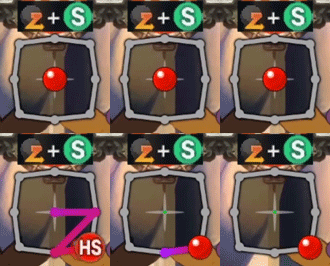
360 / SPD / 6248
A fairly common input, limited to grappler characters usually. Even though the instructions generally say to spin the stick 360 degrees, the game actually only cares if you hit all 4 cardinal directions (in any order you want, as long as it’s a complete rotation). An easier way to perform this move when you’re learning it is to do a half circle back, then tap up. Since you need to tap up at some point during the input, if you’re too slow to press punch, you will jump. This means it’s generally easier to do 360s when you’re already jumping in on your opponent, or dashing, or doing some other action that will prevent you from jumping.
how do you make deep traversal systems for 2D games? I was thinking about outland which has a double color mechanic where you switch them to phase through same colored bullet patterns, but it seems just monkey see, monkey do
The idea is, create different movement capabilities for the player with different physical properties, different niches, and design obstacles around those, without making the obstacles strictly about demanding the player use one type of traversal on it. Don’t make any movement ability a silver bullet for a particular type of obstacle.
You can see this a lot in good 3d platformers (all 2 of them), like Mirror’s Edge, or Mario games. You have a lot of different movement mechanics, but none of the obstacles specifically require you to use one, they’re more generic, like, get up to this height, move across these moving platforms, avoid these obstacles, and leave the rest up to you.
A lot of 2d games already have deep movement systems, like Castlevania Symphony of the Night (and many of the games following in that style), Super Metroid, Smash Bros Melee, Yoshi’s Island, Sonic, Gimmick!, Demon’s Crest, Wario Land 4, Megaman X (especially X3, which had a grapple and airdash), Ori and the Blind Forest, Megaman and Bass, and more.
There’s a lot that can be done with airdashes, double jumps, long jumps, slides, ground pounds, and more.
What are your favorite type of restrictions for challenge runs? (Stuff like no damage, X weapon only, ect.)
I like low% runs. Where you try to limit how much of an essential resource you pick up or use, or whatever. The Mario 64 ABC run is a great example of this, as well as Low% in a number of Metroid games. Min Captures, max moons in Mario Odyssey seems to be shaping up to be this too.
I like restrictions which force creativity. Pacifist runs tend to be cool too. It’s cool to see things that are technically possible, but the game simply wasn’t designed for.
What do you think of special moves in fighting games that damage the player when they use them?
I’m not a fan of mechanics that push both players closer to losing simultaneously, negative feedback. Mechanics like this could also be called Collateral Damage or Mutually Assured Destruction. The idea is, you’re taking damage, but hopefully you deal more than you take, and even though you’re wrecking yourself, you will push the game closer to ending faster and be on top when it does end.
You can think of moves like this dealing effectively less damage, since they’re damaging you at the same time, so you’re not gaining as big a lead over your opponent by using them. So if I deal 4 points of damage to you, and 1 to myself, I only really dealt 3 points of damage to you, but moved the game 1 point closer to overall conclusion. This can tend to make games more swingy, because it functions a bit like negative feedback. It also makes characters with this trait effectively weaker than characters without it, unless their damage is compensated for the damage they deal to themselves.
In a game like Smash where the amount of damage you can take isn’t capped, and isn’t directly tied to losing, this can work out slightly better, because you can continue to use the self-destructive moves ad infinitum, just taking on additional damage, instead of outright killing yourself. I take this tactic with Snake a lot. He can pull out grenades and go suicide bomber with them, and you blow yourself up a lot, but hopefully you blow the enemy up more often. Also when coming down, you can pull out a grenade and if the opponent hits you, it will cause you to drop the grenade. If they hit the grenade too, then it will explode, damaging both of you, and overriding the knockback of their move, usually for a lower knockback, which can help you survive a lot of hits. In this way you can evade death at great personal cost, while dealing damage to the opponent as well. Since there isn’t a fixed percentage that you die at in smash, you can abuse this a fair amount, and use it to turn the tables on your opponent (though of course, you come out a lot worse in that trade than they do).
Overall though, I think adjusting payoffs in this way doesn’t contribute significantly to the depth of a game. It doesn’t strongly differentiate the game states in my opinion the same way changing the physical characteristics of moves does. I don’t think Pichu is significantly more interesting for damaging himself, I think it’s largely pointless. Even if it is a cool touch for characters like Tien in DBFZ (and it works mildly better in DBFZ, because killing a character is a much bigger benefit than just getting a health advantage, so it can be a tradeoff of orthogonal assets, rather than strictly victory points).
They’re cool. They’re a very rare feature of games, something that’s high risk, but low reward, however still being a critical part of a rock-paper-scissors triangle. You get to beat the opponent’s attack or throw, but if blocked, you take more damage than you ever would have dealt.
It’s your only want to beat an opponent’s meaty in a wakeup scenario, the only way to really hurt the opponent instead of just sitting there and taking pressure, but it also carries a big risk.
The downside of conventional reversals, DPs, is that only some characters have them usually, so the rest of the cast just needs to sit there and take it when pressured, and they’re kind of simple. They either beat a meaty, or lose if the opponent blocks. Not the most nuanced range of interactions. It would be cool to see more investigation into other reversal options, like reversal tech rolls, reversal counters, etc. Some games like Blazblue and Smash have more options on knockdown to make their wakeup games more complex, which is also cool, but also feel like they dilute the wakeup game a bit from where it sits in street fighter. I’m not really sure how to balance this honestly.
Still, it’s neat to have something that sits in an unconventional place on the payoff matrix. (as long as it’s not low risk, high reward) It’s rare to see things that are so specialized in that way.
Do you really believe that eastern devs are better than western devs? if so what brought you to that conclusion? What is it that eastern dev do differently?
Y’know, yeah. I do think that. I mean, I think it because Japanese games tend to be good more consistently, and the majority of my favorite games (and the games I believe are the best games) are Japanese.
Is it possible for a console fps to be good? Or can a high quality FPS only be realized for pc?
FPS games are about pointing at things using a cursor and clicking on them. Console controllers are not very good at this, meanwhile keyboard & mouse are not very good at letting you press an assortment of buttons for different, easily accessible, common use, functions, and at moving a 3rd person character.
The example I usually cite is, have you ever tried using your console’s web browser? You know how difficult it is to click on things when your cursor is moved by an analog stick? Compare that to using a mouse to browse the web. That’s what it’s like to play an FPS game with a gamepad versus a mouse. Consequently, I think almost every FPS game is better served with a mouse and keyboard than a gamepad.
If you want to build a better console FPS game, then it’s probably a better idea to minimize the amount that aim factors in and emphasize other skills instead. Something that plays better to the strengths of the gamepad. A good example would be Metroid Prime, which used tank controls and sidedashing around locked on targets, as well as having morphball sections.
Probably a more realistic solution is to create it as a 3rd person shooter instead. Gamepads are better at controlling a 3rd person character than a mouse and keyboard is, so it naturally makes sense to have a shooter be 3rd person on console instead of 1st person. Some games that pulled this off successfully are Infamous, Vanquish, and Nier.
One exception I have found is this indie game named Hunternet I was asked to try out. In that game, there is a fixed turn speed, even for mouse players. It’s a spaceship dog-fighting game, so this is an integral part of the gameplay. This guideline may also apply to Descent and games in a similar vein. Of course, the enemies and other players in these games are bound by similar restrictions, so it is a game more about dog-fighting, managing your movement to line up for the shot than simply pointing at things and clicking on them. Descent, also designed for dogfighting, likely fits this mold as well.
How much of a problem is extended travel time in games? For example: lack of fast travel in the beginning of Dark Souls, or traveling to a location in an open world? Is it just filler?
I think this is a false premise.
Travel time can be a pain, but I think the better metric is, time spent without a challenge of some kind, or even more accurately, time spent without an interesting decision, because obviously things like configuring equipment, leveling up, and other such clerical tasks aren’t challenging, but they involve interesting decisions.
I have stated many times that I really like that there’s no fast travel at the start of dark souls. I like that you need to pathfind your way around a complex series of areas that have new connections opening up as you go, so trying to find the optimal route is an interesting decision in-of itself, and you need to do things like fight enemies on the way there which is an interesting series of decisions, and given you’re pathfinding, you end up generally going through the areas in an order you didn’t go through it the first time, so it’s slightly different each time, rather than just repeated content.
I think open world games suffer a little more in this respect because the world is not dense enough with challenges. Traveling from place to place takes a lot of time, and you don’t do much along the way, which can be boring. This is where lessons from platformers or racing games could probably factor in more.
What genre, if any, do you think benefits most from an open world?
The open world genre.
I mean, open world is kind of its own genre at this point, right? Among the big entrants we have RPGs, like Skyrim and the Witcher 3, “Stealth” like Asscreed and MGSV, and a ton of 3rd person shooters, like Just Cause, Watchdogs, GTA, Far Cry, MGSV, Red Dead Redemption, plus a lot of others, and we have sandbox games like Minecraft and No Man’s Sky.
I don’t think any genre benefits particularly more than any other genre from being combined with open world. It’s just a content presentation style really. Probably games that are more sandboxy like minecraft or breath of the wild benefit a bit more, but I mean, being sandboxy comes with being an open world game to a degree.
I sometimes like to watch SpeedRuns, one thing that I noticed is that Sonic doesn’t appears as famous in the speedrun community as I thought it would be, It is somewhat popular but its really small compared to Mario and Zelda. Its a design thing or its simply due to the overall quality and sales?
This raises an interesting point, the distinction between what makes an actually good speedgame (game that people speedrun) and what people think correlates with a good speedgame.
People tend to think of what would make a good game to speedrun as being a game which involves speed and has a fairly linear track, much like a footrace, or a car race.
The games that tend to work out best for speedruns are more like an obstacle course or a playground, things with multiple possible means of approach. Mario and Zelda tend to be a bit closer to this generally speaking than Sonic games, which tend to be a bit more straightforward, usually. Of course it does help that Mario and Zelda are more popular games overall.
I was more specifically referring to Classic Sonic. Modern Sonic is more a linear track, but Classic Sonic have multiple paths that intersect and have physics that encourage experimentation with both the paths and physics to get the optimal route, at least on paper that’s how I viewed it
I was including classic sonic. I’m aware of the multiple tracks thing, but I don’t think the classic sonic games are amazing speedgames (though they are good ones).
Oh, and to add onto the previous post, a good speedgame isn’t necessarily fast or slow in its pace; instead a good speedgame has a lot of opportunities to apply skill to go faster than the normal means of progression, and a lot of different possible progressions that affect one another in an intertwined relationship, making total optimization of the game extremely difficult, both to attain skill-wise, and to discover routing-wise. It’s about allowing players to demonstrate a range of competency at the game, rather than simply going fast in a time pressure scenario (literally running with speed) as some people tend to interpret it (like mario maker level creators, or people who intentionally try to build games that cater to speedrunners, but don’t understand what speedrunners actually enjoy).
Is it impossible for a Linear 2D game be an excellent game for Speedrun? I can only think of 3D games or 2D games that let you choose at least the stage order. I don’t really remember any 2D game that is populer to Speedrun but uses a linear stage order
Super Meat Boy lets you pick which stages of a world you want to complete before unlocking the boss, but is otherwise mostly linear.
I’m not sure if Cuphead lets you pick stages, but it probably counts. (update, it lets you pick stages)
Shovel knight lets you pick stage order, but you need to play all the stages.I don’t think the 2d sonic games let you pick or skip stages.
Ducktales lets you pick stage order, but all stages are required.
The Megaman games are popular, but let you pick stage order.
Contra, Castlevania, and Ninja Gaiden all do not let you pick stage order. These are not among the most popular games, but they each have at least 100 players on speedrun.com, making them more popular than Wind Waker HD.
Metal Slug X has 50 players, putting it above Link’s Awakening.
Kero Blaster has 18 players.
I think the bigger question here is, how many linear 2d games that don’t let you pick stage order are there actually? Probably the most common would be arcade games, which I don’t think are that popular as speedgames. There don’t seem to be that many games that fit this description in the first place.
What do you think of the “bloom” mechanic in FPS games?
I dislike randomized bullet spray in general, so naturally I don’t like Bloom either.
For those not aware, Bloom is when a gun’s bullet spread area increases over time as it’s fired, resetting when you stop firing. It’s supposed to encourage burst shots as opposed to spray fire. I don’t understand the intention of doing this, except maybe some sense of realism. It seems like whatever it accomplishes could be accomplished a different way than this.
In regards to “bloom” in FPS or randomized bullet spread, what would be your alternative? I assumed it was for skill purposes. My assumption was that instead of your gun being a laser beam, you now have to control the recoil in order to win the gun fight.
Bloom is not Recoil. It’s about the cone of fire expanding over time, not the cursor moving upwards over time.
Bloom does add a skill element, burst firing the weapon instead of holding the trigger down, but it’s questionable if adding a skill element like that is the actual intent of bloom, because that’s a pretty lame and linear skill element to add, requiring people to tap the button instead of hold it down.
My alternative would honestly be just having the gun be a laser beam, with a fall-off in damage over a range, so that you can’t use an assault rifle as a sniper weapon. Barring that (if you REALLY wanted it to look like a gun and have the bullets spray everywhere so it looks somewhat realistic), deterministic bullet spread, similar to Counter Strike, so that skilled players could functionally have the gun work like a laser beam anyway. Star Citizen is doing a neat thing with recoil based on procedural animations, but I don’t really expect that to be much different functionally than random recoil or spread.
If you wanted the minor skill element of pacing your shots, you could have damage decrease as you fire longer. There’s always a deterministic way to recreate these behaviors without introducing randomness, but for some reason I always get ridiculous amounts of pushback on removing this type of randomness. We happened to make these effects in mimicking real life weaponry, and post-hoc we’re defending the benefits of designing weapons this way. We could achieve these same benefits without invoking the random number generator, but people complain that it’s unrealistic, that players won’t like that type of behavior, that it won’t actually accomplish the same purpose, etc.
I don’t see the point in having some of your shots randomly miss, and therefore your DPS randomly being higher or lower sometimes. I don’t see the point in being able to compensate for this by pacing your clicks.
Honestly, I’d like to be able to just point the gun at people and hold down the trigger while keeping the reticule on the target. I don’t get why we need all these other things getting in the way of that. I don’t get why we need to randomly vary how much damage you do. I get that bullet spread makes shots less accurate over a distance, so you do less DPS the further they are, but you could do that just be reducing damage based on distance. It’s a very indirect method of accomplishing the objective.
Having randomized bullet spray, or bloom, or iron sights, or some such just means that you need to do some extra little thing to maximize your DPS, like burst fire depending on range, raise your sights, and it doesn’t add any significant extra layer of decision-making to the game, it just means that you need to do a slightly more complex motion to optimize your DPS, and RNG will come down and screw you over in varying amounts.
Is there a name for ‘reverse Bloom’? Weapons that gain accuracy from sustained fire? Can’t recall ever seeing it in a game.
I can’t think of any games that do that either, but it sounds like it could be cool, reward people for commitment. I still hate anything with randomized bullet spread though. Honestly, just increase the damage of the weapon over time. Don’t bother with bullet spread. There’s literally no good reason to add bullet spread to a game. There is no gameplay benefit achieved with bullet spread that cannot be achieved by deterministic means.



 Celia Wagar's CritPoints