Bullet Sponges

What do you think of the phrase “bullet-sponge” enemies? Is it a valid complaint?

Yes actually. It’s a weird matter of pacing to have an enemy you just keep hitting that won’t die. This is also tied into poor feedback, about how much health enemies have left. I have some old notes and ruminations I wrote on this that were never really completed, but I’ll share it here:
http://www.evernote.com/l/AMxyBLzLcbhHDKl0oIkN2IDHTqbxXns-MtU/

I think this is why some enemies use multiple health bars, because feedback about how much damage you’re doing is more clear to the player when the bar moves more each hit. Continue reading

Air Gear Game Design Ideas

Which mango series do you think would have some great material to be used in a videogame?

Air Gear, no doubt.

I’ve been rereading it recently and just going, holy crap this would make such an amazing game, but it would be so impossible.

It just has this amazingly rich system it built for skating. It was inspired by Jet Set Radio, but took the concept a lot further and made it more into its own thing, focusing less on graffiti and more on turf wars + the powered skates themselves.

It has this core concept of powered inline skates, these can be customized with different parts and there are different types, riders that operate in teams and compete over turf in different competitions that are varied within each category, progression from simpler tricks to harder ones, different styles of tricks that different riders specialize in, the 8 roads that categorize the different styles of tricks and 8 kings who are the masters of each road, and even tuners who help repair and “tune” the different skates to perform their best.

Here’s a few wiki entries explaining things, there are unmarked spoilers for the biggest twist in the series, so be warned.
http://airgear.wikia.com/wiki/Air_Trecks
http://airgear.wikia.com/wiki/Parts_War
http://airgear.wikia.com/wiki/Kings_and_Roads
http://airgear.wikia.com/wiki/Regalias

And imagining a game of this is awesome, because it has this incredible hero’s journey thing going on with it. The main character starts out barely being able to walk in air trek skates, to riding up flagpoles, to being able to go up walls, to eventually riding on pure air. Other characters learn to shoot fire from their skates, freeze time, and shoot layers of wind at their opponents. There’s a lot of assorted powers throughout the series, but the key is there’s this sense that characters learn them through effort and experimentation. Naturally, having played fighting games and speedrunning mirror’s edge, I have a good idea what this could feel like. When I first learned to kick glitch in mirror’s edge, it was a world opened up to me. It was magical. One of the core themes of Air Gear is this magic of pulling off a neat trick.

The trouble, the part where it’s impossible is, how do you allow players to do all these moves? How do you allow players to learn these moves? How do you pack all these tricks and moves into a system which is naturally designed to have this progression from normal skating to grinding to wallriding to flying across buildings and eventually flying through the air? How do you make players steadily go through these stages?

Part of the reason there can’t ever be a game of Air Gear that lives up to the source is any normal game designer would solve this effortlessly by just making a stat system. Okay, you’ve done 30 dashes, your speed levels up. 30 wallrides, now you can wallride a bit higher. Your overall trick level is 20, now you have access to elemental tricks, all of which are one-button that you can bind to whatever face button or trigger you want.

What I’d really like to see is a control system that somehow emulates the way characters learn tricks. You can take some cues from fighting games, speedrun tricks, mirror’s edge and of course Skate for this.

But how do you feasibly build that, introduce new concepts to the player over time, and avoid players accidentally riding on sheer air by buttonmashing? I don’t honestly know. Is it even possible on current controllers?

Maybe you could have leveling up for the styles and tuning just to keep the insane number of possible tricks you could do reasonable?

The perfect inspiration for air gear tricks is super metroid tricks. The walljump, shine spark, space jump. They’re all really nice design inspirations for low affordance tech. There could be RPG systems that actively change how easy the inputs are to do, like lengthening the windows or even changing the read algorithms to add extra shortcuts.

It’s not a style of game that really conforms to the types of game design that is common nowadays. You’d have to work out how the environments would work, all the things players could trick off of, how to combine tricks, a lot of things.

But damn, it could be awesome. I might write up a design doc if I get any good ideas for it.

So why do you like Air Gear so much? Genuinely curious.

It’s hard to explain without spoiling it. The anime is a good adaptation in terms of just having a better intro, building up the beef between Ikki and the Skull Saders better, as well as introducing the world of the storm riders a bit better, but after that it doesn’t really do the manga justice, and unfortunately a lot of the early arcs aren’t so great, especially behemoth, which is practically just anime fighting instead of inline skating.

What I like about it and what got me into it is, it builds up this world with a real mythic force behind it. There’s this sense of the whole stormrider culture of competition and mutual cooperative self improvement through competition, which is something I personally identify strongly with. Then in the background, there’s the Kings, and the Roads, and the Regalia, and a lot of it is kept vague early on. Early on Ikki sees the Wing Road, and it’s not portrayed as a literal element of magic, but there’s still this sense of manifest destiny that he’s going to climb to the top and learn how to fly. Having the crowd in the anime version of the Devil’s 30/30 was a great touch, and not showing his final attempt was probably the best wrap-up they could have given that limited part they were able to adapt.

Then he starts learning wind road stuff directly from Sora and you have that whole hero’s journey mentor thing going on, with it further cementing manifest destiny because Sora is someone who was nearly crowned the wind king, but he got too high and came crashing down, which is related to the initial fears that Ikki should be kept away from the stormrider world, and his journey to become strong so he can do what he loves. And then you learn that the tower of tropheaum isn’t some metaphor but is a real thing controlled by none other than the people he was brought up with, but because of his path to become the wind king, he’s destined to fight them, even though Ringo is in love with him and they’ve been close ever since they were kids.

And here’s where the big spoilers come in:

And then you find out that ALL OF THAT IS BULLSHIT! His Mentor, Sora planted ALL THIS STUFF ON THE INTERNET to create the entire stormrider mythology. He trained Ikki to be the wind king and set up Genesis in the first place as a monumental distraction for everyone so he and his twin brother could swoop in at the last moment, steal the wind regalia that was stolen and hidden from him years beforehand, as well as a special Toul Tool To tuner. You get this massive betrayal by the mentor character mid-story when it seems like Ikki was finally gearing up to take down Sleeping Forest. From there all kinds of shit gets fucked up, and Ikki finds out the real truth about the Tower of Trophaeum. But kind of the genius of it is that because it’s a comic, because it’s a story, the manifest destiny and mythology stuff is still true in a way, by it’s own merits rather than in-universe urban legend, you still have this hero’s journey arc and the ending is positively insane.
Infinite Continues & Checkpoints in General

How do you feel about infinite continues? If it’s more complex than “yay or nay”, can you name some games where they work and some where they don’t?

I’m fine with infinite continues. Castlevania 3 has infinite continues, whereas Contra or Curse of Issyos doesn’t, to provide an example. Infinite continues (in an arcade game context) just means that the furthest you can fall back is to the beginning of a stage instead of the beginning of a game. It’s subdividing the checkpointing system a bit more. So you have say tier 1 checkpoints, midway points through the level, and you return to those when health is depleted (costing you a life), then you have tier 2 checkpoints, the beginnings of levels, which you return to when your lives are depleted (costing you a continue), then there’s tier 3 checkpoints, the beginning of the game, which you return to when your continues are depleted. You could honestly make these systems any way you want, not just conforming to this type of structure, and many games do, like modern games that only have tier 1 checkpoints and never cost you lives or continues, never sending you back further than the last checkpoint. There’s games that allow you to optionally enable checkpoints or not, games that allow you to destroy checkpoints for a reward (shovelknight), and more.

I think the question here is, is it fair to send the player all the way back to the very beginning of the game? That depends on the game. Games with limited continues are pretty much invariably arcade style games, which also means games that are maybe 30 minutes long at the most, averaging between 15 and 20 minutes usually from beginning to end. These games typically also don’t have persistent character customization or rigorous item collection, things that take up a lot of time and effort which players would hate to lose. Castlevania 3 from beginning to end for the average player takes more than 30 minutes. It’s much longer than the original game and that’s probably why it moved to infinite continues (assuming the original castlevania didn’t, I honestly don’t remember).

Curse of Issyos, which I’m still playing (got to path of scylla’s boss), can be completed in about 15 minutes from beginning to end, so it’s very reasonable to start from the beginning. Same deal for Contra, which I beat recently.

Dark Souls by comparison is nearly impossible without checkpoints. There is a special reward in dark souls 2 for not using bonfires, but notably you’re allowed to light them, but not sit at them. This means you can enable them as checkpoints and still continue on your journey. In a game that can run for a hundred hours like dark souls, erasing everything if you die too much is tantamount to cruelty.

An interesting game idea might be a game like dark souls, except you have a limited number of lives to continue from bonfires, and if you run out you restart the game with all your items and stats intact. So you need to clear the whole game on a limited number of lives/continues, but you grow stronger as you progress further, making the early areas trivial. Some game has probably done that before.

Is it possible to add depth to grinding?

Uhhhhhh, that’s complicated. Technically grinding has whatever depth the base game has, just players intentionally repeat one part that they know they can beat.

The problem of grinding is more one of human psychology. We try to find the fastest lowest effort way of getting the results we want, even if it makes us bored.

I’d say the solution is to minimize or prevent grinding, force the player to move between content in order to improve. Otherwise they’ll stake out the one place with the highest EXP return and closest to whatever respawns the monsters. This can be done by having monsters refuse to drop EXP after being killed a certain number of times, forcing you to move on, by adding points of no return, by making encounters not respawn, etc.

Alternative solutions would be to speed grinding up by offering choices in how to grind. Actually, TWEWY is a great example here. TWEWY’s random encounters are opt-in, so you never get encounters by accident and you don’t need to go running around in a field until one pops up on you. The cool thing about them is also that you can chain the encounters for bigger rewards, so you can chain up to like 10 battles in a row, which you need to beat without healing.

So the idea is, allow players who want to grind to get access to battles instantly, and give them the option of facing something super hard to get a ton of EXP in one go.

People want to get to the end result, you might as well give it to them quick, but don’t give it to them for free or you’re writing them a blank check to wreck the game balance.

As for actual ways to vary grinding, you can have things like EV training in pokemon, which was trivialized in later games with good reason in my opinion. In Tales of Symphonia, every character has a Technical vs Strike meter that changes based on their equipped EX-Skills through combat, and grants access to different moves.

Stage Hazards

What do you think of stage hazards in fighting games? I don’t like them but I don’t know why. I might just be a scrub.

I am fine with them as long as they are predictable and don’t make the entire game about them.

Much as it may surprise you, I played smash bros casually for many many years before becoming competitive. I played on stages with hazards a lot. I even played with items on at one time in both melee and brawl.

Among the stages with hazards/gimmicks I liked Mute City, Port Town Aero Drive, Brinstar & Brinstar Depths, Pokefloats, Fourside, Big Blue, Onett, Peach’s Castle, Green Greens, Shadow Moses, Delfino Plaza, Mario Kart, Eldin Bridge, Norfair, Frigate Orpheon, Halberd, New Pork City, Skyworld, and Castle Siege. I liked that most of these telegraphed what was going to happen before it did. I liked playing around the unique difficulties of each stage. It was fun.

I don’t think stage hazards work as well in traditional fighting games because things like platforming don’t work as well in them. Smash Bros has a separate jump button. It has air control. It has a robust movement system on the air and ground that traditional fighters don’t. Also you’re allowed to walk through opponents in smash, and side switching happens a lot more often. Characters are smaller proportionally. It’s just better overall.

Over time, the stage hazard systems get less interesting to me, due in large part to how much they interfere with the normal flow of the match, the part I want to explore and improve at. Also most of these stages had serious balance issues, which is the real reason I don’t play on them anymore, that and I just don’t tolerate as much jank anymore. I didn’t like the slightly reworked versions of Skyworld or Temple: M that appeared in Project M while they were legal. I don’t like a lot of the technically legal stages that are in the top row of the PM netplay build. Making a stage that really feels totally right to me now is a lot harder.

The other issue is, a lot of stages with hazards suck. Like Distant Planet has lame hazards. And Summit. Stuff can come out of nowhere and occasionally you just get wrecked.

I liked how PSASBR allowed you to turn off hazards. I didn’t like how all the stages would go through the hazards just once in sequence and never repeat them ever again.

In Injustice I think it’s some cancerous shit.

Fitting Fighting Game Mechanics into a Shooter?

What elements of fighting games do you think could work in shooters?

Okay, I have a lot of these ideas actually.

For one, the round structure. You could have a 1v1 fight with life refills for both players when one of them dies. Reset the match. I think Quake Live had a mode that worked like this actually.

Supers are an obvious one that Overwatch implemented (the ults both charge up over time and as you deal damage or healing to other players).

A more nuanced idea is having projectiles that disappear if one player is hit. Not only does this actually appear in some fighting games, but it would help FPS games emulate the rock/paper/scissors nature of fighting games. Currently FPS games are all about trading hits and trying to hit your opponent more consistently with a higher DPS weapon from a position of advantage. You kill your opponent if you can DPS more efficiently rather than necessarily counter their actions. A big part of the reason the same doesn’t happen in fighting games is the way hitstun interrupts attacks during startup. So imagine faster/slower shots, shorter/longer ranges, shot startup time, blocking, reasons to not shoot constantly.

Bigger projectiles, shooting large swaths of projectiles, and having them move slower. The idea here is space control, denying space to your opponent by laying down the fire. Slow projectiles are a big deal in fighting games because you can operate alongside them. They can serve this same role on FPS games. They need to be bigger because FPS characters have a wider space to move across. Having a wave of projectiles, grouped together like a larger projectile, could avoid the problem of the whole thing fizzling on touching a wall. The projectiles in one shot could be programmed to all disappear when hitting a player, and individually disappear on hitting environment geometry.

Using more buttons on the mouse. Currently FPS games get attack variety in by separating out the attacks among a bunch of weapons that the player switches between. This is slow, this is clumsy. Unless mapped efficiently, across relatively few keys, players can’t switch weapons very efficiently without sacrificing access to the movement keys for a few seconds. Basically, make less weapons, give them more diverse functions, map them to more buttons on the mouse. A gaming mouse has like 5 buttons on it. That’s plenty. 2 is too few. You might lose some people due to not owning a gaming mouse, but you can double bind those functions to the keyboard. On that note, the number of keys used should probably be reduced. You can get more functionalities out of the mouse buttons by having charge functions and tap versus press functions too.

Juggle Combos. These can get really dynamic in some fighting games. They can work off projectiles exclusively with some characters.

Projectile variety. Fighting games have amazing projectile variety. There’s no FPS projectile as versatile as Link’s Bombs in Melee in any FPS game. Part of it is also the way the 2d space constrains movement and keeps it clear what’s going on

Intro to Megaman

I’m a little intimidated by how many games there are in the Megaman series. What games would you personally recommend, or how would you help someone new to Megaman?

Okay, I think the best starting point is probably the classic megaman series. It’s the simplest, and if you start there you won’t miss the features from the later games. From the original series I’d recommend 1, 2, 3, and 9, plus Rockman and Forte. 2 is a good starting point because the USA version is fairly easy, they smoothed it out compared to megaman 1, and it has nice variety. 1 is kinda rough around the edges, has a weird scoring system, kinda janky level design at times, but it’s still pretty great. 3 is supposed to be really good, harder than 2, but I haven’t played it yet. 9 is my favorite of the classic series. It’s super smooth, has great bosses, great enemies, great levels. Rockman and Forte is on my list to play. I love the speedrun. Icewall is broken as fuck.

From there it’s probably best to move onto the X series, after you’ve played at least one classic game. X1, X2, and X3 are the best. I’ve heard negative things about every game from X4 onwards. X1 is the only one I’ve beaten of those, it sets the pace really well, adds new abilities to megaman’s repertoire, generally a solid game. X2 and X3 is where it starts to get technical, because there’s more movement abilities, like air dashes, grapples, and frame perfect double jumps off charge shots.

The Zero and ZX series can be played interchangeably. I’ve beaten Zero 4, ZX, and ZX Advent. The Zero series was weird and had a kind of shaky foundation. It tried to change things up by adding a mission structure where you were allowed (and where it was even optimal) to fail missions. It also has leveling up to gain new abilities and Cyber Elves, which had 1 time use effects. By Zero 4 they worked a lot of these elements out or toned them down to be less janky. I don’t know how good the series is overall, and I haven’t heard much. I’d recommend it anyway.

ZX is a bit harder than Advent. Both use a Metroidvania structure for the world with areas unlocking as you get new biometals or boss forms. In ZX, you fight various bosses of 4 different types to gain their biometal, giving you access to a new form. If you avoid hitting their weakpoint the biometal gets stronger. The different Biometals have unique abilities, like airdashing, shooting in paths defined by a grid on the touch screen, detecting hidden items, etc.

ZX Advent is the conclusion, and the main character has the power to copy the form of all the bosses you fight. So you can literally turn into the boss, and use their powers. These are of course used as metroidvania style keys. The bosses have very different physiques, with some being large, some being small, etc. You can also copy the biometals from the previous game later on, and there’s a faster way to switch between forms from the touch screen in this one.

Megaman Battle Network is the weirdest spinoff. Dunno which one to recommend. It plays completely differently, but has a really creative realtime RPG grid battle setup with a deck of chips that have different attacks.

Favorite Glitches and Advanced Techniques

What are your favorite unintentional advanced techniques in videogames?

Aw man, there’s a ton.

Kick Glitching has to be up there, it’s really beautiful. There’s just a ton you can do with it. You can influence it’s trajectory based on a ton of factors, and even do different jumps off it.

Rocket Jumping and damage boosting in general is a classic.

Skiing in Tribes was the perfect trick for a game with maps and weapons like it has. Too Perfect.

The butterfly cancel in Gunz was amazing. Totally opened up the movement system.

Toggle escape and the toggle fallbreak glitch were great in Dark Souls. Parrywalking and Binoboost were great in dark souls 2, especially binoboosting.

I like how you can save your jump in metroid prime hunters then jump in the air if you didn’t previously. Scandashing is also great in Prime 1 (NTSC).

Not unintentional, but shine sparking is just great. Walljumping is implemented in a pretty neat way in that game too.

The sky high cancel in MGR felt great to pull off, but it was kind of shitty in that it was the most damage efficient option.

The 2in1 cancel in SF2 started a revolution. It was the perfect thing.

The item underflow “Soft Gameshark” glitch in Pokemon Red, Blue, and Green is hilarious.

Strafejumping is a perpetual classic.

Accelerated Backhopping in the new source engine is a new-age classic.

Ori’s extended glides off bash if you release the control stick are great. Also like everything in that game. Infinite bash jumping is great too.

The ability to put away your sword in dishonored is small, but neat. (and makes you move faster) Also being able to abuse the vaulting mechanic to boost up certain walls.

Jump canceling is totally intentional in DMC, but whatever, it’s too cool. Sword Hangers are neat with vergil.

Backwards long jump in Mario 64 is great.

Bomb rodding in Link Between Worlds is neat.

Landing cancel in post-sotn castlevania games.

Snaking in Mario Kart DS and F-zero GX.

Frame 1 double jump during an airdash if you release a shot in MMX3.

cloning in starcraft, also patrolling with vultures to allow them to attack while moving.
http://wiki.teamliquid.net/starcraft/Micro_Tips

Palm bomb jumping in Psychonauts.

LAM jumping in Deus Ex is cool as fuck, also pointless once you get the speed upgrade.

The MGR super jump is fun once you learn how to do it (and bind L3 + R3 to a single button)

The sword boost in Dark Messiah, coupled with bhopping, is cool as fuck.

all the icewall clips in rockman and forte

everything cool in Vanquish

And that’s all I got.

Fighting Game Alignment Chart

How would you break down the many different fighting game playstyles such as rushdown, turtling, zoning, or any others you can think of?

A friend of mine (ClarenceMage) came up with a really brilliant way of separating it out actually.

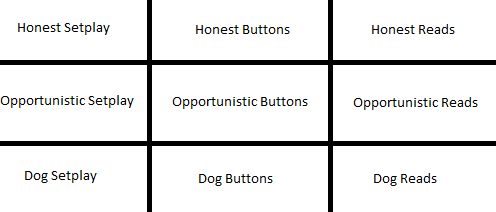
fighting game alignment chart.png

The idea is you have these two scales: Horizontally, you have a scale between Game Knowledge (left) and Player Knowledge (right). Vertically, you have a scale between Safe Guaranteed Play (top), and Risky Unpredictable Play (bottom).

Setplay revolves around setting up situations and capitalizing off of them. Setplay is highly reliant on game knowledge, it’s all about knowing the game better than your opponent. Examples of setplay players would include Armada (Honest Setplay) and Marn (Dog Setplay).

Buttons is about winning the footsie neutral game. It’s player knowledge, part game knowledge, so it falls somewhere between setplay and reads. You gotta know a bit of what your opponent is thinking, but also a bit of how to use your options best to win. Examples of Buttons players would be Hungrybox (Honest Buttons), PPMD (Opportunistic Buttons), and Infiltration (Dog Buttons)

Reads is about knowing your opponent’s tendencies. It’s about attacking at just the right time in just the right place. It relies heavily on player knowledge. Examples of Reads would be Snake Eyez (Honest Reads), Mango (Dog Reads) and Daigo (also Dog Reads).

Playing Honest is about sticking to guaranteed setups with a small chance of failure. Honest players tend to mix in a variety of approaches instead of pursuing a single gimmick and play according to what has the best odds of success. Honest players are the ones that almost always block low on wakeup or tech neutral. Honest players can have this tendency towards safety taken advantage of, but tend to have very consistent performance to make up for it.

Playing Dog is about going for what works and throwing caution to the wind. It’s about dogged persistence to win the way you want to win. Dog players tend to go for high risk high reward options or get killed trying. Dog players will ultra on wakeup, shoryuken in your face, charge the fsmash in the direction you’re about to roll, go offstage for the gimp.

Playing Opportunistic is a mix of Honest and Dog, trying to adapt to how the opponent is playing at that moment, seizing opportunities to grab just a bit more advantage where you can, but sticking to what you know works when the going gets tough. Opportunistic players are flexible, but can psych themselves out trying to follow their opponent’s patterns and be in the wrong mode at the wrong time.

Of course, there are a lot of ways to divide playstyles or categorize them. If you want to get deep down, it comes down to the player’s tendencies to use some options over others and the frequency of that option use, and you can’t totally quantify that.

Every Great Alien Fight in Half-Life

I went back to Half-life, and I cannot agree that it’s anywhere near great. The base systems are though–the movement system makes for a great speedrun, and the weapon variety plus that makes for great multiplayer–but encounter design is severely lacking. As you mentioned, some fights are interesting due to level design, but those are few and far between, and the most interesting encounters are always against soldiers or assassins, which are the hitscan enemies, though their occassional use of grenades makes them a bit more interesting. The rest of the enemies are never used in interesting ways, which is a complete waste of potential.

Hmm, I have some counter examples, but it’s tricky to link to specific youtube timestamps on ask.fm. Someone just sent in a combat montage, albeit mostly against soldiers, which I’ll be posting alongside this. I mean, I can’t deny that the soldier encounters have good encounter design, helped by the diverse weapons and the fact that soldiers take hitstun, it’s just kind of a shame about the hitscan.

Early black mesa has a lot of headcrab encounters that aren’t the hardest thing in the world, but are reasonably stimulating. They combine these with vorts, zombies, and houndeyes rather frequently.

The elevator ride down where the headcrabs ambush you at 10:30 is rather interesting and tricky. Then they have a bunch of headcrabs at the bottom and a houndeye in a box. It’s not the most threatening, because they can’t hurt you much, but it’s a rather dynamic aiming, shooting, moving challenge. Not a lot of other games have things like this.

There’s a good arrangement of rooms at 11:50 onwards with some vorts, some headcrabs, etc. They ambush you, they have room to chase you, you have room for cover. (also this guy is playing on easy I think, but I’m really just using him since he’s bound to run through a lot of rooms)

Also kinda cool is the turret at 18:10 with the headcrabs under it.

At the start here you have the bullsquid in the lower area, and the vort that teleports in behind you. Unfortunately this guy does not go into that area. Then there’s a combination of 2 bullsquids and headcrabs in the freezer room at 3:30, which is a rather interesting room.

bullsquids and houndeyes in a curving hallway at 11:00 Works for those enemy types. You can ignore them with the tram though.

17:30 has a bunch of houndeyes, bullsquid can snipe from afar, headcrab is waiting far side of the bridge.

The tentacle encounter is a thing. Use grenades to draw it away, try to get to the ladders.

On a Rail has a bunch of interesting encounters, like the one before the moat into the next area. That has a bullsquid and houndeye and I think turret too.

1:20 onwards. And a combination encounter of vorts and soldiers at 12:00

vorts at 9:40

The first ichthysaur encounter is kinda cool.

Cool encounter with barnacles and a vort at 14:20, guy shows off why perfectly.

starts with 2 cool encounters. headcrabs, vorts, cold room. The 2 vorts in the hallway after is neat too.

questionable ethics starts you in the middle of a bunch of houndeyes. Has a ton of great fights all around.

cool encounter from the get-go here.

5:00 has an awesome encounter from that point to the end of the level. This one gave me some trouble.

The Lambda Complex at 6:40 onwards is entirely aliens and it’s pretty cool.

Great encounter before the warp into Xen at 5:00 and everything from Xen onwards is aliens.

I feel like the alien factory from 5:35 onwards is worth highlighting, it’s a ton of great encounters.

You are kind of right, they did underutilize their aliens. Many of their uses in the early game are strategic in ways that are kind of tricky to deal with, but don’t open up as many possibilities as many of the soldier fights due to simpler terrain. One of, or both, the expansions, Blue Shift, and Opposing Force, makes a lot more use of the aliens, even introducing the Race X aliens which are unique.

I don’t think I’m willing to say the game isn’t great because of this underutilization. It still has great weapon variety, some solid platforming, great enemy variety overall, and the soldier fights are still pretty good, but you make a fair point that it could have been better than it was.