Ori: Definitive Edition

What do you think of Ori and the Blind Forest Definitive Edition?

It doesn’t quite live up to all expectations; mostly because it’s hard to make the original map structure as interconnected as I would prefer given the way the world is laid out, but it does do a lot to aid the interconnectivity of the world, and the warp points are a decent compensation.

Basically, the trouble with the original as a metroidvania game is that all the major points of interest function on their own little part of the map and don’t involve movement through any others. There’s no reason to backtrack if you are interested in progressing. Each area is its own self contained obstacle course and you’d only want to return in order to pick up collectibles.

So Definitive Edition still has this problem, but they made the world more interconnected and added warp points, which makes it a bit easier to backtrack for collectibles. Also now that all the areas can be backtracked to, including dungeon areas, there’s no danger of missing collectibles in say the ginso tree.

On the upshot, they added a new dash ability. It lets you move really fast, recharges on contact with the ground. What’s also cool is that the trick where you release the control stick right as you do the move also works with Dash, so you can do a bash style boost anywhere and ride the momentum as you glide and double jump. What’s also cool about this is they had it work in combination with the charge jump, so if you charge then dash, you’ll do a charge dash that goes further and can hurt enemies and break walls.

They also added a new grenade tossing ability. It kind of makes sense given the physics engine, but doesn’t really see much use except for hitting switches that can only be hit by this ability.

These abilities are both hidden in a new area placed close to the start that is designed to avoid using most of the other abilities available to you, so you can clear those areas as soon as you get walljump or maybe double jump. I ended up not visiting this area until late in the game unfortunately (after getting charge jump, right before ascending mount horu).

I think they also placed more collectibles that can only be obtained with late-game powers in earlier sections of the game. I definitely noticed a couple blocked off by the grenade toss power.

Also interestingly, they kept all of the old glitches, and most of the old skips. I was able to perform the cutscene skip save glitch in a few places, and do a number of the old skips. Good work on their part keeping that alive.

There’s a new easy, hard, and hardcore mode. I played Hard mode, and it ramps up the damage significantly. Makes the game about as hard as I’d like. I felt the original was a bit too forgiving.

Overall, it’s definitive. It’s better than the original. It couldn’t completely overcome the original’s flaws because the world structure of the original was a bit too restrictive, but it did a nice job regardless.

Castlevania 3 Level Design Counter-Analysis

http://gamecareerguide.com/features/869/good_games_bad_design__episode_.php thoughts on this article?

Ha ha. An article on why the game that I praise as being a masterpiece in level design has poor level design. Maybe they should have reviewed one of the actually interesting levels instead of the first one.

Here’s a video so you can see the first level in motion:

1-01. You were given a safe space to try out the controls before being thrown into the action. They placed a candle at the top of the stairs, so that if you walk up the stairs, you are rewarded for doing so, building the basic behavior that walking up stairs is rewarding. Stair controls in classicvania were very rigid, so it’s nice to have a place to try them out without risk.

1-02. Now you have stairs in conjunction with skeletons. These are the most basic enemy type in the game, giving you a place where you can be damaged, but also destroy skeletons. You can walk up the stairs, but need to be somewhat careful of the movement of the skeletons. The game is starting you off slow. Mario did much the same thing.

His ideas here for how the game could branch off and offer all these amazing possibilities are getting way too far ahead of himself. The game is giving you a chance to acclimate yourself to the controls.

The “disappointment well” is the most insignificant thing.

Also here you have a heart that drops over a pit, but because of the sine pattern of hearts, you can catch it without jumping off the platform, minor skill challenge, important for the room ahead.

Funny that he disregards the chapel. Guess he’s only focusing on the bad.

Maybe they’re playing a bit hardball here. You can react to it if you’re familiar with the controls. It’s not fair to say that this is the first enemy that has a real challenge. There were bats in the chapel.

They have you move far to the right to ascend because stairs only go diagonal, and they want you on the far end of the top platform. Also it brings the next skeleton into view so he can become active throwing bones down at you while moving you out of the way of his bones to face him head on.

The skeleton below the overhang has quite clever positioning actually. He blocks the stairs down, practically asking the player to fall, he tosses bones up at you, he offers the risky option of jumping over him to skip him. Plus this is a great opportunity to use your subweapon, as both the bottle and axe will hit him down there.

I don’t know the purpose of the top platform with the candle either.

There’s a candle in the “disappointment well”. The first swivel platform also lets you test the platforms in a safe environment before the real test with the medusa heads ahead. Also notice the first one spawns in a place with no platforms. He’s right about the way players might accidentally take the bottom path, but it’s not a huge fault.

1-03. It’s the first level, it doesn’t need to strongly engage the player. It just needs to establish the basics. This room has enemies that need to be dispatched 1 at a time continually, and a small jump that might be made more dangerous by enemies on the other side.

The skeletons don’t jump randomly, flea men are a fair way to ramp up the challenge.

It’s not earlier misdirection. There can’t be misdirection if the pattern doesn’t exist yet. I know the author has a preconception from prior castlevania games, but in this game this is the first instance of turkey.

There’s two flea men here, both fight you individually. It wouldn’t make more sense to put the zombies here because it’s not flat ground, and the space is rather cramped in comparison.

I’ll admit that it’s a fault in the boss that you can get trapped without a way to escape.

Overall, this analysis short sells a lot of the level design of the first level. The way they took pictures, omitting most enemies, really makes it a lot harder to understand what’s going on in the first level.

The other thing is, it’s the first level. They’re not trying to destroy the player. It’s the ramp-up, the teaching phase. All these “disappointment wells” cost seconds at most.

They keep reiterating that the player’s not really learning anything, but lets look it over:

They get an opportunity to try out the controls, including the stairs. They get an opportunity to destroy some enemies or get hurt. They’re required to climb stairs to proceed. They get an opportunity to break candles and catch their contents over safe gaps. They are required to hit enemies or get hurt. They are required to jump to aescend. They have an opportunity to fall into a bottomless pit. They are introduced to enemies with projectiles, they are required to jump over the easiest type of bottomless pit, with a ramp up, mimicking the jumps in the chapel, so they won’t make the mistake of thinking they can walk over it. They’re introduced to medusa heads and a new type of level feature, the swivel panels. The medusa heads themselves are like more extreme versions of the bats they faced earlier. They face respawning enemies, required to whip them to proceed and potentially get the cross item which clears them. They have to jump over a real bottomless pit in combination with the respawning enemies. Then they face the flea men, the first dynamic enemy, and have a chance at wall chicken. Finally they face a boss who is one of the simplest bosses in the game, but has the minor flaw that the player can get trapped and forced to take damage.

To win, the player needs to know how to move, climb stairs, whip, and jump. Optionally they need to know how to break candles, and use subweapons. These are all the skills the player uses throughout the game. The first level has accomplished its job and the game is now free to challenge the player under the assumption they have all the skills necessary.

Why’s everything an RPG these days?

What do you think of this trend of making everything a RPG? I think it’s a excuse to make games with shit gameplay.

C’mon, do you think developers intentionally sabotage their own games? People do things because they think it’s the best course of action. It’s hard for people to bear the cognitive dissonance of intentionally doing something they don’t think is the best option.

It’s much simpler to say that they have a different set of values, that they look at it a different way.

On a base level it feels good to grow stronger. It feels good to find something easier than you did before. You can do this through legitimately getting better at the game and more consistent at executing, or you can do this through stats increasing. The brain registers these things in similar ways.

On the marketing end, adding hamster wheels to games makes them last longer. Players get a sunk cost in the games. You have regular reward scheduling. Simple stuff.

Beyond that, it kind of makes an intuitive sense to most people. You want your game to be more complex? Add more functions. You can’t really add new mechanics, so add bonuses that players invest into. Look at all the online multiplayer games like Call of Duty where you grind for things, and have loadouts of mostly identical weapons. RPG mechanics can be attached to anything, so they are attached to everything. Don’t know when to dole out new abilities? Make it an RPG, let experience points sort it out. Don’t want to overwhelm players with having tons of abilities from the start? Same thing. It’s progression and tutorialization in one package.

It doesn’t fit in everything, it’s kinda lame to grind to trivialize games, but people think it’s cool, and it appeals to some base human desires in a way.

How would you make a morality/character alignment system?

Okay, what function do morality/character alignment systems perform?

They usually control:
1. What powers the characters can get/have
2. What choices the player is capable of making
3. Other characters/enemies reactions to the player
4. What ending you get
http://www.giantbomb.com/moral-decisions/3015-93/

One common drawback is they’re frequently a sliding scale from good to evil, with more powerful benefits as you’re further down one end of the scale, at which point it’s worth asking why they don’t just lock you into one choice at the beginning of the game since they clearly don’t want you to switch mid-way or mix and match. Mass Effect lets you mix and match at any time, sometimes to the other one’s exclusion though, and if you weren’t building up points for one from early into the game, you’ll get locked out of choices later on.

Morality systems differ a lot in impact across various games. Shadow the Hedgehog has a complete branching tree of levels that are traveled based on morality, with a good, bad, and sometimes neutral objective in every level. Dishonored has the levels change based on “chaos” level, with a net additive effect across levels. Some SMT games like Strange Journey have a synergy effect between demons if they have the same alignment. Undertale has practically a whole different campaign for genocide versus pacifist (weak example compared to the others, I know). Demon’s souls has character and world tendency.

So what type of system would I make? I don’t really know. It’s not the type of thing I’d include in the first place honestly. I’d probably make up hokey alignments like the ones on the alignment chart below that a friend of mine (clarencemage) made up for fighting game players. I lean towards a dishonored type system, except I’d have different outcomes for good and bad that made levels more interesting as suited to that playstyle, rather than one just making the game flat easier. Like have different enemies appear. That and if I went with a system that was just one sliding scale of good to bad, I’d have neutral with unique things showing up in the middle, or some type of special reward for players who mix it up and end up neutral, or who swing all the way from one alignment to the other. I also really like the shadow the hedgehog approach, it’s just cool.

Maybe I’d go full D&D and have a grid of 9 alignments. Have power upgrade trees for each of them, when you get enough points to shift alignments, you lose your greater powers, then regain the ones appropriate to that alignment after a while.

What would assign alignment? Miscellaneous grindable actions (like every open world game)? Specific exclusive objectives (shadow the hedgehog and Undertale)? Sidequests? I really have no idea.

If I REALLY cared, I’d probably think about real world morality long and hard and try to come up with something that reflected that.

Counter Picking

What are your thoughts on counter picking?

What part of counterpicking? People who counterpick? The strategy? Games that facilitate it?

Well this came up just after an Overwatch ask, so I think I’ll talk about counterpicking in that. I’m in favor because it means that first off, there is a natural counterbalance to good team compositions, without having to get stuck in a bad matchup for a whole round. Second, sure all the characters are kinda simple, but you get to switch between them frequently so it kinda makes up for it in variety, because they’re fairly dissimilar. Third, there’s an actual extra strategic layer in counterpicking that happens over the course of the match, which is pretty neat.

As for counterpicking in general as an honor sort of thing. There’s no shame in it, it’s another part of the game. If you know your opponent favors a character, there’s absolutely no shame in picking one that beats their common choice. I did a $100 money match with a friend of mine once, and I went entirely Snake instead of my main character Marth. Play to win. With that same friend on another occasion, we did an draft pick Iron man competition in 3rd Strike, where we went back and forth picking characters from the roster. On my first turn to pick, I snatched his best character, Q, and was sure on the second turn to grab my best character, Ken, before he realized that this was the optimal strategy. I didn’t need Q to win, I only needed Ken, but I grabbed his best resource, where I could fall back on a bunch of characters. If counterpicking is the right strategy, go for it.

So sometimes you come up against an opponent that gives you a tough time. You have a bad matchup against their character. Maybe this is a recurring thing, maybe you play Ice Climbers and run into Peach a lot. Should you counterpick? The answer here gets a lot more fuzzy. In fighting games, getting good with a character is a big investment. Being good enough with two characters to be able to pull one out in response to your opponent is tough. In the moment you gotta question yourself, “am I actually good enough with this second character to stand a better chance of winning than if I stick with my primary character in a disadvantageous matchup?” Then beyond that, can you adapt to the new character fast enough to play effectively, and can you switch back to your main when the time comes. You might even have a situation like Infiltration at Evo 2015 where he clearly has a massive bag of characters to pull out and it causes doubt during character selection.

On the game design level though, how much should the game be about picking characters before the round even starts? You get competitive card games which are almost entirely determined by this sort of thing, and some fighting games have so many characters that it becomes purely about who can play more of them, which kinda sucks if you’re a mono-main or a beginner. In that respect, keeping the character count down isn’t an entirely bad thing, if it means that people can just choose a character and stick with it, much like how Smash Bros Melee players do. Having options is cool, but you eventually have to pay a price logistically. This can also be aided not just by making the game really balanced, but by preventing any matchups that are 7:3 or worse, however as more characters are added, that’s harder and harder to do while preserving diversity. Higher levels of investment into characters, such as in Guilty Gear, can also lead to players being less inclined to counterpick or stray from their main.

The Secret Behind Platinum’s Quality?

If you ever get to the new TMNT game by Platinum, what’s your opinion on it?

I played it briefly.

It’s kinda boring. It doesn’t tell you the sequences for the combos for some reason. I checked all the menus. The sequences are the same on all the turtles, but each one has slightly different attack animations at a difference cadence and range and all. All of them can mash light attack in the air to do an air sequence, and press heavy attack for a diving attack. Then they each have slightly different sets of special attacks that do slightly different things. The game has a unique block/dodge/parry system. You can press R1 to dodge, hold it to block while spinning in shell form, then release right as you’re hit to parry an attack. Dodging perfectly lets you circle behind enemies and jump on their back to deal damage by mashing buttons. Speaking of that, there’s a fuckton of mashing in this game. You gotta mash to interact with things, and mash to revive when you get knocked out.

Each stage is a big cityscape with ninjas all over it. Occasionally objectives pop up that you can complete. You can use see-through-walls-vision to find where shit is going on. Beat up ninjas and eventually you get access to the boss.

So, kind of a disappointment overall. It’s a really simple combat system, and meh enemies, with plenty of filler content all over.

What’s interesting is the director. It was directed by Eiro Shirahama, who you might notice was also the director of Legend of Korra. Legend of Korra was probably Platinum’s biggest miss up to this point, which lead to a surprise when Transformers Devastation was amazing. So why was Transformers Devastation good among these three licensed cartoon games? The director of Devastation was actually Kenji Saito, who you might also know as the director of Metal Gear Rising.

So this makes me wonder, what other recurring directors have we had at Platinum Games? The answer is almost none. Almost every Platinum game has a different director. Even ones you’d think would have the same director like Mad World to Anarchy Reigns, and Bayonetta to Bayonetta 2 have different directors (perhaps this explains the difference in quality between Bayo 1 and 2). I’m only really looking at directors here because I know that a lot of the corporate attitude of Platinum is inherited from what Shinji Mikami established back at Capcom, where it’s all about the director’s vision. You’ll notice there are few repeating people in other roles as well though.

Of the recurring directors we have Hideki Kamiya (Bayo 1, W101, Scalebound), Yusuke Hashimoto (Bayo 2, Star Fox Zero), Eiro Shirahama (Legend of Korra, TMNT), and Kenji Saito (MGR, TD). This leads me to think that Kenji Saito is something really special to the company, he may be an even better director than Kamiya. I’d keep an eye on him in particular in the future. It also leads me to think that Hashimoto and Eiro Shirahama aren’t very good directors.

Wii U

What are your thoughts on The Wii U?

Bayonetta 2, Wonderful 101, Mario Maker. Don’t care about anything else on the system.

Nintendo doesn’t release good software. They didn’t exploit the potential of the system that everyone originally saw. Nobody wants to put up with the large controller for games that largely only have tacked on functionality for it. Continue reading

Making Turn Based Battles Actually Fun

How would you make turn based battles more engaging? (Aside from the mechanics that the mario and luigi and paper mario series use?)

In my current opinion the key is to have a much wider separation between optimal decisions and suboptimal or terrible decisions and to have these change on a turn-by turn basis. To really make Turn Based Battles more engaging, you need to make it more about the player evaluating the circumstance and needing to judge what options are best for the situation. These need to change turn by turn so that the player rethinks on a continual basis, so they are engaged in the primary challenge.

How do you do this? First, options need to have tradeoffs versus other options. If you have a clear sorting order, like a bunch of JRPGs that have Bolt1 Bolt2 Bolt3 or something along those lines, you end up with people using the most powerful option most of the time. There need to be other variables and dimensions to options besides how much HP damage they output in order to make them worthwhile over your most damaging option. In SMT, attacks that hit opponent’s weaknesses also gain turns for you, turns are another dimension of advantage that can ultimately translate into more damage than simply your most damaging option at that moment. (though obviously the problem here is that hitting their weakness usually is your most damaging option, then you gain a turn on top of that, so not the best example).

Ultimately what determines who wins in a turn based RPG is who can output the most damage, so everything comes down to either doing the most damage every turn, or setting up a circumstance in the future where you can output even more damage than you are now, while also balancing these against your survival. So the most basic tradeoff is dealing damage versus healing it, then dealing a lot of damage now versus more later, versus healing. Most traditional stat buffs in JRPGs are basically things that allow you to deal more damage in one way or another. You get direct damage buffs, which increase your damage on later turns, speed buffs which mean you attack faster, dealing damage more frequently, ultimately dealing more damage, accuracy buffs, which mean missing less which is more damage, etc.

So the questions to ask are, how can I make an option tempting that isn’t one of these existing options without making that option the only one people want to pick? How can I make people want to pick a different option every turn? How can I make someone want to prioritize different targets every turn? What other resources besides enemy HP and own HP can we make the player compete with enemies over?

Some basic ways of doing this are decay cycles, having things drop off in effectiveness over time, like how buffs in SMT expire after 3 turns, so they need to not only have a turn spent on applying them, but also need to be reapplied periodically, which can eat out of damage output in the short term. The Breath of Death VII and Cthulhu Saves the World games have enemy power grow by 10% every turn to stress efficiency, so if you can’t take out enemies fast enough, you will end up with enemies that can annihilate you, so long term setup strategies are not always as good as getting in that blast of damage to eliminate an enemy damage source this turn.

Other ideas are having things become good and bad on cycles, then making sure the options have orthagonal benefits to each of them so they’re tempting even during cycles where they’re bad over the options which are good that cycle. I’ve never seen this one done before.

Enemies can be spread out and attacks can have different hit areas so that you might be forced to hit certain enemies along with other enemies, and not get the optimal effect where you want it to. So like you might hit the weak to fire enemy with the brunt of your blast, but also the absorb fire enemy gets the second most intense part of the damage splash, healing it, so you might have done a really big net damage to the enemy group, but still healed that one pesky fire absorbing enemy. one ability might only affect every other member of a group, two enemies might be adjacent and needed to be killed on the same turn to die, so you can’t use that ability to kill them, but you can use it to hurt the one that’s ahead in life so they’re within range of each other.

It’s all about coming up with tradeoffs like that, and enemies that play off those tradeoffs.

I kind of like this question because it demonstrates a real predictive quality of game design theory in an area that is very abstract conceptually. I can talk about what the potential answers to this question would look like even without giving specific answers.

Smash Bros Melee Beginner’s Guide

I get a lot of people asking me how to learn the basics of Melee. Here’s some essential resources for learning how to play Melee:

This video is a great rundown of the basic mechanics, in an order that is good for beginners:

This video is probably the best place to start, it lays out most of the advanced techniques that are still in use today. Some of the terminology is a bit outdated, some of the topics like DI aren’t explained in as much detail as they should be, but it’s still a pretty good guide overall. If you’ve NEVER played before, pay attention to the in-game how-to-play tutorial shown at the beginning of this one.

This channel is SSBMtutorials, it has tutorials for a ton of characters on a great variety of topics. It’s made by a top player and goes into a lot of detail.
https://www.youtube.com/channel/UC46ZTid4t2ctB6osM0WTiJA

This thread links to videos that show every advanced technique for every character in the game with the inputs for that technique on-screen.

This channel contains “trials” videos for the top tier characters (and Captain Falcon for some reason) showing you basic techniques you can practice in training mode that will help you understand your character better.
https://www.youtube.com/channel/UC6R7DuarfdRdJtZvtDRedAQ/videos

This is an article I wrote that explains in depth how the entire grounded movement system in Melee works:
https://critpoints.wordpress.com/2015/12/28/the-smash-bros-movement-system/

This is another article I wrote about how the grounded neutral game tends to work in Melee:
https://critpoints.wordpress.com/2015/12/25/footsies-in-melee/

This last one explains how all the recovery systems in Smash Bros work:
https://critpoints.wordpress.com/2016/04/16/mtm-smash-bros-di-techs-and-meteor-cancels/

This page links to every characters’ hitboxes and framedata:
http://smashboards.com/threads/stratocasters-hitbox-system-new-download-link.283973/

This is a compendium of practically everything you could ever want to know about smash bros.
http://smashboards.com/threads/2014-ssbm-compendium-of-knowledge-updated-1-2-14.339520/

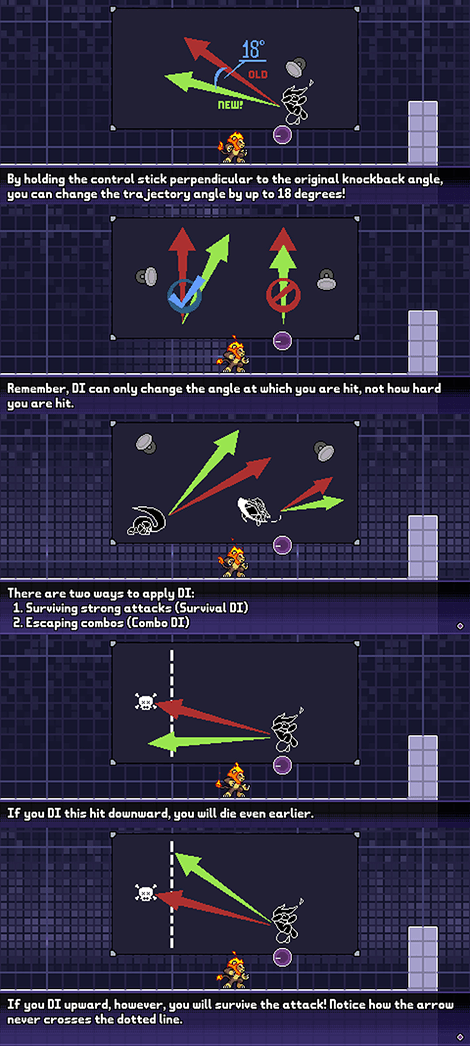
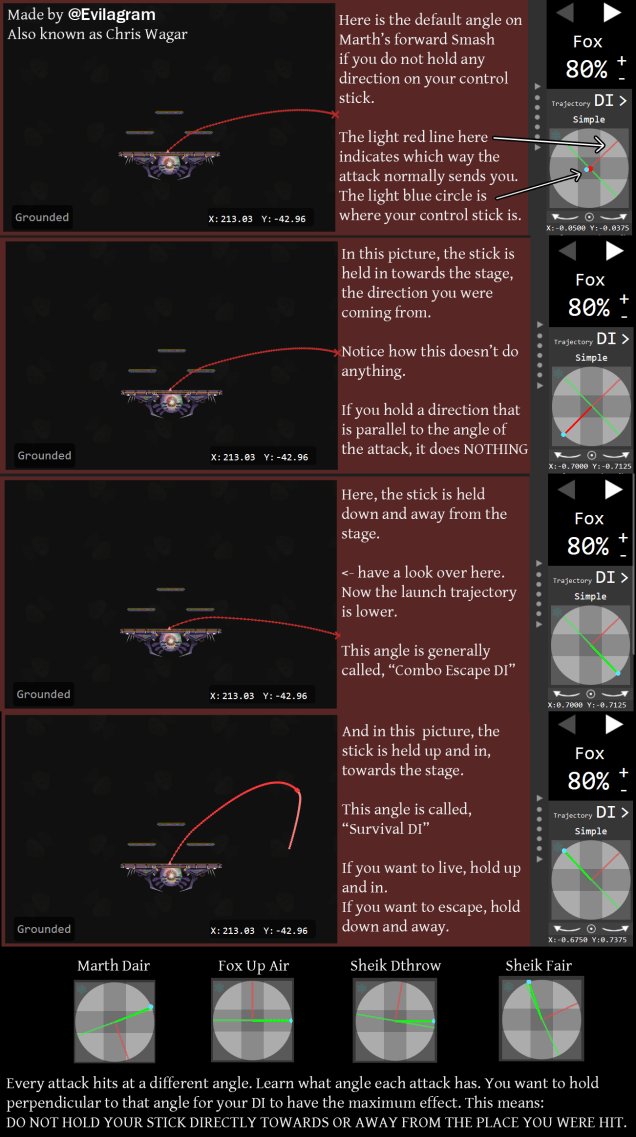
Directional Influence is a subtle mechanic that isn’t explained very well in most tutorials online, here’s some pictures that explain it.
rivals DI tutorial 1rivals DI tutorial 2
directional influence DI infographic tutorial