Street Fighter 6 is the “Beginner’s First Fighting Game” I’ve been looking for.
I’ve been harping on for years that fighting games shouldn’t be getting easier, they should do a better job teaching you how to play them. We’ve seen some improvements in tutorials over time, such as Skullgirls, Xrd Sign & Revelator, Under Night In-Birth, and Them’s Fightin’ Herds, but all our most of the above have been brief system tutorials for the most part with very little on fighting game fundamentals.
Frame: Also called “tick”. The smallest unit of discrete time in a video game.
Startup: The period of time in an attack animation up to the first hitbox (collider that hits other objects) appearing. Active: The period of time in an attack animation across which a hitbox is present and capable of hitting other objects. Recovery: The period of time in an attack animation after the hitbox has disappeared, before the character returns to a state where new actions can be input, or they return to an idle state. Hitstun: An animation that plays when a character is damaged by a hitbox, during which the character is incapable of acting until the animation has completed. Blockstun: Like hitstun, but for blocking. The stunned animation played by a blocking character when they are hit by an attack. Usually shorter than hitstun in duration.
Advantage/Disadvantage: The difference in time between when an attacker recovers from their move, and a defender recovers from hitstun or blockstun. Establishes who gets to act first, like a head-start in a race. When a player is at advantage, it is their “turn”. Frame Advantage: When the attacker gets to act before the defender does, allowing them to perform a move with a head-start over the defender. Also called, “plus”. Frame Disadvantage: When the defender gets to act before the attacker does. The attacker has handed over their “turn”. Also called “minus”. Combo: When a move has so much frame advantage on hit, that another move can hit the defender before hitstun ends. A sequence of moves that each hit the opponent while they are still stuck in hitstun. Block String: A sequence of moves that each leave the attacker at frame advantage (plus) on block. If there is no gap, it is a “true” block string. Unsafe: When a move has so much frame disadvantage that the defender can hit the attacker before their move recovers, punishing them.
Frame Trap: When a move leaves an attacker at frame advantage, allowing them to launch another attack that will catch any action the defender makes, besides blocking. If the defender tries to attack when the attacker is at advantage, they will get frame trapped by the attacker’s next move. Pushback: Each attack pushes the defender backwards. Attacks tend to obey a rule where longer ranged attacks have less frame advantage, and longer startup, so frame traps get looser as the defender is pushed further back.
This Dustloop page is a helpful companion to this article.
Every attack has 3 phases, startup, active, and recovery. Startup is time before the attack has a hitbox out. Active is the time that the hitbox is out. Recovery is the time after the hitbox is out before you return to idle.
Attacks inflict a stunned animation on those that they hit, either hitstun or blockstun. This stun animation will interrupt whatever animation is currently playing, even if that animation is stun. In most games, the hitstun and blockstun animations are different durations, with hitstun being longer than blockstun.
If the hitstun animation is longer than the recovery frames of the move, then the attacker will be able to act first, before the enemy who was stunned. Frame Advantage means it’s your turn, and the amount is how much of a head start you get.
It is easy to focus on a myopic view of skill in video games as pushing a button to hit a tight timing window. It’s a common skill test. It’s a very obvious demonstrable skill. Most laypeople can easily recognize that it takes skill. However, there are a lot of other skills that are common in video games, and the purpose of these skill tests is not just to test skills in a vacuum, which is easy, you could go hop on human benchmark and do that all day, but to create a larger system of choices and interactions that test a variety of skills at once, and creates variety in the way each skill is tested.
I have previously written on what I feel makes a game souls-like or not. I think Sekiro has a lot of the same feeling that Souls games do, being made by the same developer and having a world that reacts similarly to your actions, but I don’t think it’s a Souls-like game because the combat doesn’t emphasize the same skills. I think Sekiro is closer to Batman Arkham Asylum than the Souls games.
Demon’s Souls was a critical innovation in combat systems compared to other 3rd person action games because of a few key decisions: Slow player attack speed, uncancellable attacks, shared stamina across running/dodging/blocking/attacking, a realtime healing animation. Sekiro has 1 of these, realtime healing, which is the least essential. Instead, Sekiro has fast attacks, it lets you cancel them for a significant portion of the startup of the move, and it does not have a stamina system, only a guardbreak meter.
So, I’ve been playing Elden Ring lately, and taking some notes. In the process of drafting up my thoughts on it, I ended up with a long tangent about non-linear interconnected maps in Metroidvania style games, and how the souls series tackled this precisely once with Dark Souls, and never again, because they made every bonfire warpable. I decided this tangent was long enough to deserve its own article.
The open world of Elden Ring creates a level of non-linearity and interconnectedness that hasn’t been seen in the series since Dark Souls 1. Ordinarily, fast travel to every bonfire would ruin this, but I think it works fairly well in Elden Ring’s case. Areas aren’t connected by corridors like the Soulsborne games, so you end up doing a lot of exploration anyway, instead of just teleporting to the level you want to go through. Given the distance between locations, going without fast travel wouldn’t really have been viable, because you might end up needing to travel a really REALLY far distance.
The benefit of nonlinear games (like Demon’s Souls) is that you can complete content in differing orders, making it so that no two playthroughs repeat content in the same order, adding a degree of depth. Nonlinear interconnected games (like Dark Souls) expand on this by having you traverse mixed portions of content forwards and backwards, even after you’ve beaten it, meaning you don’t just experience content out of order, but in a varied stitched together order many times over, while also having to engage in pathfinding challenges. In a nonlinear game, you might simply select the content you want to complete as need arises (eg. figure out what level has the thing you’re after, warp to it, progress through the level until you get it).
A bunch of different videos have popped up lately in fighting game circles, about “Emergent Gameplay”. I’ve watched a number of them and they’re grasping at concepts they can’t totally describe. They use a lot of vague terminology and almost say what they want to, but not quite. The gist is, old games had Emergent Gameplay, new games don’t, but why?
Fighting Games don’t attract a lot of new blood. The majority of people who buy fighting games will never attend a single tournament for that game, never post about it online, and never interact with the community in any way. This means that the success of a competitive scene is tangential to the success of the game overall.
Fighting games being unpopular compared to other genres of competitive game is a demographic problem. Demographic problems require systemic solutions, not individual solutions. It’s easy to say that the problem is players who don’t have the drive to improve themselves, but a lot of people just bounce off of fighting games, even though they really want to go on an improvement journey. Fighting games can do a lot structure themselves to get these new players on the right track to understanding the game.
Magic the Gathering went through a similar issue early in their game’s lifespan. At first, they catered to pro players, and the game started to slowly die as MTG became more complex and more irrelevant to beginners. MTG ended up revitalizing themselves by decreasing their investment in competitive play, and instead focusing on creating appealing characters that people could connect to, and an easy introductory experience for beginners.
Wizards of the Coast called the non-competitive kitchen table players, “The Invisibles” because they don’t participate in the broader community, yet they make up the majority of the consumers. This is the case for every game or media product. The majority of a game’s fans will never ever participate in an observable way, but they’re the people who are the backbone of your sales, and they’re the people who filter into the competitive scene. Therefore, having an approachable game creates a more healthy and active scene for everyone.
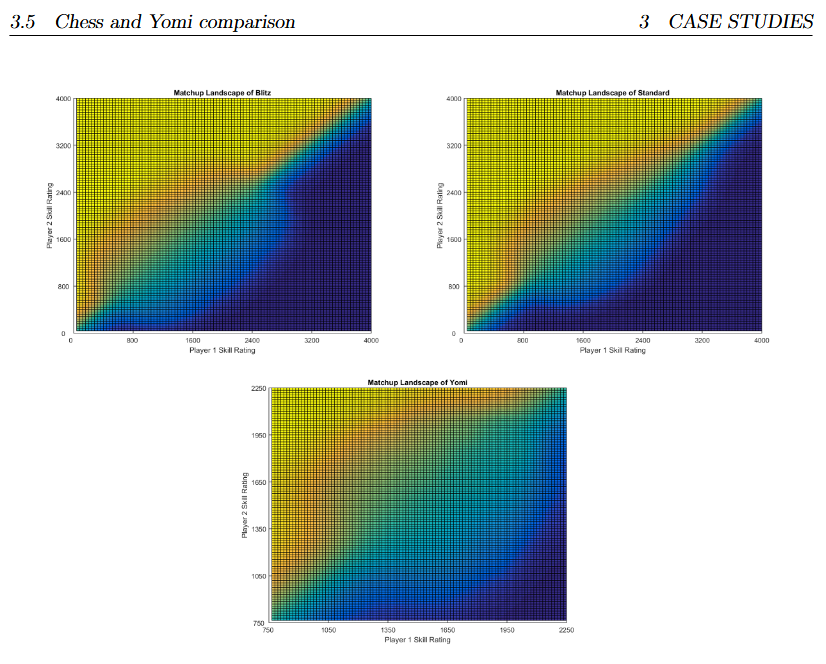
Recently in my discord, one user, Hambone, linked a study related to skill rankings in Blitz Chess, standard Chess, and the card game Yomi by David Sirlin, and how well those rankings correlated with win ratio. You can read the full study here. From it emerges this amazing chart:
This chart is a depiction of a game’s consistency across skill levels, with a spectacular illustration of how there are certain bottlenecks where consistency goes up and down. (for those with color blindness Player 2 winning is represented on the graph as yellow, losing as dark blue. Slight wins are orange, slight losses are light blue, and 50:50 is represented as teal). It’s worth noting that the skill ranking of an average player is 1200. From this chart, we can intuitively extrapolate a number of conclusions, but first lets make some observations: We can see that Yomi is less consistent across all skill levels than either variant of chess. We can see that chess has a short period near the bottom skill level where better players very consistently beat worse ones, then there’s a free-for-all near mid-low level, and another bottleneck at higher to top levels of skill. We see a mild version of this trend even in the yomi chart.
From this we can conclude that aspects of these games make them more or less consistent. From personal experience, I’m going to put forward that the big thing that makes a game consistent is execution testing, a style of game that I call an “efficiency race” (eg. racing games, games that directly compare a skill that is dependent exclusively on you and nothing else). The things that make a game less consistent are Randomness, and unweighted Rock Paper Scissors (eg. games of chance and games with hidden information, where you directly interact with your opponent). For example’s sake, there are some games where you cannot become consistent, such as a pure coin toss. The graph for this game would be teal (50:50 odds) across the entire chart. A hypothetical perfectly consistent game, where the better player always wins, would be a perfect split of yellow/dark blue directly across the diagonal center line, with almost no teal.
A friend on twitter was confused when I said Dunkey wasn’t a good reviewer recently. I asked him to pick out the video he thinks is Dunkey’s best review and I’d go over it. He picked Dunkey’s Mario Sunshine review, from this year. I know I said I wouldn’t do any more critic critique, but here you go. Hopefully this is better than any of my old stuff.
My biggest criticism of Dunkey is that he’s not a good critic, but he acts like he is, even though he does nothing fundamentally different from anyone at IGN. He’s part of the group that hates corporate reviews because they’re fake, not because they lack depth/insight, but he acts like being fake and lacking insight are the same thing (because he can’t tell the difference), so when he does an “honest” review, he thinks it’s automatically deep/insightful, because he has no idea what that actually means. The crowd that hates modern game reviews don’t hate them because they have a discerning eye. They hate them because they’re hearing the “wrong” things get praised/criticized. Dunkey praises/criticizes the things this crowd wants praised/criticized, so he gets treated like a good reviewer, even though he does the exact same thing as IGN. Same process, different conclusions, both bad reviews. Dunkey frequently has correct conclusions (relative to that crowd at least), but always bad reviews. You’re not a good reviewer unless you show your work.
Editors note: This is another guest post by Durandal, though I wrote most of the paragraph on encouragement/discouragement and push/pull. If you’d like to submit a guest post, contact me on discord.
Boss fights involve fighting against one or more enemies that are usually harder than what came before in the game. Story/gameplay-wise they’re an effective way of setting the climax for a level or chapter, which is why they’re so widely used. Many genres like beat ‘em ups, platformers and shoot ’em ups all often feature great boss fights, like Credo in DMC4, Death in Castlevania 1, and the Battleship in Contra 3. But then you have bosses in first-person shooters.