How Dark Souls Changed Combat

Most games with 3rd person combat have enemies with slow reactable attacks, and player characters with very quick unreactable attacks, such as Ocarina of Time, Devil May Cry, God of War, Batman Arkham, Witcher, and so on. The Soulsborne series made a bold decision with regards to this. The standard attack speed of most weapons is roughly the same speed as enemy attacks. This means that attacking after an enemy does generally means they’ll hit you first, interrupting you, unlike other series where your attack will come out first. This means you can no longer react to an enemy’s windup with an attack of your own.

By slowing down your attacks, the souls games put you on the same timescale as enemies. Enemies need to be slow so you can react to their attacks and defend against them, and slowing down your attacks to match theirs means there’s more of a risk that they’ll interrupt you before you interrupt them. This means that enemies can afford to rely on hitstun less to be threatening. Overall, it creates more of a neutral game between you and your opponents, where you jockey for position and try to use attacks strategically. Because you’re less sure to hit first, whiff punishing becomes more important to safely hitting enemies.

Slowing down attacks also means that attacks could be more diverse in the time at which they hit, and thereby exhibit a wider range of tradeoffs between damage, range, and speed, which Dark Souls leveraged to create a diverse assortment of weapons. Nioh then leveraged this further by attaching a bunch of moves to the same weapon, and finding ways to distinguish them all using the stance system.

There isn’t a lot to say about this. Slowing down attacks while keeping your defensive options fast is a simple effective trick for emphasizing more of the neutral game in any game with 3rd person combat. It makes individual enemies more threatening, and multiple enemy fights more dynamic too. Obviously not every game should work this way, but it’s cool in the games that use it.

Wonderful 101’s User Experience is a Nightmare

I started replaying Wonderful 101 Remastered recently (I’ve bounced off this game before), and the User Experience (UX) of this game is REALLY REALLY BAD. Here’s a quick introduction to User Experience for people who don’t know. User Experience is a field of design descending from User Interface design that incorporates a lot of different aspects that users run into in the process of trying to interact with a software product or service. In a game, User Experience covers not just the UI, but the presentation of game elements on the screen, the way that rewards are structured, the way new options are unlocked, the color coding of various elements (like enemies, attacks, etc), the presence and intrusiveness of cutscenes, the controller layout, online ranking systems, cosmetics, the tutorialization, and even the structure of the game’s mechanical design itself. Something like the way Gears of War gives new players in online multiplayer a subtle buff for the first 5 matches, so they’re more likely to win and therefore stick around, is UX. UX is ideally informed by research, both on the level of the whole discipline, and for individual games and playtesting to find pain points for new users. Playtesting with new users is inherently UX.

This article helps explain UX in the context of games better: https://medium.com/@player_research/what-is-games-user-experience-ux-and-how-does-it-help-ea35ceaa9f05

Platinum games AS A WHOLE, have extremely bad UX. Wonderful 101 manages to kick it up a notch from the normal badness of Platinum’s UX.

Continue reading

Doom Eternal Review ft. S.G.S.

Editor’s Note: The original draft and most of the content of this was written by our discord mod, S.G.S. I stepped in to help flesh out sections comparing the gameplay styles of Classic Doom versus Eternal, Resource Manangement, Enemy design, and wrote the Marauder section by myself.

Honestly, I’m nothing short of thoroughly impressed this time around. id Software took the interesting but flawed attempt at action FPS that was Doom 2016, and capitalized on the potential it had in a splendid way.

Doom 2016’s resource management was handled via glory kills for health and chainsaw use for ammo, combined with more “traditional” level design with health and ammo pickups strewn about. This felt like a clash of ideals to me. Classic Doom (and a lot of older shooters) had non-renewable resources that were limited exclusively to pickups around the map, which meant that routing through the map to acquire weapons/ammo/health/armor became an important skill to master. Classic Doom was about resource gathering and attrition, which created a chain of events across a map which had context with each other. Your options later in the level were based on what resources you found, and which you spent, earlier in the level. Various maps tune this balance differently leading to some maps starving you of resources, while others have few weapons to work with; plenty of maps even place weapons in locations that require you to deal with encounters on the way.

Doom 2016, however, had a system in place that showered (heh) you with resources at a moment’s notice, which flew squarely in the face of level exploration as resource management. Combat encounters were decontextualized from one another. You even obtained weapons in a continuous fashion, meaning they were more akin to upgrades rather than resources you locate (or fail to locate) on a map. Eternal pushes this style of resource management further by adding flame belches for armor, which is another layer to manage. As such, the exploration of a level is more for progression and secrets, rather than for resources, and you don’t experience attrition over the course of the level, because infinitely respawning enemies, and infinitely refilling chainsaw/flame belch/glory kill are your source of ammo, armor, and health. Doom Eternal does not deserve to be thought of in the context of Classic Doom, it’s better to think of it as a completely different game series.

Continue reading

Transitive (Efficiency Race) vs Non-Transitive (Rock Paper Scissors)

So I’ve said that there’s 2 types of multiplayer game fundamentally: Efficiency Race and Rock Paper Scissors. This video (re)introduced me to the mathematical concept of Transitive and Non-Transitive relations. This is an amazing lens for describing the difference between these two fundamental games.

In an Efficiency Race, there is always one option, or set of options that is always better than the others, per some metric of efficiency (time or victory points). This means that options (or combinations thereof) can be ranked against each other in a transitive fashion. If A > B > C, then A > C. Trackmania is the most pure example of this out there, since you cannot interact with the opponent in any way and a given route will always be faster or slower than another route (assuming you follow it exactly).

rockpaperscissorspayoff - Copy


This is the payoff matrix for an efficiency race version of rock paper scissors, notice that rock always wins, and scissors always loses, unless they tie

Continue reading

You don’t know what Game Feel is, read the damn book please!

FoxitReader_60DGUvMluH

This article is going to be me unapologetically shilling for Steve Swink, because Game Feel is Rocket Science Quantum Computing Laser Surgery handed to Cave Men who decided that nomadic pastoralism is a better pursuit than being agriculturalists or hunter gatherers, dooming future civilization forever.

GAME FEEL! It’s the way a game feels to play! It’s incredibly intuitive as a concept, people talk about it CONSTANTLY! Yet, if you look up GDC talks on the topic, or youtube videos, it becomes obvious that no one has read the fucking book, despite it going into WAY more detail than any of those talks do.

FoxitReader_oxgNi1aVHY
Continue reading

Are Fan Expectations More Important Than Quality? ft. Durandal

Editors note: This article was co-written by Durandal and I. We each contributed a number of paragraphs and edited back and forth to make the final product.

If you stick around gaming discussions long enough, you might hear the phrase: “it’s a good game, but it’s not a good [franchise/genre] game”. Meaning: while the game might be fun, it does not fit the identity or expectations of a particular franchise or genre. A game not matching expectations is a valid reason to dislike a game, but there’s a tendency amongst fans and reviewers to treat not meeting expectations as an objective flaw with the game’s design. So when there’s a new game which breaks the mold of its genre/franchise, many would criticize the game’s design for not meeting their preconceived notions of how a game in said genre/franchise should play.

This can happen when a game tries to take a classic genre in a new direction, such as Ikaruga. During location tests it got mixed reactions because it didn’t play like any other shmup at the time. Most arcade veterans liked shmups for their straightforward appeal of dodging bullets and blowing everything up. But here the polarity-switching mechanic gives you a shmup that makes you rely much more on strategy and routing over reflexes, making the game more puzzle-like than your average shmup.

Instead of judging Ikaruga in a neutral light from a fresh perspective, many people judged it purely through the lens of what they think a shmup should do. But being a “puzzle shooter” doesn’t make Ikaruga worse or better, just different. Instead of acknowledging that the game is not up their alley, they view the game’s design as objectively flawed. Only how objective can said flaws be to someone with no experience with the genre/franchise?
Continue reading

Gamedevs Should Not (Exactly) Copy My Criteria to Make a Successful Game

I don’t expect anyone to make a game that perfectly fits my model of what a good game should be and ignores everything else typically involved in making a commercial game, including me.

The reality is, my idea of what a good game is impractical and conflicting with making a popular or best selling game. I judge games and enjoy games for aspects that I would not prioritize during development, and a lot of aspects of making a successful game fall outside the scope of my work. I try to write articles incorporating this broader perspective too, because I’m interested in it, but the core of my philosophy is about making what I would consider a good game, rather than a successful one.

Of course, I still think that someone interested in designing a game should listen to me to some extent (why else would I write?). I still think that I am providing a unique and helpful perspective, but success will always be a medium between my perspective and what’s actually effective to reach and appeal to a wider audience than just me. There are certainly aspects of my writing and philosophy which overlap with general success, but the line is always going to be up to the developer, and it’s never going to be completely clear.

Continue reading

Play Western Games on the 2nd Hardest Difficulty

2_u2yx

This is a rule I usually abide by for western games. There are exceptions, such as Doom 2016, Doom Eternal, Halo (except 2), Quake 1, STALKER (hardest difficulty reduces the health of all humans), or Starcraft. For the rule to apply, there need to be at least 2 harder difficulties above normal (Normal/Hard/Hardest applies, Easy/Normal/Hard does not), and the hardest difficulty needs to not be unlockable, or playable through some type of NG+. This rule can apply to some Japanese games too (such as Nier, which has some enemies on hard that regenerate health faster than you can deal damage).

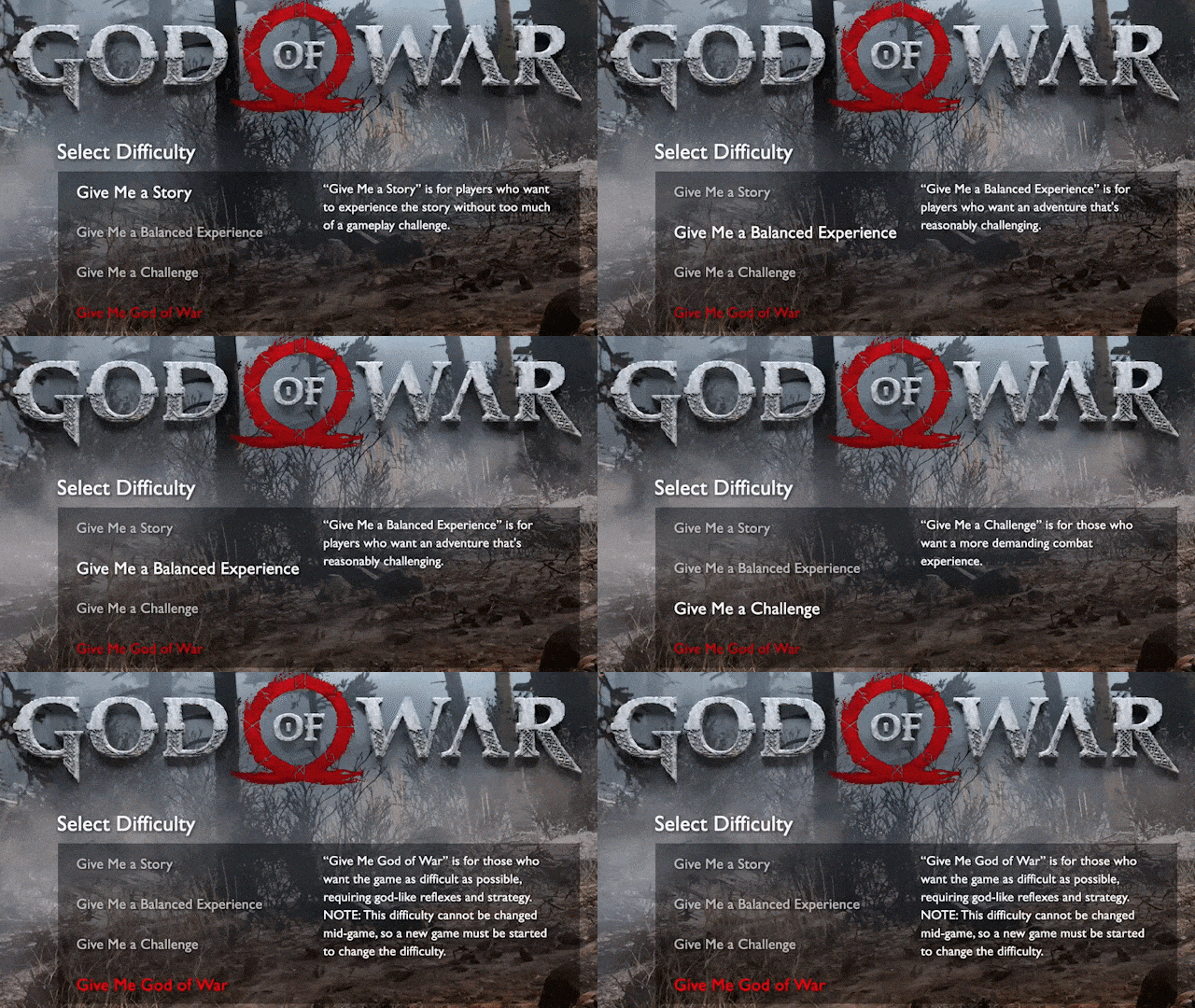
For some examples of games where this is true, we have: Old Doom (Nightmare is a joke difficulty, adding respawning enemies into a game about ammo attrition), Call of Duty (Veteran is bullshit), Titanfall 2, Bioshock Infinite (1999 mode, though honestly hard is still a big annoying jump from normal, and 1999 mode isn’t much harder), God of War (hardest difficulty has enemies engage Devil Trigger for insanely high health, and they can’t be launched anymore), Diablo 3 (Inferno, on release), Torchlight 2, Mass Effect 2 (here is a forum post outright mentioning the rule), Gears of War, Batman Arkham Series (turning off counter indicators is fine, but damage is way too high and enemies have way too much health), Uncharted, Spec Ops: The Line, Serious Sam, System Shock 2, Far Cry, FEAR, and Metro 2033. Continue reading

Dead Cells Review

Dead Cells for Nintendo Switch - Nintendo Game Details

Dead Cells bills itself as a Metroidvania Roguelike. It’s a 2d platformer, where you find randomized loot and fight through procedurally generated levels. You have 5 slots on your character for items: 2 weapons, 2 tools, and an accessory. Your basic options are to use your weapons or tools, jump, double jump, roll, chug a potion, ground pound, or generic use button.

Dead Cells’ big influence is from Metroidvanias, and I think the influence is definitely positive on the game, but I don’t think it’s really a metroidvania, and I don’t think making it more like a metroidvania would be good for it. Metroidvania is a design pattern across the entire map of a game’s world, where the map loops on itself, allowing areas from later in the game to fold back on areas from earlier in the game, where objectives are dispersed across this map to encourage unique routing. Despite technically not being a metroidvania, the level structure it chose for itself is still extremely effective in its goals.

Continue reading

A Critique of Doom Eternal’s Story

Doom Eternal - Doomguy Confronts Khan Maykr Scene - YouTube
There have been some complaints about the story of Doom Eternal in comparison to Doom 2016, and I’ve gotta say, I agree. Doom Eternal’s story is disappointing, largely because it doesn’t build on the premise of 2016 and introduces a bunch of characters that we don’t get any time to become attached to as villains. That said, this has absolutely no bearing on Doom Eternal’s quality as a game. It’s a vastly better game than its predecessor, and is one of the best FPS games ever released, very possibly the most tightly tuned FPS game ever released, in a way reminiscent of fighting games, in a way stylish action games should be envious of.

I know I have a bit of a reputation for being “fuck story”, but it’s not that I don’t enjoy stories or enjoy analysis of them. I’m willing to put up with an actively bad and obtrusive story in the name of a good game and likewise I can appreciate good stories from bad games (Legacy of Kain Soul Reaver is my go-to example for this). I don’t want to build a platform where I’m expected to have a nonsense hardline position where it doesn’t make sense.

Some people have been complaining about the story of Doom Eternal, and I think their complaints have merits. Anyone saying the lame story makes the game bad can shove it.

I enjoyed Doom 2016’s dismissal of story elements by the main character. I thought the core concept of 2016 was good, corporation leverages hell to power energy crisis earth, devolving into intracompany demon cults going rogue and fucking everything up. Hayden is like, “but energy tho” and Doomguy does not give a single fuck. We have a neat sequel hook of Hayden betraying us at the end, and Eternal just does absolutely nothing with that. Continue reading