I don’t expect anyone to make a game that perfectly fits my model of what a good game should be and ignores everything else typically involved in making a commercial game, including me.
The reality is, my idea of what a good game is impractical and conflicting with making a popular or best selling game. I judge games and enjoy games for aspects that I would not prioritize during development, and a lot of aspects of making a successful game fall outside the scope of my work. I try to write articles incorporating this broader perspective too, because I’m interested in it, but the core of my philosophy is about making what I would consider a good game, rather than a successful one.
Of course, I still think that someone interested in designing a game should listen to me to some extent (why else would I write?). I still think that I am providing a unique and helpful perspective, but success will always be a medium between my perspective and what’s actually effective to reach and appeal to a wider audience than just me. There are certainly aspects of my writing and philosophy which overlap with general success, but the line is always going to be up to the developer, and it’s never going to be completely clear.
This is a rule I usually abide by for western games. There are exceptions, such as Doom 2016, Doom Eternal, Halo (except 2), Quake 1, STALKER (hardest difficulty reduces the health of all humans), or Starcraft. For the rule to apply, there need to be at least 2 harder difficulties above normal (Normal/Hard/Hardest applies, Easy/Normal/Hard does not), and the hardest difficulty needs to not be unlockable, or playable through some type of NG+. This rule can apply to some Japanese games too (such as Nier, which has some enemies on hard that regenerate health faster than you can deal damage).
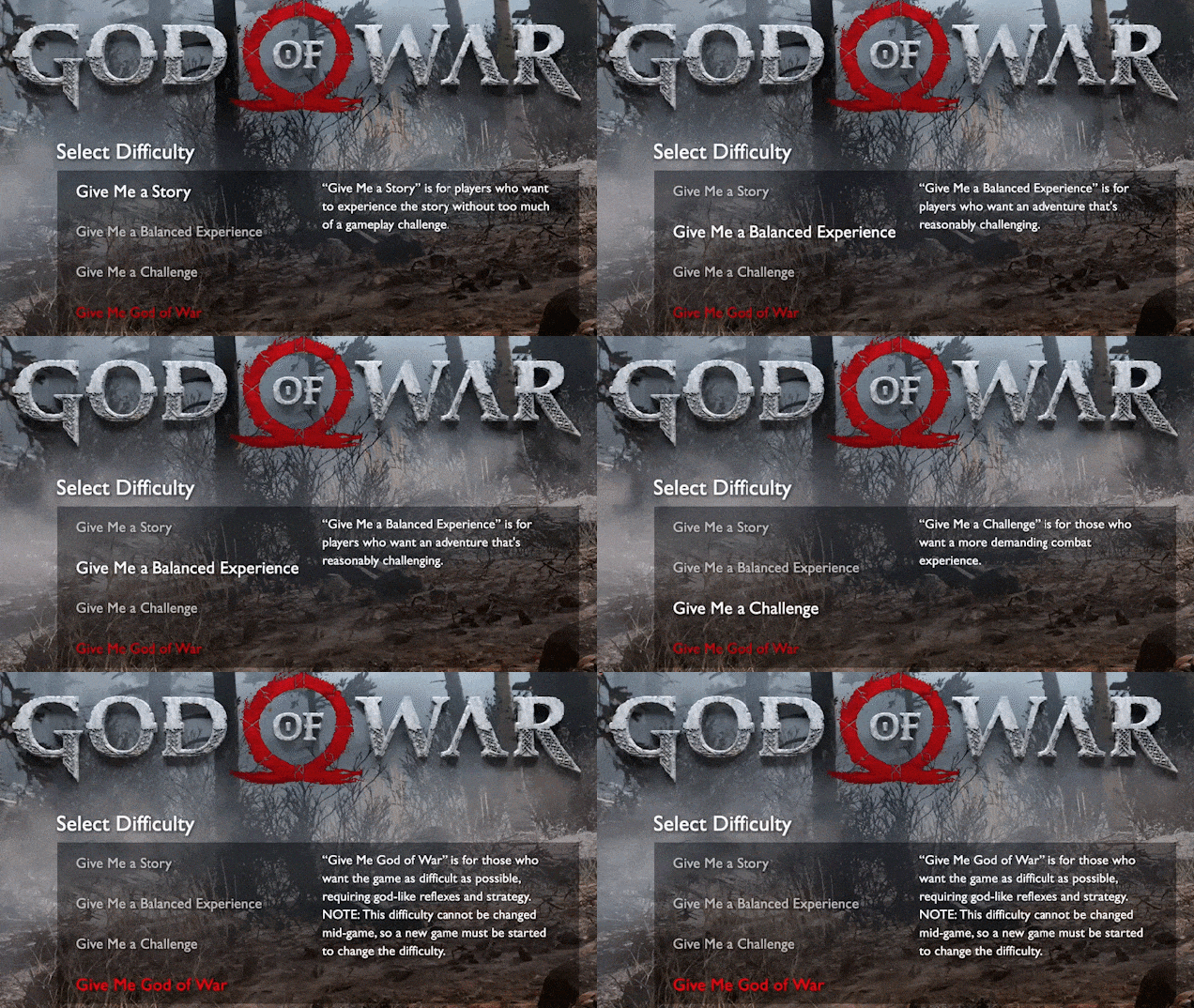
For some examples of games where this is true, we have: Old Doom (Nightmare is a joke difficulty, adding respawning enemies into a game about ammo attrition), Call of Duty (Veteran is bullshit), Titanfall 2, Bioshock Infinite (1999 mode, though honestly hard is still a big annoying jump from normal, and 1999 mode isn’t much harder), God of War (hardest difficulty has enemies engage Devil Trigger for insanely high health, and they can’t be launched anymore), Diablo 3 (Inferno, on release), Torchlight 2, Mass Effect 2 (here is a forum post outright mentioning the rule), Gears of War, Batman Arkham Series (turning off counter indicators is fine, but damage is way too high and enemies have way too much health), Uncharted, Spec Ops: The Line, Serious Sam, System Shock 2, Far Cry, FEAR, and Metro 2033. Continue reading →
Dead Cells bills itself as a Metroidvania Roguelike. It’s a 2d platformer, where you find randomized loot and fight through procedurally generated levels. You have 5 slots on your character for items: 2 weapons, 2 tools, and an accessory. Your basic options are to use your weapons or tools, jump, double jump, roll, chug a potion, ground pound, or generic use button.
Dead Cells’ big influence is from Metroidvanias, and I think the influence is definitely positive on the game, but I don’t think it’s really a metroidvania, and I don’t think making it more like a metroidvania would be good for it. Metroidvania is a design pattern across the entire map of a game’s world, where the map loops on itself, allowing areas from later in the game to fold back on areas from earlier in the game, where objectives are dispersed across this map to encourage unique routing. Despite technically not being a metroidvania, the level structure it chose for itself is still extremely effective in its goals.
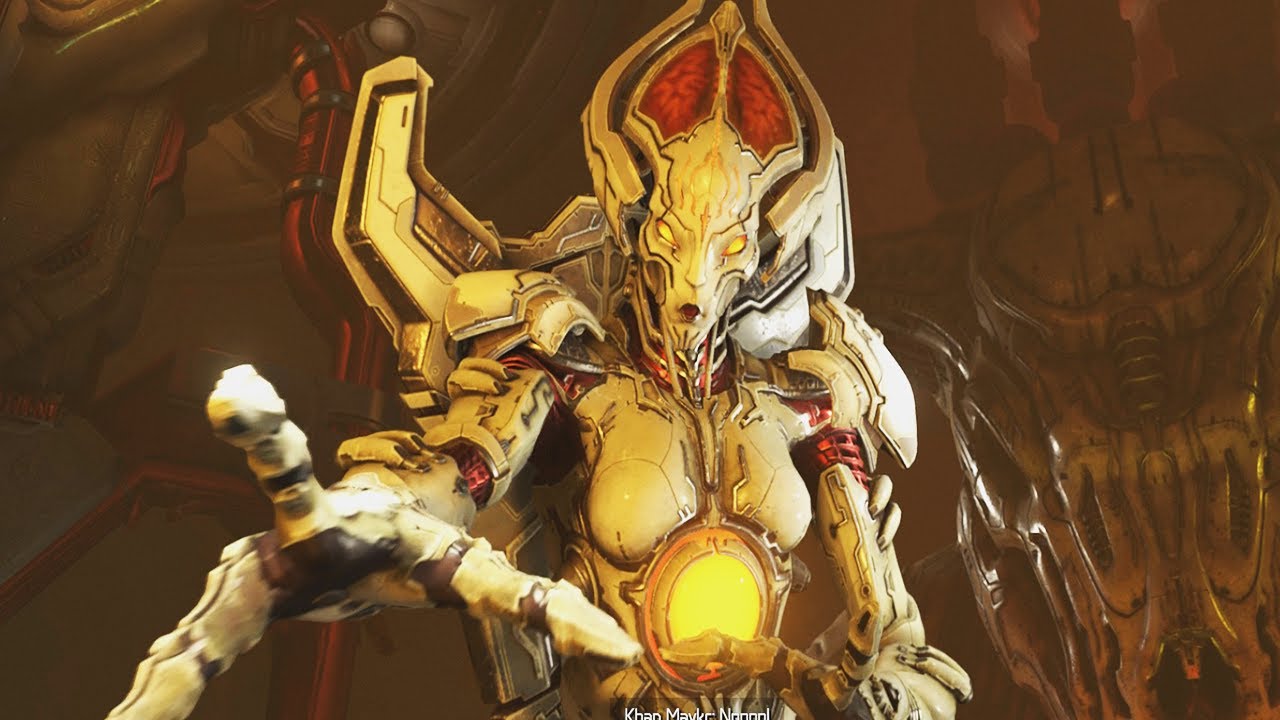
There have been some complaints about the story of Doom Eternal in comparison to Doom 2016, and I’ve gotta say, I agree. Doom Eternal’s story is disappointing, largely because it doesn’t build on the premise of 2016 and introduces a bunch of characters that we don’t get any time to become attached to as villains. That said, this has absolutely no bearing on Doom Eternal’s quality as a game. It’s a vastly better game than its predecessor, and is one of the best FPS games ever released, very possibly the most tightly tuned FPS game ever released, in a way reminiscent of fighting games, in a way stylish action games should be envious of.
I know I have a bit of a reputation for being “fuck story”, but it’s not that I don’t enjoy stories or enjoy analysis of them. I’m willing to put up with an actively bad and obtrusive story in the name of a good game and likewise I can appreciate good stories from bad games (Legacy of Kain Soul Reaver is my go-to example for this). I don’t want to build a platform where I’m expected to have a nonsense hardline position where it doesn’t make sense.
Some people have been complaining about the story of Doom Eternal, and I think their complaints have merits. Anyone saying the lame story makes the game bad can shove it.
I enjoyed Doom 2016’s dismissal of story elements by the main character. I thought the core concept of 2016 was good, corporation leverages hell to power energy crisis earth, devolving into intracompany demon cults going rogue and fucking everything up. Hayden is like, “but energy tho” and Doomguy does not give a single fuck. We have a neat sequel hook of Hayden betraying us at the end, and Eternal just does absolutely nothing with that. Continue reading →
The Legend of Zelda and its imitators, Okami, Darksiders, God of War 2018, Beyond Good and Evil, Legacy of Kain: Soul Reaver, have a particular style of “puzzle”, where you need to notice a switch somewhere and activate it. The developers of Darksiders coined a term for this, “Nuzzle”, short for “Not a Puzzle”. Nuzzles can be useful for teaching a player how to use a puzzle mechanic for the first time. Zelda style games tend to have items or abilities that you unlock which can be used to flip switches that cannot be flipped by any other means. When you get a new ability, it helps to have a simple example of what it can interact with and how it works. The Witness does this in each area that introduces a new puzzle symbol, by having a sequence of 5-10 nuzzles that demonstrate how it works in the simplest way possible, expecting you to learn how the puzzle symbol works via induction so that you can reason out puzzle solutions with deduction.
A nuzzle can be broadly identified as a 1-step puzzle, or a riddle. Nuzzles don’t test critical thinking skills, they simply test if the player is paying attention, or remembers what the switch operating mechanic is at all. Of course this is critical for tutorial purposes, new or inexperienced players need guidance to know how to solve puzzles, but the trouble comes in when Nuzzles are deployed broadly long after the basic puzzle mechanics are understood, as a replacement or filler for puzzles, which is what Zelda-like games tend to do long after puzzle mechanics have already been introduced (such as when you’re asked to light 2 torches in the final dungeon of the game, or hit a sequence of switches in the order they tell you when there are no enemies in the room, and no other confounding factors, such as time limits, or additional puzzle mechanics).
The Souls series and its imitators have a pretty consistent formula for their stories and lore that generates a cool “story-sense” for games about exploration without straightforward cutscenes, but the formula has a particular weakness too.
The first setup is that there’s a great kingdom, or town, or space station, or so on that has a rich history, and many geographically distinct areas. This kingdom was usually great because it relied on something dangerous, like souls, the first flame, or the blood of the great ones. Continue reading →
Combat in a video game is good when you have a variety of options (discrete verbs that have unique animations, state, or use of unique entities) or sub-options (things like position, timing, rotation etc that modify the function of a verb) which have varied outcomes, and determining which option/suboption to use for a more/less optimal outcome in a given situation is unclear, but can be logically deduced.
If elements of your combat system are random (have output randomness, as opposed to input randomness), such as randomizing which attack you’ll perform when you press a button, then the best option for a scenario cannot be logically deduced. The same is true if the way that attacks function is unclear or inconsistent (like funky hitboxes producing drastically different outcomes with similar inputs, or the visuals not clearly communicating how the move works). Ideally the player should be able to visualize in their mind the outcome of different inputs, working it out like a math problem (“oh, I could have done that instead”). This makes a game fair and understandable. Continue reading →
You’ve seen paired animation before, even if you didn’t know what it was called. Many people have frequently called these “canned animations” or some such. I first discovered the technical name for it is Paired Animation when I saw a production video on Assassin’s Creed Origins, that happens to define what it means. In Insomniac’s Spiderman titles, they call these “Synced Animations”
“We’ve drastically changed the paradigm of what is fight. In previous [Assassin’s Creed games], we used what we call technically a paired animation system. Which means when you swing your weapon, the hero and enemy align, they play an animation together, you wait for it to finish, and then you continue fighting. We went to a hitbox system, which means that anytime you swing your weapon, no matter the distance or if anyone is around you, you’re gonna swing. That means that distance matters. The speed of your weapon, your position relevant to other enemies, [it all] matters. If you have a big spear and are swinging it around you can hit multiple enemies at the same time. It’s not just about the damage anymore, [but about] speed, length, position and the number of enemies you’re fighting.”
In short, it’s when both a player and enemy are involved in the same animation, one of the player attacking, and one of the enemy being hit, neither being allowed to move independently while this is going on. This approach allows animators to have the player character manipulate the enemy’s body and limbs in the animation directly, as opposed to both of them playing separate animations that don’t really follow from one another, like a sword swing and generic hitstun. This is necessary for things like catching an opponent’s punch.
So where have you seen Paired animation before? Assassin’s Creed is the obvious one, every game before Origins had paired animations for all combat. The Batman Arkham series uses paired animations for all punches, counters, and takedowns, plus jumping on top of an enemy’s head. Dark souls uses paired animations for backstabs and ripostes, plus opening doors and operating devices. Doom 2016 and Eternal use paired animations for glory kills and chainsawing. Every fighting game in existence uses paired animations for throws/grabs.
So what’s bad about paired animations? Many reasons were listed in the Asscreed developer’s quote. Paired animations don’t let you hit multiple enemies with large weapon, because they’d need to make a specific animation for hitting all those enemies and a coded way to transition into it smoothly (Deus Ex Human Revolution did this with the multi-takedown, but it cut to black so it could set the enemies up and play the animation, otherwise the transition would be jarring). They don’t factor in the length of your weapons, because most weapons have distance-closing animations, letting you snap to a target. And the speed of the move doesn’t matter, because you can’t be interrupted by the opponent you’re attacking, since they’re caught in the damage receiving animation from you.
The key problem with paired animations is the way that they snap onto enemies (games have gotten better about this, ). Snapping in general can be problematic, because it erases specific circumstances, normalizing them into the same outcomes every time. Paired animations don’t care what was going on before they started, your spacing, velocity, movement, they take whatever happened and deliver a uniform result. Many paired animations are also invincible, because it’s difficult to resolve what would happen if they were interrupted (and resolving them the normal way leads to out-of-bounds clips in many games!). This leads to the awkward circumstance of trying to initiate a paired animation on purpose to go through other attacks, or coming out of a paired animation with an attack directly on top of you. One clever change that Nioh made from Dark Souls, was removing backstabs and instead giving bonus damage to hits from behind. Parries in Nioh are still frequently paired animations.
Beware the succ
When is okay to use paired animations? Paired animations are good for actions that specifically require them, obviously, such as grapples, and operating objects. In most fighting games, throws make both participants immune to damage. In the Smash Bros series, people can still be hit during a grab, but there is hyper armor applied during the throw part of the animation, to guarantee it finishes successfully. Paired animations are acceptable in circumstances where 1 tap will eliminate an enemy completely, since it would already always have the same result, and already doesn’t depend on circumstance. Examples would be takedowns in Deus Ex Human Revolution, or Glory Kills in Doom 2016.
Editor’s Note: This is another guest post by Durandal. Join our discord for more in-depth gameplay discussion. http://discord.gg/EfPY4r9
DOOM (2016) was the first game to mix character action design with first-person shooting. Unfortunately it also half-assed the execution. But, that means there’s plenty to learn from its mistakes.
First, some context. DOOM (2016) plays nothing like DOOM (1993) (henceforth referred to as nuDoom and olDoom). In olDoom combat and exploration intertwined, but most combat in nuDoom takes place in locked-off arenas. This was done to get around the Door Problem in olDoom and encourage aggressive play. Long-term resource management through item placement shifted to short-term by having fallen enemies drop most of your resources. You will spend most of your resources in the arenas where most of the enemies are, so this change makes sense. To make up for the simple enemy AI, olDoom relied on placing the enemies by hand and designing the levels around them. Trying to kill and trying to run past the enemies were equally risky. But in nuDoom, the enemies (and the player) have more movement options. To allow the enemies and player to exert their newfound mobility, the layouts became more circular and vertical. And instead of enemy placement, encounter design in nuDoom relies more on mixing different enemy behaviors. However, enemy design and level design is where nuDoom falls flat the most. Continue reading →
A lot of people have covered this topic before. I’m more doing this to pin the idea down in case it comes up in conversation again, than because it’s something that really needs to be discussed.
Souls-like is a subgenre of Action RPG games, formed by the unique conventions of Demon’s/Dark Souls. Similar to a roguelike, the Souls series of games have come up with a number of unique conventions that many other games have taken some degree of inspiration from. Games that follow enough of these conventions can be called Souls-Like. Some of them are more influential than others.
High Influence
Collecting a currency that is lost on death, but stored at the place where you died, and erased when you die again.
There are standard action RPG trappings: levels, equipment, consumable items,
The player’s standard attacks have a startup of about half a second or longer (30f at 60fps)
Players and enemies can have their attacks interrupted by hitstun.
All combat actions (attacking, dodging, blocking, running, parrying) are rationed through a shared stamina bar.
You are committed to attacks once you start them and generally cannot interrupt your attacks, except by being hit by enemies.
Attacks have actual hitboxes during their animations, not paired animations.
There is a dodge and block ability.
Using checkpoints resets your health, healing items, and the enemies in the level, but don’t reset items collected or changes to the level’s state.
Level design based on checkpoints and opening up shortcuts to earlier checkpoints.
Low Influence
Spells, items, and other actions have associated animations that can be interrupted by hitstun before they take effect.
Other players can join you to cooperate in beating levels.
Other players can invade your single player session to try to kill you in PVP
The actions of other players on the network can have an effect on your local session, such as leaving messages behind.
You can warp between checkpoints.
Some moves have super armor, or there is a poise system that confers armor
No pausing, except at checkpoints
The controller convention of having attacks and blocking on the shoulder buttons, and item management on the Dpad.
Having a classless RPG system, where the only differentiation between characters is their stats and equipment, no fundamental new abilities, or permanent bonuses.
Having a metroidvania style interconnected world that becomes more interconnected over time.
There aren’t many cutscenes, or canned animations.
The setting of a kingdom that was once great, but some calamity connected to the main plot befell it, and now you’re wandering through its corrupted remains.


 Celia Wagar's CritPoints