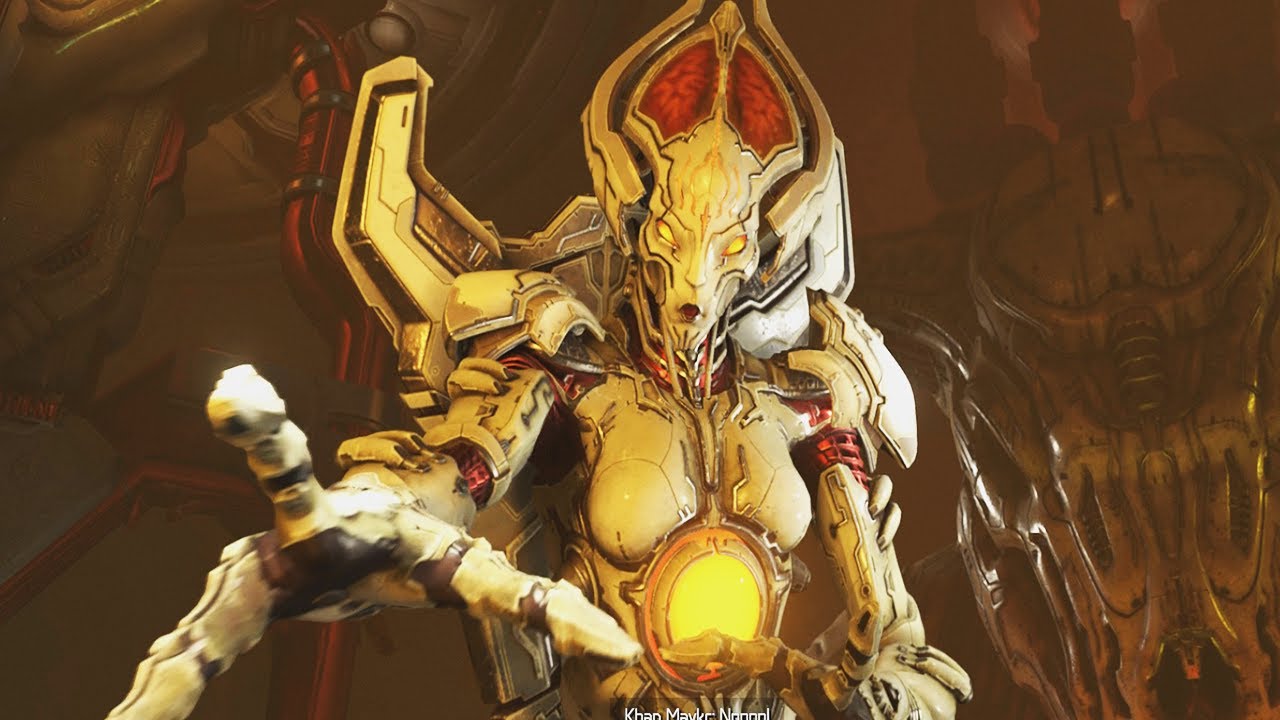
A Critique of Doom Eternal’s Story

Doom Eternal - Doomguy Confronts Khan Maykr Scene - YouTube
There have been some complaints about the story of Doom Eternal in comparison to Doom 2016, and I’ve gotta say, I agree. Doom Eternal’s story is disappointing, largely because it doesn’t build on the premise of 2016 and introduces a bunch of characters that we don’t get any time to become attached to as villains. That said, this has absolutely no bearing on Doom Eternal’s quality as a game. It’s a vastly better game than its predecessor, and is one of the best FPS games ever released, very possibly the most tightly tuned FPS game ever released, in a way reminiscent of fighting games, in a way stylish action games should be envious of.

I know I have a bit of a reputation for being “fuck story”, but it’s not that I don’t enjoy stories or enjoy analysis of them. I’m willing to put up with an actively bad and obtrusive story in the name of a good game and likewise I can appreciate good stories from bad games (Legacy of Kain Soul Reaver is my go-to example for this). I don’t want to build a platform where I’m expected to have a nonsense hardline position where it doesn’t make sense.

Some people have been complaining about the story of Doom Eternal, and I think their complaints have merits. Anyone saying the lame story makes the game bad can shove it.

I enjoyed Doom 2016’s dismissal of story elements by the main character. I thought the core concept of 2016 was good, corporation leverages hell to power energy crisis earth, devolving into intracompany demon cults going rogue and fucking everything up. Hayden is like, “but energy tho” and Doomguy does not give a single fuck. We have a neat sequel hook of Hayden betraying us at the end, and Eternal just does absolutely nothing with that. Continue reading

Nuzzles: Not a Puzzle

CODE FOR DOOR C489 Kia or Welcon 58880

The Legend of Zelda and its imitators, Okami, Darksiders, God of War 2018, Beyond Good and Evil, Legacy of Kain: Soul Reaver, have a particular style of “puzzle”, where you need to notice a switch somewhere and activate it. The developers of Darksiders coined a term for this, “Nuzzle”, short for “Not a Puzzle”. Nuzzles can be useful for teaching a player how to use a puzzle mechanic for the first time. Zelda style games tend to have items or abilities that you unlock which can be used to flip switches that cannot be flipped by any other means. When you get a new ability, it helps to have a simple example of what it can interact with and how it works. The Witness does this in each area that introduces a new puzzle symbol, by having a sequence of 5-10 nuzzles that demonstrate how it works in the simplest way possible, expecting you to learn how the puzzle symbol works via induction so that you can reason out puzzle solutions with deduction.

A nuzzle can be broadly identified as a 1-step puzzle, or a riddle. Nuzzles don’t test critical thinking skills, they simply test if the player is paying attention, or remembers what the switch operating mechanic is at all. Of course this is critical for tutorial purposes, new or inexperienced players need guidance to know how to solve puzzles, but the trouble comes in when Nuzzles are deployed broadly long after the basic puzzle mechanics are understood, as a replacement or filler for puzzles, which is what Zelda-like games tend to do long after puzzle mechanics have already been introduced (such as when you’re asked to light 2 torches in the final dungeon of the game, or hit a sequence of switches in the order they tell you when there are no enemies in the room, and no other confounding factors, such as time limits, or additional puzzle mechanics).

Continue reading

The Souls Story Formula

The Souls series and its imitators have a pretty consistent formula for their stories and lore that generates a cool “story-sense” for games about exploration without straightforward cutscenes, but the formula has a particular weakness too.

The first setup is that there’s a great kingdom, or town, or space station, or so on that has a rich history, and many geographically distinct areas. This kingdom was usually great because it relied on something dangerous, like souls, the first flame, or the blood of the great ones. Continue reading

What makes good combat?

Combat in a video game is good when you have a variety of options (discrete verbs that have unique animations, state, or use of unique entities) or sub-options (things like position, timing, rotation etc that modify the function of a verb) which have varied outcomes, and determining which option/suboption to use for a more/less optimal outcome in a given situation is unclear, but can be logically deduced.

If elements of your combat system are random (have output randomness, as opposed to input randomness), such as randomizing which attack you’ll perform when you press a button, then the best option for a scenario cannot be logically deduced. The same is true if the way that attacks function is unclear or inconsistent (like funky hitboxes producing drastically different outcomes with similar inputs, or the visuals not clearly communicating how the move works). Ideally the player should be able to visualize in their mind the outcome of different inputs, working it out like a math problem (“oh, I could have done that instead”). This makes a game fair and understandable.
Continue reading

What the Heck is Paired Animation?

You’ve seen paired animation before, even if you didn’t know what it was called. Many people have frequently called these “canned animations” or some such. I first discovered the technical name for it is Paired Animation when I saw a production video on Assassin’s Creed Origins, that happens to define what it means. In Insomniac’s Spiderman titles, they call these “Synced Animations”

“We’ve drastically changed the paradigm of what is fight. In previous [Assassin’s Creed games], we used what we call technically a paired animation system. Which means when you swing your weapon, the hero and enemy align, they play an animation together, you wait for it to finish, and then you continue fighting. We went to a hitbox system, which means that anytime you swing your weapon, no matter the distance or if anyone is around you, you’re gonna swing. That means that distance matters. The speed of your weapon, your position relevant to other enemies, [it all] matters. If you have a big spear and are swinging it around you can hit multiple enemies at the same time. It’s not just about the damage anymore, [but about] speed, length, position and the number of enemies you’re fighting.”

In short, it’s when both a player and enemy are involved in the same animation, one of the player attacking, and one of the enemy being hit, neither being allowed to move independently while this is going on. This approach allows animators to have the player character manipulate the enemy’s body and limbs in the animation directly, as opposed to both of them playing separate animations that don’t really follow from one another, like a sword swing and generic hitstun. This is necessary for things like catching an opponent’s punch.

So where have you seen Paired animation before? Assassin’s Creed is the obvious one, every game before Origins had paired animations for all combat. The Batman Arkham series uses paired animations for all punches, counters, and takedowns, plus jumping on top of an enemy’s head. Dark souls uses paired animations for backstabs and ripostes, plus opening doors and operating devices. Doom 2016 and Eternal use paired animations for glory kills and chainsawing. Every fighting game in existence uses paired animations for throws/grabs.

So what’s bad about paired animations? Many reasons were listed in the Asscreed developer’s quote. Paired animations don’t let you hit multiple enemies with large weapon, because they’d need to make a specific animation for hitting all those enemies and a coded way to transition into it smoothly (Deus Ex Human Revolution did this with the multi-takedown, but it cut to black so it could set the enemies up and play the animation, otherwise the transition would be jarring). They don’t factor in the length of your weapons, because most weapons have distance-closing animations, letting you snap to a target. And the speed of the move doesn’t matter, because you can’t be interrupted by the opponent you’re attacking, since they’re caught in the damage receiving animation from you.

The key problem with paired animations is the way that they snap onto enemies (games have gotten better about this, ). Snapping in general can be problematic, because it erases specific circumstances, normalizing them into the same outcomes every time. Paired animations don’t care what was going on before they started, your spacing, velocity, movement, they take whatever happened and deliver a uniform result. Many paired animations are also invincible, because it’s difficult to resolve what would happen if they were interrupted (and resolving them the normal way leads to out-of-bounds clips in many games!). This leads to the awkward circumstance of trying to initiate a paired animation on purpose to go through other attacks, or coming out of a paired animation with an attack directly on top of you. One clever change that Nioh made from Dark Souls, was removing backstabs and instead giving bonus damage to hits from behind. Parries in Nioh are still frequently paired animations.

Beware the succ

When is okay to use paired animations? Paired animations are good for actions that specifically require them, obviously, such as grapples, and operating objects. In most fighting games, throws make both participants immune to damage. In the Smash Bros series, people can still be hit during a grab, but there is hyper armor applied during the throw part of the animation, to guarantee it finishes successfully. Paired animations are acceptable in circumstances where 1 tap will eliminate an enemy completely, since it would already always have the same result, and already doesn’t depend on circumstance. Examples would be takedowns in Deus Ex Human Revolution, or Glory Kills in Doom 2016.

Doom 2016 Review (Guest Post by Durandal)

Editor’s Note: This is another guest post by Durandal. Join our discord for more in-depth gameplay discussion. http://discord.gg/EfPY4r9

DOOM (2016) was the first game to mix character action design with first-person shooting. Unfortunately it also half-assed the execution. But, that means there’s plenty to learn from its mistakes.

First, some context. DOOM (2016) plays nothing like DOOM (1993) (henceforth referred to as nuDoom and olDoom). In olDoom combat and exploration intertwined, but most combat in nuDoom takes place in locked-off arenas. This was done to get around the Door Problem in olDoom and encourage aggressive play. Long-term resource management through item placement shifted to short-term by having fallen enemies drop most of your resources. You will spend most of your resources in the arenas where most of the enemies are, so this change makes sense. To make up for the simple enemy AI, olDoom relied on placing the enemies by hand and designing the levels around them. Trying to kill and trying to run past the enemies were equally risky. But in nuDoom, the enemies (and the player) have more movement options. To allow the enemies and player to exert their newfound mobility, the layouts became more circular and vertical. And instead of enemy placement, encounter design in nuDoom relies more on mixing different enemy behaviors. However, enemy design and level design is where nuDoom falls flat the most.
Continue reading

What is “Souls-Like”?

A lot of people have covered this topic before. I’m more doing this to pin the idea down in case it comes up in conversation again, than because it’s something that really needs to be discussed.

Souls-like is a subgenre of Action RPG games, formed by the unique conventions of Demon’s/Dark Souls. Similar to a roguelike, the Souls series of games have come up with a number of unique conventions that many other games have taken some degree of inspiration from. Games that follow enough of these conventions can be called Souls-Like. Some of them are more influential than others.

High Influence

  • Collecting a currency that is lost on death, but stored at the place where you died, and erased when you die again.
  • There are standard action RPG trappings: levels, equipment, consumable items,
  • The player’s standard attacks have a startup of about half a second or longer (30f at 60fps)
  • Players and enemies can have their attacks interrupted by hitstun.
  • All combat actions (attacking, dodging, blocking, running, parrying) are rationed through a shared stamina bar.
  • You are committed to attacks once you start them and generally cannot interrupt your attacks, except by being hit by enemies.
  • Attacks have actual hitboxes during their animations, not paired animations.
  • There is a dodge and block ability.
  • Using checkpoints resets your health, healing items, and the enemies in the level, but don’t reset items collected or changes to the level’s state.
  • Level design based on checkpoints and opening up shortcuts to earlier checkpoints.

Low Influence

  • Spells, items, and other actions have associated animations that can be interrupted by hitstun before they take effect.
  • Other players can join you to cooperate in beating levels.
  • Other players can invade your single player session to try to kill you in PVP
  • The actions of other players on the network can have an effect on your local session, such as leaving messages behind.
  • You can warp between checkpoints.
  • Some moves have super armor, or there is a poise system that confers armor
  • No pausing, except at checkpoints
  • The controller convention of having attacks and blocking on the shoulder buttons, and item management on the Dpad.
  • Having a classless RPG system, where the only differentiation between characters is their stats and equipment, no fundamental new abilities, or permanent bonuses.
  • Having a metroidvania style interconnected world that becomes more interconnected over time.
  • There aren’t many cutscenes, or canned animations.
  • The setting of a kingdom that was once great, but some calamity connected to the main plot befell it, and now you’re wandering through its corrupted remains.
  • NPCs that all have a sinister chuckle.
  • The game is hard.

The “Silver Bullet” Game Design Problem

A long time ago, I read an article titled, “Silver Bullet Combat” that was rather coherent about describing a common problem in game design. The article is now only available as a PDF and might eventually disappear, so I’m going to reiterate it in my terms.

So the gist of silver bullet style design is that Werewolves can only be harmed by silver, but once you shoot them with something silver they die instantly. A silver bullet is an option that can simply and clearly solve a problem that has no other (viable) solution. Part of game design is trying to differentiate the player’s options from one another, by making them good at different things. The easy way to do this to give enemies special resistances that can only be penetrated if you use a specific option. The trouble is that if a problem has a specific solution, then it’s not an interesting choice to solve it. There’s no tradeoffs, and no depth. Continue reading

What should be in a review?

Include a basic summary of what the game is about and how it’s played.

Contextualize how you played it, so people can get an idea of your process and extrapolate how that may have shaped your review. (in playing BOTW, I made it clear that I aimed to play the game a certain way)

Make clear observations that attempt to explain how things work in a nuts-and-bolts way (pointing out velocity, acceleration, state, etc), instead of unclear descriptive words (smooth, slippery, tight, etc). Build up to a conclusion, don’t start with one and forget to justify it.

Never mark a game down for being hard. You’re allowed to say it’s too hard for you, or one part is too hard relative to others, but difficulty isn’t inherently bad. Difficulty affects depth, which is more important. Does the way the difficulty was implemented create more or less depth? (more by encouraging you to try different things instead of stick to one thing, or less by requiring a specific solution) Remember, there is no such thing as artificial difficulty, it’s hard or it isn’t. Continue reading

Why FEAR 1 Is The Most Important Hitscan Shooter – ft. Durandal

This is another guest post by Durandal. If you’d like to submit a guest post, contact me on discord.

In the 00’s, developers forgot how to make singleplayer shooters with deep combat anymore. For the sake of realism most weapons were made hitscan to resemble how guns work IRL. Enemy variety suffered, since hitscan tracers don’t have as many mutable properties as projectiles do. Weapon variety suffered, since identical enemies don’t warrant a varied weapon arsenal as much. Finally level design suffered, because there isn’t a whole lot you can do with identical weapons and enemies.

So what do you do if the core gameplay lacks variety? The common approach taken by most developers was switching to another style of gameplay to avoid wearing out the core shooting. Instead of running, you’re now driving a tank. Instead of gunning, you’re now forced to be stealthy. Instead of depth, you’re shooting for breadth. Shooters became theme park rides where every half hour they introduced a new mechanic or mode of gameplay and then threw it away for good. Remember all the vehicle sections? The turret sections? The sniper sections, forced stealth sections and escort missions? They weren’t mechanically deep, but they were at least something different.

Soldier of Fortune, No One Lives Forever, the Medal of Honor games, the Call of Duty games, TimeSplitters, Black, Return to Castle Wolfenstein, XIII, the new Wolfenstein games, the Gears of War games, the Killzone games, the Resistance games, even exceptions with standout combat like the Halo games and Vanquish all fell prey to this need to completely change the mode of gameplay for the sake of variety. That’s what happens when you don’t believe your core gameplay can carry the game — when you don’t know how to iterate on hitscan combat.


Stealthily sniping spotlights on a slowly moving monorail really plays to the strengths of Vanquish’ rocket-boosting combat

And then there’s FEAR. On the surface it’s identical to other shooters at the time, save for a slo-mo power and a three-weapon limit instead of the usual two. Here you’ll be fighting the same grunts over and over using a shotgun and some assault rifle variant. Yet despite this generic premise, FEAR managed to stand out in an oversaturated market. Not because of gimmicks or unique mechanics, but somehow good hitscan combat and “good” AI. So what did FEAR do right?

First, FEAR’s combat arenas are circular — meaning each path you can take is surrounded by one or two covered flanking routes. These allow you to circle around the main path and get the drop on enemies, which beats taking guaranteed hitscan damage in a direct firefight. Without these you’re left with a hallway (similar to the left layout in the above diagram) that only allows you to move back and forth, where all you can do is sit in place and play peekaboo; only moving up when most of the enemies are dead. Circular map design (like the right layout in the above diagram) then discourages simple and repetitive strategies like these by giving you the opportunity to move around enemies.

Second, the Replica AI can also make use of these flanking routes. Since no position is safe, both you and the Replicas are always trying to outmaneuver each other for a better angle. This new dynamic gives level designers more options to play around with: arena layout, height variation, player/enemy points of entry, cover density, and other opportunities for creating varied encounters can be used without resorting to gimmicks. More importantly, the levels provide the AI with options too. Without them the Replicas would be stuck playing peekaboo, just like you. “Good” AI is pointless if it has no meaningful options to use.

Third, FEAR grants you the initiative. Before the fight begins, the Replicas will spread out across the arena, unaware of you. This allows you to scan the arena layout, set up traps, and choose how to start the fight. This not only gives you more engagement options, but gives you more courage to start in the middle of the action.

Compare this to entering a new room only to find several Replicas inside already firing at you. Here your only options are to rush in for a better position, or retreat behind the doorway and take potshots. The former will kill you; the latter is boring, because it leaves you with no other viable movement options. There the Replicas can only flush you out with grenades, or waltz into your choke point one-by-one. Even if the room ahead is a well-designed circular arena, it’s wasted if you’re already pushed out of it when the fight begins.

But there’s another aspect to FEAR that sets it apart, and that’s information warfare. Here you have to deal with a fog of war. Enemies are spread out in such a way where you can’t see them all at once, and you’re rarely given a full overview of an arena. So without perfect information, you have to improvise through prediction and info gathering.

One such layer of information is sound, like how the sound of footsteps can give one’s position away. The Replicas are very vocal not just to appear smart, but also to give you more information. This way you can hear what their status is, or what they’re about to do next. Other sources of information may include lighting. Shadows reveal enemies around corners, and Replicas get alerted to your flashlight. And by knowing that Replicas prefer to flank, you can predict the path they’re more likely to take.

Compared to shooters with a similar focus on positioning like Quake 3 or Rainbow Six: Siege, FEAR’s info warfare is very basic. The former pit do pit you against actual human opponents, after all. But FEAR proves there’s untapped potential for singleplayer hitscan shooters where the AI can outmaneuver you. FEAR only doesn’t take the idea that far. To that end, there could be secondary objectives. Vying for resources or having to capture/defend a target would expand the mindgames; force both parties to consider more than killing each other. Diverse enemy behaviours (sneaky, distant, aggressive) could expand what you can predict/exploit. More movement options (destructible surfaces, teleporting, grappling hooks) could expand how you approach each other. Tools such as radars and drones could expand how to gather information. Both parties could spread misinformation using holograms, cloaking devices, traps, and smoke grenades. Most of the Siege operators would make for interesting enemy types, actually.

The flanking game is what makes FEAR great, but the slo-mo power and being able to carry up to 10 instant-heal medkits conflicts with that. Both allow you to tank damage that would have killed you otherwise. And because slo-mo energy refills fast and medkits are handed out like candy, you have a lot of resources to tank through enemy fire; playing down the flanking game in favor of a shallower yet more effective playstyle.

Mechanics that mitigate damage (regenerating health/shields, portable medkits, slo-mo) do allow more aggressive playstyles in the face of hitscan. But these tend to have the opposite effect of encouraging thoughtless brute-force playstyles. Why think about movement if I can tank most damage anyways? To compensate, games could offer you tools to gain the positional advantage. In Crysis and Vanquish you can spend your energy for a positional advantage (Maximum Cloak/Speed, knee thrusters) or an offensive advantage (Maximum Power/Armor, slo-mo). So could FEAR’s slo-mo energy also be used for a speed boost.

FEAR managed to remain engaging despite its limited enemy/weapon variety and it being all hitscan by adopting a new design paradigm. One where positioning and constant movement are emphasized rather than tanking damage or trench warfare, proving that interesting combat can be had with only hitscan. Sadly, no singleplayer game tried to follow in FEAR’s footsteps since, despite the massive unexplored potential of this new paradigm that Rainbow Six: Siege also hints at.