Building Counterplay for PvP Games

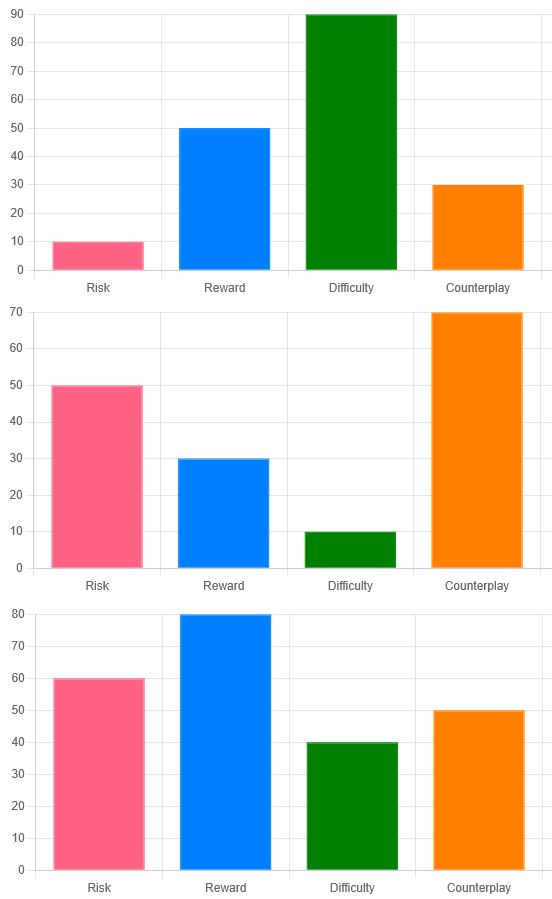
I have a 4 factor model for move/option design in PvP games:

  • Stake (how much you stand to lose by choosing this option, either in costs or penalties)
  • Reward (how much you stand to gain if this option succeeds and stand to gain regardless)
  • Difficulty/Chance (the likelihood that the option will be successfully executed)
  • Counterplay (what range of options this move beats, and how hard/soft a counter)

The purpose of dividing across these 4 factors is to help illustrate to designers the different levers they can pull, instead of focusing purely on a linear risk/reward relationship.

It’s common for a lot of designers to get stuck thinking that everything risky has to have a proportionate amount of reward, and everything rewarding has to have a proportionate amount at stake. Having lopsided stake/reward relationships is possible and healthy when the difficulty and counterplay are considered.

A subtle factor of this model is that cost is a type of risk, and therefore something you put at Stake. When you pay a cost, you’re risking that that investment won’t pay off. Therefore An upside of this model is that it separates Risk from Difficulty/Chance of Success, which are often conflated. “This move is risky, because you’re likely to mess it up.” By separating Risk out into Stake, Difficulty, and Counterplay, we can think more carefully about how each of these different factors play into an option’s design, and we have a wider design space for option design.

Within counterplay there is a lot of nuance to how counters can be designed. I’m going to identify 2 spectrums:

  • Hard vs Soft
  • Wide vs Narrow

A hard counter is one that is guaranteed to always shut down the option that it counters. A soft counter is one with more wiggle room.

A wide counter can beat a wide variety of options. And a narrow counter can only deal with a very specific one.

By dividing counterplay across these two axes, we can see the relative strengths and weaknesses of different moves and intentionally alter the counterplay of moves relative to our needs.

Continue reading

I Don’t Really Like Deus Ex

Deus Ex is THE game that popularized the Immersive Sim genre. It lived as a cult classic for decades until it was picked up again for Human Revolution and Mankind Divided, then dropped like a sack of potatoes when Square Enix tried to split the plot of Mankind Divided across 2 games in order to get twice the money and the audience decided they didn’t like that.

So what is an Immersive Sim? I think Imsim is a specific design lineage among the developers of Looking Glass Studios and Ion Storm, much like the modern Souls-like subgenre. Many people credit the first imsim as Ultima Underworld, and it was succeeded by System Shock 2, Thief, and Deus Ex, going on to produce later examples such as Arx Fatalis, Dark Messiah of Might and Magic, Bioshock 1 & 2, and the Prey reboot.

Immersive Sims are typically set in the first person perspective, have fairly linear story progression through a series of “mission” levels played in a specific sequence, but many routes that can be taken through each level, and access to these routes is modulated by the RPG skills or upgrades that the player has chosen to invest into. When dialogue with NPCs is possible, there are frequently many different options available, and NPCs and notes found scattered around the world provide a large amount of exposition about the events of the game setting

In addition to this, imsims tend to place a strong focus on systemic interactions between different objects and entities, outside of the player. This can be through physics (stacking boxes), NPC interactions, or other environmental features (Thief’s water and moss arrows). This has the stated goal of provoking “emergent gameplay”, which is something I typically hold in high esteem.

So why don’t I like Deus Ex? I don’t think the game’s various systems add up to all that much.

Continue reading

How to Code Fighting Game Motion Inputs

So previously I’ve taught you How To Perform Fighting Game Motions, now lets learn how developers coded them. As far as I know, nobody has documented how to do this before, and it’s essential for anyone making a fighting game, or anything like a fighting game.

There is a website called SFVSim that catalogues change differences between versions for moves in Street Fighter V. This includes a lot of data on each move, including the input requirements.

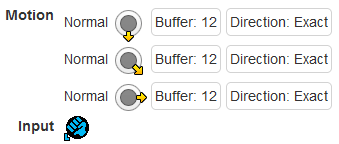
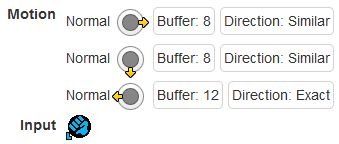
This is extremely helpful for determining the logic involved for these motion inputs. The buffer on each direction determines how much time in frames is allowed to elapse before the next input is provided, or the motion becomes invalid. In other words, it determines how quickly you need to do the motion, and how much time you have to press the button after you’ve completed it.

Continue reading

VR is Focusing on the Wrong Things

Disclaimer: This has been on the backburner for a very long time. I’m sorry if some information is out of date, or if I’m missing something.

My original attitude towards VR was skeptical to dismissive. Anyone who knows me knows that I’m skeptical about anything promising “immersion” and pretty much the concept of immersion in general. I got to try a prerelease Oculus VR headset at a showcase in New York City and it was pretty much what I expected, a screen strapped to my face, while I controlled an FPS game like I’ve always done. To me, VR was another type of screen, I didn’t expect it to fundamentally change anything about video games.

First Gen VR devices changed my mind, they brought on motion controls, like the Wii and PS Move. I eventually got to try a Vive headset, with Valve’s The Lab, SuperHot VR, and a couple others, and I saw what the device could do, and it was pretty obvious that there was untapped potential there. VR seems like a way to make motion controls work much more feasibly than they ever had before, and that could lead to some legitimately new game genres!

The Shortcomings of Current VR Games

My trouble is that VR is also couched in this “immersive promise”. People want the holodeck and full-dive like SAO or Ready Player 1. VR Companies promise that VR is the future of immersion into a virtual world, where we can finally enter The Matrix, The Metaverse, Ready Player 1; You get the picture, right? Except, VR as it currently exists is horrible at all of those things. VR isn’t suited for you to walk around virtual worlds at all.

Continue reading

Scrubs & Johns: A Defense Against Bad Sportsmanship

Competition gets personal. Competition gets people riled up and sometimes people get angry. Being a gracious loser and a humble winner is tough. Being a bad sportsman is a common and easy pattern of behavior to fall into, and the Fighting Game and Smash communities have created different types of defenses against salty players who can’t hold their Ls.

No Johns

In the Smash Bros community, legend says there was once a guy named John who had an excuse for everything. “I didn’t sleep well last night!” “The CRT was tilted away from me!” “The sun was in my eyes!” “My dog ate my inputs!” Naturally this wasn’t very polite to his opponents.

This eponymous John was so infamous that eventually, when people would make excuses for why they lost, people started to say, “No Johns!” It became such a big meme that over a decade later, Reggie Fils-Aime would quote it in a promotion for Smash 4.

No Johns helped to promote an environment where, rather than complaining, people would focus on the game and improve. It wasn’t perfect, but it was a funny and certainly helpful.

Continue reading

The Secret History of Zelda

A lot of people who know me know that I don’t especially like 3d Zelda games before Breath of the Wild, but explaining why, and who is responsible for those design decisions is a long long story.

The Arcade Roots of Zelda

Zelda 1 had intense arcade-y action with a diverse array of enemies.

The Legend of Zelda (hereafter, Zelda 1) was an Open World Action game. In retrospect, it’s been called an action-adventure game, but understanding it as an open world action game is probably more fitting to the context in which it originally arrived. It was designed by Shigeru Miyamoto, who was inspired by childhood adventures, where he would travel on foot across the countryside and try to map out the places he’d been to. He also was attempting to distinguish it from Super Mario Bros by making it nonlinear, top-down, and a number of other ideas.

Continue reading

The Big Catch: Tacklebox Review

The Big Catch: Tacklebox is a demo for an upcoming 3d platformer game, The Big Catch. Despite being only a demo, Tacklebox is closer to a prologue chapter, featuring a different protagonist and entirely distinct areas from the upcoming game! This free “demo” has so much content, that it’s practically an entire game in its own right.

In The Big Catch: Tacklebox, you are tasked with catching fish, who run around on tiny legs around ancient ruins scattered across a desert plateau. You can also collect coins/tokens, which unlock the final dungeon if you collect all 696 of them. Naturally, this is a bit like 3d platformer collectathons of the past, but part of what helps distinguish Tacklebox is that rather than scattering coins and fish around everywhere, they’re in deliberately chosen locations that are difficult to get to. While cleaning up some of the better hidden coins at the end of the game can be a bit of a pain, for the most part, the game focuses on only putting coins in locations that are a challenge to get to, so that they’re closer to optional challenges scattered across the game, rather than simply collectables for the sake of being collectible.

Continue reading

Building Skill Tests @ Game Design Skills

I’ve been writing with GameDesignSkills.com for a while now. I’m a moderator on their discord, Funsmith Club, and I’ve been working with Alexander Brazie on a game design course for the past 4 years, and we’re currently teaching test lessons with a live audience and doing workshops with them!

I’ve also been writing articles for Game Design Skills. You might have noticed that some of the Depth articles on my site have gone missing. I’ve combined multiple of them into one article which is now hosted here on Game Design Skills. I’ve also published an article on game design pillars with them.

Today, I published an article on level design, or more broadly, skill tests and dynamic skill challenges, with Game Design Skills, which you can find here: https://gamedesignskills.com/game-design/player-skill-test/

I am still going to be writing and publishing content to this blog, but I’m also going to be linking articles I get posted over there when they go up.

If anyone’s curious, I’ve still been developing Charmed Chains. I have a card database now, and I’ve created a process to automatically data merge the cards into a template for easy printing. I’ve changed the direction of the game fairly dramatically from where it was during the last playtest, switching to a focus on pump spells (“combat tricks”) and I’ve incorporated colors and color identity into the game. I hope to run a playtest at Evo when I go there next month!

How to be a Good Fighting Game Community Member

The Fighting Game community has different social expectations than a lot of other areas of public life, and gaming. There is a different idea of what’s considered fair, what’s considered cheating, and what sort of behavior is expected. The FGC has its own social contract you could say. Admittedly, some of this article might just be projection on my part, of what I want to see in the community, or what I imagine the community is like, more than what is actually community norms. Some of these guidelines are going to partially restate each other.

  1. No one is expected to play at your level. Nobody is obligated to go easy on you.
  2. No one is expected to refrain from any particular tactic or character pick, especially a winning one.
  3. You are responsible for your negative emotions, and it is your responsibility to not lash out at other people.Trash talk is expected to be in good fun, and not borne out of a personal grudge.
  4. You are responsible for your character picks and your choices of tactics.
  5. If you think something is broken or unfair, start using it. There is no honor in choosing to lose.
  6. It’s okay to want the game to be different (whether it’s about balance or focus), but that should be separate from hating the game or players.
  7. It is polite to acknowledge and celebrate your opponent’s successes, especially when they exploit your habits or knowledge. Especially when they win in a dirty or lame way.
  8. Take responsibility for your mistakes or shortcomings, but don’t use them as excuses.
  9. It’s up to you to take improvement seriously.
  10. Don’t disrespect the other person’s skill level.
  11. It’s not your job or anyone else’s job to haze newcomers.
  12. Don’t be afraid to ask people for games. (and don’t apologize for being bad)
  13. Don’t keep secrets about how your character works.
  14. Keep a spirit of open collaboration.
  15. You’ll get better advice if you ask specific actionable questions about game scenarios, and you might not get any advice if you ask too broadly.
  16. Be willing to pick up new games. (corollary, don’t be that bitch that holds up brackets)
  17. Welcome new players and 0-2ers.
  18. You’re not the main character.
  19. Exploit every advantage available to you, but keep it in the game. Don’t be rude outside the game.
  20. Focus on self-improvement instead of results.
  21. Play to win, especially in tournament.

Altogether, the spirit of the fighting game community is that this is a place to take the game seriously, but not personally. You have a responsibility to yourself and your opponents to play your best, and never hold it against anyone else playing their best, no matter what style they choose to play.

I feel like the community has forgotten some of these when I see saltiness over people picking top tier characters, or complaining about characters or tactics they don’t like. It’s okay to want the game to be different than it is, but remember that as a competitor, you should take advantage of even the things you think are unfair or boring. A lot of modern fighting game discussion has devolved into complaining over increasingly small and ineffable imbalances in the most balanced games in the history of the genre. It would probably serve us all to have some grace and to move on to games we enjoy more when we’re not happy. There are hundreds of amazing fighting games out there, we don’t have to stick with games that make us miserable just because they’re new and popular.

All in all, have a fun time and treat your community and your competitors right. What makes the scene magical is us.

Parries are the Mindkiller

Parrying is so cool that it short-circuits people’s higher brain function, leading them to slam it into everything, and allow it to beat absolutely everything. Parrying in single player games is an EXTREMELY DANGEROUS thing to add to your game, and it should be done with utmost caution, at risk of destroying your entire game’s design.

So first up, what exactly is a parry? A parry is a timed button press with a narrow window that will completely nullify almost any attack headed at you, and sometimes will leave the opponent in a state to be punished, or sometimes outright deal a massive amount of damage to your opponent. A parry is different than a block, because blocking can be held continuously for a variable length of time, and there are frequently penalties to blocking, or blocking too many attacks. A parry is different than dodging, because your character will not move, and will absorb the incoming attack rather than ignoring it. This can mean playing a paired animation, or taking some hitstop and parry-stun. For the sake of this article, if the first few frames of blocking will nullify an attack and negate all damage you take, I’ll be including it as a parry.

Continue reading