Sometimes it’s No More than Mashing

Mashing is when a player rapidly presses a button or buttons as fast as they can. Mashing is one of the simplest video game skills. It’s worth recognizing that mashing is actually a skill. Some people are better at mashing than others. People devise techniques for mashing most effectively. Mashing can vary by game. Mashing isn’t always recognized as a skill, because many people do it in order to avoid learning how to play certain games, and other people deride some games as “button mashers”.

There are a lot of reasons to mash buttons in all sorts of games. If you want to perform an action at the soonest possible moment, then mashing is a good way to guarantee you’ll be close, especially if you don’t know exactly when to press the button. If you want to hit a tight window, then mashing similarly gives you a lot of chances to align a button press with that window. If you don’t know how to play an action game with a lot of similar attacking moves, then mashing all the buttons can be a way to of useful results. If a move has a short or no recovery time, then mashing can help you perform that move as many times as possible in a second. And of course, some games include minigames and special moves that rate how fast you can mash.

Continue reading

Roger Ebert was Right About Video Games and We Have Failed Him

Disclaimer: I know I’m dredging up a long dismissed argument from 10 years ago, and discussing it in all the same tone as people did back then, despite everyone having moved on. My core thesis is that the settlement to the argument was based on a miscommunication which solidified into apathy, without a real understanding of the form of the argument, and I think the topic deserves more consideration, because I believe games are art, but I also believe the people arguing that games were art ten years ago were right for the wrong reasons.

Over 10 years ago in the late 2000s, it was fiercely debated over whether or not games were art. Famous film critic Roger Ebert threw his hat into the ring by declaring that games are not art, and never will be art. Before he died in 2013, he half-heartedly recanted and admitted that some games were probably art, but more than anything, it feels like he kind of rolled over in response to a massive amount of backlash, rather than actually having a point made about what art is, and how games can fit that conceptual bucket. This seems to be the case, because a year before he died, he sent out this tweet:

The game that critic was talking about was DARK SOULS by the way. And you can read the article, it’s an incredibly uncharitable take on the game, but it’s also looking from the wrong perspective. Ebert, and everyone who argued against Ebert, were all looking from the wrong perspective. They weren’t arguing over whether or not games (interactive systems of play) were art, they were arguing over whether the software products we call games happened to have art packaged alongside the interactive systems of play. They were arguing over whether these interactive systems were art-adjacent, not whether they themselves were art. In other words, “Yeah, the game isn’t art, but look at all this art we included alongside it!”

Continue reading

Game “Loops” are an Illusion

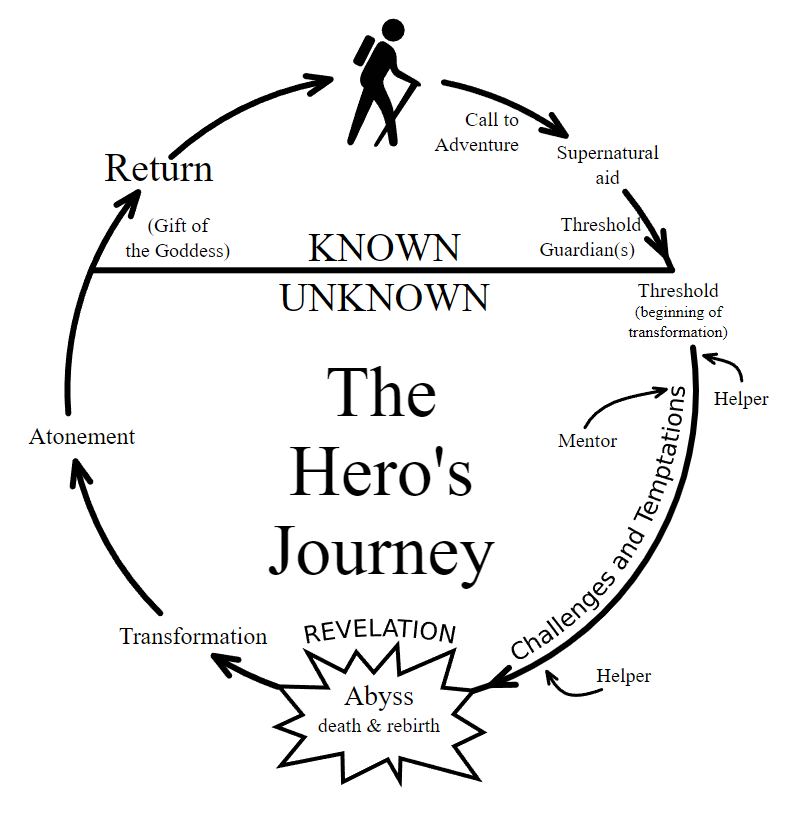
Game Loop has become an industry-standard piece of terminology for video games. It’s taken as a default, a forgone conclusion, or necessary for a game to function. It has a role in game development similar to 3-act structure or the Hero’s Journey in storytelling. These structures are presented as inevitable, ever-present throughout history and culture, and essential to good storytelling or game-making, but many stories and games don’t follow these structures and are still successful and well-regarded.

Some people argue you cannot make a game without loops, or tell a story without 3-acts, or say that the Hero’s Journey is the monomyth from which all other stories derive, but there is nothing definitionally inherent to games or stories that necessitates these things.

Continue reading

It’s Not the Yellow Paint, It’s What the Paint Represents

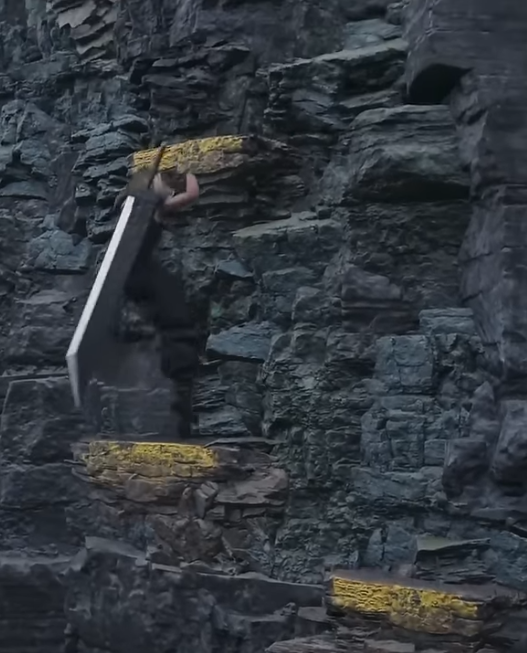
Recently footage of Final Fantasy VII: Rebirth was released, and it contained a shot of The Yellow Paint that we keep seeing to denote objects in the environment that can be climbed or otherwise interacted with. Kayin wrote an article on this, and it inspired me to write my own take.

What’s wrong with Yellow Paint?

So, why do people kneejerk hate the yellow paint? People hate the yellow paint because it “breaks their immersion”, since there’s no diegetic reason why every single ladder, cliff face, or vaultable cover would be splattered in the same yellow or white paint and because it makes them feel like they’re being treated like a child, needing to have the interactable part of the environment highlighted so they can progress.

Continue reading

Cost Granularity in Card Games

In Charmed Chains, I chose some early restrictions to emulate some of how Yugioh plays, and over time I’ve been shifting towards different ideas of what I want to do with the game. I chose these restrictions because there are a lot of indie and industry collectible card games that emulate Magic The Gathering (Force of Will, Hearthstone, Lorcana, Final Fantasy, Digimon, etc) in whole or part, and very few that emulate Yugioh (Dual Spirits). When I started making this game, I was really into Yugioh (I’ve recently been swallowed whole by MtG Commander), and I was very much inspired by different facets of Yugioh’s design that I felt could be pushed further (having a defined grid and effects that are based on columns), as well as some aspects of Magic The Gathering (blockers getting a choice in whether to take damage with their creatures, or let it hit them directly).

However, these limitations have lead to some issues with granularity, which I’ve previously discussed. I’m worried that low granularity in creature costs will lead to homogenization in people’s decks, unless I either adopt a resource system more similar to most card games, or start to enforce more strict archetypal synergies, like Yugioh did.

To understand the issues I’m facing, first I’ll need to explain how the resources in Yugioh and Magic The Gathering work.

Continue reading

Celia’s Tips for Clear Writing

A lot of what I’ve ended up critiquing video essayists and other games writers about is the clarity of their writing. I feel like many people are trying to create “Good Writing” rather than communicate effectively. Many video essays are written more like political speeches than they are trying to be direct and informative. It feels like they are informed by what makes good fictional writing more than good technical writing, and try to carry a vibe to the detriment of their message.

Here are the principles I follow to make my writing direct and effective:

Continue reading

Pseudoregalia Review

Pseudoregalia is an indie 3d platformer metroidvania, a rare combination. And it has the best movement I’ve ever seen outside of a Mario game. It starts off a little slow, but quickly ramps up as you get the slide and wallkick powerups. The game is very short, I was able to beat it in only 5 hours.

Movement & Powerups

There are a number of optional collectibles throughout the game, augmenting your health, regeneration, or giving small buffs, but obviously the movement powerups are the only thing that really matters. Each of the movement powerups allows you to access new areas, but also just enhances the way you move through the game in general. Slide initially lets you slide under small gaps, but eventually gets upgraded into a slide jump that lets you jump across massive gaps, and even bunnyhop to maintain momentum.

Another powerup gives you 3 wall kicks, which push you away from walls if you kick into them directly, requiring you to use them carefully to scale walls. Eventually you get a ground pound, which lets you jump extra high by jumping as you hit the ground, like Mario in Odyssey, and if you jump at the start of the groundpound, you’ll do a backflip, which helps counter the momentum of a wall kick, raising you neatly onto a platform after kicking off of it. This is like the missing link in the movement that really helps it all fit together. Finally, there is a wall run, which is obtained last. It snaps onto walls reliably and generally feels pretty good to use.

Continue reading

How to Pick a Fighting Game Character

The first step in picking up any fighting game is picking a character. Character crisis is a familiar experience for any fighting game player, from beginner to veteran. Even seasoned professionals with decades of experience go through character crisis.

If you’re completely new to fighting games, there are 3 basic mindsets to how you should pick a character:

  1. Eat your peas and carrots, pick a shoto.
  2. Pick a character you think is fun or cool!

Continue reading

What is Charmed Chains? (My New Card Game)

For the past year I’ve been drafting ideas for a constructed card game (a game where you build a deck out of a bunch of cards, then play an opponent). I’ve been hinting at this game a little in recent posts. My working title for the game is: Charmed Chains.

I think the best way of illustrating what the game is about is by showing you the game mat:

Every card in the game is either a Familiar (Creature/Monster), or a Charm (effect card, like a spell). Familiars and Charms are played to the board, and can have effects specific to where they are placed. Familiars can move during the battle phase, and many charm effects extend across the row or column they’re placed in.

This means Charmed Chains is a game about position and placement of your cards. As the attacker: You want to place your familiars in places where they can destroy or attack past your opponent, and the defender wants to move their familiars to block or evade your attacks. You also want to move your familiars into position to take advantage of buffs your charms will provide, and evade the debuffs of your opponent.

Continue reading

Card Game Design as Systems Architecture

Designing a card game has honestly called on more of my programmer skills than thinking about video games. Card games are surprisingly a lot like enterprise web applications. Cards go through lifecycles and have callback functions and methods similar to an object going through its lifecycle in any enterprise application.

Lifecycle Hooks & Callback Functions

Objects in an enterprise software application, such as components in Angular or React, go through a lifecycle as they are instantiated, go through state changes, and are eventually destroyed. Each of these has a “lifecycle hook”, which is a function that is called when that particular lifecycle event happens.

In card game terms, these are similar to effects that trigger when a card enters the battlefield, leaves the battlefield, is tapped, or attacks or blocks. Trigger conditions are lifecycle hooks for cards.

A callback function is one that triggers when another object goes through some type of change. It’s subscribing to another object’s state, then doing something when that object does something.

Continue reading